






By Jim Shimabukuro (assisted by ChatGPT)
Editor
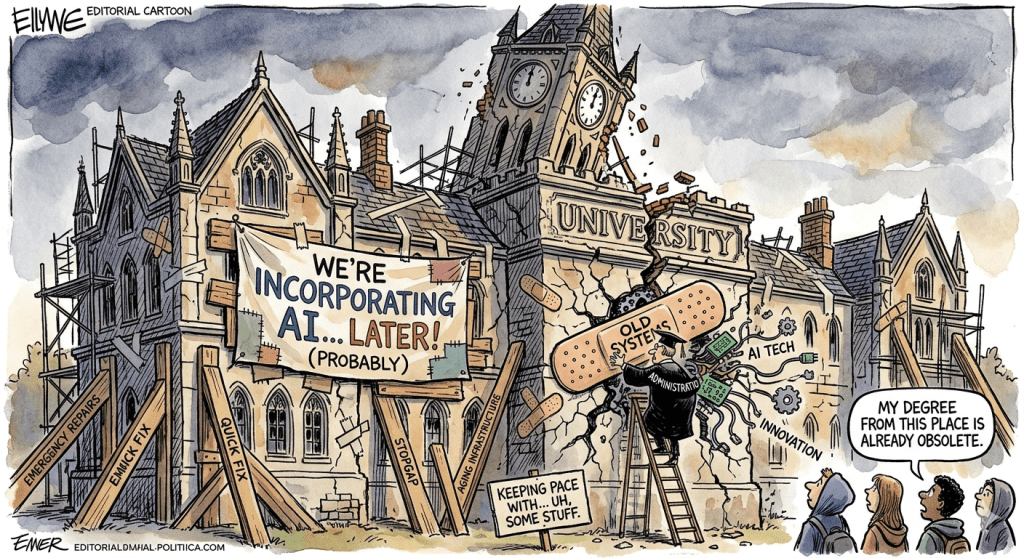
A university can give everyone an AI account and still leave students struggling to find reliable help, professors uncertain about acceptable use, and staff copying information between incompatible systems. The emerging infrastructure-first approach addresses those institutional conditions. Its significance reaches well beyond technology purchasing: decisions about shared AI systems increasingly determine who receives educational support, who controls academic work, and what an institution can afford to provide.

The evidence through the beginning of October 2026 supports a clear position. Building shared, governed AI capabilities is becoming a durable direction in education. The strongest examples combine technical investment with faculty participation and practical support. Their educational value must be demonstrated through what students learn and what services improve. Institutions that treat purchasing access as the accomplishment risk committing scarce resources without establishing that value.
Recent developments make the issue concrete. On September 30, the University of Michigan announced an AI app store connecting its university AI tools with services including Google Drive, Gmail, and Canvas. On September 24, Arizona State University explained the usage allocations supporting student access to its CreateAI platform. On September 21, Digital Promise announced a second cohort in a $26 million K–12 AI infrastructure initiative. These are different projects, but each builds capacity that multiple educational applications can use (University of Michigan Information and Technology Services [U-M ITS], 2026; Timoh, 2026; Digital Promise, 2026).
What ‘infrastructure-first’ means
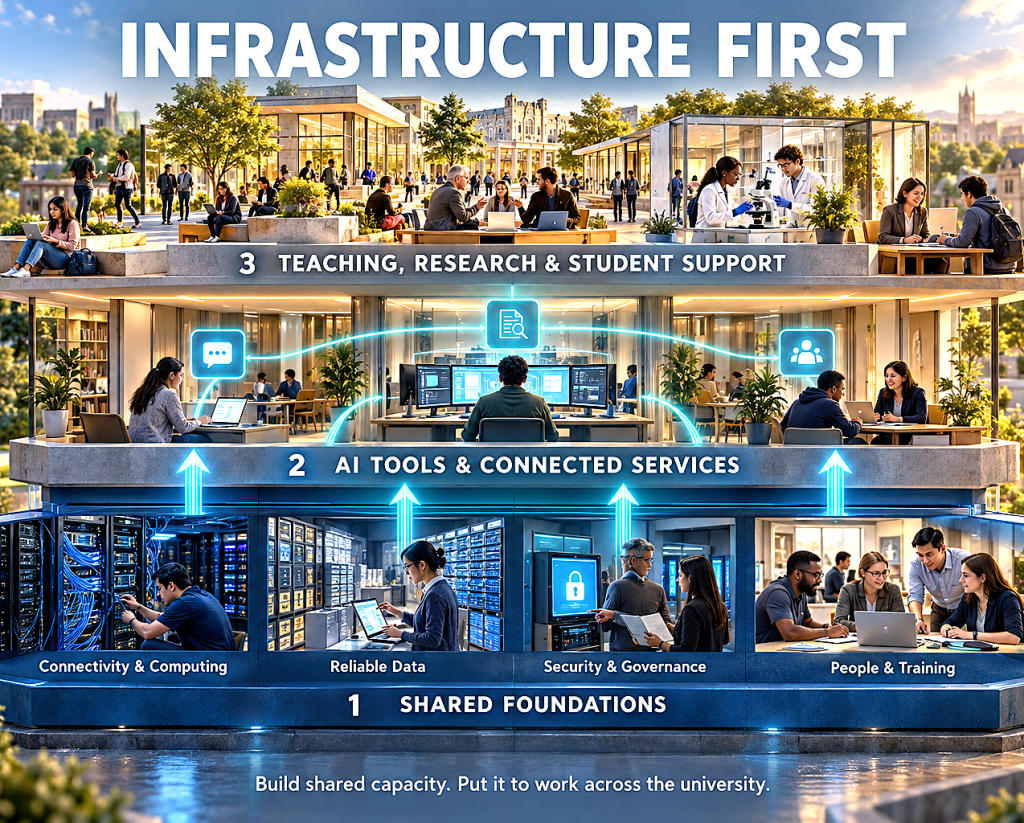
There is no single accredited infrastructure-first model, membership organization, or agreed adoption threshold. The phrase describes a family of approaches. In the AI context, it means establishing dependable, reusable institutional capabilities before expanding a collection of disconnected products. “First” describes a priority and a dependency; institutions can improve those capabilities while running carefully bounded instructional experiments.
At the most basic level, those capabilities include electricity, connectivity, suitable devices, and computing capacity. They also include information that is accurate and usable across systems, secure sign-in, rules governing access, and agreements about how suppliers handle institutional material. A useful model further includes trained people, support services, and ways to test whether an application works for its intended users. Infrastructure includes the ongoing work needed to maintain these arrangements.
Two distinct forms are emerging. Research universities may invest in substantial computing facilities that support scientific work and AI instruction across disciplines. Colleges can also organize shared access to externally hosted AI, integrate it with existing services, and provide local support without owning a supercomputer. Both approaches can support infrastructure-first development. The appropriate choice depends on the institution’s educational purposes and resources.
The September 18 EDUCAUSE guide to institutional interoperability supplies a practical explanation. Interoperability means systems can exchange information and use it meaningfully. It connects that capability to advising, student support, reliable reporting, and AI readiness. The guide states that “AI tools require structured, clean, interoperable data to function effectively” (EDUCAUSE, 2026). This requirement is especially relevant to AI that answers questions about a particular institution or works with student records; a general writing assistant has different data requirements.
Consider a hypothetical student asking whether a required course will count toward graduation. The answer may depend on the student’s catalog year, completed credits, transfer evaluation, and a department’s current rules. An AI assistant that sees only a public course description can produce a fluent answer while missing the decisive information. Connecting appropriate records could make its assistance more useful. The institution must also decide which records it may see, how to verify its answer, and when an advisor must take over. Those decisions are part of the infrastructure.
The same logic applies to a professor developing a course assistant. A reusable platform can supply approved AI models, controlled access to course materials, and a testing process. The professor supplies the intellectual purposes, instructional choices, and standards for acceptable responses. Sharing these capabilities can reduce the need for every department to negotiate its own arrangements. Whether that actually reduces costs or improves learning requires local evaluation.
The institutions and people shaping the development
Arizona State University illustrates the platform approach. Enterprise CIO Lev Gonick has described the need to rethink an “application centered world,” in which separate systems provide an incomplete view of the student experience. ASU’s University Design Institute presents his approach as combining external partnerships, secure internal infrastructure, and experimentation by faculty and staff (Arizona State University University Design Institute [ASU UDI], n.d.). His argument places institutional design alongside computing.
ASU’s CreateAI Builder is available to students as of fall 2026. It enables users to create assistants without coding, ground responses in supplied materials, share projects, integrate them with Canvas, and test accuracy against expected answers. These functions turn shared infrastructure into something faculty and students can adapt to particular purposes (Arizona State University [ASU], n.d.-a).
The financing is instructive. ASU’s September 24 guidance says, “Students are not personally billed for standard CreateAI usage.” Student-owned projects receive monthly allocations, and a project may pause when its allocation is exhausted. Students receive access through an institutionally managed service with real operating limits. That arrangement makes resource allocation an educational decision: a course depending on the service needs a workable response when capacity runs out (Timoh, 2026).
The University of Michigan demonstrates the connection between technical and academic leadership. Its 2026 AI in Education Working Group was sponsored by Provost Laurie McCauley and Vice President for Information Technology and CIO Ravi Pendse. Its charge explicitly includes circumstances in which AI use may be inappropriate for desired learning outcomes. This establishes a consequential principle: building shared AI capacity can coexist with discipline-specific decisions about when students should work independently (University of Michigan, 2026).
Michigan’s September 30 app-store announcement takes another step toward integration. Its M-Connectors make everyday services available through U-M GPT and Maizey. This matters because the usefulness of an institutional assistant often depends on reaching authorized material where people already work. Connecting services also increases the importance of permissions, revocation, and accountable oversight (U-M ITS, 2026).
The California State University system shows the scale attainable through collective provision. Chancellor Mildred García and system CIO Ed Clark are prominent leaders of its AI initiative. In April 2026, CSU reported more than 94,000 responses to its fall 2025 survey and said over 4,300 faculty had completed voluntary professional development through AI Commons. García’s stated standard was direct: “Data must inform and guide our decision-making moving forward” (California State University [CSU], 2026a).
CSU’s April account of faculty learning described tools made available to more than 470,000 students and 61,000 faculty and staff. It also documented faculty-organized learning activities. That combination of system purchasing and local academic participation provides a more substantial model than a campus announcement about a new chatbot (CSU, 2026b).
Student leaders are shaping the development as well. The Cal State Student Association’s February 24 white paper identified Katie Karroum, then its vice president of systemwide affairs, as a student representative in initiative deliberations. Its assessment warned that “access alone is not equity,” citing uneven awareness, training, and clarity about classroom expectations. The association reported an approximately $17 million agreement covering February 2025 through July 2026. That figure describes the earlier contract period, rather than a verified current renewal price (Cal State Student Association [CSSA], 2026).
The University of Florida offers a different model, built around shared research computing. A May 2026 university account of Michael Carrillo’s case study traces its initiative to contributions from NVIDIA cofounder and UF alumnus Chris Malachowsky, NVIDIA, the university, and state support for hiring. HiPerGator AI was completed in 2021. By 2025, the study reported more than 230 AI-designated courses across all 16 colleges and 14,000 annual student enrollments; enrollments count course registrations rather than necessarily distinct students (University of Florida, 2026).
Carrillo’s explanation identifies what other institutions would need to reproduce: “executive alignment, resources to help researchers and faculty actually use the system, broad faculty engagement and infrastructure for student learning.” The machine supported a wider educational program. A university buying similar hardware without those commitments would be undertaking a different project (University of Florida, 2026).
The development extends beyond the United States. The National University of Singapore announced university-wide ChatGPT Edu access beginning August 31, 2026, complementing its in-house AI-Know platform. Its leaders include Provost Aaron Thean and Chief Information Technology Officer and Vice President Tan Shui-Min. The announcement couples managed access with a compulsory first-year module beginning in academic year 2026–27, Applied Generative AI: From Prompting to Evaluation. Tan emphasized adoption in a “secure, scalable and sustainable way” (National University of Singapore [NUS], 2026).
These institutions are prominent examples rather than a definitive global ranking. EDUCAUSE helps spread the approach through research and implementation guidance; Jisc supports UK institutions’ digital development; Digital Promise and university research partners are building shared resources for schools. Commercial suppliers, including OpenAI and NVIDIA in the examples above, provide major technical capabilities and have commercial interests in wider adoption. Educational institutions retain responsibility for deciding what constitutes educational value.
The time frame and the strength of the trend
The early phase predates the public enthusiasm for generative AI. Florida’s 2021 deployment shows that institution-wide AI capacity can grow from research infrastructure. Michigan launched U-M GPT in August 2023, with accessibility included during development. ASU announced its OpenAI collaboration in January 2024. CSU launched its system initiative in February 2025. Those milestones establish a several-year progression from early platforms toward large-scale access and support (University of Florida, 2026; Rosen, 2023; Davis, 2024; CSU, 2026a).
The current phase, visible in August and September 2026, emphasizes wider participation and integration: NUS combines access with freshman preparation; ASU expands student building capabilities; Michigan connects AI with everyday services. Institutions are also examining their underlying readiness. Jisc’s September 22 digital maturity assessment received 88 responses from 83 UK providers. Its account identified funding as the most frequently cited single barrier, followed by staff capacity and time, and reported low maturity in digital capability, including AI capability (Jisc, 2026).
There is no defensible worldwide percentage of institutions that have adopted infrastructure-first AI. Available surveys measure related activities, often with different definitions. EDUCAUSE’s January 2026 report, based on 1,960 higher education employees surveyed in September–October 2025, found that 92% of respondents reported an institutional work-related AI strategy, while only 13% reported measuring return on investment. These are respondent reports from a voluntary survey, not a census of distinct institutions. A strategy could consist largely of pilots and guidance (Robert, 2026).
Student behavior creates additional pressure. HEPI’s 2026 survey of 1,054 full-time UK undergraduates, conducted in December 2025, found 95% used AI in at least one way and 94% used it to help with assessed work. The latter includes assistance such as explaining concepts; it does not mean 94% submitted machine-written assignments. Only 38% said their institution provided AI tools. The report describes AI use as “near universal” within the surveyed population (Stephenson & Armstrong, 2026).
Taken together, the evidence supports a strong direction of travel among visible leaders and substantial demand for institutional support. It supports a weaker conclusion about completion: many institutions have yet to establish the skills, funding, integration, and evaluation needed for dependable services. The strength of the movement is therefore best judged as substantial and growing in institutional commitment, uneven in implementation, and insufficiently demonstrated in educational outcomes.
A temporary-fluke explanation fits this record poorly. Several institutions are linking AI to recurrent services, curriculum requirements, and multi-year investment. Connectivity, sound records, security, accessibility, and staff expertise also remain useful when a particular AI product disappoints. The durable element is that shared capacity. Individual subscriptions, experimental assistants, and supplier relationships can still be abandoned.
For 2026–2027, the likely trajectory is continued expansion of access, training, and connections to existing systems. During 2028–2030, institutions are likely to face harder choices about renewal costs, shared services, and which functions warrant deeper automation. These are projections from the documented direction, rather than announced universal deadlines. A slower path remains plausible where finances or staffing are constrained. England’s school connectivity program already provides one concrete public funding horizon through the 2026–2030 financial years (Department for Education [DfE], 2026).
K–12 is part of the same development
The clearest recent K–12 example involves educational resources as infrastructure. Digital Promise’s September 21 announcement describes eight new grantees in its $26 million multi-year program, with projects lasting six to twelve months and outputs to be openly licensed. Pati Ruiz, its director of learning technology research, identifies “pedagogical and learning goals” as central to the work (Digital Promise, 2026).
Recipients include Harvard’s Ying Xu for OpenLiteracy, the University of Florida’s Walter Leite for a dialect-inclusive early-reading speech dataset, and National Trail Local School District’s Brian Pool for privacy-preserving writing feedback. Partners include Georgetown’s Massive Data Institute and Catalyst at Penn GSE. Such shared datasets and evaluation resources could improve many subsequent products. They illustrate how universities and schools participate in the same development rather than operating in separate technological worlds (Digital Promise, 2026).
England’s September 1 school broadband guidance makes the physical requirements equally visible. The program draws on a £325 million Department for Education budget to improve school connectivity over 2026–2030. Eligible schools receive help with gigabit-capable connections, while remaining responsible for purchasing broadband service. The budget supports connectivity more broadly; it should not be described as a £325 million AI-only investment (DfE, 2026).
The educational stakes differ for children. A school must consider developmental needs, family expectations, safeguarding, and the formation of basic skills when deciding which AI uses to permit. Shared infrastructure can support carefully designed tools and stronger oversight, but widespread access alone provides no assurance of learning.
A 2025 randomized field experiment involving nearly a thousand high-school mathematics students makes this distinction tangible. Hamsa Bastani and colleagues found that students using a standard-style GPT interface performed better during assisted practice but subsequently received grades 17% lower than the control group when access was removed. A tutor designed with learning safeguards largely mitigated the negative effects. The study concerns a particular setting and design, but it establishes why institutions should evaluate unaided learning alongside performance with AI (Bastani et al., 2025).
The implications that should drive educational decisions
The most immediate implication is a change in what equal opportunity requires. A shared license can reduce differences in purchasing power. Students still need usable devices, dependable connections, accessible interfaces, clear course expectations, and instruction in evaluating answers. A college serving working adults or students with limited resources should examine when and where its services actually function. A platform available only under conditions some students cannot meet can preserve existing disadvantages.
For students and parents, this changes the questions worth asking about an institution. What AI support is included? What can a student use in each course? Who helps when an answer is wrong? Can students complete required work when a tool fails or an allocation expires? A persuasive answer explains the service, its limits, and the learning expected of the student. The number of available products says little about those conditions.
For teachers and professors, shared capacity can make course development more feasible. A writing instructor could configure an assistant to ask for evidence, compare draft passages, or help a student examine a source. The educational purpose should determine the tool’s behavior. A polished revision generated instantly may be inappropriate when the assignment requires the student to practice revision. Faculty need time to test these choices, discuss them with colleagues, and assess student work without making platform availability a mandate to use it.
The academic consequence is that evaluation must become part of implementation. Institutions should ask whether students can explain, apply, and transfer what they have learned after assistance is removed. They should also examine the quality of work completed with appropriate AI assistance. These are complementary educational questions. The mathematics experiment demonstrates the danger of measuring only assisted performance; universities need their own evidence across disciplines and student populations (Bastani et al., 2025).
Infrastructure decisions also redistribute authority. A central service can establish which tools are permitted, what information they may use, how interactions are recorded, and which activities receive funding. These choices affect teaching and academic freedom. Faculty governance, student representation, librarians, accessibility specialists, and frontline staff should therefore participate before procurement and integration decisions become difficult to reverse. Their participation needs defined responsibilities and a decision process, rather than consultation after an agreement is complete.
Privacy becomes more consequential as AI gains access to useful institutional information. The hypothetical graduation assistant becomes more capable when it can retrieve accurate records, and more sensitive because those records concern a person. Institutions should provide the minimum access needed for a specific function, maintain records of consequential actions, and offer ways to correct data and challenge outcomes. Admissions, financial aid, discipline, and other consequential decisions require identifiable human responsibility.
Research access presents a related problem: receiving computing credits or an award does not necessarily establish permission to use the service. Olga Lavinda’s September 28 preprint examined ten qualifying academic access pathways and a process at one US university. It found weaknesses in the public specification of duration, outcomes, and liability. The small, exploratory study cannot establish how common the problem is, but its “authorization gap” usefully describes a failure institutions should prevent: resources allocated without a workable route to approved use (Lavinda, 2026).
The financial implication is an ongoing service obligation. Institutions should budget for support staff, training, integration, accessibility, evaluation, and renewal, alongside licenses or hardware. They should distinguish a task completed faster from a demonstrated reduction in institutional cost. Time saved helps students only if the institution decides how to use it. An advisor relieved of routine information requests might spend more time on complicated cases; understaffing or new administrative demands could absorb the same capacity.
Staff participation matters for that reason. Employees who understand advising, registration, financial aid, or library work often know where an apparently simple automation will fail. Institutions should give them paid development time and influence over redesigned processes. Claims of efficiency should be checked against errors, rework, workload, and service quality. Eliminating a task and eliminating the need for professional judgment are different outcomes.
Shared provision also creates dependence on suppliers. Moving course materials and workflows into a platform can make a later move expensive. Institutions should seek exportable data, documented connections, predictable pricing, and a practical exit plan. ASU describes CreateAI as a “model and cloud independent environment,” illustrating one attempt to preserve options across suppliers. Whether such independence works in practice still depends on contracts and implementation (ASU, n.d.-b).
For smaller colleges, community colleges, and institutions in lower-resource settings, copying a well-funded research university’s hardware strategy may be impractical. Collective purchasing, shared technical staff, and openly licensed educational resources deserve evaluation against local priorities. The relevant goal is dependable access to capabilities the institution needs. A modest service that reliably supports instruction can have greater educational value than ambitious capacity that students and faculty cannot use.
Global comparisons must begin with those conditions. Shaoshan Liu and colleagues’ April 2026 preprint on embodied AI for science in the Global South emphasizes reliable computing, energy-efficient hardware, modular robotics, local data pipelines, and open standards. It is a proposal rather than evidence of broad adoption. Its central implication for education is nevertheless concrete: access to a model cannot compensate for an unreliable laboratory, power supply, or technical support (Liu et al., 2026).
Professional education exposes the same dependency. In a September 15 essay, University of Florida nursing scholar Lisiane Pruinelli describes information buried in incompatible clinical records and the expertise needed to interpret it. She writes, “The sophistication of our AI cannot exceed the reliability of the infrastructure beneath it.” Preparing nurses, teachers, and other professionals therefore includes understanding the conditions under which an AI recommendation is dependable (Pruinelli, 2026).
For governments and the public, infrastructure-first development raises a question about public educational capacity. Funding common resources can extend access beyond institutions able to negotiate large individual agreements. It can also create public obligations to maintain systems and establish accountable oversight. The K–12 program’s openly licensed outputs offer one example of investing in resources others can reuse. Education needs room for such public resources alongside commercial services.
The trajectory should be judged by results that matter outside technology departments: more equitable access to effective support, clearer academic expectations, stronger independent and assisted learning, dependable services, and sustainable costs. Institutions should publish evidence of those results, including disappointing findings. A renewal decision should be able to survive the question of what students gained.
Infrastructure-first development matters because it can change the institution’s ability to deliver education at scale. It can also lock in arrangements that shape teaching, student opportunity, and public spending for years. Its strongest form puts educational purposes in charge of shared technical capacity and gives the people affected a role in governing it. Building that capacity is becoming a serious institutional commitment. Earning confidence in its educational value is the work that now follows.
References
Arizona State University. (n.d.-a). CreateAI Builder. Retrieved October 1, 2026, from https://ai.asu.edu/ai-tools/createai-builder
Arizona State University. (n.d.-b). CreateAI platform. Retrieved October 1, 2026, from https://ai.asu.edu/create-ai-platform-product-release-notes
Arizona State University University Design Institute. (n.d.). How Arizona State University is democratizing AI with ASU CIO Lev Gonick. Retrieved October 1, 2026, from https://udi.asu.edu/co-lab/clips/how-arizona-state-university-democratizing-ai-asu-cio-lev-gonick
Bastani, H., Bastani, O., Sungu, A., Ge, H., Kabakcı, Ö., & Mariman, R. (2025). Generative AI without guardrails can harm learning: Evidence from high school mathematics. Proceedings of the National Academy of Sciences, 122(26), e2422633122. https://doi.org/10.1073/pnas.2422633122
Cal State Student Association. (2026, February 24). CSSA’s white paper on CSU’s AI initiative. https://calstatestudents.org/cssas-white-paper-on-csus-ai-initiative/
California State University. (2026a, April 1). CSU releases findings after conducting the largest and most comprehensive survey on artificial intelligence in higher education. https://www.calstate.edu/csu-system/news/Pages/CSU-Releases-Largest-and-Most-Comprehensive-Survey-on-Artificial-Intelligence-in-Higher-Education.aspx
California State University. (2026b, April 13). CSU advances AI strategy through faculty learning. https://www.calstate.edu/csu-system/news/Pages/CSU-Advances-AI-Strategy-Through-Faculty-Learning.aspx
Davis, A. (2024, January 18). A new collaboration with OpenAI charts the future of AI in higher education. ASU News. https://news.asu.edu/20240118-university-news-new-collaboration-openai-charts-future-ai-higher-education
Department for Education. (2026, September 1). Schools gigabit broadband. GOV.UK. https://www.gov.uk/guidance/schools-gigabit-broadband
Digital Promise. (2026, September 21). New grantees awarded by the K–12 AI Infrastructure Program. https://digitalpromise.org/2026/09/21/new-grantees-awarded-by-the-k-12-ai-infrastructure-program/
EDUCAUSE. (2026, September 18). The integrated institution: A guide to interoperability for student success. https://www.educause.edu/content/2026/the-integrated-institution-a-guide-to-interoperability-for-student-success
Jisc. (2026, September 22). Funding and staff capacity biggest barriers to digital transformation for UK universities finds new Jisc report. https://www.jisc.ac.uk/news/all/funding-and-staff-capacity-biggest-barriers-to-digital-transformation-for-uk-universities-finds-new-jisc-report
Lavinda, O. (2026, September 28). After the award: The authorization gap in academic access to frontier AI [Preprint]. arXiv. https://arxiv.org/abs/2609.36304
Liu, S., Tang, J., Hassan, M. S., Sharkawy, M. H., Fouda, M. M. G., Shang, T., & Wang, Z. (2026, April 8). Infrastructure first: Enabling embodied AI for science in the Global South [Preprint]. arXiv. https://arxiv.org/abs/2604.06722
National University of Singapore. (2026, August 11). NUS powers education, research and administration to new heights with AI through a strategic collaboration with OpenAI. https://news.nus.edu.sg/nus-powers-education-research-and-administration-to-new-heights-with-ai-through-a-strategic-collaboration-with-openai/
Pruinelli, L. (2026, September 15). Everyone wants AI. Is nursing building the informatics infrastructure it needs? University of Florida College of Nursing. https://nursing.ufl.edu/2026/09/15/everyone-wants-ai-is-nursing-building-the-informatics-infrastructure-it-needs/
Robert, J. (2026, January 12). The impact of AI on work in higher education. EDUCAUSE. https://www.educause.edu/research/2026/the-impact-of-ai-on-work-in-higher-education
Rosen, S. (2023, September 14). Building the world’s first accessible AI chat interface. Michigan Technology Community News. https://michigan.it.umich.edu/news/2023/09/14/building-the-worlds-first-accessible-ai-chat-interface/
Stephenson, R., & Armstrong, C. (2026, March). Student generative artificial intelligence survey 2026 (HEPI Report 199). Higher Education Policy Institute. https://www.hepi.ac.uk/wp-content/uploads/2026/03/HEPI-Report-199-Gen-AI-Survey-2026.pdf
Timoh, F. (2026, September 24). Is there a cost to using CreateAI for students? Arizona State University. https://ai.asu.edu/there-cost-using-createai-students
University of Florida. (2026, May). New case study examines how a supercomputer became a university-wide AI strategy. https://news.ufl.edu/2026/05/warrington-press-building-ai-university/
University of Michigan. (2026). 2026 AI in Education Working Group report. https://genai.umich.edu/committee-reports
University of Michigan Information and Technology Services. (2026, September 30). University of Michigan launches AI app store. https://its.umich.edu/computing/ai/m-connectors/announcements/um-launches-ai-app-store
###
Filed under: Uncategorized |





















































































































































































































































































































































































































































































Leave a Reply