
My Spring of Discontent: A Proposal for Flipped Conferences

Jim ShimabukuroBy Jim Shimabukuro
Editor

ET4 Online — Sloan-C’s 6th Annual International Symposium for Emerging Technologies for Online Learning, April 9-11, 2013 — was everything you could ask for in a conference. The number of presentations was mind-boggling. I was able to take in just a few. One was by Robbie K. Melton, associate vice chancellor of eLearning and a full tenured professor at Tennessee State University. She talks about “Impact and Transformation of Mobilization in Education: Emerging Smart Phones & Tablets Innovations” (10 Apr. 2013), but I have no doubt that she could probably talk about anything and get her audience to buy in. She strides the floor, mingling with her audience.
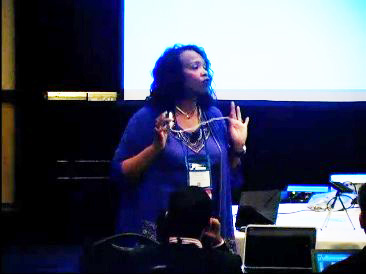
Robbie K. Melton

Robbie K. Melton

Her voice is vibrant, her presence is compelling. She has you hanging on every word. You know that she probably has outstanding teacher awards covering all four walls of her office. In a debate, you’re sure her opponents would probably end up cheering for her. One of the innovations she mentions allows professors to override the mobile devices that students bring to classrooms. With this gadget, professors can maintain control in their classrooms even in this BYOD era. However, you know she doesn’t need it in her classrooms. She’s that good.
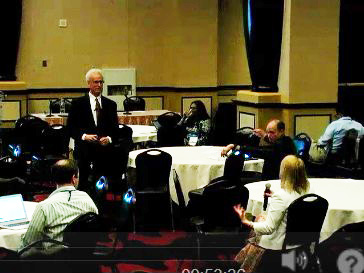
Kim Coon

Kim Coon

Another standout speaker was Kim Coon, executive vice-president for strategic partnerships at Comcourse, Inc. While Melton was hot, Coon was, well, cool. His talk was on “Making the Next Big Thing Happen, When Nobody Believes You Can: Moving from Idea, to Consensus, to Implementation” (9 Apr. 2013). He, too, mingles with the audience, carrying an extra mike for audience members to use. He’s a master at engagement. He gets the audience involved. He remembers the names and comments of those who have picked up the mike, and he integrates them into his talk, almost seamlessly, like a magician.  Continue reading

Time Out at TCC 2013: How Social Media Saved the Day

By Stefanie Panke
Editor, Social Software in Education

Last week 1000 attendees enjoyed three days packed with information and discussion at the 18th Annual TCC Worldwide Online Conference, held from April 16-18, 2013. The acronym TCC stands for Technology, Colleges and Community. Organized by the University of Hawaii, TCC is the oldest running worldwide online conference designed for university and college practitioners. Addressees include faculty, academic support staff, counselors, student services personnel, students, and administrators.

As usual, my review is by no means an authoritative summary but comprises an eclectic collection of talks and topics I found particularly interesting as well as general observations of the conference’s atmosphere and features.

Day 1 (April 16):  Technical Hiccups, Engaging Presenters

TCC 2013 started with the GAU* for an online event: The conference site was down. Surprisingly, the impact was not as devastating as one would think. The social media team quickly rose to the occasion and posted the link to an alternative entry page on Facebook and Twitter. Social Media saved the day!

panke01

The first session I attended dealt with the question of how to approach the challenge of training faculty in using instructional technologies. Sher Downing, Executive Director for Online Academic Services (OAS) in the School of Business at Arizona State University, presented her strategies in the well-received talk “Ways to Train Faculty.” To facilitate online learning, the OAS team developed a comprehensive faculty training package that comprises innovative formats such as “hit the road” one-on-one training in faculty offices, online and interactive training and certification, faculty blogs, faculty roundtables and informal chats “on the dean’s patio.” Especially the latter seem to be an ideal space for discussing ideas, visions and problems among faculty and instructional designers.

Continue reading

Professional Cohorts: A Little Help From Your Friends

By Jessica Knott
Associate Editor
Editor, Twitter

Cohort I

I recently had the opportunity to attend the Educause Midwest Regional Conference in Chicago, Illinois. While there, I attended a session by Brian Paige, IT Director of Calvin College, Bo Wandschneider, CIO (Chief Information Officer) of Queen’s University, and Melissa Woo, Vice Provost for Information Services and CIO at the University of Oregon entitled “Creating Peer Mentoring Networks for Leadership Development.” Calling themselves a “cohort,” these three, and others they have picked up since their initial meeting, have become a support group of sorts for each other as they navigate careers in leadership positions in the higher education field.

Bo Wandschneider, Melissa Woo, Pete Hoffswell, and Dan Ewart.

Bo Wandschneider, Melissa Woo, Pete Hoffswell, and Dan Ewart.

I asked them some questions about their experience, and, in true cohort fashion, they collaborated together in a Google document to answer. The following responses are the collaborative effort of Paige, Wandschneider, and Woo, as well as Pete Hoffswell of Davenport University and Dan Ewart of the University of Idaho.

What drew you to the people you ultimately grouped with?

What drew us to each other were our commonalities. We’re all in a more-or-less similar stage in our career progressions. As such, we face similar challenges and had a lot in common that we wanted to discuss. Currently four of the five of us are CIOs (and the rest of us are encouraging the fifth!). Interestingly only one of us was a CIO at the time of joining the group. Three of us became CIOs during the time we’ve been in the group. An additional motivating factor for one of the group’s members is that he’d seen presentations given by some of the members of the group and was excited about the chance to explore their ideas further. However, what’s probably most important and the one thing that really drew the people in the group to each other was the willingness to share and trust.  Continue reading

Give Your Phone a Voice!

M_Curcio_80By Mike Curcio
Student at Kapi’olani Community College
University of Hawai’i

Google Voice (Voice) is a telephony management service offered by Google. Like their other services, Voice is free-of-charge, with the exception of international calls. If you already have a personal Google account, and, with 425 million active Gmail users worldwide, chances are that you do, getting started with Voice can be very easy.

voice

One of the initial steps in the setup process is selecting a phone number. Voice can assign users a phone number from most U.S. area codes (Alaska and Hawaiʻi users cannot currently obtain local phone numbers through Voice). Alternatively, users can choose their own phone number in many area codes. Let’s say you own a pet grooming company. You could check the availability of the number “DOG-WASH” or “364-9274.”

Voice is officially available to users in the U.S. only, but I have successfully used it in Japan with no problems, making and receiving free calls and text messages to and from the U.S. via Voice’s web interface. With the help of a WiFi connection and another free Android App, GrooveIP, I was also able to use my phone to send and receive calls and text messages, just as I would at home, without being charged for data or minutes. U.S.-based international students may want to set up Voice accounts for their families back home.   Continue reading

Interactive Holographic Images Preserve Stories of Holocaust Survivors

Lynn ZimmermannBy Lynn Zimmerman
Associate Editor
Editor, Teacher Education

As part of their programming on April 8, 2013, which was Holocaust Remembrance Day, WBUR Here & Now broadcast a story that illustrated a unique approach using technology to preserve the stories of Holocaust survivors. World War II and the Holocaust ended in 1945. Therefore, those who survived those years are aging and dying. Over the past 20 years there have been numerous attempts to preserve the stories of those who survived, from films to audio recordings, documentaries to webcasts.

Simulated Holographic Video of Holocaust survivor Pinchas Gutter speaking to a class of students. Published on YouTube, 8 Feb. 2013.

The University of Southern California’s Shoah Foundation and Institute for Creative Technologies have come up with the most unusual to date — they are creating holographic images of survivors that not only tell the person’s story but can also interact with the audience, answering their questions. When asked how they were able to do this, Paul Debevec, Associate Director of USC’s Institute for Creative Technologies, answered that they spent about 12 hours with each participating survivor, asking them every conceivable question one might ask a Holocaust survivor to generate a database of answers using artificial intelligence technology. Stephen Smith, executive director of the Shoah Foundation, remarked that the Foundation has 52,000 testimonies and they have a lot of experience in what survivors want to talk about and what questions students ask.

The idea is that this technology is a way to give children of the future a chance to see, hear and interact with a Holocaust survivor long after the last one has gone. The interviewer was concerned that the idea was rather ghoulish. However, Smith, assured her that this was not the case. He explained that is like watching very good quality 3-D TV.

It is expected that the technology will be available for museums within the next year or two. Debevec predicts that this technology will be economically feasible for everyone in the future.

Pinchas Gutter - see his simulacrum at http://hereandnow.wbur.org/2013/04/08/holocaust-survivor-holograms

Pinchas Gutter – see his simulacrum.

You can see Pinchas Gutter’s simulacrum at http://hereandnow.wbur.org/2013/04/08/holocaust-survivor-holograms

Mars One: Exciting Adventure or Hoax?

picture of Harry KellerBy Harry Keller
Editor, Science Education

Updated 3/22/15
[Update 5/8/13: Please see “Mars – A New Beginning,” Harry’s follow-up plans for this article and discussion. Update 5/18/13: See Martian Rhapsody: Chapter 1 – Landing. -Editor]

The Mars One project has received quite a bit of press lately. This project plans to establish a human colony on Mars in 2023 with four people. The project is the brainchild of Bas Lansdorp, a Dutch businessman. You must give him credit for creativeness. Much of the financing will come from a 24-hour television reality show that will follow every step of the project, including watching the new “Martians” as they adapt to the harsh Mars environment.

According to the Mars One website, this project will use existing technology. The habitat consists of modules that will arrive on Mars over a period of years and will be moved into place by a Mars rover. The first colonists will do the final assembly. Every two years, four more colonists will arrive until the total population consists of twenty immigrants. At that point, the colony intends to be self-sustaining, requiring no additional supplies from Earth. No kidding!  At $10,000 per pound, Earth will not continue sending oxygen, water, food, Mars suits, and more to Mars regularly.

MarsOne2025

If you haven’t guessed yet, the trips by the colonists will be one-way only. There’s absolutely no provision for bringing them home. Even with an estimated $6 billion budget, the money just isn’t there. So, who will these colonists be? Interestingly, Lansdorp proposes to charge for the privilege of taking a one-way trip to hell. But, I’m getting ahead of myself.

Bas Lansdorp

Bas Lansdorp

The technology does exist to ferry materials, habitats, and a few people to Mars. The technology exists to produce enough solar power to eke out a sort of living there, in principle. The concept of establishing human habitation on another world must create a sense of excitement in anyone who has the time to pay attention. The educational opportunities would be enormous. The new colonists would be “going boldly where no one has gone before” – unless NASA gets there first with their round-trip Mars program.

Continue reading