






By Harry Keller
Science Editor
Ever since ‘Oumuamua visited our solar system in 2017, interest in possible extraterrestrial visitors has surged. So far, astronomers have identified three such interstellar visitors, far more tangible than any UFO sighting. The official name for ‘Oumuamua is 1I/‘Oumuamua. The “1” means it’s the first interstellar object discovered. The “I” indicates its interstellar origin.
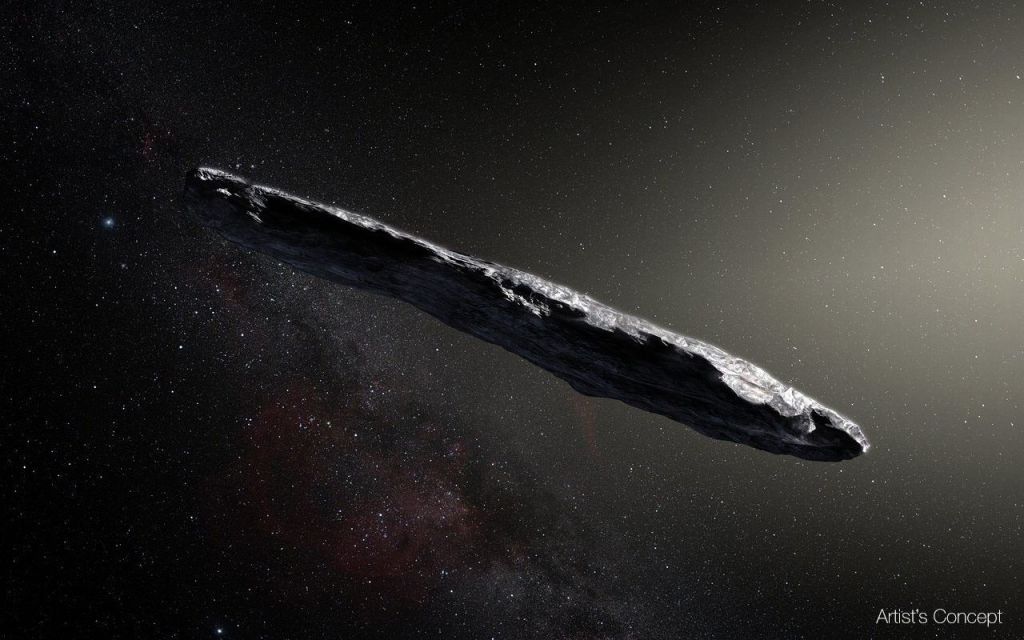
These are real objects, not atmospheric phenomena or hoaxes. They cannot be secret aircraft flown by the United States, Russia, or China. Despite their distance from Earth, modern telescopes can discern substantial information about their shapes.
1I/‘Oumuamua
‘Oumuamua (Hawaiian for “scout from afar”) has a long, narrow shape. This odd shape bolstered claims that it came from an alien civilization. However, it tumbled through space—an unlikely behavior for a probe.
Scientists expected ‘Oumuamua to act like a comet and show a coma—a glowing cloud of gas—as it approached the Sun. The fact that it didn’t only fueled speculation about alien origins. A spacecraft wouldn’t have a coma. Scientists have since proposed a theory classifying ‘Oumuamua as a comet. It’s complicated.
‘Oumuamua traveled at about 26.5 kilometers per second (16.5 miles per second), or 0.0000884 times the speed of light. At that pace, it would take more than 11,000 years to cover a single light-year. The closest star, Proxima Centauri, lies over four light-years away and likely lacks life-bearing planets. Even that nearby star would need 44,000 years for ‘Oumuamua to reach our solar system. Imagine an alien civilization 100 light-years away—that would be a journey of more than a million years.
This strange asteroid or comet also came nowhere near Earth on its hyperbolic path into and out of our solar system. Its closest approach was 15 million miles (24 million kilometers). It then continued on its hyperbolic trajectory, leaving the solar system forever.
2I/Borisov
It took only two more years to find a second interstellar visitor—2I/Borisov, a comet. It was the first interstellar visitor that behaved like an ordinary comet. With its typical coma of gas and dust, that much was clear. However, spectral analysis revealed that its coma contained an excess of carbon monoxide (CO).
Carbon monoxide has a boiling point close to that of liquid nitrogen and a freezing point about 15 degrees Celsius lower. This indicates that Borisov formed in a very cold region. If it had formed in a warmer part of its home star system, the CO concentration would have been much lower.
The high CO concentration, at least 35% of its water content, and possibly equal to it, suggests that Borisov formed around a cool red dwarf star or far from a warmer star. Because red dwarfs are the most common stars in the galaxy, scientists lean toward that origin. Our comets, by contrast, have CO concentrations only about 4% of their water content. The comet’s pebbly composition also suggests that large planets gravitationally stirred its home system.
Comet 2I/Borisov dove deeply enough into our solar system to reach its perihelion inside Mars’s orbit but still far outside Earth’s. Its hyperbolic trajectory will take it away again, never to return.
The pebbles in the comet and its great distance from Earth tell us this was no interstellar spy.
3I/ATLAS
Six years later, in July 2025, 3I/ATLAS joined the list. This is another genuine comet, and it has some unusual characteristics that have drawn the attention of UFO enthusiasts. It is the largest visitor yet, possibly several kilometers across. While it has the usual comet tail streaming away from the Sun, it also has a tail pointing toward the Sun. Scientists think the sunlit side heats up enough for its frozen gases to vaporize directly into space—a process called sublimation—which produced the unexpected second tail.
3I/ATLAS is also the fastest of the three at over ~130,000 miles per hour (210,000 kilometers per hour, or 58.3 kilometers per second), more than double the speed of ‘Oumuamua. Some estimates are higher, ~152,000 mph. Even so, it would take 22,000 years to travel from Proxima Centauri to our solar system. If aliens had anything to do with this comet, they would have to be extraordinarily patient aliens.
As with 2I/Borisov, the coma composition is unusual. This time, the carbon dioxide (CO₂) concentration is unusually high. It must therefore have formed far from its parent star, but not in as cold a region as Borisov.
The galactic trajectory of this wandering comet suggests it originated in the Milky Way’s thick disk, toward the galaxy’s center, meaning it might be more than seven billion years old—about 2.5 billion years older than our solar system. Any rational person will agree that no alien is that patient.
This comet will pass within 170 million miles of Earth at its closest approach on December 19, 2025, making the “alien probe” theory highly improbable. It will pass by Jupiter on its way back to interstellar space. Its hyperbolic orbit guarantees that it will never return.
Summary
The three extrasolar objects discovered so far show no signs of being artificial. They are moving far too slowly to serve as interstellar vehicles for any alien civilization. Even 1I/‘Oumuamua appears to be a comet—one that has spent an extremely long time in interstellar space, so long that cosmic rays have likely broken much of its water into hydrogen and oxygen. The slight extra acceleration observed as it left our solar system could have been caused by hydrogen boiling off its sunlit surface.
The latter two objects are certainly comets, not interstellar spaceships.
The three interstellar visitors have appeared roughly once every four years on average. The sample size is small, so predicting the next one remains impossible. Still, astronomers will be ready when it comes with new surprises. You’ll have another chance to see 3I/ATLAS in early December when it emerges from behind the Sun—though you’ll need a telescope to spot it.
Of course, all three extrasolar objects are “alien” in the literal sense: they come from beyond our solar system. Their trajectories confirm this beyond doubt. However, that does not mean they came from alien civilizations or are alien spacecraft.
For SETI and those hoping for alien visits, these three objects aren’t the evidence you’re looking for—and future ones will likely tell the same story. Would an alien civilization send such large and visible ships to our solar system? Probably not.
[End]
Filed under: Uncategorized |


 Educational Technology and Change Journal

Leave a comment