



By Harry Keller
Science Editor
To discuss this matter, I must consider the past, present, and future of artificial intelligence and the growth of technology. I was there when the phrase “artificial intelligence” first appeared in 1955, but I encountered it much later in the early 1960s. Its earliest incarnation was as learning machines. I was so fascinated by the topic that I purchased Nils Nilsson’s “Learning Machines” and studied it closely. I still have the book and my notes. Much more recently, I took a MOOC from Caltech, my alma mater, on artificial intelligence to gain greater insight into the subject.
Technology growth is another matter. I have been watching it for a long time. Technology contains much more than computers. A can opener is technology. Technology seemed to explode in the twentieth century. Understand that using a tree branch to move a rock is a form of technology. It’s a simple machine.
That’s enough introduction for this topic.
I have decided to ignore the current exaggeration about the “Singularity.” There are many definitions, and most make little sense. I read the book (as much as I could handle). It assumed unlimited exponential growth. It started off rationally and then turned into extreme science fiction.
Technology has been assumed to grow exponentially because it has, and because new technology builds on previous advances. I argue that technological growth is inherently limited and, if we had the right metrics, would follow a sigmoid curve. I believe we are now entering the linear phase of that curve, but I could be off by a decade or two in either direction.
The “Singularity” is an illusion, if I am anywhere near right. However, the Singularity supporters have been moving the goalposts. If they keep it up, there will be a “Singularity,” but it won’t be Earth-shattering.
What limits technological growth? Acceptance. Society can only absorb technology at a limited rate. People learn new stuff at a finite rate. Go too fast, and they are overwhelmed. Financing. New technologies are expensive to create and market. While some cost improvements have occurred, overall, they tend to cost more. The ROI suffers. An upper limit. This one is speculation on my part. Just as there’s a limit to how many transistors you can put into a given space, there are similar limits to every technology.
Call it the “Sigmoid Factor,” if you will. Exponential growth forever is impossible. (Also, mathematical singularities cannot exist in the real world.) Refer to the famous story about the inventor of chess to understand this. Eventually, growth slows down, first becoming linear. Later, it decays exponentially, approaching its limit asymptotically. Even linear growth cannot last forever.
I argue that artificial “intelligence” is fundamentally different from human intelligence, but that’s not the main point here. The real point is that AI is just AI systems. It exists within computer systems. Some people oppose my saying this, but AI is software. We have been training software for 50 years. What’s different now? Computers are larger and faster. Algorithms like neural nets are more advanced. Has there been a major leap forward? I don’t think so. Will a certain size or speed trigger a “Singularity”? I’m not convinced.
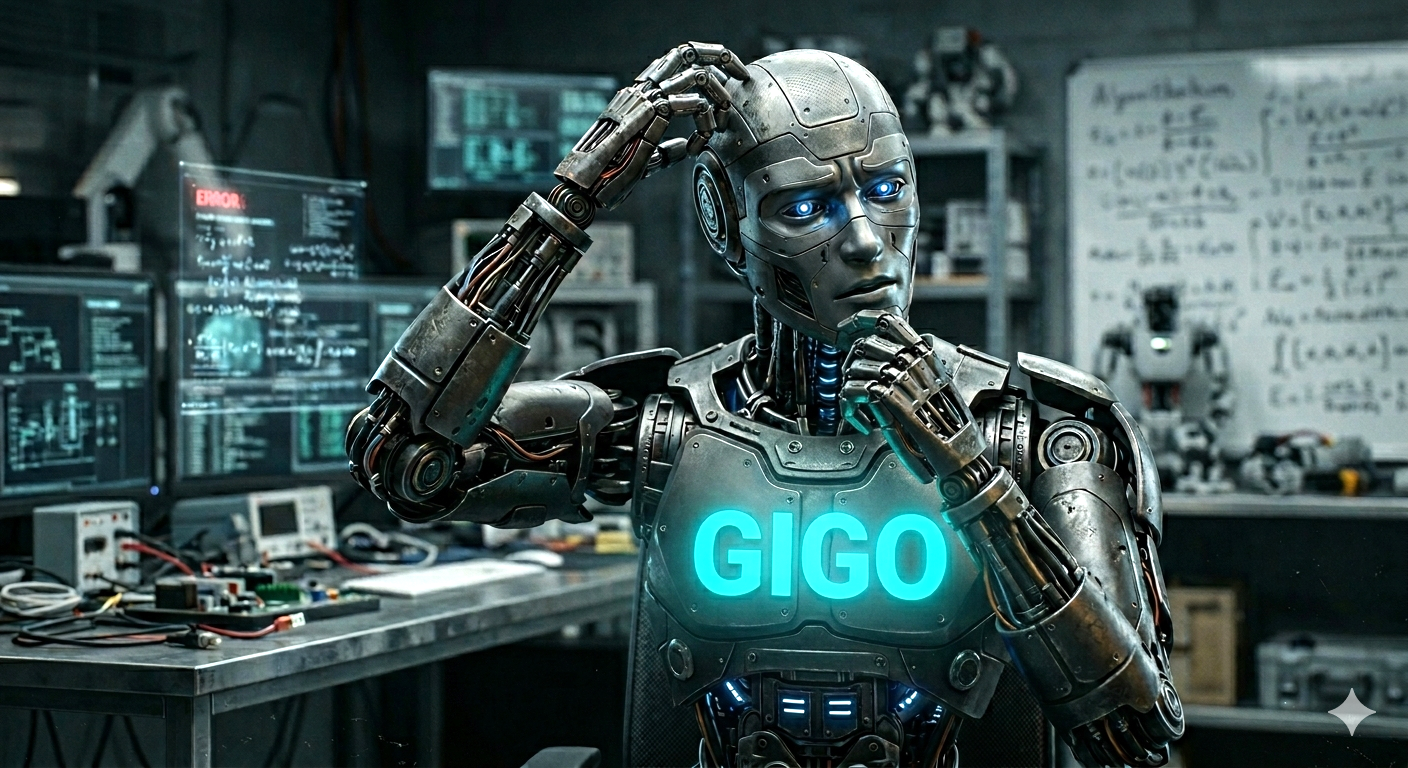
What is the major difference today? Humans have a limited processing speed. If something happens more quickly than around a tenth of a second, it might as well be instantaneous. If it takes more than 2-3 seconds, we become anxious. With large memories and fast CPUs, computers can now answer questions fast enough that they don’t make us wait too long and might even appear instantaneous. For some applications, this capability is crucial. Real-time answers can save lives, for example. For most applications, waiting a minute is not a problem. Of course, we don’t like to wait that long. We have been hypnotized by the speed into thinking that fast means smart. Smart means something else entirely, and if we pay attention, we note that our AI systems hallucinate and have other issues. Why? Because we have made them so fast, and the algorithms are flawed. An old computer saying is GIGO (garbage in, garbage out).
AI systems are a great tool. We have had many great tools previously. The steam engine is one. The telephone is another. These inventions fundamentally altered society. We are facing another change in society. That’s all. Well, I shouldn’t be so dismissive because any basic change in society is an earthquake. However, we have faced them before and have weathered them to come out better on the other side, although some will argue that point.
Let’s ask how we can benefit from new technology, particularly AI. Don’t fear the modern version of the steam engine, telephone, or computer. Even the wheel and axle was a world-changing invention. AI systems will not take over the world, even if they do reduce human employment. The simple solution to unemployment is to reduce the workweek. A more difficult approach guarantees a universal basic income. Many oppose this idea, but it cannot be evaded much longer.
I do not argue that we should be complacent in the face of advances in AI. Each new technology can be used for ill. The wheel and axle led to the war chariot. As with nuclear power, let’s limit its destructive potential and find uses that benefit society.
I have found an excellent use for AI myself. As a sometime writer, I can use an editor. Human editors are costly but very valuable. I have an AI editor that is inexpensive and very useful… but imperfect. Hey! My human editor was also imperfect. My writing is imperfect. People are imperfect. I also use AI for writing research. I can’t afford human editors and researchers, but I don’t expect to grace the New York Times bestseller list.
Instead of fearing AI systems, put that mental energy you’re losing into understanding them. Then find ways to incorporate them into your life. You can’t beat “low cost, high reward.” Go for it!
[End]
Filed under: Uncategorized |


 Educational Technology and Change Journal

Leave a comment