Acronym in Cheek: STEM, STEAM…

picture of Harry KellerBy Harry Keller
Editor, Science Education

[Note: See Bob Hoffmann’s response in “Proposal for a Holistic Emphasis in K-12” (11/24/13). -Editor]

STEM (Science, Technology, Engineering, and Mathematics) has taken over from simple, unadorned “science” as the term describing our science classes. Because most of these classes use technology and mathematics already, the major change is the addition of engineering. Many science classes already had some sort of engineering-oriented activities they call projects. The NGSS (Next Generation Science Standards) has increased the emphasis on engineering.

STEM, as a moniker, has had such success that it has resulted in some copycat acronyms. Preeminent among these is STEAM, which adds art to the list. I have absolutely nothing against inserting art into science classes and even support the idea. However, the creeping growth of an acronym does bother me as does the omission of equally important areas of learning for students in science classes.

I also happen to think that that putting technology into the acronym is superfluous. I’d much prefer, for example, thinking as the T in STEM if you have that letter at all.

I have read many spirited discussions about STEAM replacing STEM, and they all seem to originate from teachers of traditional art classes where drawing, painting, and sculpting is taught. What about performance arts? What about music? I have not seen anyone agitating to add those to science classes. Why not?

There’s also the crucial role of history and social science in general to learning. There certainly is much history in science, both the history of science and the historical context. Our children can learn much from this analysis, possibly more than memorizing the names of U.S. Presidents or of the Kings of England along with dates. Why do we not see agitation for SHTEM or HEMST? Not a clever enough acronym? That’s hardly a sufficient excuse.  Continue reading

Martian Rhapsody: Chapter 1 – Landing (REVISED)

martian_rhap017

[Note 7/6/14: See Chapter 2 – Rocks. -Editor]

Harry Keller

Harry Keller

To the reader: I’ve decided to redo chapter one to incorporate story ideas that wouldn’t have been possible with the original chapter. Please bear with me, and I apologize for the false start. I hope you’ll enjoy this adventure as much as I’m enjoying sharing it with you. Best, Harry.

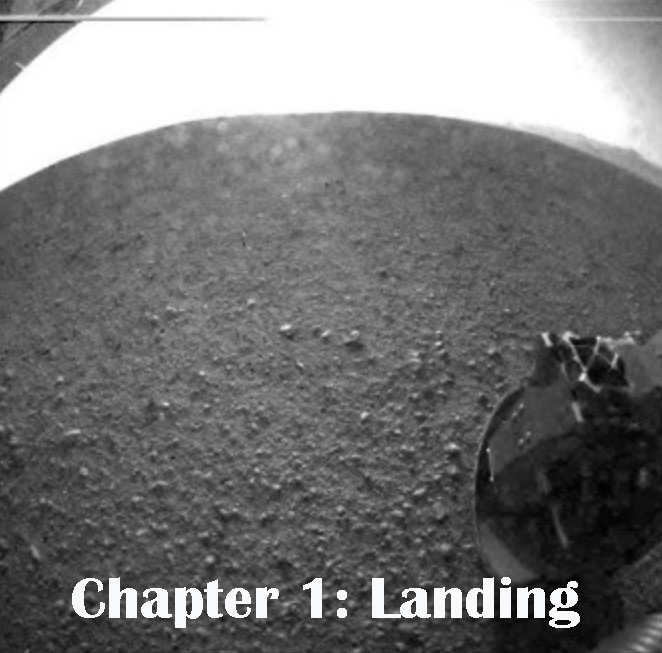
mars-As the Google Mars shuttle continues its weeks-long deceleration toward its unbelievable destination, the crew of four busily checks the instruments on the attached Citigroup crew module where they have lived and worked for four months. They are so involved in monitoring not only their own module but also the Royal Dutch Shell supply module that they momentarily forget that they’re about to become the first humans ever to set foot on another planet. The shuttle holds the two attached modules like a parent carrying twins in both arms. It may look awkward to those used to air-based flight but creates no impediment to travel in the vacuum of space.

“Final pre-separation check,” snaps Aleka as the about-to-be Martians go through procedures necessary to ensure a clean separation from the shuttle. She glances out of the small thick window and sees the edge of the red planet against the black of space with its countless bright point lights of stars strewn haphazardly across its seemingly infinite reaches as though a child had thrown diamonds and diamond dust on a vast expanse of black velvet.

A few weeks earlier, the entire crew of four was excited to see the small red dot of Mars expand and grow into a shiny red penny in the black, deep expanse of space  – nearly 14 billion light-years deep, far beyond human imagination. Now, it fills most of one side of their view. Earth has receded to a pale blue dot, left forever to the billions living there. A new world awaits. Humans will triumph over Mars someday. Aleka has promised herself that this will be that day.

“Check,” says co-pilot Chun. Her engineer’s mind racing with the excitement and the checks she’s performing to ensure a safe entry and landing.

Four years of training guarantee that the anxious crew all know their roles in this landing precisely. The captain, Aleka (Allie), is the only flight-trained pilot on the mission, but all of them have spent countless hours in the landing simulator and can take over if necessary. Redundancy has been the watchword of the Mars mission from the very beginning. For the landing at Amazon base, however, there could be only one crew module. Everything depends on its successful entry into the absurdly thin Mars air, about 1% of the density of that on Earth, followed by the powered descent to the surface.  Continue reading

‘Inspiration Mars’ Inspires

picture of Harry KellerBy Harry Keller
Editor, Science Education

Mars seems to be everywhere these days. Who will go? How will we go? When will we go?

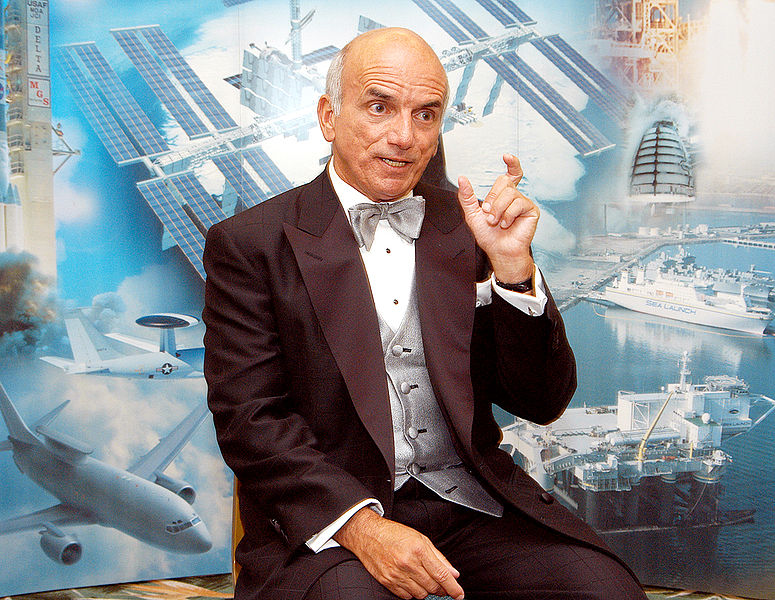
These questions have yet to be answered. Dennis Tito, a millionaire with Mars instead of stars in his eyes is focusing on a project he terms “Inspiration Mars.” This is not a landing but just a flyby. It’s not a four-person flight but rather a two-person flight by a man and a woman, both past child-bearing age for the reasons of radiation during the 501-day trip.

There’s one very conspicuous hitch in this program, readily admitted by all involved: the date. In order to be efficient, space missions to Mars must take place roughly once every two years, when Earth and Mars are aligned in their orbits. In 2018, there will be a special alignment that occurs infrequently and provides what the Inspiration Mars people call a “exceptionally quick, free-return orbit” that’s available just twice in every fifteen years. The next such launch window is in 2031, according to the Inspiration Mars site. This project has a very tight schedule.

 Inspiration Mars

By orbiting Mars at about 100 miles above the surface, the mission will avoid encountering the thin Martian atmosphere and will also use the so-called slingshot effect that takes some momentum from the planet itself to accelerate the spacecraft back to Earth and shorten the return trip considerably. It also reduces the amount of fuel that the craft must carry considerably.  Continue reading

Farnsworth’s Fusion: What’s It All About?

picture of Harry KellerBy Harry Keller
Editor, Science Education

Last February, Conrad Farnsworth achieved nuclear fusion in his father’s shed in Wyoming*. This would be a big deal were it not for fourteen other high school students who had done this previously. You can find a YouTube video of his accomplishment and will note that the poverty-stricken need not apply. The equipment I see there would cost a few thousand dollars new and over a thousand even if you scrounged quite a bit. You even have to have a cylinder of deuterium, the stable heavier isotope of hydrogen. It has an atomic mass of two instead of hydrogen’s one due to an added neutron in its nucleus.

“First Neutrons,” uploaded to YouTube by Conrad Farnsworth on 2 Dec. 2011.

He achieved fusion by confining the deuterium in an extremely hot plasma, hundreds of millions of degrees hot. That’s hot!

Plasma is the fourth state of matter after solid, liquid, and gas. A plasma is like a glowing hot gas. Its molecules have disintegrated into atoms, and those have lost electrons to become ionized. Ionized gases can conduct electricity just like your fluorescent lights (today’s energy-saving CFLs for example) do. The ionized gas in those lights causes the fluorescent material lining the inside of the glass to glow.

Gases like to expand when they’re heated up. This expansion cools them down. To achieve enormous temperatures and fusion, you must confine the gas to prevent expansion. The problem you’ll face is that no known substance can survive those high temperatures. You cannot make a bottle to hold your super-hot plasma out of any material in the universe.  Continue reading

Martian Rhapsody: Chapter 1 – Landing

PLEASE SEE THE REVISED VERSION OF THIS CHAPTER.

martian_rhap017

Harry Keller

Harry Keller

Preface

After receiving many comments from my article, “Mars One: Exciting Adventure or Hoax?“,  and exploring many issues of any such undertaking as well as the specifics of Mars One, I have decided that the conversation has become increasingly technical and therefore less interesting to our readers. In order to make our conversation more interesting and to bring more people into the conversation, I am presenting a series of episodes in a fictional future in which the first permanent settlers will arrive on Mars. While Mars One and our discussion have generated many of the ideas, this series does not claim to have a relation to any specific Mars settlement program. It just explores the issues involved in such a venture.

For the purposes of making the exposition and discussion more real, I will name the first four humans to arrive on Mars: Aleka (Hawaiian female: aka Allie) is the flight-trained captain, Balasubramian (Indian male: Balu for short and Bob among the crew) has the crucial survival role of botanist, Chun (Chinese female: aka Chunnie) functions as the engineer, and Dawit (Ethiopian male: everyone just calls him Dave) is the mission communicator. For the purposes of having a broad gene pool, the early settlers have genetic roots that include a worldwide geographical scope of origins.

I’d like to encourage you all to participate. Each chapter will end with a problem that must be solved. I am interested in seeing ideas different from the ones I imagine and may rewrite future chapters if better answers are submitted. If you are a science teacher at any level, please consider discussing these issues in your classes. We’re nearing the end of the school year now, and this sort of discussion may work nicely with the end-of-year mentality that you encounter. A fun, open discussion can make science come alive for students. Use NASA images to liven things up. -Harry E. Keller

Chap01_Landing2

mars-As the Google Mars shuttle continues its weeks-long deceleration toward its incredible destination, the crew of four busily checks the instruments on the attached Citigroup crew module where they have lived and worked for four months. They are so involved in monitoring not only their own module but also the Royal Dutch Shell supply module that they momentarily forget they’re about to become the first humans ever to set foot on another planet. The shuttle holds the two attached modules like a parent carrying twins in both arms. The configuration of shuttle and two landing modules may look awkward but creates no impediment to travel in the vacuum of space.

Four years of training guarantee that the anxious crew all know their roles in this landing precisely. The captain, Aleka (Allie), is the only flight-trained pilot on the mission, but all of them have spent countless hours in the landing simulator and can take over if necessary. Redundancy has been the watchword of the Mars mission from the very beginning.

For the landing at Amazon base, however, there could be only one crew module. Everything depends on its successful entry into the absurdly thin Mars air, about 1% of the density of that on Earth and containing 95% carbon dioxide, followed by the powered descent to the surface. Ordinary chemical rockets slow the landers as they approach the surface where the gravity is 38% of that of Earth. While the low gravity means that less fuel is required for descent, it still is strong enough to kill everyone if the landing module crashes. Every element from the heat shield and parachute to the landing engines must function perfectly for a safe landing.  Continue reading

Mars – A New Beginning

picture of Harry KellerBy Harry Keller
Editor, Science Education

[UPDATE 5/18/13: See Martian Rhapsody: Chapter 1 – Landing. -Editor]

The discussion on “Mars One: Exciting Adventure or Hoax?” (4.8.13) has been wonderful, and I thank all of those who have participated. I’d like to take this entire issue to another level. Please stay tuned, watching ETC-J for a new beginning of the discussion about Mars.

"A crater near the Martian North Pole with a large lake of water ice. The lake is about 10 km across." - Robert O'Connell, University of Virginia.

“A crater near the Martian North Pole with a large lake of water ice. The lake is about 10 km across.” – Robert O’Connell, University of Virginia. NASA photo.

ETC-J is working on a serialized fictional account of the first Mars settlement so that those who are not so technically oriented can participate. We’ll have plenty of science and will address those issues we’ve talked about in the article and the discussion and many more in the context of the possible actuality of a Mars settlement. We’ll also have personalities and their reactions to crises. We’re making the assumption that it will happen within 20 years, maybe ten or so. We will use only technologies that we have or that could become available within this time frame. Exceptions will be made to this rule only if there absolutely is no other way, and we’ll still make every effort to make it scientifically sound. As a scientist, I wouldn’t have it any other way.

You’ll read about some real surprises in the episodes. We’ll be as creative as possible and will encourage all of you to write in with your ideas about how to solve the problems facing the settlers in the most recent episode. Some of your ideas will find their way into future episodes and will be acknowledged in the discussion.

If you know a science teacher, be sure to clue her/him into what’s going on. We’ll have special challenges for science classes to discuss. We invite science teachers to respond on behalf of their classes and to sign with their school name. I’m hoping that my own business, Smart Science Education Inc., will be able to fund some prizes, but I cannot make promises about that yet.

While prompted by the discussion of Mars One, any resemblance to the actual Mars One program is unintended. We will use the best ideas from anywhere, including Mars One, in our narrative, but this is NOT Mars One.

Watch for the first episode soon and be ready with your commentary on any science errors in each episode, solutions to the problems facing the settlers, and the science class challenges. I’m looking forward to a stimulating discussion. I hope you’ll join us on this adventure.

Mars One: Exciting Adventure or Hoax?

picture of Harry KellerBy Harry Keller
Editor, Science Education

Updated 3/22/15
[Update 5/8/13: Please see “Mars – A New Beginning,” Harry’s follow-up plans for this article and discussion. Update 5/18/13: See Martian Rhapsody: Chapter 1 – Landing. -Editor]

The Mars One project has received quite a bit of press lately. This project plans to establish a human colony on Mars in 2023 with four people. The project is the brainchild of Bas Lansdorp, a Dutch businessman. You must give him credit for creativeness. Much of the financing will come from a 24-hour television reality show that will follow every step of the project, including watching the new “Martians” as they adapt to the harsh Mars environment.

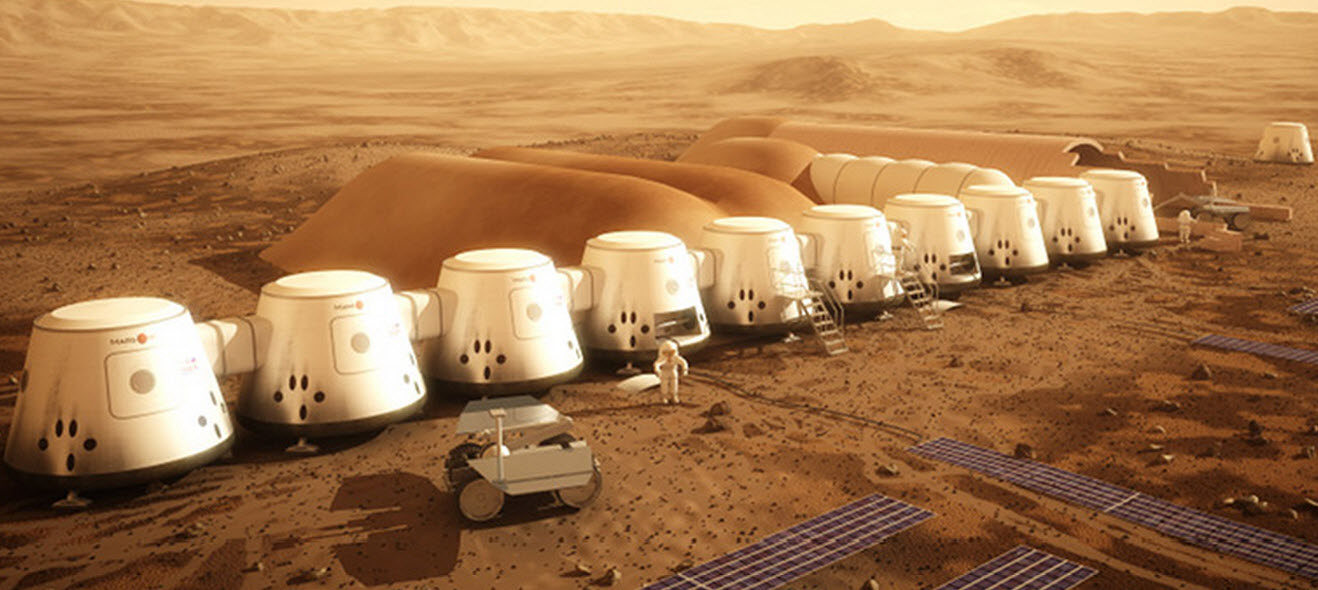
According to the Mars One website, this project will use existing technology. The habitat consists of modules that will arrive on Mars over a period of years and will be moved into place by a Mars rover. The first colonists will do the final assembly. Every two years, four more colonists will arrive until the total population consists of twenty immigrants. At that point, the colony intends to be self-sustaining, requiring no additional supplies from Earth. No kidding!  At $10,000 per pound, Earth will not continue sending oxygen, water, food, Mars suits, and more to Mars regularly.

MarsOne2025

If you haven’t guessed yet, the trips by the colonists will be one-way only. There’s absolutely no provision for bringing them home. Even with an estimated $6 billion budget, the money just isn’t there. So, who will these colonists be? Interestingly, Lansdorp proposes to charge for the privilege of taking a one-way trip to hell. But, I’m getting ahead of myself.

Bas Lansdorp

Bas Lansdorp

The technology does exist to ferry materials, habitats, and a few people to Mars. The technology exists to produce enough solar power to eke out a sort of living there, in principle. The concept of establishing human habitation on another world must create a sense of excitement in anyone who has the time to pay attention. The educational opportunities would be enormous. The new colonists would be “going boldly where no one has gone before” – unless NASA gets there first with their round-trip Mars program.

Continue reading

Don’t Blame Teachers for the Poor State of STEM

[The following is a response to colleagues’ comments, in ETCJ’s staff listserv, re the need for change in the way science is traditionally taught. The discussion was spurred by the 2 Feb. 2013 report, “For Each and Every Child: A Strategy for Education Equity and Excellence,” by the Department of Education’s Equity and Excellence Commission. -Editor]

You have to remember, I got thrown out of schools for doing all of the things that we talk about that are going to be the future. I worked with the White House. The principal called me in and said, “You can’t do this technology stuff in Arlington Schools if you want to stay.” That was not a choice to me. Teachers who did what they were told are still probably working. I was not what the schools wanted, an innovator using technology. You are preaching to the wrong person.

I can’t demonstrate my skills right now. I don’t have a place to do it. Tracy Learning Center in Tracy, CA, is where I worked to help establish advocacy. My benefactor died.

Nysmith School in Herndon, VA, and a few other schools and projects do what I love. NCLB took the steam out of STEM, the science out of the classroom, and the focus away from what was called SMET, now STEM. NCLB took me out of the classroom. I will always remember the discussion.

I was with people who are STEM evangelists in the Nysmith School, which I visited in the NIIAC times. We as a council visited the school back then. Both of the schools are not mainstream. Tracy School is a charter school, K-12, mostly minority kids, very minority. Because the school has a longer day, with another month in the school year, it has to be a charter school. We had a plan.  Continue reading

Robert E. Yager Discusses ‘Hands-On’ Science Education

picture of Harry KellerBy Harry Keller
Editor, Science Education

Dr. Yager is a Professor of Science Education at the University of Iowa and the Iowa Academy of Education. He has a long career in this area, and we should pay attention when he writes.

He has just written a short article for Science Education Review (11.3 [2012], pp. 54-55), “Does ‘Hands-On’ Indicate Real Reforms of Science Teaching?”* It begins with the following sentence. “Too often the reform of science for K-12 students is described as being ‘hands-on.’“ Everyone seems to be calling for reform these days. So, this is a valid discussion. Many of the reformers are “hands-on” advocates and even extremists who insist that no science education should be anything but “hands-on.” The short piece, just 1.5 pages, is well worth reading for anyone involved in science education.

Robert E Yager

Robert E Yager

Dr. Yager makes the point that involving muscles does not necessarily involve the mind. Indeed, as I also have seen, just the opposite is often the case. Science is about exploring. According to Dr. Yager, “One uniqueness of humans is their interest in exploring the natural world.” This uniqueness can drive the excitement and engagement of students with science. Losing it tends to do exactly the reverse.

Further on, he says, “Hands-on may be needed to develop tools to investigate student ideas.” Then, he counters with, “Often collecting evidence involves technology, not science!” He’s saying that you might use hands-on to collect evidence for your scientific investigation, or you might use technology. The hunt for dark matter is all technology. The Mars rovers are distant technology. Neither is truly hands-on. However, I take the view that science and science education are not the same thing. Just because scientists are trending away from hands-on, does that mean that students should too?

Continue reading

Next Generation Science Standards Fall Flat

picture of Harry KellerBy Harry Keller
Editor, Science Education

[Note to the reader: I am CEO of an online science lab provider and, while this article does not address online learning, it does have opinions related to the use of science labs. While I have made every effort to avoid bias based on my current position and believe that my opinion would be the same were I, for example, still a university professor, readers should be aware of my personal connection in this regard. -HK]

The long-awaited Next Generation Science Standards (NGSS) second draft has been published for public review*. This is the final public review version. After diving into them, I found them lacking in some important respects.

I’ve taken the time to look at both versions (DCI­ and Topic arrangements). They’re both the same material arranged differently. I haven’t bothered with elementary school standards because I’m happy with doing any science at all in grades K-5.

I spent some time in the middle school area and was disappointed with the lack of academic rigor, the insufficient range of topics for three years of learning, and the paucity of quantitative investigations indicated. So, I went on to the high school topics hoping for something better.

As a chemist, the first thing I looked for was chemistry. There’s so no such topic. The NGSS document is arranged under three heading: PS, LS, and ESS. These stand for physical science, life science, and earth and space science. Earth and space science is certainly physical in nature but has its own separate section, while chemistry must lie hidden in physical science somewhere. The word chemistry does not appear.

Instead, most of what I’d term chemistry appears under two headings: Structure and Properties of Matter and Chemical Reactions. All right, a derivative word for chemistry does appear there but only in the topic-oriented version.

In order to see what’s afoot here, it’s necessary to list the topics under these headings. The good news and the bad news is that there are only ten topics (eleven if you count the bonus topic). It’s good because the list is short and easy to write here. The bad news is that this is all that there is for an entire year of high school chemistry. To give the NGSS their due, the introductory material does indicate that these are “core” ideas and that teachers are free to add on more material. You have to wonder how many teachers will bother to expand on the requirements that they’re given.   Continue reading

Teaching Science — A Former Classroom Teacher’s View

[Note: This article was originally an email reply to Harry Keller. Bonnie had published a reply, “The Sad State of Teaching Thinking in Our Nation’s Schools” (3 Dec. 2012), to his article, “Need More Software Engineers? Teach Thinking Skills Better” (29 Nov. 2012). In his email to Bonnie, Harry attached a draft of a book he’s working on, which clarifies some of the ideas in his article. –Editor]

I don’t have any answers and I have not had time to read your draft. I have been consumed with family responsibilities and some of my emails have gotten lost while running two households. Sorry about that.

I was always punished for teaching thinking, until I was picked by President Clinton to be on the NIIAC. OK, and with the Lucas Foundation, which was also a boost. But my heart is sad. I see the same things going on in schools now, and worse practices. Not sure about Common Core and how it will be enacted.

The tests you hear about are the tip of the iceberg. There are internal, school-level, grade-level, county and practice tests.

I was a gifted and talented teacher. It was because I was determined to make school better, interesting and a compelling place to go. So  I learned not to gate kids. I thought I knew math but found that I was very poorly prepared, that most people taught with their hand in the back of the book (for the answers), and that most schools allowed only one way to do math — the approach used in the book. A student, who was brilliant, took me to task when he understood number systems and then invented his own. It is really not that hard, but you have to get it. I took lots of courses that required thinking, creating, inventing — and understanding math. I understood cuisenaire rods and visual math. My 4th graders tested at the top in standardized math tests. All of them.  Continue reading

Not Satisfied, but Hopeful, About Online Science

By Dan Branan, Ph.D.
NANSLO Lab Director
Colorado Community College System

John Adsit wrote a recent article (“No Satisfaction in Finding on Online vs. Traditional Science Classes,” 22 Oct. 2012) commenting on a study by the Colorado Department of Higher Education’s study showing, among other things, no significant difference in long-term college grades and GPA when comparing community college students who had taken their introductory science courses online with those who had taken them in the traditional community college classroom (Epper, 18 Oct. 2012). I had initially posted a response to John’s article, and was asked by the editor of ETCJ to expand it into an article, which I greatly appreciate. In short, it seems to me that John has largely missed the mark with regard to the Colorado study and its implications.

For many years, as an online educator in the community college system in Colorado, I have listened to traditional colleagues claim as a fact that students taking online science courses are not as well-prepared and, in fact, are at a disadvantage, compared to traditional students. The traditional model was held up as the standard, without proof, even though, as John points out in his post, there have been studies indicating that the traditional educational model does not work as well as it should in the first two years of college.

John’s initial response to the Colorado study is to merely sneer at the demonstrated equivalence of online vs. traditional science classes at the community college level by stating that “students in general learned very little in the first two years of college,” relying on the excellent analysis in Academically Adrift. While I cannot dispute the findings in that report, I do have an important question about its true meaning: Do we have proof that college education has ever been different? While it may indeed be a cause for alarm, could it be that the first two years of college are a time when students undergo a wide range of mental and personal transformations in readiness for the culminating two or three years before they earn their degree? Isn’t it true that the first two years of college are often filled with fairly bland courses in preparation for study in one’s chosen field of interest?

After all, the U.S. still possesses an undergraduate educational system that many students from around the world envy. According to a report last year from the Institute of International Education, the number of international students enrolled at U.S. colleges is 32 percent higher than it was a decade ago, and this is largely due to undergraduate enrollment of Chinese students.  Continue reading

The Real Story on Online Science Labs

picture of Harry KellerBy Harry Keller
Editor, Science Education

John Adsit has written very well (“No Satisfaction in Finding on Online vs. Traditional Science Classes,” 10.22.12) about some of the issues raised by the Colorado Department of Higher Education study (Epper) and has expressed some excellent insights into this field. In some ways, I wouldn’t go quite as far, and, in others, I’ll dig more deeply.

While it’s mostly true that a university cannot meet these standards in large classes, it does not have to be so. It’s because most professors are dedicated to research and not to teaching that such situations abound. I was such a professor with 350 students in a freshman chemistry course with labs. I met with my 22 teaching assistants weekly and visited lab sessions constantly during the course. It left me little research time but helped to build a good quality course. (Today, I’d make a much better one, but I was new to teaching then.)

In community colleges, there’s no excuse for not meeting the goals of America’s Lab Report (ALR). It’s not a publish-or-perish environment, and the class size is smaller.

John has listed the ALR goals in his remarks, and I’ll comment on them specifically. I see no excuse for not meeting the second set of four goals that addresses integration of science labs with the overall course. These are overarching goals for any lab course and would be easy to meet for anyone who cares to make the effort.

The first set of goals focuses more closely on the labs themselves. These are nice goals, but are not all equal when it comes to designing great lab experiences. I’ll take them out of order to put them into the proper context.

3. Understanding the complexity and ambiguity of empirical work.

This is so important that ALR singles it out as the one goal that can be achieved in no other way than through a science lab. In this context, it’s important to note the part of the report that John left out, the definition of a science lab:

Laboratory experiences provide opportunities for students to interact directly with the material world (or with data drawn from the material world), using the tools, data collection techniques, models, and theories of science.

Note well that the data must always come from the “material world.” That statement completely rules out simulations that use equations and algorithms to create the data.

Continue reading

No Satisfaction in Finding on Online vs. Traditional Science Classes

A recent study by the Colorado Department of Higher Education (Epper)* finds no significant difference in the performance of community college students who took science classes online and in traditional classrooms. This is consistent with many studies that show online learning to be as effective as classroom learning, but the importance of this study in the area of science is, sadly, less significant than it appears.

The study had two parts. One compared the grades of students within the system. This has little value as an indicator since grading was left to the instructors and thus provide no standard basis for comparison. The other part of the study is more valuable, showing no significant difference in the performance of the students after they transferred to four year colleges and universities. The students who completed their first two years of science education online did just well as those who completed it in regular classrooms. The significance in terms of science is the challenge to the common perception that students need to spend time in a true laboratory to get a proper science education. This online program used specially designed kits to replace the formal lab experience, and other programs used other online approaches.

Unfortunately, the 2010 study Academically Adrift shows there is little reason for celebration. That study found that students in general learned very little in the first two years of college. The conclusion of this study, then, implies that the online science program didn’t do any better (or worse) than a traditional program that we know isn’t working. One would hope that the online program is an improvement, and, in fact, it should be able to achieve improvement without breathing hard.

In 2005, the National Research Council published America’s Lab Report, a devastating look at science education in America. It was particularly concerned with the very poor way in which laboratory work was incorporated into the instructional process. Although that report focused on high school courses, the nature of the identified problems is almost certainly just as likely to be found in college classrooms, if not more so. This study not only shows why lab courses are ineffective, it also points the way to how they can be improved, whether in the physical classroom or in the online environment.

This was a meta-analysis that looked at a huge number of studies in science education.  Some of the studies actually indicated that students would perform better if labs were eliminated entirely. The reason is simply a matter of instructional alignment. Achievement in science is usually measured by the ability of students to memorize and repeat facts related to science. They are rarely assessed on their ability to think and perform as scientists, by investigating, forming hypotheses, and following the scientific method to solve a problem or reach a valid conclusion. Thus, instructional time spent on anything other than learning and memorizing facts is time wasted.  Continue reading