
Mars: One-Way or Round-Trip?

picture of Harry KellerBy Harry Keller
Editor, Science Education

[Note: This is part of Harry’s series on Mars, which began with “Mars One: Exciting Adventure or Hoax?” (4/8/13). As of 12/8/13, the discussion is still very active and has grown to 585 responses. Many of the comments are of article length, and the breadth and depth of information and participation make the discussion just as if not more valuable than the original article. The article has been tweeted 38 times and mentioned in 284 Facebook posts, and these figures are growing by the day -Editor.]

Mars is in the news again.1 And again. It seems that everyone is going crazy over Mars. The problems of getting to Mars are many and difficult, but that’s not stopping plenty of people from making plans and issuing press releases.
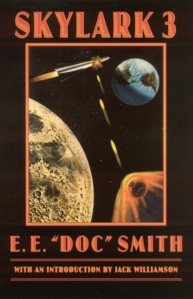
Skylark series

When I think back to my youth, I recall reading my first science fiction novel in a small local library after school in 1953. It was E. E. (Doc) Smith’s story of space travel, one of the Skylark series. At that time, no one had even put a tiny object into orbit.

A mere four years later, Sputnik I was launched, and the world entered the space age for real. Rockets to space were no longer science fiction. The next year, 1958, the United States put Explorer 1 in orbit. It weighed about 31 pounds. Dwight Eisenhower was president then. We were in the middle of the Cold War, and Nikita Kruschev was in charge of the Soviet Union. Both his picture and that of Sputnik I were on the cover of Time magazine the previous year. Indeed, if memory serves, he was the “Man of the Year.”Kruschev and Sputnik cover
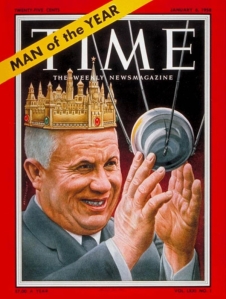
No one knew how much payload could be put into space. No one knew the effects of prolonged weightlessness on people. The Van Allen radiation belts were discovered and verified by Explorer 1 and Explorer 3 in 1958, raising the issue of radiation in space.

Despite the lack of experience in putting satellites in orbit and the great uncertainties in putting a human in space, the United States not only put men into space but even put them on the Moon just eleven years later. ELEVEN YEARS! Starting from a tiny satellite in orbit, a lunar landing module weighing over 1,000 times as much and holding two people landed on the Moon in that short time.

Those who say that we can’t put people on Mars in 10-15 years don’t remember the magic decade of the 1960s. You have to watch out when you use that word, “can’t.” The Mars Direct program was proposed in the 1970s and was to have people on Mars by 2000. That didn’t happen, and technology has advanced enormously since then. It’s more possible today, and it’s still a very tall undertaking.  Continue reading

Proposal for a Holistic Emphasis in K-12

Bob Hoffmann80aBy Bob Hoffmann*

[Note: This article was written in response to Harry Keller’s “Acronym in Cheek: STEM, STEAM…” (11/11/13). -Editor]

Thanks for your insightful article.

This exact question was presented as New Business Item (NBI) #43 to the delegates of the National Education Association (NEA) Representative Assembly (RA) in terms of “ways to integrate the arts into STEM.” The Vocational, Career, and Technical Educators’ Caucus (of which I am a past-chair) looked into the claims by supporters of the “Put the Arts into STEM” (STEAM) initiative and found that the motion would give an NEA endorsement to massive changes in our courses. We organized an effective response, which defeated the motion among the 9000+ delegates.

The STEAM Initiative advocates claimed that “art is used everywhere in STEM,” from the Fibonacci series in math and nature to the “Harmony of the Spheres” of the solar system orbits, from design in architecture to the “form factor of the iPad in your hands.” We should certainly recognize that this is true in specific historical cases, yet our challenge now is to encourage similar innovations from our students, keeping in mind that such grand new ideas are the exception, not the rule.

The maker of the proposal, Mr. Tom McLaughlin, identified the source of many of their arguments for STEAM as a book by Robert S. and Michele M. Root-Bernstein titled Sparks of Genius: The Thirteen Thinking Tools of the World’s Most Creative People. While the authors clearly support the integration of creative thinking skills with the arts, the inverse does not seem to hold — that students must learn the arts to become creative thinkers.  Continue reading

Acronym in Cheek: STEM, STEAM…

picture of Harry KellerBy Harry Keller
Editor, Science Education

[Note: See Bob Hoffmann’s response in “Proposal for a Holistic Emphasis in K-12” (11/24/13). -Editor]

STEM (Science, Technology, Engineering, and Mathematics) has taken over from simple, unadorned “science” as the term describing our science classes. Because most of these classes use technology and mathematics already, the major change is the addition of engineering. Many science classes already had some sort of engineering-oriented activities they call projects. The NGSS (Next Generation Science Standards) has increased the emphasis on engineering.

STEM, as a moniker, has had such success that it has resulted in some copycat acronyms. Preeminent among these is STEAM, which adds art to the list. I have absolutely nothing against inserting art into science classes and even support the idea. However, the creeping growth of an acronym does bother me as does the omission of equally important areas of learning for students in science classes.

I also happen to think that that putting technology into the acronym is superfluous. I’d much prefer, for example, thinking as the T in STEM if you have that letter at all.

I have read many spirited discussions about STEAM replacing STEM, and they all seem to originate from teachers of traditional art classes where drawing, painting, and sculpting is taught. What about performance arts? What about music? I have not seen anyone agitating to add those to science classes. Why not?

There’s also the crucial role of history and social science in general to learning. There certainly is much history in science, both the history of science and the historical context. Our children can learn much from this analysis, possibly more than memorizing the names of U.S. Presidents or of the Kings of England along with dates. Why do we not see agitation for SHTEM or HEMST? Not a clever enough acronym? That’s hardly a sufficient excuse.  Continue reading