





 By Harry Keller
Editor, Science Education
Now that Elon Musk has revealed details of his Hyperloop concept for traveling between cities faster than double the speed of an airplane, it’s time to put his ideas to the test. Will they work? Should we build it?
Such a complex system has no trivial answer. We can consider two important factors, however. Will it work? Does it satisfy the demands of a new technology?
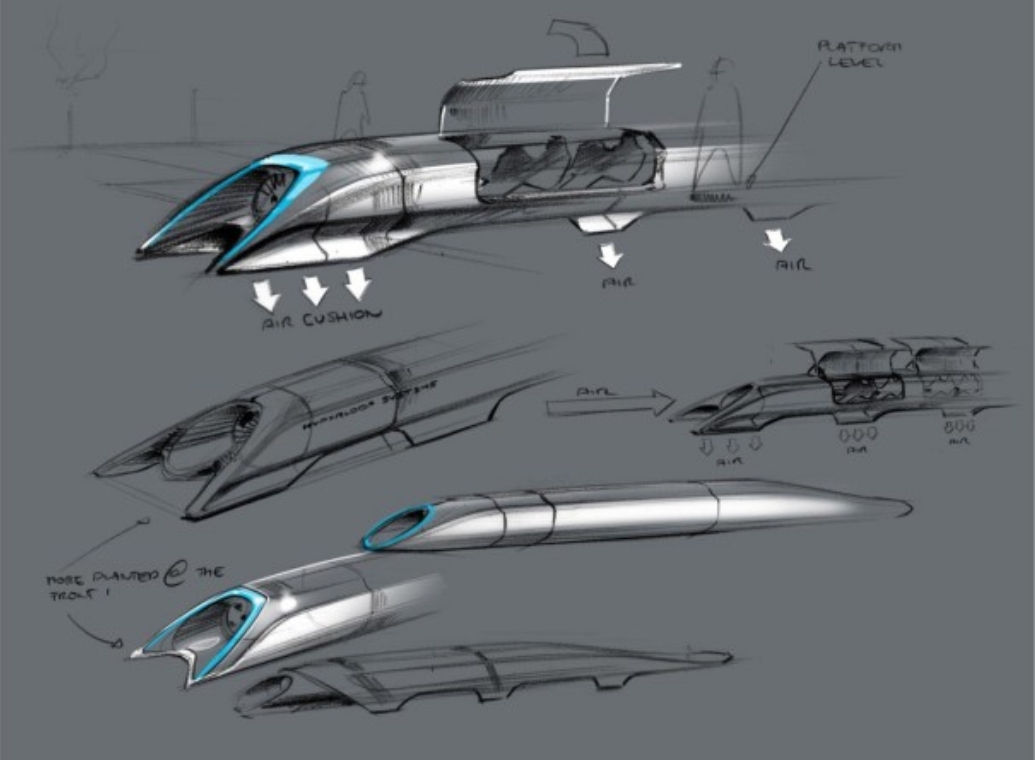
Hyperloop, by Elon Musk, Chairman, Product Architect and CEO, 12 Aug. 2013.
For the second question, the answer comes from considering how technology is supposed to work. When you inject technology into an existing space such as travel (or education for that matter), it should work better, result in faster results, and cost less than what it’s replacing or supplementing. Dan Goldin of NASA put it into really simple terms long ago: Better, Faster, Cheaper.
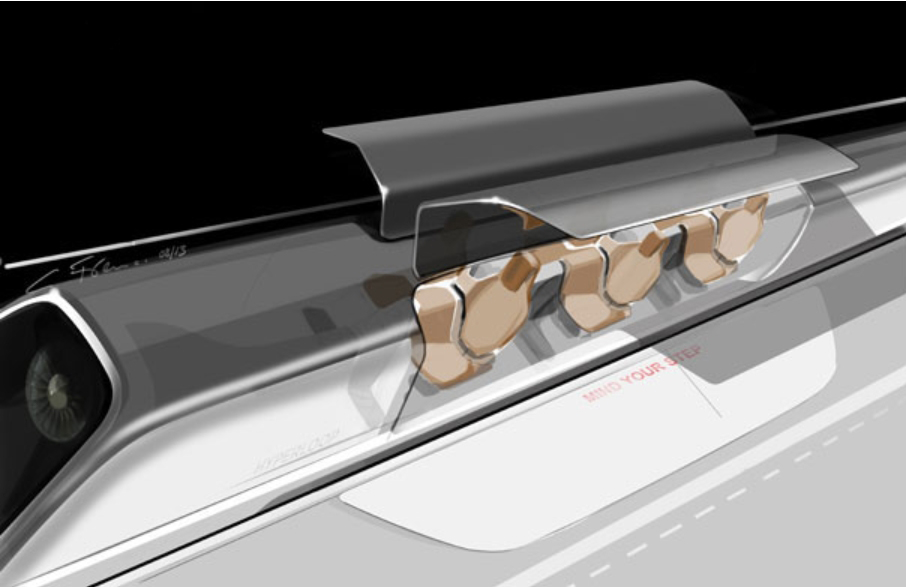
Hyperloop pod.
How does Elon Musk’s plan stack up? From his own blog, here are his goals for intermediate distance transportation of from a few hundred miles up to around 900 miles when compared to existing system.
- Safer
- Faster
- Lower cost
- More convenient
- Immune to weather
- Sustainably self-powering
- Resistant to Earthquakes (he’s in California)
- Not disruptive to those along the route
The second two items match nicely. Musk claims that a ticket on the Hyperloop from Los Angeles to San Francisco should cost about $20 one-way. The speed of 700 to 800 mph certainly counts as faster. Is it better too? That depends much on what you consider to be better. The travel pods will hold about 28 people if his design is chosen. They will not be spacious. His drawings suggest a rather cramped environment that could bother claustrophobic passengers, except that this system will be above ground and could have a view. However, the drawings don’t show windows.
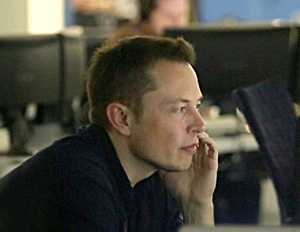
Elon Musk in Mission Control at SpaceX. He is a South African-American inventor and entrepreneur, best known for founding SpaceX and for co-founding Tesla Motors and PayPal.
A 350-mile trip might take around a half-hour, long enough to become upset with being in a small closed space with others. The potentially longest trip of 900 miles would require over an hour. All current modes of transportation, planes, trains, automobiles, and boats, have windows that passengers tend to like very much despite the view. Looking out of a window at 30,000 feet or traveling at 70 mph can be disconcerting. However, the power of the desire to see overcomes this problem for most.
Filed under: Transportation | 5 Comments »


 Educational Technology and Change Journal
