Glean: Open Online Videos to Boost Math Instruction

Leilani CohenBy Leilani Cohen
Math Teacher
Frederick Douglass High School
Atlanta, GA

This year, to keep things realistic, I chose one New Year’s resolution: to use more technology in my classroom. Luckily, a colleague turned me on to Glean a few days after the start of the year. It’s a new website that hosts educational video lessons from thousands of teachers on YouTube, and I’ve had a blast using it. I’m encouraging my students to use it to become more self-directed learners.

Glean screenshot of video and alternate videos on Pythagorean Theorem.

Glean screenshot of video and alternate videos on Pythagorean Theorem.

Here’s a brief description of Glean from their about page:

Hundreds of amazing teachers post educational videos online every day. At Glean, we’ve structured and organized these videos, tagged them by educational standard, and wrapped them in interactive tools (like Q&A and practice exercises). We’ve even built technology to pick the ideal teacher for the student based on his/her learning style and ability.

I have seven tablets in my high school math classroom so we’re not quite a 1:1 yet, but I make sure each student uses a tablet at least once each day. I’ve started adding Glean to the rotation of educational software I have them use.

So far our usage is simple. I choose the most appropriate video given the class topic for the day (say, Pythagorean Theorem) and assign this to each student. After watching the video, if the students are confident in their understanding of the concepts, they can move on to my exercises. If not, they can choose from a dozen or so alternate videos covering the same topic on Glean. Of course, hearing things more than once helps students learn a concept well, but hearing things more than once from a different teacher at a different pace using different visual media, I feel, helps even more.

This is why I’m excited about Glean, which could eventually take the place of Khan Academy in my class. So far feedback has been overwhelmingly positive from my high school students, and I’m excited to see how their usage changes with the product over time!

Mars One Steps Up

picture of Harry KellerBy Harry Keller
Editor, Science Education

Bas Lansdorp has announced the selection of the first Mars One candidate pool, selected from over 200,000 applicants. The final four will come from a pool of 1,058 people chosen through a process involving “rigorous simulations, many in team settings, with focus on testing the physical and emotional capabilities of our remaining candidates.”

While the announcement says that over 200,000 applied, it’s unclear that all of those paid the fee and submitted the video. The criteria for selection are given at the site, but few can readily be applied to applicants, many of whom may have lied on their applications.

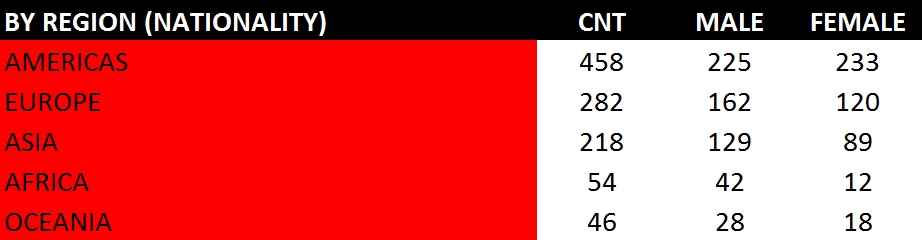
Round 2 data from the Mars One project.

Round 2 data from the Mars One project.

Only three criteria are quantitatively measurable: 100% visual acuity (correction with lenses allowed), blood pressure below 140/90, and standing height between 157 and 190 cm. (Note: I’m ineligible with a height of 190.5 cm even though I meet the other two criteria here.)  Some others are qualitatively measurable: free from drug, alcohol, or tobacco dependency, normal range of motion in all joints, and disease free.

There are some interesting statistics in their announcement. The pool has 44.6% women. The oldest person is age 81 and will be 92 at the estimated time of manned launch. The largest age group is 26-35 at 39% with 18-25 having 34%. The United States has by far the largest number in the pool at 28% with Canada coming in second at 7%. These are followed, in order, by India, Russia, Australia, China, Great Britain, Spain, South Africa, Brazil, Germany, France, and Mexico. In all, 107 countries are represented, 30 with a single person being accepted for round two and 24 with two. This list may be heavily biased by the requirement of English fluency, by the population size, and by the relative wealth of the countries.  Continue reading

Smartphones – Friend or Foe?

Renee Imes80By Renee Imes
Student at Kapi’olani Community College
University of Hawai’i

In modern Western civilization, I would venture to say, most of us own a smartphone. They are in essence another appendage, and being without that tether or lifeline could be cause for despair. I wonder though if this device is turning us into a zombie-like society that uses technology to think, instead of our minds.

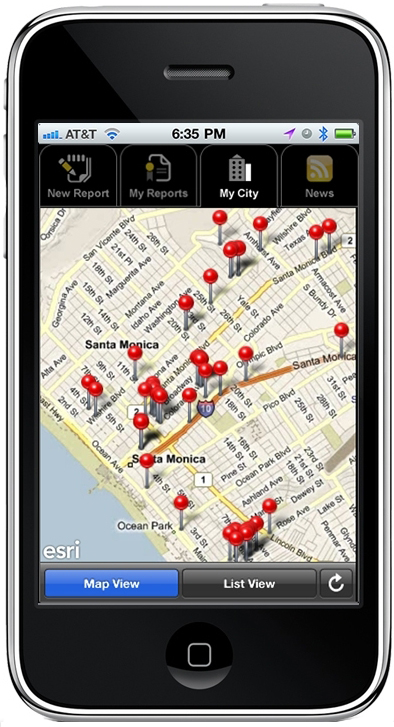
smartphone mapDuring the summer of 2005 when I went on my healing cross-country driving, hiking and camping sabbatical, I used a road map. I really loved my maps. The pages were well-worn, dog-eared, and had many coffee stains. I had two maps: one was a Thomas Guide and the other, Rand McNally. My maps had details such as highways, urban roadways, gas stations, landmarks, and major hotels as well as campgrounds and more. I have doubts anyone under the age of 40 has ever used a map such as this. My maps and a couple of tour books were the only tools I had. I did have a cell phone, but this was when the phone was just a phone for calling, not equipped with all the bells and whistles of today’s smartphones. I had it only for emergencies and as a means for family to reach me.

Using the maps made me an interactive participant in my travels. I had to know how to chart out the best routes to get from one city to the next, and from state to state. I had to know my fuel tank and how far a tank of gas would get me, so that meant I had to know how far in miles each gas station was as well as rest areas. Many times I had to quickly create detour routes to avoid construction or weather issues.

Maps also became a social tool. When I was in campsites, gas stations and rest areas, my fellow travelers and I talked at length over our maps. We pointed out routes to take, what to avoid, the best eating establishments for a budget and more. We felt like kindred spirits.  Continue reading

Learning: Transformational, Flipped, Enhanced, Distracted

lynnz_col2

Preparing Teacher Candidates to Work with English Language Learners in an Online Course Environment
By Stephanie E. Dewing in TEIS News, December 2013

Dewing reports on a study she did with students in an online ESL for Educators course. She was interested in whether the students experienced transformational learning, a change not only in what a person knows but how they know it. She found that, although learning occurred, the course fell short of this goal. She asserts that because convenience and flexibility are the primary reason many students take online courses, attention must be paid to course design so that it meets the needs of students while creating an environment for transformational learning.

Don’t Make These Mistakes with Flipped Learning
By Meris Stansbury in e-School News, December 12, 2013

Stansbury cautions that flipped classrooms can quickly become run-of-the mill if teachers don’t think outside the box in their planning. She gives several concrete examples of ways that flipped classrooms can live up to their potential.

Movies Enhance Language-learning Program
By Kellie B. Gormly in TribLive Lifestyle, Dec. 6, 2013

Mango Languages, a Michigan-based language teaching company, offers programs that are based on popular media, especially movies. Subtitles and interactive learning materials engage the learners in grammar and vocabulary use, as well as commentary and cultural explanations about what they are seeing.

Age of Distraction: Why It’s Crucial for Students to Learn to Focus
By Katrina Schwartz in Mind/Shift, December 5, 2013

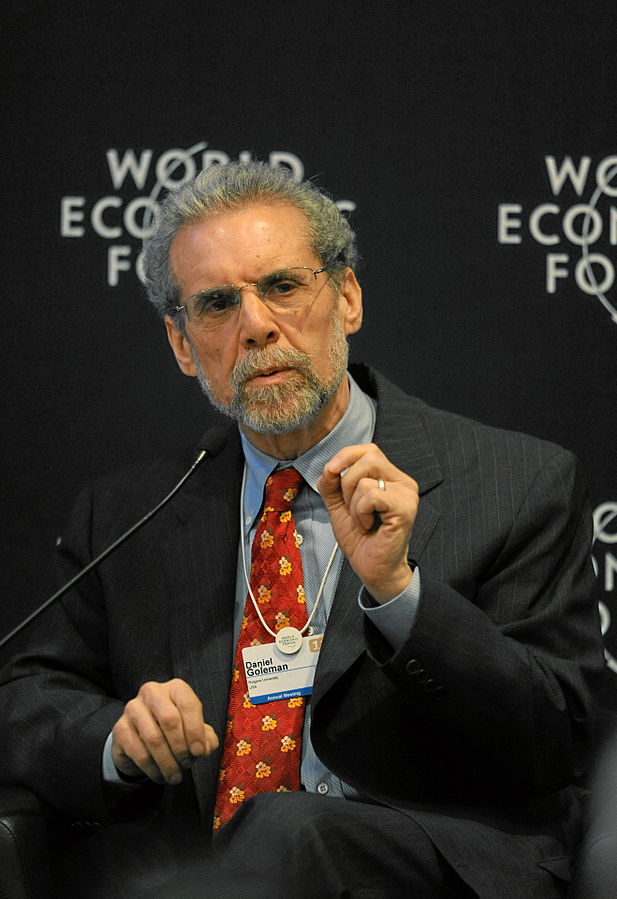
Today’s world holds many distractions for young people, particularly in the digital world. Daniel Goleman, a psychologist and author of Focus: The Hidden Driver of Excellence, is concerned that young people are not developing appropriate neural connections in order to help them develop good focusing skills. He contends that everyone needs to learn to use digital devices smartly, and children, especially, need to develop the capacity to concentrate to use them well.

Making Mistakes and Learning

picture of Harry KellerBy Harry Keller
Editor, Science Education

You’ve probably heard that you learn by making mistakes. The bigger the consequences of your mistake, the more likely you won’t forget.

I used to live in Massachusetts where I built a house with a 400-foot driveway. Where I lived, about 35 miles west of Boston, there was plenty of snow in the winter. At first, I just shoveled the driveway. I was young, foolish, and into doing it yourself. After a particularly snowy year, I gave in and purchased a nice big snowblower.

If you’ve ever used one of these, you know that springtime provides the real challenge. The snow is wet and tends to stick in the chute. You have to dig it out fairly frequently. Just below the chute is the high-speed impeller, a very dangerous bit of the equipment. Snowblowers have a safety device that prevents you from sticking your hand into the chute, but my arms are long enough to defeat that device. I can put my hand into the chute without stopping the impeller and did so many times before the fateful day on which I put my hand in too far.

I had on thick leather mittens, but they didn’t help a bit. Although they were not damaged in the slightest, my middle finger’s last segment was decimated, essentially destroyed. The pain was extreme. My wife drove me to our nearest emergency clinic, about a half-hour away. All the while the pain was escalating. I nearly fainted on the way in and did collapse for a moment on the floor of the elevator.  Continue reading

PISA Days Are Here Again (Part 3): Beyond An Emotional Appeal

John SenerBy John Sener

[Note: This is the last in a three-part series, “PISA Days Are Here Again.” See parts 1 and 2.]

Given that education has become such a critical element of national success, well-being, and identity, you’d think that the discussion about US students’ performance on the latest round of PISA international test scores would be a rational one. Instead, it is something very different, which at times resembles a collective spell that has been cast on the American public. What’s really going on here?

Daniel Goleman, author of  Emotional Intelligence (1995).

Daniel Goleman, author of Emotional Intelligence (1995).

Daniel Goleman’s book Emotional Intelligence (1995) offers some clues, in particular an appendix that describes the hallmarks of the emotional mind. It’s an interesting exercise to explore how well these hallmarks map with common elements found in articles about PISA gloom-and-doom, especially US Secretary of Education Arne Duncan’s “threat of educational stagnation and complacency” speech.1

1. Quick to the draw:  Goleman states that “the emotional mind is far quicker than the rational mind” whose quickness “precludes the deliberate, analytic reflection that is the hallmark of the thinking mind” (p.291). At first glance, that seems to fit the pattern quite well; deliberate, analytic reflection is noticeably absent in the mainstream media articles about the topic. In another sense, though, this characteristic may not fit as well as it seems — more on that a little later.  Continue reading

Teaching About Global Warming

picture of Harry KellerBy Harry Keller
Editor, Science Education

With all of the misinformation regarding global warming or climate change, it’s hard to deliver convincing information to students. The subject has many aspects. One that receives lots of negative press is the so-called “greenhouse effect.”

The term in a misnomer because the effect of carbon dioxide, methane, and other warming gases is very different than the effect that keeps a greenhouse warm. In the latter case, it’s merely the isolation from the cold air outside of the greenhouse that creates the effect. Glass is a sufficiently good insulator to stop conductive loss of heat and certainly eliminates convective losses. However, it does not block infrared (IR) radiation and keep it from escaping.

To demonstrate this fact, you only have to paint the inside of a small foam cooler black, put a piece of glass over the top, and illuminate it with a heat lamp. A thermometer punched through the side and shielded from the heat lamp with a small piece of cardboard completes this simple experiment. I have done this experiment, and the temperature will not rise.

John Tyndall, author of "The Bakerian Lecture: On the Absorption and Radiation of Heat by Gases and Vapours, and on the Physical Connexion of Radiation, Absorption, and Conduction," Philosophical Transactions of the Royal Society of London, Vol. 151 (1861).

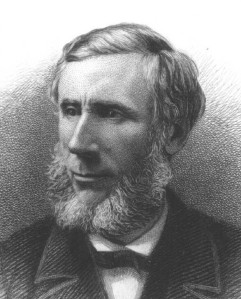
John Tyndall, author of “The Bakerian Lecture: On the Absorption and Radiation of Heat by Gases and Vapours, and on the Physical Connexion of Radiation, Absorption, and Conduction,” Philosophical Transactions of the Royal Society of London, Vol. 151 (1861).

The atmospheric greenhouse effect is more subtle. John Tyndall discovered the effect and published his findings in 1861, the year the United States Civil War began. His paper makes very interesting reading because it describes how he had to make his own apparatus and the nature of his measurements. Its general availability is only through our technology today.  Continue reading

PISA Days Are Here Again (Part 2): Time for a New Song?

John SenerBy John Sener

[Note: This is the second in a three-part series, “PISA Days Are Here Again.” See part 1 and 3.]

The latest round of national self-flagellation generated by the recent announcement of the latest round of PISA international test scores (and neatly packaged by the US Department of Education as “PISA Day1) has subsided for the most part. Unfortunately, the accompanying memes and their destructive power continue to reverberate through the American psyche, humming a depressingly familiar tune. Let’s listen more closely to what the song sounds like:

PISA Days are here again
Time to moan and gnash our teeth again?
Do our kids just stink at math again?
PISA days are here again…

Upon closer examination, the notion that we can determine much of anything useful about the state of American education or its economic impact through PISA or any other standardized test scores quickly falls apart like a wet answer sheet. As one critique has noted,2 standardized tests are less objective than is commonly believed: they don’t measure actual student achievement; their results are routinely distorted or misapplied for assessment purposes; they encourage students to become “superficial thinkers.” Instead, consider this list of traits from educational critic Gerald Bracey that we presumably want our learners to have: creativity, critical thinking, resilience, motivation, persistence, curiosity, endurance, reliability, enthusiasm, empathy, self-awareness, self-discipline, civic-mindedness, courage, compassion, resourcefulness, sense of beauty, sense of wonder.3 What do they have in common? Standardized tests measure NONE of them.

PISAday2013

Still, as a recent New York Times editorial4 bemoaned, don’t PISA results demonstrate that US kids stink — er, “lag behind” in math, and that “even [US] gifted students can’t keep up” with the rest of the world in math and science? There are several answers to this question, including: “No,” “So what?” and “That’s actually a good thing.” One reason is that PISA results purport to represent the achievement of all American 15-year-old students (on a low-stakes, largely meaningless snapshot of an event, but that’s another line of critique). In reality, analyses of math test results that take socioeconomic factors into account have found that US students are doing just fine5 or even scoring near the top.6 Not that the results really matter; as another report noted, the US (or any large country for that matter) doesn’t need all of its students doing math and science at a high level, but rather only a “sufficient number of highly educated workers.7 So in fact, any STEM workforce shortage could be met (at least in theory) by adopting one of the NYT editorial’s proposed solutions: more focus on boosting achievement of gifted students in math and science (which could, among other things, drag down the US’s overall PISA scores). Indeed, this may be a good thing, for as University of Oregon researcher Yong Zhao has found, countries with high PISA math scores actually score lower on measures of “perceived entrepreneurial capabilities.”8 As Zhao argues in his book World Class Learners: Educating Creative and Entrepreneurial Students,9 teaching students to think like entrepreneurs (resourceful, flexible, creative, and global) is different from preparing students to be homogenous, compliant, and standardized workers for mass employment (and guess what’s excellent preparation for that outcome?). Nevertheless, the chorus bemoaning US PISA test results remains loud:

Altogether shout it now
There is no one
Who can doubt it now
Chinese, Poles & Finns will rout us now
PISA days are here again

Actually, there are all sorts of reasons to doubt PISA results. As the Brookings Institution’s Tom Loveless has pointed out,10 the PISA results for China are heavily skewed since the Chinese government only allowed the release of results for Shanghai, an area which is highly unrepresentative of the country as a whole. Yet that hasn’t stopped the major media outlets from shouting out the results, for example “China: The World’s Most Clever Country?”11 (BBC), “US Teens Lag in Global Education Rankings as Asian Countries Rise to the Top12 (USNews/NBC News), and “U.S. Students Get Stuck in Middle of the Pack on OECD Test13 (Bloomberg).

Continue reading

Jorge: The Education of a 12-year-old in an Immigrant Family

Jeremy Scott Burg80By Jeremy Scott Burg
Student at Kapi’olani Community College
University of Hawai’i

I’m packing my backpack with pajamas and a change of clothes. It’s a rare sunny Saturday in Scappoose, Oregon. I’m going to a sleepover at my best friend’s house. His name is Jorge. I say “bye” to Mom and hop on my bicycle. There are several miles to Jorge’s house, but I’m used to riding far on my dirt bike. I ride on two-lane country roads until I get to the paved logging road that will take me most of the way to his house. Cars aren’t allowed to use the logging road, and the log trucks are rarely on it, so it’s a nice safe ride for me. After that ends, I’m back on country roads for a short while when I finally arrive at the long gravel road Jorge lives on. Jorge is my Mexican friend I met while we were both attending sixth grade at Peterson Elementary School. During this sleepover, I catch a glimpse of what it is like being the first-born son in an immigrant family.

Scappoose, Oregon

Scappoose, Oregon

I ride up to Jorge’s driveway. Further down the gravel road is the big dairy farm where Jorge’s dad works. I turn into the driveway when Jorge and his younger brother, Crispin, are coming out of the house. Jorge is a little taller than me with a lean body. His thick jet black hair is cut short on the sides and left longer on top. He says I’m just in time because his mom has asked him to go to the minimart to get some supplies. The cool part is we get to take the car. Jorge is twelve years old and has learned to drive by going back and forth to the dairy farm with his dad, about a mile round-trip. He’s also previously driven to the minimart with his mom and alone. The distance is about seven miles. There isn’t much traffic or police out in the country. Jorge tells Crispin he can’t go with us. We get into his mom’s new Ford Taurus and drive away. When we are far enough away, Jorge pulls a tape of N.W.A. out of his back pocket and puts it in the tape player. We have just morphed into the two coolest twelve year olds, blasting gangsta rap with the windows rolled down. I haven’t even tried driving yet, and here’s Jorge running an errand for his mom with the family car. I feel free.  Continue reading

MOOCs Are So Much More Than Courses or Statistics

By Jessica Knott
Associate Editor
Editor, Twitter/Facebook

[Note: This article was first posted in ETCJ’s staff listserv this morning, in response to a discussion on Tamar Lewin’s “After Setbacks, Online Courses Are Rethought” (NY Times, 12/10/13). Lewin’s article was shared in a post by Harry Keller on 12/11/13. -Editor]

I have such a different view of MOOCs. Maybe it’s because I work on them from time to time.1 This e-mail won’t be nearly long enough to get my thoughts out because I’m super short on time. (I know, we all are, so that’s such a lame excuse.) But the analytics on MOOCs and the things that point to problems, such as 4% completion, 80% having degrees — in a way, I kind of see those as opportunities.

We talk about MOOCs as though they’re all one beast. I know it’s unintentional — but we do. Each MOOC is so different. Believe me, I’ve taken 23 of them. I have completed three. Some were so terribly constructed that I could get all of the correct answers to the content and still fail the quizzes. Some were so amazing that I couldn’t stop exploring and lost track of deadlines. Others? Well, others were just there. I’m sure they served their purpose, but they left no impression.

I see MOOCs like museums. You sign up, you go in and see what’s there. What do you want to get out of it? Some people are striving for that certificate. Others, like me, just want to pick up some new skills, or maybe learn some statistical tricks, or learn about scientific theories they’d never have a chance to interact with otherwise — if they had to pay.

More importantly, what *is* success in a MOOC? Is success completion? Or is success learning? Because, according to this conversation, the MOOCs have failed me. But I can tell you, while that’s true for a few of them, they’ve *far* from failed me. The conversation is shifting a little, from completion to potential. MOOCs are this really amazing thing. They can be a whole course experience, or they can be used as course content. They can stand alone, or be integrated.

I just think there is so much to the conversation and potential that can be lost if we look at MOOCs simply as courses or as statistics. Let me be clear. That’s not what I’m saying you’re doing here. I do feel that, sometimes, that’s what researchers tend to do. There is a real shift happening out there, though. It’s very exciting, that is, unless I’m a conference reviewer and reviewing your submission on MOOCs that looks like every other submission on MOOCs. Then you might not find it as exciting.

Ohio State is doing some things really right. Jesse Stommel has some great ideas. And, the standards, which I’m sure you’ve seen: Jim Groom, Alec Couros, Tanya Joosten, George Veletsianos, Amy Collier, etc. I have some blog posts, thought pieces, articles and resources if you’re interested. Let me know (jlknott@gmail.com). If I start sending them, there’s a good chance I’ll never stop.
__________
1 See MOOC MOOC! The interview (9/11/13) and MOOCulus for Calculus Fun: An Interview with Tom Evans (7/11/13).

Space Heats Up

picture of Harry KellerBy Harry Keller
Editor, Science Education

All eyes are not on Mars these days even though the recent news will buoy those interested in the red planet. Some significant events have taken place in space flight in the last two months.

Perhaps, one of the biggest is the entry into the commercial space race of Amazon’s Jeff Bezos. His Blue Origin rocket engine has been successfully tested for the first time (NBC article). The November 20 test was a full simulation of blast off and entry into Earth orbit using his hydrogen-fueled rocket engine with 110,000 pounds of thrust. Elon Musk’s SpaceX has a competitor.

Elon Musk, Jeff Bezos, Alan Bond, Bas Lansdorp.

Elon Musk, Jeff Bezos, Alan Bond, Bas Lansdorp.

Speaking of SpaceX, they have launched a big commercial satellite into a geostationary orbit, 22,000 miles (36,000 km) into space. The satellite is nearly 7,000 pounds (2,138 kg) and launched on December 3 at a cost that is tens of millions of dollars less than previous similar launches. The Falcon 9 rocket performed flawlessly and is the precursor for the soon-to-come Falcon Heavy rocket that will lift 116,850 pounds (53,000 kg) into Earth orbit and is likely to be the rocket used for the first manned Mars ventures.

NASA has announced the test date for its Orion manned space capsule, September 2014. Ultimately, this capsule is slated to carry humans back to the Moon. This is a larger capsule and with much more computer capability than previous manned capsules.

Another NASA announcement opens up a competition for the commercial International Space Station spaceships. These ships are due to begin transporting crews and supplies in 2017.

These sorts of competitions will lead to faster development of technologies that can make manned missions to Mars feasible. Mars One remains a long shot because of its desire to have people live out a “normal” life there. Despite Bas Lansdorp’s remark that returning people to Mars is more difficult that having them live there, the hurdles to long stays on Mars exceed those to landing and returning. Neither has been done, but the former has more unknowns; the latter mostly requires scaling some technologies and providing fuel for the return journey. While a few ideas for on-Mars fuel production have been made none have been tested outside of a laboratory.

For example, the Alan Bond concept of turning CO2 from the Mars air into CO and O2 has not been attempted with Mars air, which has 1/100th of the pressure of Earth air and some contaminants, such as omnipresent dust, that could cause problems in the real (Mars) world. The Mars Direct idea combining on-board hydrogen with atmospheric CO2 to make methane (CH4) and oxygen has the same issues. Finally, breaking water into hydrogen and oxygen means extracting water from the Mars regolith (dirt). We don’t know exactly where to find water on Mars or how to deal with the many corrosive contaminants in the ground. Until someone tests these ideas on Mars or in a very well simulated Martian environment, we won’t be sure that any will work.

See the Mars One article and spirited discussion for more on the problems of living on Mars for more than a year or so. Even a year will be tough, but should be manageable.

Mars One Delayed for Two Years

picture of Harry KellerBy Harry Keller
Editor, Science Education

At a news conference today, the Mars One team announced contracts with two vendors for studies and a two-year delay in their schedule. The first launch now is scheduled for 2018 with the launch of the first manned mission in 2025. This puts Mars One closer to the schedules of other announced Mars landings in 2030 or later. This sort of very ambitious project almost always suffers delays, and this may not be the last. Given that much of the technology, although existing in some form, has not been created in the form necessary for the trip to Mars.

Bas Lansdorp on 19 April 2013. Image from video added to YouTube by Raitis Misa on 23 April 2013.

Bas Lansdorp on 19 April 2013. Image from video added to YouTube by Raitis Misa on 23 April 2013.

No one has ever landed as large a mass as planned for Mars One on Mars. Even lifting the materials into space may extend into areas not ever reached previously. Planned rockets may be capable, but without detailed plans, it’s hard to evaluate the likelihood of success.

The funding will come from sponsorships, partnerships, and crowdfunding through Indiegogo. The crowdfunding site is already up and has raised over $8,000 of its $400,000 goal in the first hour since the news conference. The crowdfunding will finance the initial studies by Lockheed-Martin and SSTL, who will produce the 2018 lander and communication satellite respectively.  Continue reading

The ‘New Rich’: A New Conservatism in U.S. Education?

Jim ShimabukuroBy Jim Shimabukuro
Editor

Here’s a statistic and thought from Hope Yen that ought to interest anyone who’s made the connection between poverty and educational achievement: “Fully 20 percent of U.S. adults become rich for parts of their lives, wielding outsize influence on America’s economy and politics. This little-known group may pose the biggest barrier to reducing the nation’s income inequality” (“Rising Riches: 1 in 5 in U.S. Reaches Affluence,” AP/USA Today, 12/6/13).

This massive wall of nouveau riche are, according to Yen, “much more fiscally conservative than other Americans, polling suggests, and less likely to support public programs, such as food stamps or early public education, to help the disadvantaged.”

For the 20%, success may breed contempt — contempt for those who can’t work their way out of poverty. An intriguing question involves the relationship between this hardscrabble group and the nation’s growing affinity for standardized tests. Are the new rich more inclined to support national and international testing? And, more importantly, why?

One of the new rich interviewed by Yen says that much of her income goes toward putting her children through college. She is probably representative of a 20% mindset that views testing and high test scores as the entry pass to degrees and economic success. The tests are a means to an end, and the end is separation, separation from the have-nots.

In this scenario, education begins to mirror the gated communities that attract the new rich, and high scores are passes into our nation’s gated schools and colleges. You want entry? Fine. Score well on standardized tests.

But the real victims are the children and youth who are born into poverty. Theoretically, they can study their way out of their circumstances, but the deck is stacked against them from day one. Ironically, the few who do make it out often become the new gatekeepers of privilege, chanting the mantra, “If I can do it, so can you.”

If the new rich are the force behind the testing movement and if the reason is to maintain and even exaggerate the income divide, then the question is what can be done to reverse this trend or somehow close the gap.

I don’t think there are any easy answers. In fact, as a nation, we may find the premise behind this question embarrassing, exposing an instinct that is more self-serving than charitable.

Can Technology Expand the Reach of Great Teachers?

Frank B. WithrowBy Frank B. Withrow

We have always had examples of schools and teachers that, regardless of their support, were able to inspire and bring out the best in students. My anatomy teacher, Dr. Davis, was a teacher who intuitively inspired students to think and to excel. He was a Presidential Scientist and world renowned authority, but he spent as much time working with an undergraduate student as he did in his post graduate classes.

We have always had these inspiring teachers. The question is, Can technology expand their reach? The question is whether we, as a nation, wish to honor teachers and schools and foster a true love of learning. I am less concerned about a grade for our schools and learners than I am about developing a society that honors learning whether it is through technology or inspired teachers.

If we desire good schools we will have them. Technology can expand the number of children now denied schools worldwide. For the first time, technology has allowed us to dream of schools for every child in the world. Some countries will do well with this dream; others will stumble.

Right now it is difficult to pick the winners and losers.

PISA Days Are Here Again…

John SenerBy John Sener

[Note: This is the first in a three-part series, “PISA Days Are Here Again.” See part 2 and 3.]

I’ve already written about comparative achievement tests.1 Now that “PISA Days” are here again, thus begins another round of national self-flagellation about the supposedly sorry state of American education based on dubious interpretations of international test scores of questionable credibility and limited value.2 I’m in the midst of a lot of work-related catching up, but I suspect I’ll be pulling together my thoughts about this latest round of PISA-induced moaning and gnashing of teeth over the next week or so.

I don’t think that the NBCNEWS article3 is strong at all — it’s as formulaic as all the others that are sprouting up as predictably as flowers after a desert rain. It quotes sources (e.g., Eric Hanushek) with well-known biases on which they base their living and professional careers. It has the predictable counterargument buried in the middle and ultimately dismissed without much substance, and it concludes that Things Are Bad and Slowly Getting Worse. I’ve already read several of these articles, and I will be surprised to find one for which I don’t already know how the plot ends.

BTW, here’s an angle on such articles that just popped up for me: last night, for unrelated reasons I was re-reading parts of Daniel Goleman’s book Emotional Intelligence (1995), in particular the chapter about “The Hallmark of the Emotional Mind.” Goleman apparently posits that we have an emotional mind as distinct from our analytical one. I haven’t done the mapping yet, but I have a strong suspicion that the current spate of PISA doom articles are based almost entirely on emotional arguments. No one writing these articles is doing any actual analysis of the facts, and if they did, the arguments would fall apart like a house of cards.

Part of me wants to bemoan the fact that so many professionals, including some educators, want to embrace the PISA results so uncritically. But I think the more interesting angle is the fact that we seem to respond, collectively and individually, to emotional arguments. Winning the analytical argument is not enough; one has to win the emotional argument somehow. I’m still figuring out how that happens…

Or, here is one antidote to this madness: Diane Ravitch’s article, which includes an analysis of Keith Baker’s work (which unfortunately costs $$ to access) through which he concludes that “standings in the league tables of international tests are worthless.” I’m in the process of collecting other more rational responses to this latest release of PISA results, from which I hope will emerge a reasoned, analytical summary of what the PISA results mean (or don’t mean). But I remain more intrigued by the question lurking in the background: why do people respond so emotionally and not rationally when it comes to international test score results? More on that in a later post…

__________
1 John Sener, “Standardized Tests and Foul Shooting: Look Out, Michael Jordan!“, ETCJ, 3/12/11.
2 John Sener, The Seven Futures of American Education: Improving Learning and Teaching in a Screen-Captured World, 2012, p. 78.
3 Daniel Arkin, “US Teens Lag in Global Education Rankings As Asian Countries Rise to the Top,” NBCNEWS/AP, 12/3/13.

A Caltech Grad in a Caltech MOOC, Part 5

picture of Harry KellerBy Harry Keller
Editor, Science Education

[Note: Harry, who holds a BS in chemistry from the California Institute of Techology and a PhD in analytical chemistry from Columbia University, is sharing his first MOOC experience in this series. See part 1, 2, 3 and 4. -Editor]

The End of My First MOOC Journey

As an audit student, my motivation to finish is not great. I have to ask if drop-out rates mean not taking the final exam because I never intended to punish myself that way when I began. I already have a very good doctorate in science and have no incentive to acquire more initials after my name today.

The last two lectures of the course were both quite technical and, once you penetrate the jargon, quite illuminating. They brought me to the state of the art in machine learning: SVM and RBF.

I was introduced to machine learning decades ago and was interested enough to obtain a book on it, the only book available at the time. This book was heavy on theory and not very useful to a practitioner. Machine learning in those days consisted of just one approach, known today as PLA or Perceptron Learning Algorithm. It was adequate for simpler learning situations and was adjusted to work in others but was not really sufficient.

The machine learning universe expanded with the advent of neural networks, a learning concept that sprang from biological work at the time. Neural networks are still used but not very often.

Today, support vector machines (SVM) and radial basis functions (RBF) represent where machine learning lies. The former requires an advanced mathematics known as quadratic regression (QR). The latter only requires matrix manipulation and iterative processing, both readily available with software.  Continue reading

Breakthrough: Online Bachelor’s Degree for $19,200

Jim ShimabukuroBy Jim Shimabukuro
Editor

Mount Washington College, accredited by the New England Association of Colleges and Schools, is offering Bachelor’s Degrees in Accounting, Business Administration, Business Administration: Management, Business Administration: Marketing, Information Technology. It’s also offering Associate’s Degrees in Accounting, Business Administration, and Information Technology. The following are excerpts from the press release, 11/18/13:

With a tuition structure starting as low as $4,800 per academic year ($2,400 per term), students can complete an IT bachelor’s degree for less than $20,000, making it among the most affordable regionally accredited programs in the United States. Mount Washington College also offers business degree programs within the same highly affordable tuition structure.

 Mount Washington College, 3 Sundial Ave, Manchester, NH ‎

Mount Washington College, 3 Sundial Ave, Manchester, NH ‎

Consistent with Mount Washington College’s instructional philosophy, the IT degree program allows students to pace themselves, managing the intensity of work and completion of their degree based on their individual timetable. The curriculum is designed to meet the needs of adult learners who are often balancing a full-time job and raising a family with other scheduling demands and life commitments. Student Mentors are there to help right from the start, serving as a resource to students from the time of admission through graduation.  Continue reading

New AACE Special Interest Group on ‘Assessing, Designing and Developing E-Learning (ADD)’

By Stefanie Panke
Editor, Social Software in Education

The Association for the Advancement of Computing in Education (AACE) has launched a Special Interest Group, “Assessing, Designing and  Developing E-Learning” (ADD). You do not have to be an AACE member or an attendee of previous AACE conferences to  join — though some activities will be tied to the E-Learn 2014 conference to be held in New Orleans from October 27-30, 2014.

The SIG had its inaugural meeting during the AACE E-Learn 2013 conference. If you missed it, review our presentation for collaboration ideas.

ADD3

Based on the discussion during the SIG meeting on Oct. 23, we have initiated first community activities:

  • To facilitate SIG projects, discussions, meetings and publications we want to learn more about your background and interests. Please take 10 minutes (or less) and fill out the survey.
  • We created a LinkedIn group for our SIG members to communicate with each other. Here’s the link to the LinkedIn group – join us there.
  • Are you a member of the AACE network Academic Experts? Learn more about the SIG.

Our next step is to see what information the survey brings in and share this with our SIG. We are excited about the many possibilities for collaboration and look forward to meeting again at E-Learn 2014 in New Orleans. In the meantime, stay connected through ADD SIG events and activities.

Please feel free to share this information with interested peers.

Curtis Ho and Stefanie Panke
Chairs, ADD (Assessing, Designing & Developing E-Learning)

Qualities for a Strong Online vs. F2F Teacher: Are They Different?

Joseph Chianakas80By Joe Chianakas

[Note: This article first appeared in ETCJ as a comment on “Online Learning 2012: Six Issues That Refuse to Die” (12/29/11) on 10/22/13. -Editor]

Improving education and instruction, whether it’s online or F2F, is all about the quality of the teacher. It goes without saying that a bad instructor will create a bad environment, in either setting. A great instructor will have a positive impact on students, no matter the environment. So the questions I would add are: What are the characteristics of a strong educator? Are there different characteristics for the online instructor compared to the F2F instructor?

What are the characteristics of a strong educator? Are there different characteristics for the online instructor compared to the F2F instructor?

A good online instructor must be well-organized, must create a solid structure within the CMS, and must be active and involved with the students. A good F2F instructor? Well, it’s similar, right? So what are the differences?

I think it helps to have a strong personality in the F2F environment, and for me, it’s that social interaction that I enjoy the most about teaching. I build rapport with my students, and I think that makes them enjoy class more and, thus, learn more. It sure makes me enjoy my career more.

Can we do that online? Many try, but it’s not quite the same. Then I wonder: So am I selfish? Do I just want to enjoy my work more? Maybe.

I do know without a doubt that teaching online has enhanced my F2F classes. It has improved my organization, my rubrics, my instructions, and much more in the F2F classroom. It’s easy to sit down and talk to someone about a topic or assignment. It’s significantly more challenging to clearly articulate strong discussion topics and assignments when teaching online.

I really enjoy thinking about these questions. I want to be the best educator I can be, no matter where I’m teaching. And I think it’s important for people to know that we can all learn from one another — that there is value in reflecting what we lose or gain in either medium of teaching. I want to keep asking questions like these and those in the article, and I want to get better at what I do without insulting anyone’s teaching or teaching preferences. Let’s simply strive to improve.

Why the Surface Pro 2 Will Be a Game Changer in the Tablet World Series

Jim ShimabukuroBy Jim Shimabukuro
Editor

Last updated 9/6/14

(Related articles: “Thoughts on the Surface Pro 2 After 8 Months” and “The Surface Pro 2 Will Be the Death of Notebooks.”)

I’m one of the 15 million who bought the first generation iPad in 2010-11, and I’m still using it today as a flexible extension of my desktop. I can take it anywhere within my WiFi zone and have instant connection to the web. Press, sweep, and tap, and I have my email. Tap and tap, my favorite websites. Tap and press, I’m done. No desk, no mouse, no keyboard, no waiting around.

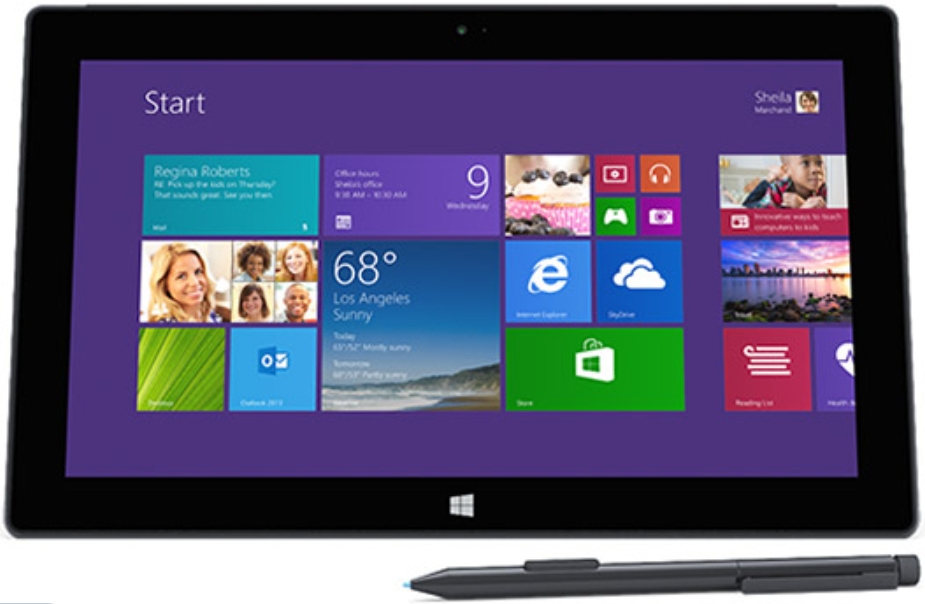
Microsoft Surface Pro 2

Microsoft Surface Pro 2

But it’s not a desktop PC, and it still can’t do some of the basics. It can handle email, both reading and writing, but it can’t multitask very easily. This means that any task that requires grabbing info from one app and using it in another is iffy and requires so many steps that it’s almost not worth doing unless you’re desperate.

My iPad also can’t do standard PC apps such as MS Word and Excel and the gazillion little utilities that I can’t live without, and its ability to handle the vast range of webpage styles is poor, which makes web browsing and research a more miss than hit exercise. There are countless workarounds for mainstream desktop programs and app alternatives for mobile devices that are supposed to render standard websites readable, but these are clunky and offer poor alternatives to the real deals.

My iPad can’t handle images and videos very well, and it balks at most online video formats outside of YouTube. Thus, it’s a great tool for what it can do, but it leaves me on a short tether to my desktop.

I’ve been closely following the 2nd-to-4th generation iPad releases, but I haven’t seen the breakthroughs that I need. I also have an android tablet to keep an eye on what’s happening in that sector, but the issues are similar.  Continue reading

ISSOTL 2013: ‘Doing SoTL Means You Never Have to Say You’re Sorry!’

By Stefanie Panke
Editor, Social Software in Education

The 10th annual conference of the International Society for the Scholarship of Teaching and Learning was held in Raleigh, North Carolina, on October 2–5, 2013, hosted by Elon University’s Center for Engaged Learning (CEL). ISSOTL 2013 attracted approximately 600 participants. Most of the attendees came from universities across the US. Visitors from Canada, Europe, Australia, and other countries added an international flair to the event.

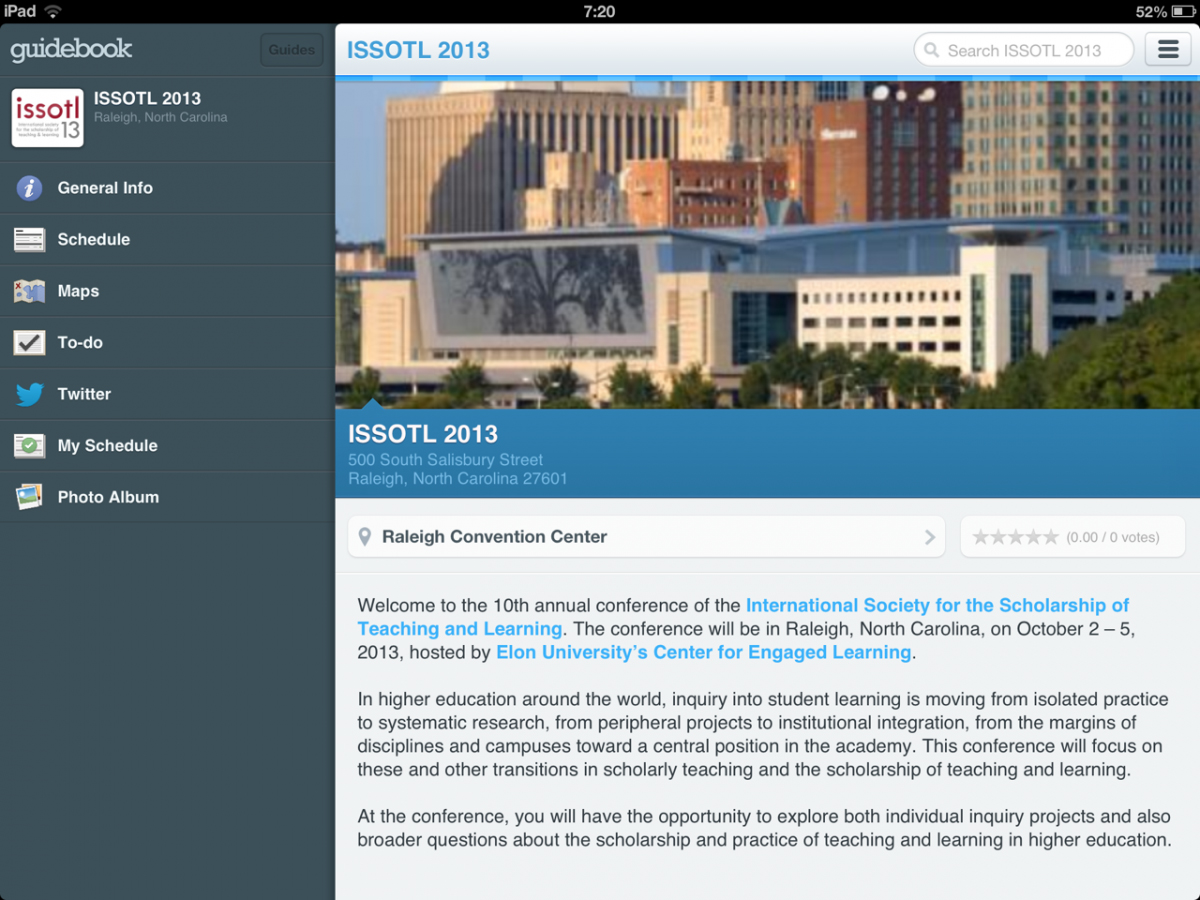
The conference organizers Peter Felten, Jessie Moore and Heidi Ihrig did a remarkable job in bringing together the traditions and values of the SoTL community with innovative ideas and emerging technologies. The conference was preceded by a free online series that featured videos, chats and discussion forums. During the event, participants were able to follow their personalized schedules on their mobile devices using the guidebook conference app.  At the same time, plenary presentations did not rely on Twitter-walls for interaction, but used buzz groups and other small group discussion formats to foster in-depth dialogue and deep processing.

 Schedule, planner and collective photo album: ISSOTL Guidebook App. Click image to enlarge.

Schedule, planner and collective photo album: ISSOTL Guidebook App. Click image to enlarge.

Wednesday, October 2: ‘The 8-track-tape Player of Opening Plenaries’

issotl 02For me, who like most participants did not book an additional pre-conference workshop or symposium, the conference started at 6:30 pm on Wednesday with the initial plenary session. The purpose of the plenary was to bridge from the online pre-conference to the live event, as the moderator Randy Bass (Georgetown University) jokingly explained: “This is not a task that anybody had to do a few years ago, and this is probably not a task that anyone will have to do a few years from now. We are the 8-track-tape player of opening plenaries.”  Continue reading

Students: Win a Trip to L.A. – Enter the IWitness Challenge – Deadline 12/2/13

i witness
Students across the country have already started working on their IWitness Challenge project sponsored by the USC Shoah Foundation – The Institute for Visual History and Education, but there’s still time for youngsters in your community to enter this free online program geared to all secondary-school students.

The deadline to enter the Challenge is Dec. 2, 2013. The winning student, along with their teacher and a family member will be brought to Los Angeles to showcase their work as part of the 20th anniversary activities for the Shoah Foundation, which was founded by director Steven Spielberg in 1994 after making “Schindler’s List.”

The IWitness Challenge (iwitness.usc.edu) connects students with the past in a very personal way that spurs them to take action to improve the future.

With access to many of the Shoah Foundation’s 52,000 testimonies of survivors, liberators and rescuers, students experience history in a way that hits home. Instead of reading facts from textbooks, students feel the emotions and build relationships with those who lived through seemingly impossible situations.

But students do more than watch the testimony. The IWitness Challenge compels them to think, to make smart choices and to create their own project and video from what they’ve learned. By encouraging teachers and students to create their own lesson plans, IWitness allows them to expand on practically any subject they wish to pursue. From civics, government and history to poetry, art and ethics, educators can tailor lessons appropriate for their classrooms.  Continue reading

VLC Media Player: Many Hidden Features

Chaz Baruela80By Chaz Baruela
Student, University of Hawai’i at Hilo

The first time I bought a laptop I used the default media player program, which is Windows Media Player. Unfortunately, there are some file types that do not work unless you download extra codecs for them. I didn’t want to download extra codecs, so I asked my friends what media player they use. That is when VLC media player was introduced to me. I have been using this program for the past five years, and in my opinion it is one of the best media players around.

VLC Media Player

VLC Media Player

First, the program is 100 percent free plus the download and install is quick and easy. When you install VLC, you don’t need to download extra codecs. Almost all video and music files such as mp4, mkv, avi, mp3, and ogg are playable as soon as VLC is installed. One classmate, Kai, commented on my post and said that he uses VLC media player to play flash video and matroska video files (Gilding). Another, Leleiohoku, said that she only found one movie that they couldn’t play (Stafford). My point is that VLC plays almost everything.

When you start up the media player, one of the first things you will notice is the interface. Reviews about how simple and attractive it looks are mixed. However, I think it is simple and has the basic functions covered such as a loop and a playlist. What you might not know is that there are some other “hidden” buttons that allow you to record, take a snapshot from a video, and a frame by frame button. I don’t see much use for frame by frame because all it does is stop the video and play it forward one frame at a time.  Continue reading

Language Is the Key to Community

Frank B. WithrowBy Frank B. Withrow

Human infants come into this world seeing, hearing, smelling, tasting and feeling the sensory world around them. The human culture developed the spoken word so that they could share private sensory experiences publicly. That enabled them to develop communities that built civilizations. About five thousand years ago mankind discovered that they could transform the spoken word into the written word. That enables mankind to transfer experience and knowledge over time and space.

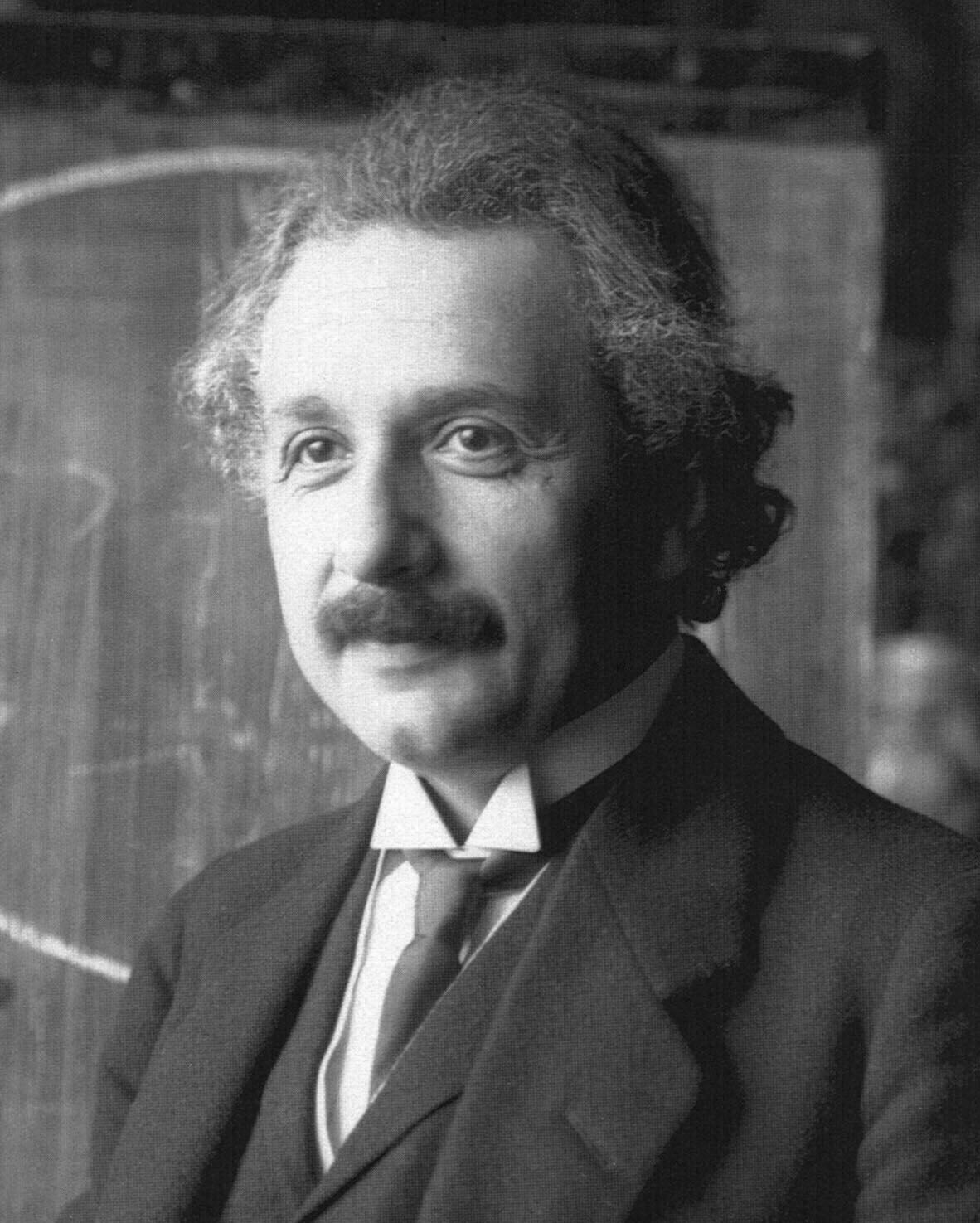
Albert Einstein

“Albert Einstein . . . felt the development of speech and language was one of mankind’s greatest accomplishments.”

I have been enjoying the thoughts and ideas about a peaceful world by a German Jew. They were written some eighty years ago as he worked at the League of Nations trying to avert World War II. He did not write in English so his original thoughts were in German and subsequently translated into English. He was very thoughtful in his deliberations. Among other things he felt technology would make us so efficient that there would not be enough work to employ everyone. He also felt the development of speech and language was one of mankind’s greatest accomplishments. I have been reading Albert Einstein’s papers of the 1930s.

We know our world through our sensory perceptions. They are the beginnings that are followed by words. There is an inherent desire by humans to communicate one with another. If our sensory perception are disabled we find a way around them to meet our needs to share. If we are deaf we use American Sign Language or lip-read. If we are deaf blind we learn touch signs. Even mentally slow children learn speech and language.  Continue reading

A Conversation with Curtis Ho: AACE E-Learn SIG on Designing, Developing and Assessing E-Learning

By Stefanie Panke
Editor, Social Software in Education

Dr. Curtis P. Ho is professor and former chair of the Educational Technology department at the University of Hawai’i at Manoa. His research interests comprise collaborative learning through distance education, instructional design strategies for teaching online, instructional technology standards in teacher education and the integration of technology into the curriculum. Dr. Ho serves on the executive committee for the AACE E-Learn conference (forthcoming in October 2013), where we co-chair a new Special Interest Group on Designing, Developing and Assessing E-Learning. Since we have never met in person (yet), I asked Curtis to comment on six statements related to assessment.

Curtis P. Ho

Curtis P. Ho

Statement 1: Authentic assessment is the “silver bullet” for deep, transfer-oriented learning – if only we knew how to do it right.

Curtis: Yes, I like the term “transfer-oriented learning” to define how we need to shape assessment. This is the gold standard for learning outcomes. After all, this is Robert Gagne’s 9th event of his Nine Events of Instruction. The challenge will be to create and implement authentic learning in an online course. How authentic can learning be if we are confining it to a 15-week semester at a distance?

Stefanie: I find David Jonassen’s work on problem solving (i.e., Jonassen 2011) a great starting point to think about the instructional design of assessment.

I am particularly interested in the design of assessment that fosters mastery orientation and offers gratification to performance-oriented learners. How can we make students want to improve and push themselves, and give them opportunities to shine and prove what they can do?

Statement 2: Assessment in online learning needs to move beyond multiple-choice quizzes in PowerPoint modules.

Curtis: I would generally agree. The ideal is to have authentic assessment at all times. However, multiple-choice quizzes may be useful in reinforcing short-term learning, and I see using this for self-check or practice. It may be used to scaffold lower level learning.

Continue reading