GIS Helps School District Extend Facilities Management Beyond the Physical Plant

By Jim Baumann
Esri Writer

The Garland Independent School District (GISD) is located in north-central Texas, adjacent to Dallas. The district encompasses approximately 100 square miles and serves the Dallas suburb cities of Garland, Rowlett, and Sachse. With an enrollment of about 58,000 students, it is the thirteenth-largest school district in the state of Texas.

The GISD has a “district of choice” policy. This policy allows parents to choose where their children will attend school, based on established criteria for ethnic balance. Annually, the district has a one-month selection period for both secondary and elementary schools. Once the selection period ends, the district’s Student Services department begins the process of assigning students to campuses based on building capacity, grade-level capacity, and seat availability. Other criteria, including campus demographic data, are considered before making the final decision on school placement.

To help with student travel and support the district of choice policy, the district’s GIS (geographic information system) department developed a Flex application for distance routing. With this application, officials can determine the location of a student’s home and local schools within the immediate vicinity.

Converting AutoCAD Files to Geospatial Data

Garland maintains 7 high schools, 12 middle schools, 47 elementary schools, and 2 pre-K schools, as well as a number of administrative offices and special use facilities. Managing these facilities for compliance with governing standards, current use, past maintenance data, and potential renovation or remodeling projects became increasingly difficult, and it was decided that an automated system was needed to prepare plans and data for quick and easy access.

For several years, the district used Autodesk’s AutoCAD for facilities management. The district’s AutoCAD facilitator, Kelli Daughtry, was responsible for converting all paper drawings into AutoCAD and maintaining facility floor plans during the district’s $385 million bond program. Approximately four years ago, the facilities department began implementing a GIS to be used in conjunction with AutoCAD. The district retains all facility floor plans in AutoCAD while using GIS to provide easy access to site plans, floor plans, room numbers, and data referenced to them.  Continue reading

Understanding the Brain, Flipped Teaching, Suicide Prevention, Common Core Shifts

inmynet

University of Chicago MOOCing in a big way… a free MOOC, Understanding the Brain: The Neurobiology of Everyday Life (Coursera), begins on April 28. According to Hannah Nyhart and Steve Koppes, “enrollment for [the] course has reached 27,000 and climbing” (“Neurobiology Online Course to Attempt World’s Largest Memory Experiment,” Medical Press, 4/23/14). Last fall, the university’s Asset Pricing MOOC enrolled 41,000 and Global Warming, 15,000.

Getting What You Pay For? A Look at America’s Top-Ranked Public Universities (ACTA, April 2014) is available for download. Here’s a quote from the 75-page document: “In a 2013 survey of over 300 employers, 93% of the executives responded that critical thinking, clear communication skills, and problem solving ability are more important to them than the undergraduate major. A majority called upon colleges to put more emphasis on writing, science, and mathematics, and over 40% called for greater emphasis on foreign language proficiency” (8). If you’ve been following studies such as this, you’re probably thinking, So what else is new. Seems the year is interchangeable, with the results remaining constant.

In an email conversation earlier this morning re this ACTA report, Harry Keller said, “At least in K-12 education, we should … merge these into a single curriculum that reaches into ELA, math, and science and that uses, as necessary, art, engineering, history, etc.” I agreed with Harry. The separation of subjects to fit schooling is unnatural. In the real world, they’re all part of a whole. Teachers have tried team teaching and interdisciplinary approaches to simulate an integrated approach, but these are always awkward and, IMHO, not sustainable. The integration has to be within the teacher. The implication for schools is flipped teaching — instead of teaching from the inside (classroom) out, they would be teaching from the outside (real world) in. This would also mean a whole new breed of teachers, with significant background in the arts and sciences as well as skill in bringing the different disciplines together in seamless learning activities in a way that’s similar to the project-learning approach.

Engaging College Students in Mental Health Awareness and Suicide Prevention (Kognito and Active Minds)… “a free one-hour webinar to discuss best practices for engaging and training students in gatekeeper skills” and suicide prevention. Scheduled for Wed, Apr 30, 2014, 4:00 PM – 5:00 PM EDT. A second webinar is scheduled for Fri, May 2, 2014, 2:00 PM – 3:00 PM EDT. Hopefully they’ll include a segment on detecting the need for help among students enrolled in online courses.

The Most Challenging Instructional Shifts in the CCSS for English/Language Arts (Education Week)… a free webinar with an emphasis on changing the way students think as well as instruction and administration. “Four of the most challenging shifts” are: Emphasis on Academic Vocabulary, Complex Text, Close Reading, and Greater Emphasis on Informational Text. Scheduled for May 1, 2014, 2 to 3 p.m. ET. As an online teacher, I’ve learned that the ability to read, correctly interpret, remember, and apply textual information is the most important skill for students in online classes.

Flipping Without Flopping: A Three-Year Study. Real Results (Echo 360)… a free webinar. Two separate sessions, May 8 for US/Europe at 11am EDT and May 14 for ANZ/Asia at 11am AEST. Review the research.

SoTL Commons 2014 in Savannah: ‘Teaching Without Learning Is Just Talking’

By Stefanie Panke
Editor, Social Software in Education

The 7th SoTL commons conference at Savannah, Georgia, was held from March 26-28, 2014. The annual event is organized by Georgia Southern University. SoTL commons is a small conference; the 2014 edition attracted around 180 participants. The majority of the participants came from small colleges and universities in the southern United States, though the event also had national reach with people from Wisconsin, Louisiana, and the Midwest, as well as a few international attendees from Colombia, South Africa, Sweden, Portugal and Nigeria.

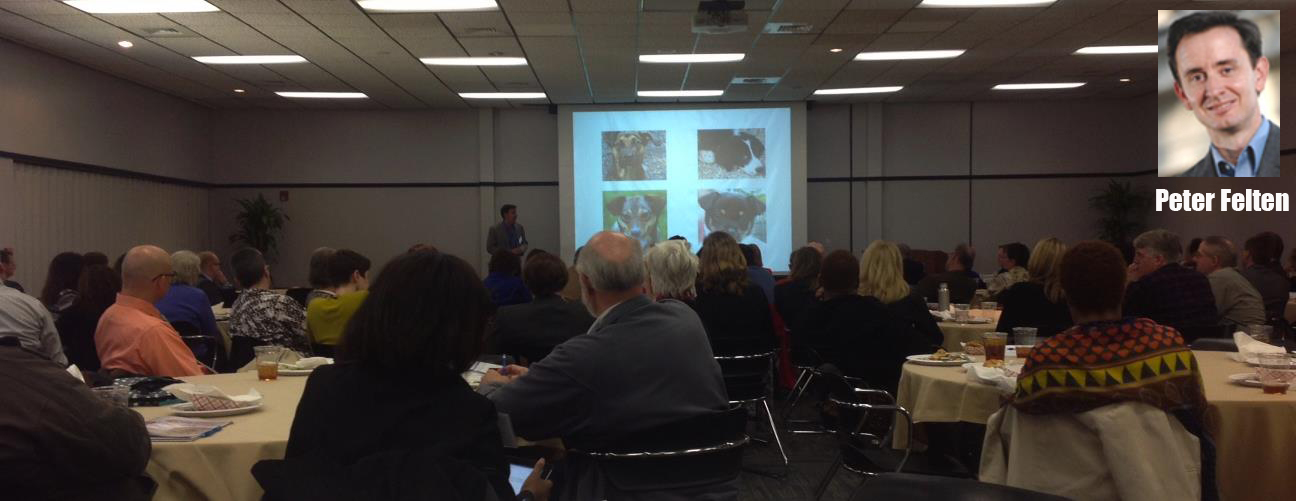
My personal conference highlight was the keynote by Peter Felten, Director of the Center for the Advancement of Teaching and Learning at Elon University. Peter used an amusing and powerful analogy to clarify the question that seems to be a crucial, non-negotiable ingredient of every SoTL gathering: What do we mean by Scholarship of Teaching and Learning?

Peter Felten: ‘Which mutt is the cutest?’ Can you give criteria for cuteness? How about criteria for excellence in SoTL?

Peter Felten: “Which mutt is the cutest?” Can you give criteria for cuteness? How about criteria for excellence in SoTL?

He  characterized SoTL as a mutt discipline — in contrast to the “best in show approach” of disciplinary research. Just as a show dog will be only appreciated by few experts in the breeding trade, disciplinary research often resides in the ivory tower. SoTL has the advantage of being widely accessible to a broader audience. However, it has to define its boundaries to be (accepted as) a scholarly discipline.
To this end, Peter presented five principles, which offer a heuristic framework to characterize any SoTL project:

  1. The inquiry is focused on student learning.
  2. The research is grounded in context — both scholarly discourse and local, organizational environment.
  3. The approach is methodologically sound.
  4. The project is conducted in partnership with students.
  5. The results are appropriately public.

These principles allow for common ground among SoTL inquiries, can help clarify and demystify SoTL to others and ultimately enhance the influence of SoTL. (For more details, see “Principles of Good Practice in SoTL.”)

The talk spurred a debate among the audience, in particular the absence of “teaching” as a perspective in the first principle. What if you are working with faculty to improve their teaching? Peter argued that ultimately every SoTL project aims at improving student learning and referred to Angelo and Cross (1993), who stated that “learning can — and often does occur without teaching but teaching cannot occur without learning; teaching without learning is just talking” (p.3 — see full text at ERIC).

Nancy Chick

Nancy Chick

Peter’s thoughts were taken up by Nancy Chick’s keynote address on the following day. She focused on the question “What is methodologically sound research in SoTL?” As editor of Teaching & Learning Inquiry, the new ISSOTL journal launched in spring 2013, Nancy was in a perfect position to highlight methodological aspects. What sets SoTL apart from disciplinary research is the variety of data sources scholars use to trace learning. Although SoTL projects comprise a wide range of theoretical, methodological, and empirical perspectives, it is crucial to find a good fit between research question and data sources.  Continue reading