



By Harry Keller
Former ETCJ Science Editor
& President of SmartScience
I live in a mountain town in Southern California. My home lies within an FS1 zone. That’s Fire Safety One, which means it has the most danger of being consumed by a wildfire.
My new home has fantastic views in all directions. The oaks, pines, and live oaks that are native to this area fill the view with green under an almost violet sky you have to see to believe. The pines and live oaks remain green year-round. Because we are situated on a steep slope at the edge of town, our views are unobstructed by neighboring houses. It’s like heaven at times.
The air is fresh at 6200 feet and so dry that summer heat and winter cold don’t feel as harsh as the thermometer suggests. We sit just above the edge of the Mojave Desert, and this wonderful dryness lends itself to fires.
Birds frolic in the trees, providing constant entertainment for those who enjoy nature. A bear visits us, as do some deer. My wife and I bought two adjacent lots and combined them for a total space of nearly half an acre. There are no homes behind us to the South. We built a trail up the hill on that side to more readily reach the local Acorn Trail leading up to the Pacific Coast Trail.
Every year, we worry about wildfires. In 2016, the Blue Cut Fire threatened our tiny town of about 5,000, but firefighters prevented it from reaching the homes. The townspeople are thankful for our firefighters who risk their lives to save our village.

I built my home to be fireproof. The first two floors of our four-story home have thick concrete walls that barely show on the South side and are completely exposed on the North side. The following two floors are sheathed in concrete panels that cannot burn. The roof is metal. Our deck uses a fire-resistant material, not wood. We had put in expensive insulation to protect against fire. I felt that fire could not scare me into evacuating.
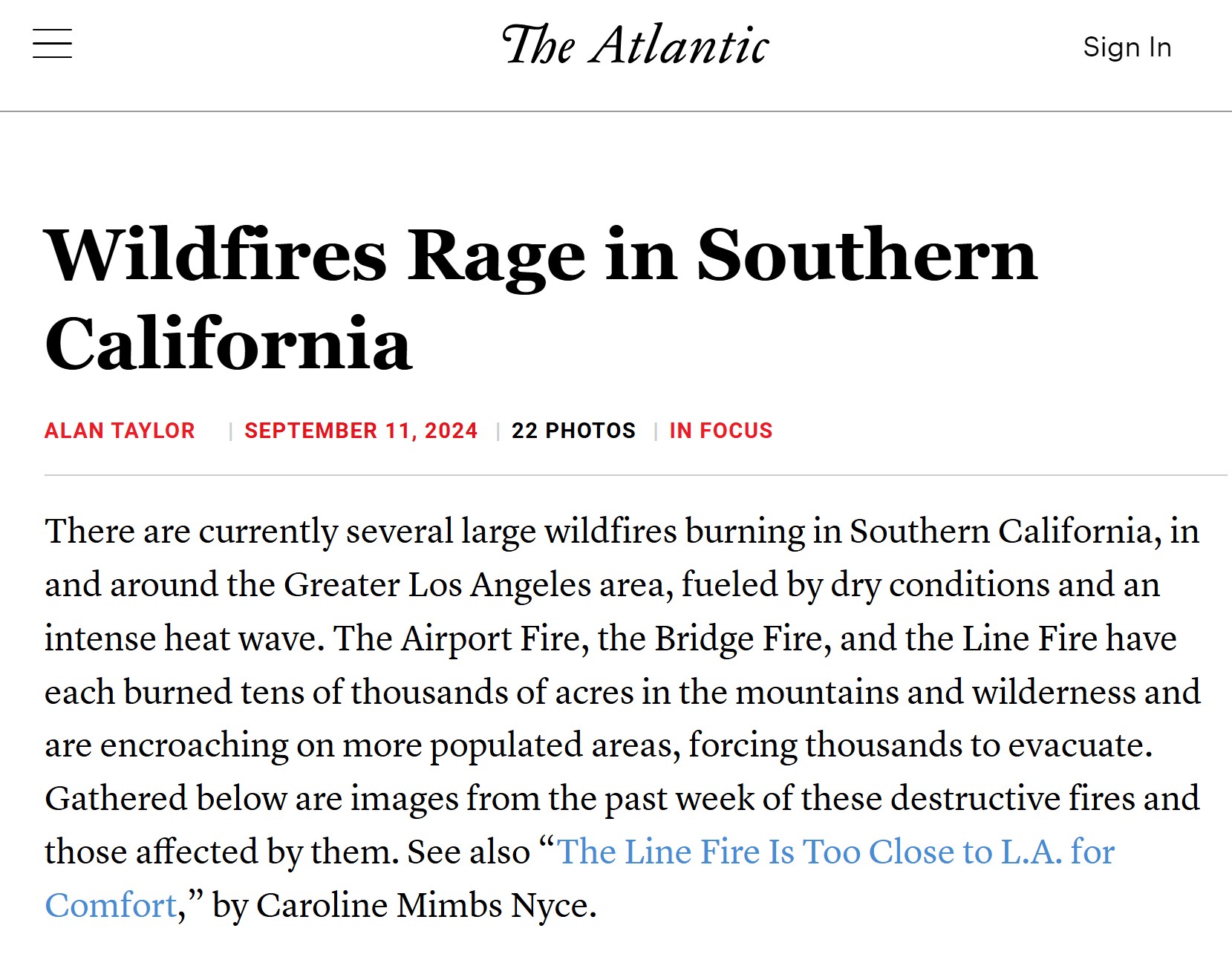
As wildfires broke out throughout California, I watched the reports carefully. The only fire in our area was the Bridge Fire, which was far to the west. I was relieved and continued to watch. This small fire suddenly grew from hundreds to thousands of acres in mere hours. That’s scary, and it was headed our way. Two days later, it arrived.
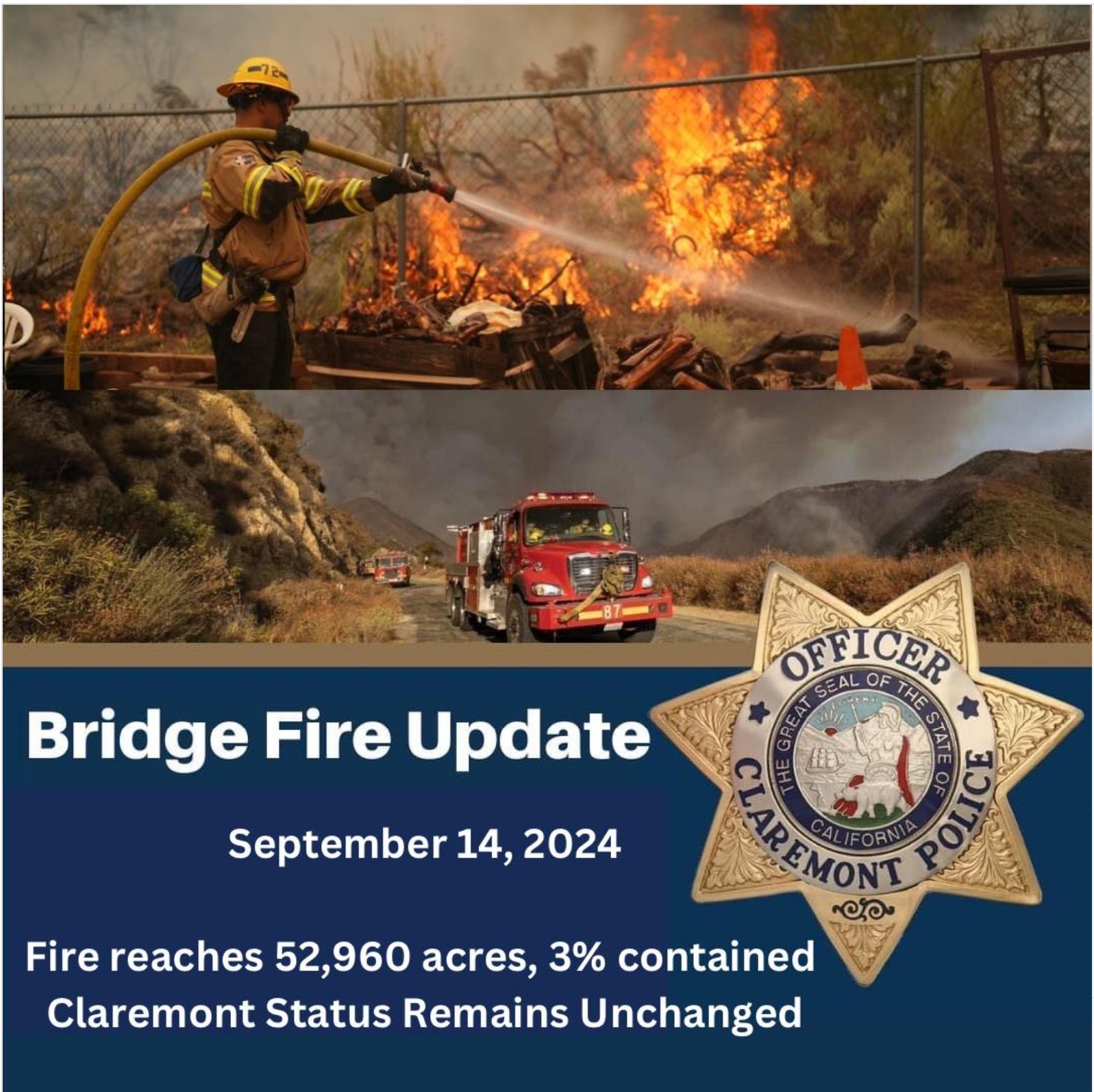
At the time, I was eating lunch with my wife 25 minutes from home. We went into the restaurant with no sign of the severe wildfires burning anywhere in the area. As we left, it looked like a sudden arrival of a weather front with dark clouds off toward home. We had eaten in the flat desert with the mountains where we lived in the distance. The high desert has an altitude of about 3,000 feet. As we drove, I realized that those clouds were not condensed water vapor but were smoke. I felt a foreboding. Could our town be on fire so quickly? I could not covey my trepidation to my wife, who has Alzheimer’s disease.
I can hardly describe the relief I felt when, after the climb up the mountainside, we arrived to find nothing indicating fire other than the smoke off in the distance, covering much of the sky to the southwest. We settled into our home and relaxed, unaware of the speed with which this fire was moving. I received some evacuation warnings on my phone but did not worry. Then, a sound truck passed by, blaring out warnings to evacuate. Still, I did not panic. Instead, I watched television until around 3-4 pm; the sky darkened so much that I had to turn on the lights in the house to see where I was going. Upon stepping outside and looking up, I was treated to a Hadean red sky, a dark, ominous red that seemed like a warning. “Get out,” it screamed at me. I was deaf to this warning. The fire wasn’t near, even though the smell of the smoke afflicted my olfactory nerves.
Your imagination and my writing skills can hardly explain what happened next after about an hour of reddish darkness. The change was quick and extreme. The darkest red suddenly gave way to bright yellow. You could have stepped outside and read a book by this light. The murky scene of our neighborhood transformed as if by magic into stark relief as though someone had turned on a hillside full of bright yellow searchlights.
What could cause such a transformation? I didn’t know, but I guessed. The fire was just over the south hillside. That was my impression. It may have been premature, but it panicked me. I ran around the house grabbing our few treasures, the cat (along with a litter box and cat food), and some underwear. I had just enough for three days. I tossed everything helter-skelter in the car, escorted my wife to the car, and took off. I left behind many valuables and memories. That yellow-clouded sky truly spooked me. So did the ash falling from the sky. Why didn’t I take more? Two reasons. I was in a hurry and had no time (in my mind) to pack. Also, I could buy necessities once I settled in, and three days seemed long enough to settle down.
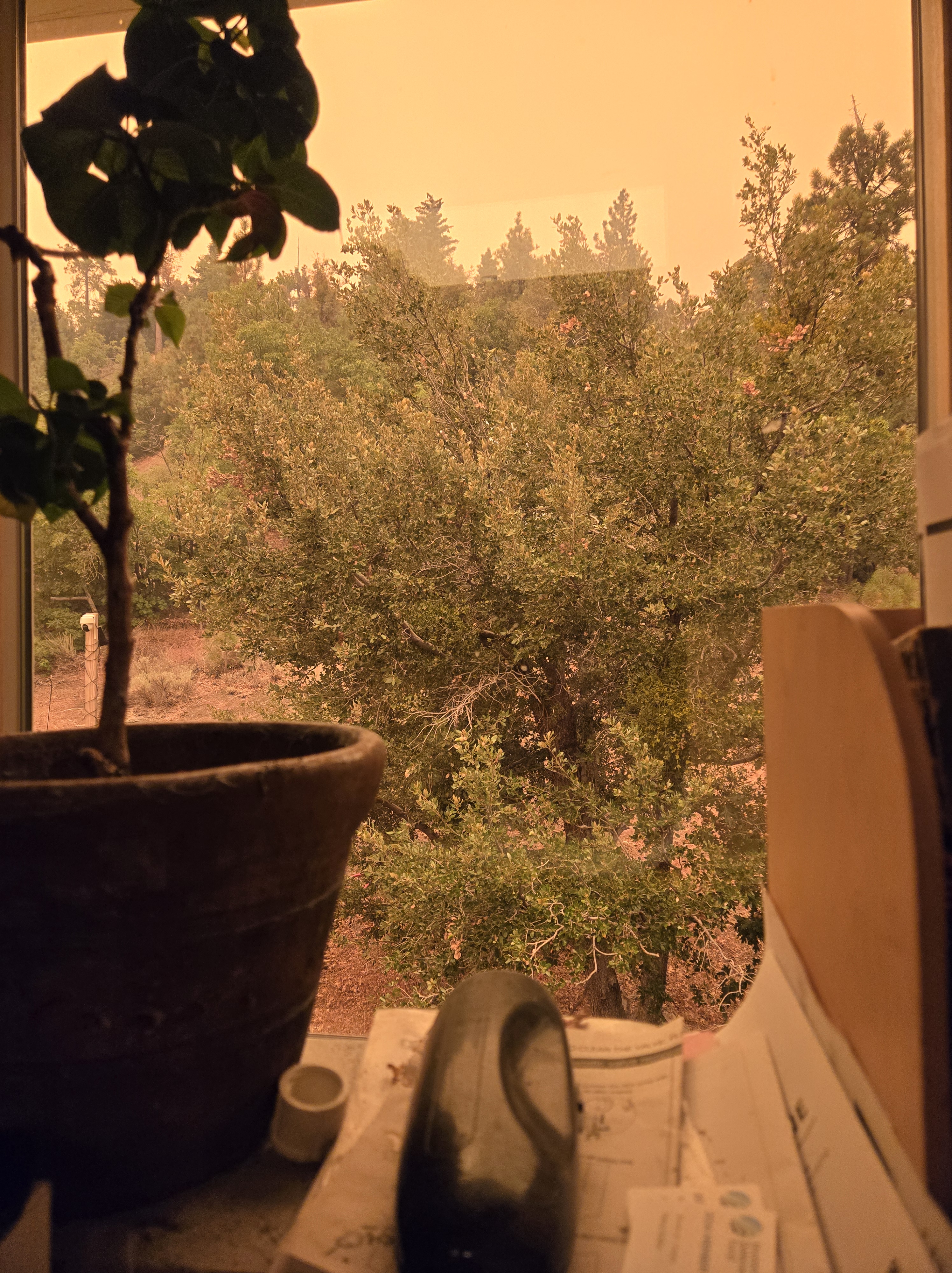
I had to leave the aquarium and my desk plant behind. An aquarium weighs so much that I couldn’t lift it. The fish in it are rescue fish. We rescued two goldfish from the pond in a cottage we rented for twelve years. We once had over twenty goldfish in that pond with an initial population of five “feeder fish.” Raccoons had decimated the population, and only two were left when we moved from that cottage. One is about nine inches long (the male). The other is about six inches.
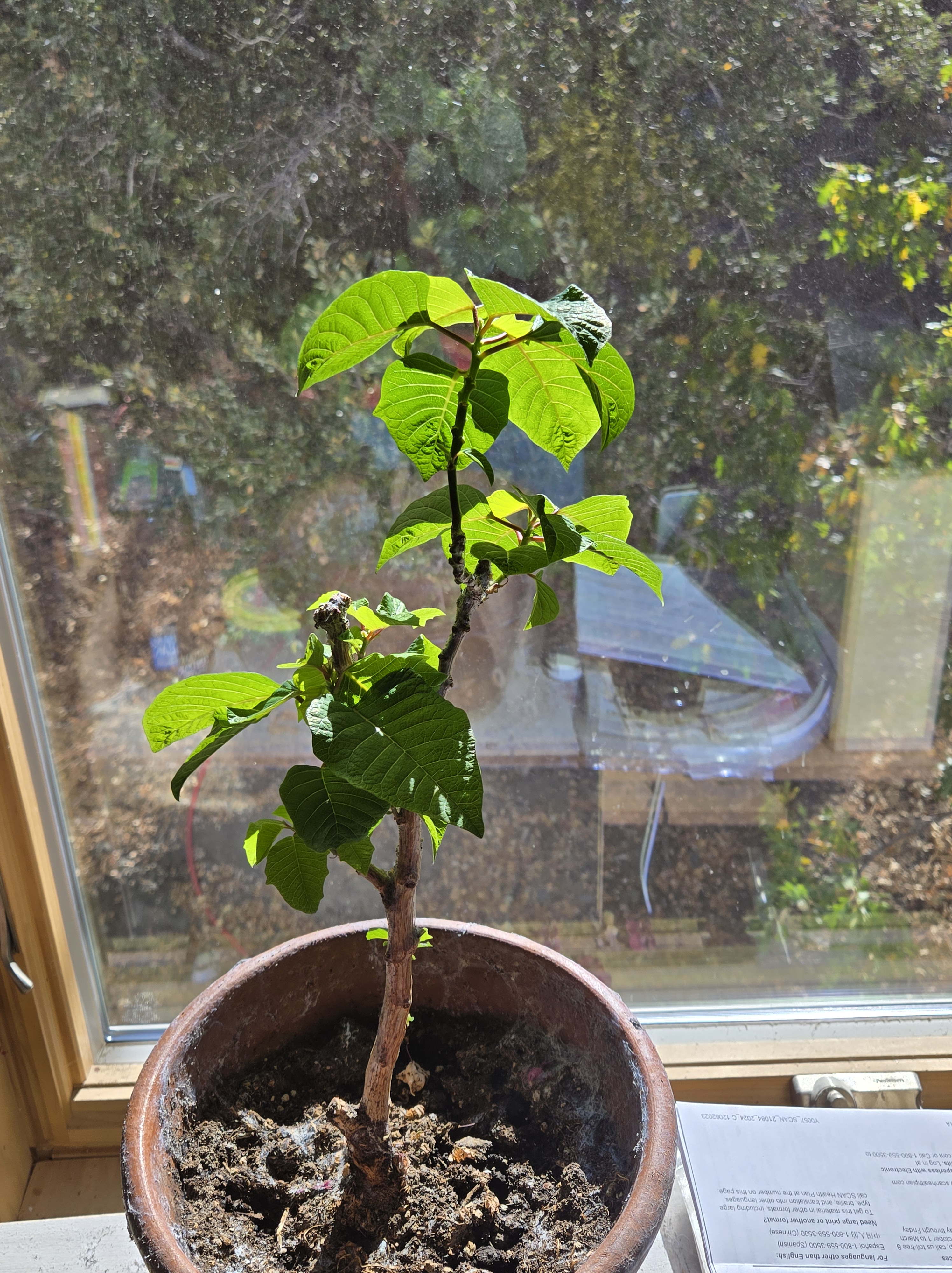
The desk plant is a rescue plant, one of those Christmas poinsettias. I repotted it and set it on my desk in our new home to brighten the room. I had been fighting scale insects that infested it for two years. I watered it daily and added some fertilizer about four times a year.
I thought I’d be back soon enough to avoid the loss of the fish and plant. On the road, I had no idea where I was going. Getting out was my only concern. There were only two roads out of town. I took the larger one. The two-lane road was jammed with traffic moving slowly. The incoming lane punctuated our exodus with emergency vehicles of many descriptions, their lights flashing. These kept coming and coming. “Wow,” I thought, “This is serious.”
When we reached the end of our road, the sheriff’s personnel blocked access back into the town. I had to choose a direction, and I chose where my two children lived at the beach. I might as well be near family. Where were we going to stay? I called my son to tell him I was safe and on the road. He offered his spare room for that night, and I gratefully accepted. Two hours on the road saw us arriving at his beachside home. I saw more emergency vehicles heading up to my town during the ride.
My daughter came over, a ten-minute ride from her home. She had reserved and paid for four nights at a local upscale hotel. I love my children.
I soon learned to scan the internet for information about the fire and road closures. I located my home on the map and watched as the fire advanced in its direction. I could make out the small trail my wife and I had built a few years earlier and the flat area where it ended. Every time I saw the fire advance in my direction, I had a sinking feeling in my gut. I felt a slight sense of jubilation whenever it did not advance toward my home.
It took eight days for the authorities to open the roads back into my town. During those days, we moved three times. We first moved from my son’s beachfront apartment to the residence hotel nearby. After four nights, we were unable to extend our stay. The front desk said, “Fully booked.” We had little problem finding another place that accepted pets about a mile away, but I encountered an issue that had never occurred to me — the gap between checkout and check-in times. Four hours. We found a decent place to eat lunch and use some of that time. When we arrived, we checked into a room without waiting until the posted check-in time. I was relieved. We had another such episode when we could not extend our stay for the same reason.
Every one of these hotels had a full kitchen. We could cook our meals if we had the food. In addition to obtaining some minimal clothing and toiletries, I had to do grocery shopping. Our first hotel was only about 100 yards from a Target store (plus traversing the large parking lot). I walked to it with my wife twice to obtain all we required. The second hotel was a slightly longer walk from Trader Joe’s. My frail wife had to stop on the way back to rest, but we had a successful trip. The last hotel required us to shop at a Ralph’s in a somewhat blighted neighborhood. The walk was three-quarters of a mile in each direction. My wife, surprisingly, had no problems walking to the store, but she had to stop twice on the return.
Living in luxury hotels may seem wonderful to some, but it becomes dull and even unpleasant long before that week plus one day is over—food, clothing, toiletries, and nothing to do. We were happy to return to an unscathed home. I immediately checked the fish. Despite having no food for eight days, they were swimming about nonchalantly. I fed them right away. The clocks on the various appliances showed the correct time. I was astonished that we had not lost power for even a second.
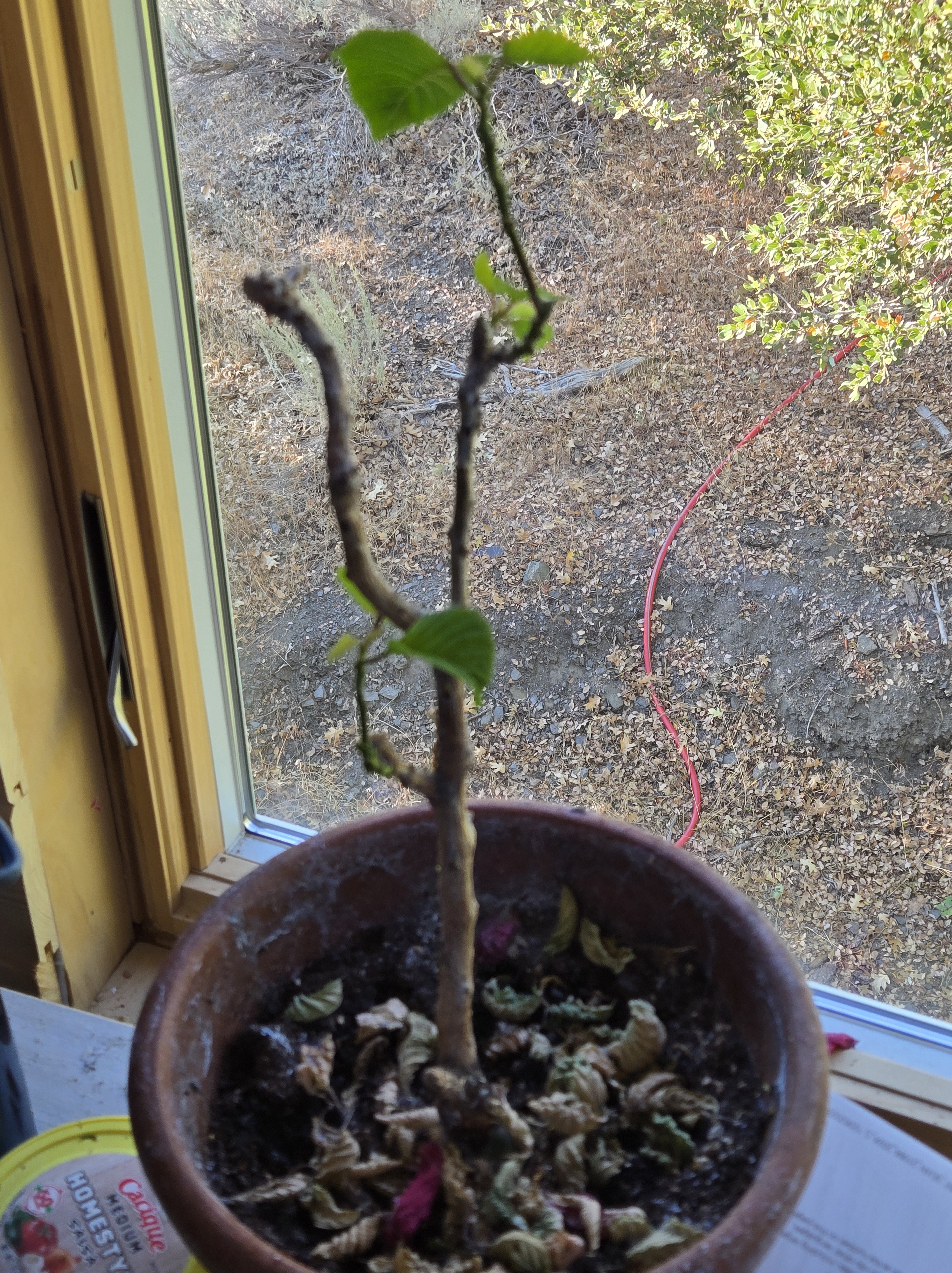
My poor poinsettia on my desk looked dead. I crossed my fingers and watered it. The food in the refrigerator was all good, even the fresh vegetables. It was almost as if we hadn’t left. The next day, I climbed our trail to see how close the fire had come. Right behind our property, a fire break had been dug. As I climbed the trail (about a ten-minute hike), numerous bootprints tattooed the dirt, and the grass growing there was trampled down. The firefighters had used our trail! At that moment, I felt I had helped stop the fire too. A short distance past the top of the trail, I could see gray areas of ground where the ground cover had been burnt to ash.
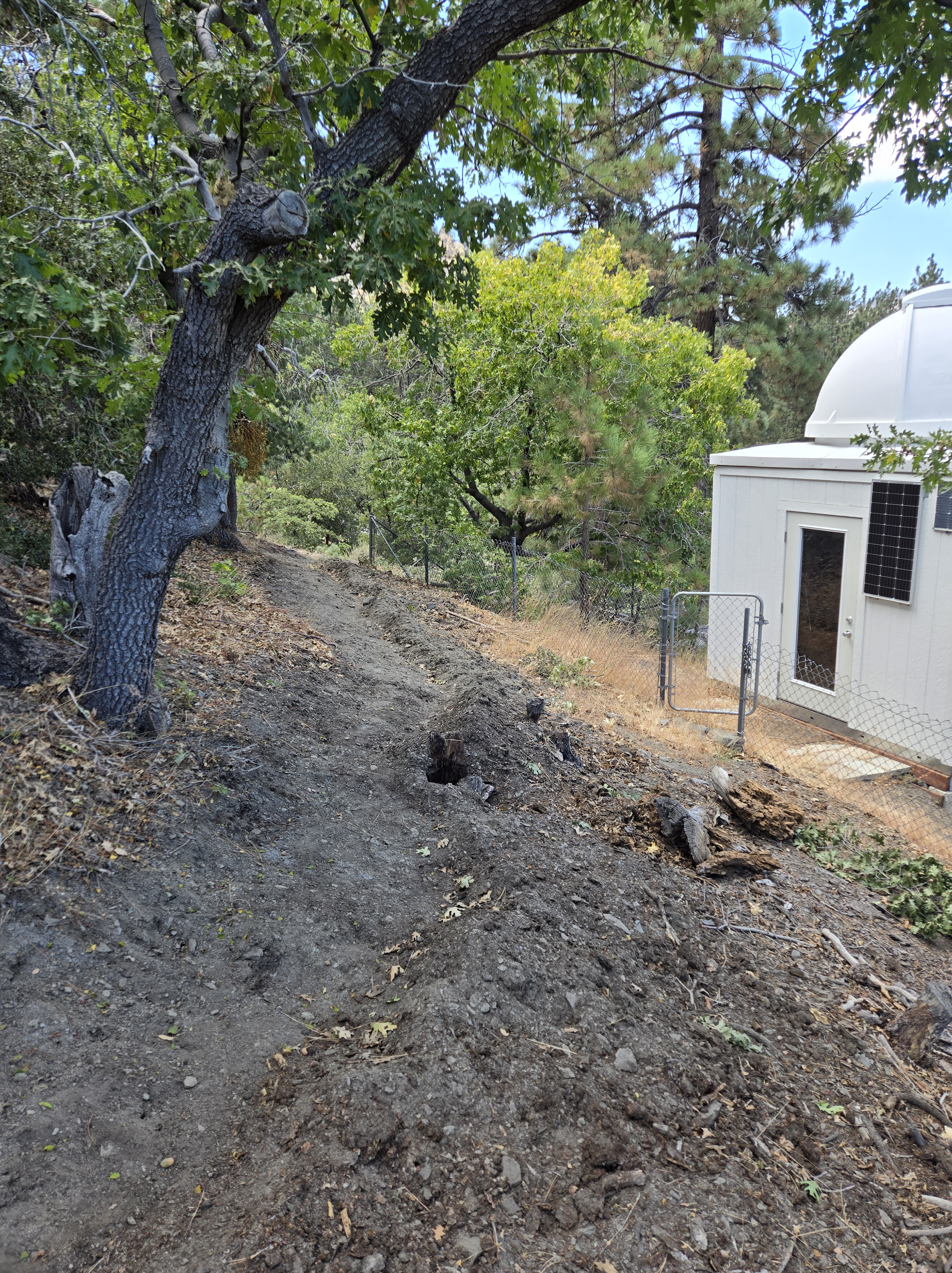
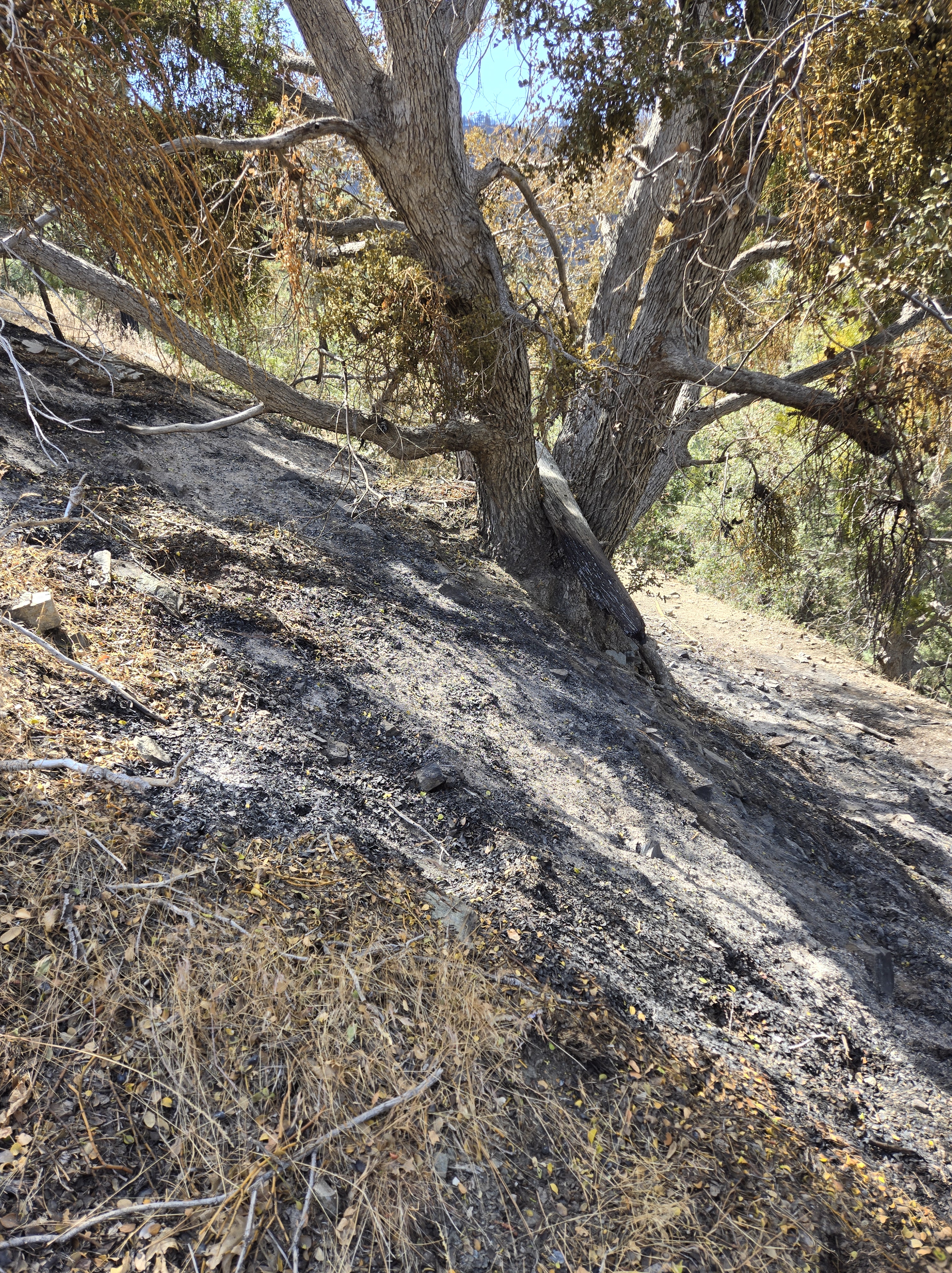
The fire’s advance had been halted by those amazing firefighters a bit over 100 yards from our property. Few trees had been burned. We could see no fire damage to the forest from our home.
The poinsettia has recovered. I trimmed it back from its excessive lanky appearance after three years in a pot. The good news is that the scale insects plaguing that poor plant for years have disappeared. They died when the plant suffered its eight-day drought.
The bad news is that the fire destroyed thirteen homes in our town. My heart goes out to those families. I hope they had good insurance. I had just closed on my insurance policy two weeks before the fire.
I sincerely hope no one reading this ever has to evacuate their homes. It’s an experience you can miss and should be on no one’s “bucket list.”
Filed under: Uncategorized |


 Educational Technology and Change Journal

An old Gaelic gambit, occasionally used humorously in letters, reads as follows: …. I begin in the hope that this epistle finds you on the ‘right side’ of the grass …
In a convoluted way it came to mind as I read your article, reverberating in Jungian recesses, to the background music of Johnny Cash singing ‘Ring of Fire’.
What a wonderfully exciting yet calmly inspiring and existential story of life in California today. Thank you, Mr Kellar.
SP … Mr Keller !
Great job! This post was really informative.