


By Jim Shimabukuro (assisted by ChatGPT-5)
Editor
Why We Need a New Term
In the world of e-commerce, we talk about “marketplaces,” “platforms,” and “fulfillment networks.” But these words miss the bigger picture: online shopping isn’t just about finding products — it’s a tightly connected loop of searching, purchasing, and delivering.
That’s why I’m introducing SBS™ — Shop · Buy · Ship. It’s a simple but powerful framework for understanding the entire commerce cycle, whether it’s controlled by one company or spread across many.
What Is SBS?
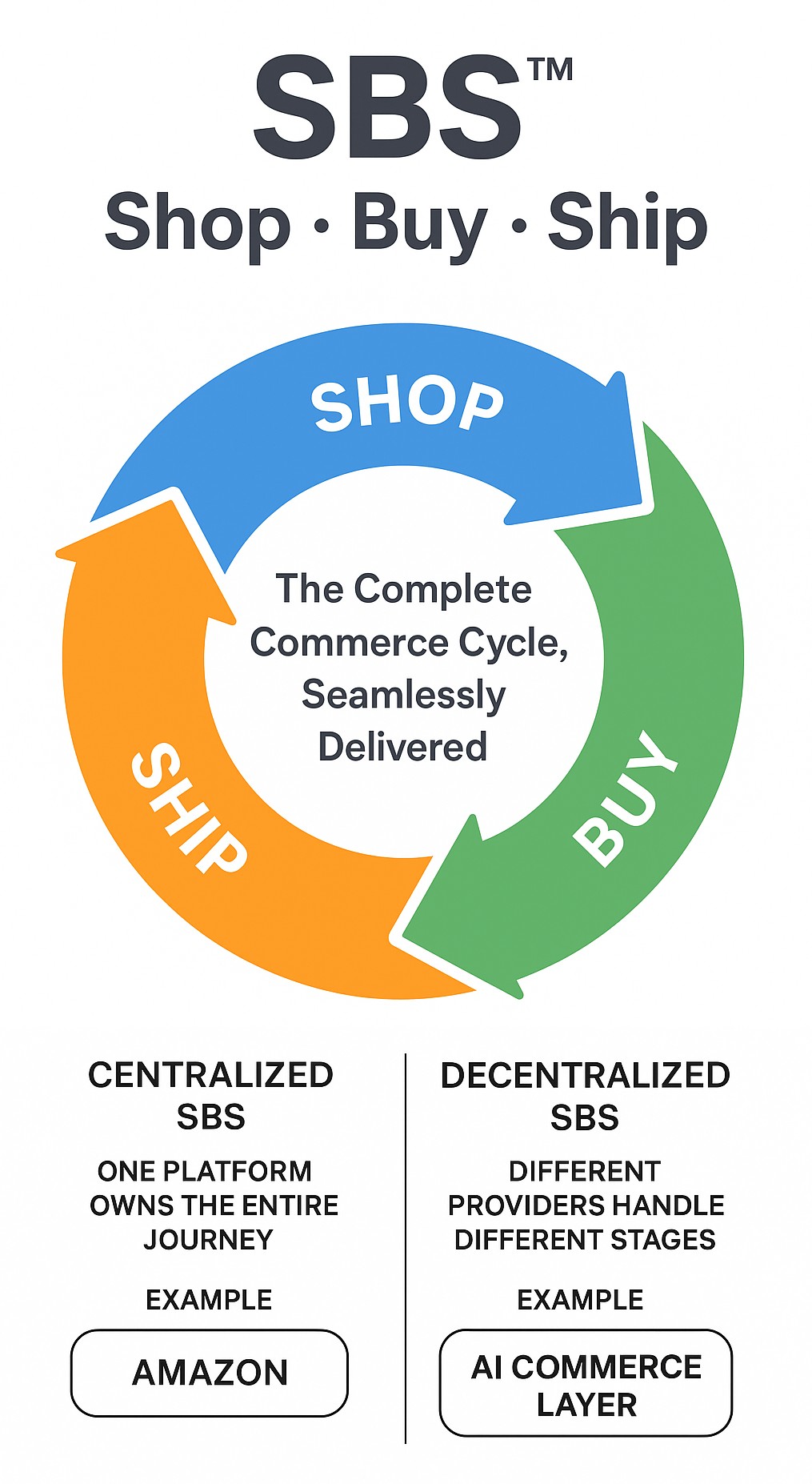
SBS™ (Shop · Buy · Ship) is the integrated process that defines how consumers discover products, pay for them, and receive them.
In an SBS model:
- Shop — Discovery through search, recommendation engines, or curated storefronts.
- Buy — Transaction and order confirmation, including payment and fraud protection.
- Ship — Fulfillment and delivery to the buyer’s chosen location.
The SBS process can be:
- Centralized SBS — One company owns the entire loop from shop to ship. Example: Amazon, where product search, payment, and delivery all happen inside a single platform.
- Decentralized SBS — Multiple independent providers handle each stage, coordinated through a common interface or AI layer. Example: A shopper finds a product through an AI commerce engine, pays via Stripe, and ships via ShipBob — all within the AI commerce engine and outside of Amazon’s ecosystem.
Centralized vs. Decentralized SBS
| Feature | Centralized SBS | Decentralized SBS |
|---|---|---|
| Control | One platform owns the entire journey | Different providers handle different stages |
| Data ownership | Platform keeps all customer data | Sellers retain more direct customer relationships |
| Consistency | Uniform experience (returns, delivery times) | Variable, but can be customized |
| Speed | Highly optimized logistics | Dependent on coordination quality |
| Innovation | Controlled by platform | Driven by multiple players |
Why SBS Matters Now
E-commerce is at a turning point. For two decades, centralized SBS giants like Amazon have dominated because they offer convenience and trust. But new technology — especially AI — is opening the door for decentralized SBS orchestration.
Imagine telling your AI: “Find me the best combination of price, delivery time, and environmental impact for a new laptop.”
In milliseconds, the AI could:
- Search dozens of independent retailers.
- Compare prices, warranties, and reviews.
- Arrange payment and shipping using different providers.
- Bundle related items (like accessories) into a single, seamless order.
The buyer wouldn’t care where each part came from — only that it was exactly what they wanted, delivered exactly how they wanted it.
SBS as a Commerce Layer
The real shift isn’t just “online shopping” vs. “in-store shopping.” It’s who controls the SBS layer:
- In centralized SBS, you adapt to the platform’s rules.
- In decentralized SBS, the platform (or AI orchestrator) adapts to your needs.
The Future of SBS
In the coming decade:
- AI will be the SBS conductor — integrating multiple shop, buy, and ship sources into one tailored experience.
- Centralized giants like Amazon will still exist — but as sources within decentralized SBS ecosystems, not the gatekeepers.
- “SBS optimization” will become a recognized business strategy, just like SEO is today.
How You Can Use SBS Thinking
Whether you’re a retailer, logistics provider, or tech innovator:
- Map your SBS chain — Who controls shop, buy, and ship in your current model?
- Look for decentralization opportunities — Where could you plug into a larger SBS ecosystem?
- Design for AI integration — Assume your future customers will shop through intelligent SBS orchestrators.
Final Word
The commerce world has been talking about “marketplaces” and “fulfillment” for decades — but we’ve never had a clean, universal way to describe the full consumer journey from desire to doorstep.
SBS™ — Shop · Buy · Ship is that language.
Use it. Share it. Build with it.
The future of commerce depends on understanding the loop — and deciding who controls it.
You are free to reference this definition with attribution. SBS™ is introduced here as a conceptual framework for industry and academic discussion.
Filed under: Uncategorized |


 Educational Technology and Change Journal

Leave a comment