





By Jim Shimabukuro (assisted by Claude)
Editor
(Also see The AGI Among Us, Close to You, Tea With Bachan: An Alien Lesson, Oregon Trail: Where Two Cultures Collaborate)
Introduction: For an insight on how this story came to be, see Basic Building Blocks for a Learning Model. -js
Marcus Chen had always approached life like a well-designed algorithm. As a data scientist for a tech startup, he found comfort in patterns, predictions, and logical sequences. So when his coworker Priya finally wore him down about trying online dating, he approached it with the same methodical precision he brought to machine learning models.
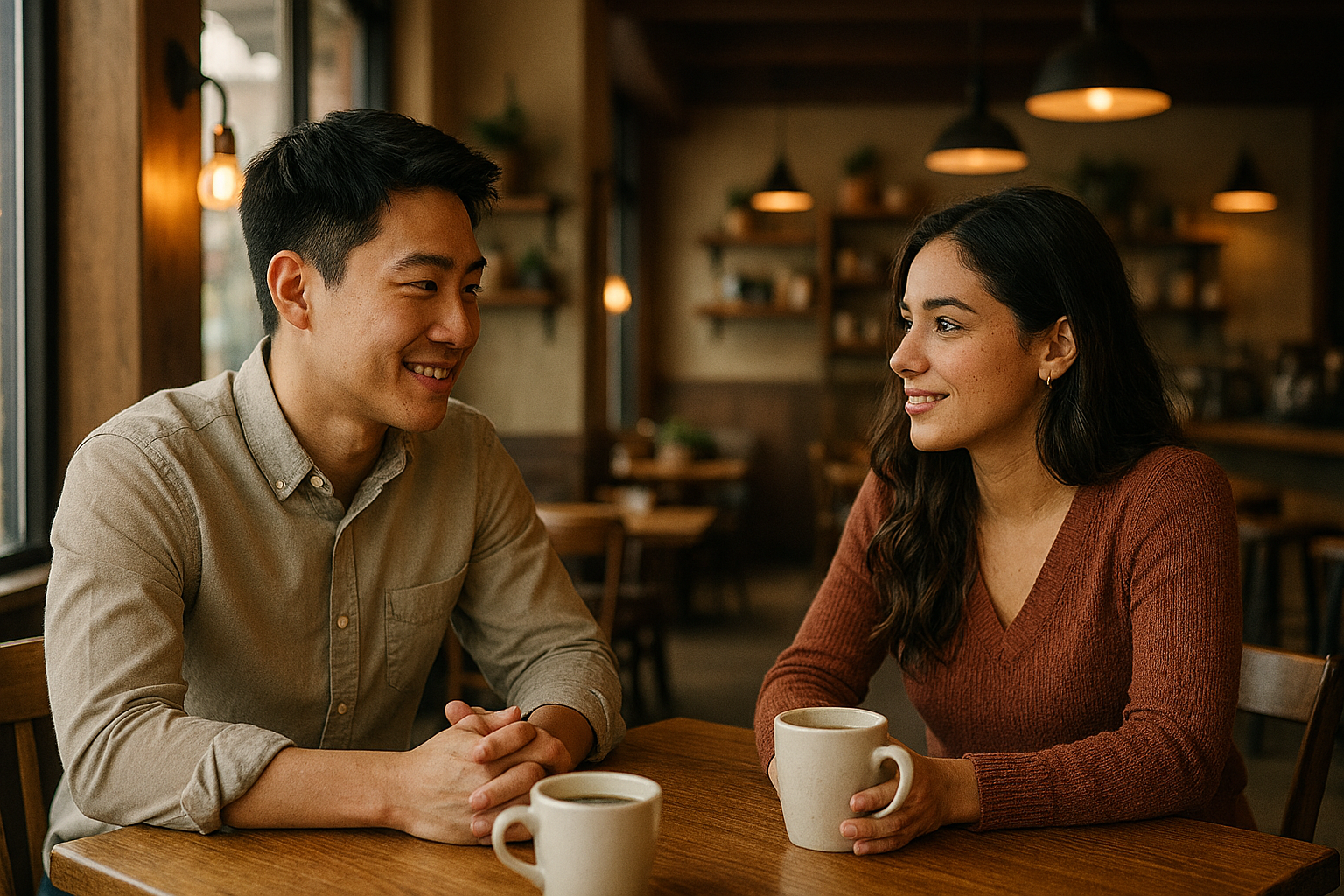
“You can’t optimize romance like it’s a recommendation engine,” Priya had laughed, watching him scroll through profiles with the intensity of debugging code.
“Watch me,” Marcus had replied, already mentally categorizing potential matches based on education level, shared interests, and photo composition quality.
That’s how he found himself on a Tuesday evening, sitting in Grind Coffee on Fifth Street, waiting for someone named Elena Rodriguez. Her profile had checked all his predicted compatibility boxes: environmental science PhD, hiking photos, thoughtful responses to prompts, and what his pattern-recognition brain had classified as “intelligent eyes” in her pictures.
He’d predicted she’d be soft-spoken, maybe a little nervous—the academic type who was more comfortable with research than small talk. He’d prepared conversation starters about climate data and had mentally rehearsed his own best stories, the ones that usually landed well with analytically-minded people.
At exactly 7:00 PM, the coffee shop door chimed, and Marcus looked up from his phone to see a woman scanning the room. But instead of the reserved wave he’d predicted, she strode directly toward him with the confidence of someone used to commanding lecture halls.
“Marcus?” She extended her hand with a firm grip that immediately recalibrated his expectations. “Elena. Hope you weren’t waiting long.”
“Not at all,” he managed, standing quickly. She was prettier than her photos—which his brain immediately flagged as statistically unusual—with dark hair pulled back in a way that suggested efficiency over vanity, and laugh lines that hinted at someone who smiled more than his predictive model had accounted for.
“Great choice on the venue,” she said, glancing around at the exposed brick walls and the gentle hum of conversation. “I was worried you’d pick one of those places where you can’t hear yourself think.”
Marcus felt his confidence settle back into place. This was going according to script. “I figured somewhere low-key would be better for actually talking.”
“Smart man.” Elena grinned, and something about the way she said it suggested she wasn’t easily impressed by obvious choices. “What’s good here? I’m thinking something with enough caffeine to power through whatever awkward first-date small talk we’re about to endure.”
His prediction algorithms stumbled. Where was the polite demurring? The careful questions about his preferences? Instead, she was already heading to the counter with an easy assumption that he’d follow.
“Two lattes?” he suggested.
“Make mine a cortado,” she told the barista, then glanced back at him. “And whatever this guy’s having, but make his decaf. He looks nervous enough already.”
Marcus blinked. “I’m not nervous.”
“Uh-huh.” Elena’s eyes sparkled with mischief. “Then why did you check your phone three times while I was walking over?”
She’d been watching him before introducing herself. This was… unexpected. His mental model began making rapid adjustments: not shy, highly observant, comfortable with direct confrontation, uses humor to defuse tension.
They found a table by the window, where golden hour light painted everything in warm amber. As they settled in, Marcus prepared to launch into his usual getting-to-know-you routine, but Elena beat him to it.
“So, data scientist,” she said, wrapping her hands around her cup. “Let me guess—you’re going to tell me about how you’re using machine learning to revolutionize something that probably worked fine before.”
Marcus paused, his prepared elevator pitch dissolving. “That’s… actually pretty accurate.”
“It’s always accurate. You tech guys have the same origin story.” She leaned forward, genuinely curious now rather than teasing. “But what do you actually do? Like, day to day, when you’re not revolutionizing things?”
The question was simple, but something in how she asked it—like she actually wanted to know, not just to fill conversational space—made him reconsider his standard response.
“Right now I’m working on predictive models for urban traffic patterns,” he said. “Trying to figure out how to reduce congestion without making people’s commutes completely miserable.”
“Okay, now that sounds useful.” Elena nodded approvingly. “How do you account for human unpredictability? I mean, people don’t just take the most efficient route. Sometimes they take the scenic route, or avoid the street where their ex works, or make random stops for ice cream.”
Marcus found himself leaning forward too. Most people either glazed over when he talked about work or asked generic questions about whether robots would take over the world. But Elena was asking about the actual challenge that kept him up at night.
“That’s exactly the problem,” he said, feeling his enthusiasm build. “Traditional models assume rational actors making optimal decisions. But humans are beautifully irrational. They make choices based on mood, memory, random impulses…”
“Beautifully irrational,” Elena repeated, smiling. “I like that. In ecology, we call it ‘stochastic behavior’—random variations that actually serve important functions in complex systems.”
“Like mutation in genetic algorithms,” Marcus said, then caught himself. “Sorry, I—”
“Don’t apologize. Genetic algorithms are fascinating. We use them in climate modeling.” Elena took a sip of her cortado. “Though I bet your dating profile didn’t mention that you think humans are beautifully irrational.”
Heat crept up Marcus’s neck. “My profile is… more traditionally optimized.”
“For what? Maximum swipe-right probability?”
“Something like that.”
Elena laughed—a genuine sound that made other patrons glance over with unconscious smiles. “And how’s that working out for you?”
Marcus considered deflecting, giving some safe answer about meeting interesting people. But something about Elena’s directness made traditional deflection feel inadequate.
“Honestly? Terrible. I’ve been on maybe fifteen dates in the past six months, and none of them led to a second date.”
“Ouch.” Elena winced sympathetically. “What went wrong?”
“I’m not sure. I mean, I researched optimal conversation topics, practiced active listening techniques, chose venues with good ambiance and acoustic properties for dialogue…”
Elena was staring at him with a mixture of amusement and something that looked like anthropological fascination.
“You researched conversation topics?”
“Well, yeah. I found studies showing that shared experiences and values-based discussions create stronger emotional connections than surface-level exchanges about work or weather.”
“Marcus.” Elena set down her cup carefully. “Please tell me you didn’t actually reference academic studies on dates.”
“Not… directly.”
Elena buried her face in her hands, shoulders shaking with suppressed laughter. “Oh my god, you did.”
“It was subtle!” Marcus protested. “I just mentioned that I’d read how couples who try new experiences together report higher relationship satisfaction, and suggested we could maybe go rock climbing sometime.”
“On the first date?”
“It was a logical progression—”
Elena’s laughter finally broke free, bright and infectious. “You beautiful, ridiculous man. You turned romance into a research project.”
Something about being called ‘beautiful’ and ‘ridiculous’ in the same sentence made Marcus’s chest tighten in an unfamiliar way. “I prefer to think of it as applying proven methodologies to optimize outcomes.”
“How’d that work out for date number seven? Or twelve?”
Marcus slumped slightly. “Point taken.”
“I’m sorry,” Elena said, though she was still grinning. “I’m not laughing at you, exactly. It’s just—you’re so earnest about it. Like you genuinely believe you can solve dating with the right algorithm.”
“Can’t you?”
Elena considered this seriously, her expression shifting from amusement to something more thoughtful. “Here’s the thing about complex systems—and people are definitely complex systems. The more variables you try to control, the more likely you are to miss the emergent properties that actually matter.”
Marcus felt his brain light up. “Emergent properties?”
“Mmm.” Elena traced the rim of her cup absently. “Like, you can analyze all the individual components of an ecosystem, but you can’t predict how they’ll interact until you observe the system as a whole. Chemistry, essentially. The thing that happens between elements that’s greater than the sum of their parts.”
“So you’re saying dating is like… ecosystem dynamics?”
“I’m saying maybe instead of trying to optimize for compatibility, you should focus on creating conditions where interesting interactions can emerge.”
Marcus was quiet for a moment, processing this. Around them, the coffee shop hummed with its own ecosystem of interactions—the barista chatting with regulars, a couple sharing earbuds at a corner table, a group of students debating something with passionate intensity.
“What about you?” he asked finally. “Do you approach dating like… ecological fieldwork?”
Elena snorted. “God, no. I’m terrible at dating. I usually end up talking about soil microbiomes or carbon sequestration until their eyes glaze over.”
“That sounds fascinating, actually.”
“See, that’s what’s weird about you.” Elena tilted her head, studying him with new interest. “Most guys say that, but they’re just being polite. You actually mean it.”
“Well, yeah. I mean, soil microbiomes are basically distributed computing networks operating at microscopic scales. How is that not fascinating?”
Elena’s expression shifted again, something warming behind her eyes. “Okay, now I’m curious. What else do you find genuinely interesting that most people think is boring?”
Marcus felt himself relaxing into more honest territory. “Traffic patterns, like I mentioned. But also the way people organize their kitchens—there’s so much psychology embedded in those decisions. Or how different cultures approach queuing systems. Or why certain songs get stuck in everyone’s head at the same time.”
“Memetic transmission,” Elena said immediately. “Ideas spreading through populations like viral patterns.”
“Exactly! And the way social media algorithms amplify certain memes over others creates these weird cultural feedback loops…”
They talked for another hour without either of them noticing the coffee shop emptying around them. Elena told him about her research on urban forest canopy and its effects on neighborhood social dynamics. Marcus explained how recommendation algorithms were accidentally creating cultural filter bubbles. Elena described the hidden fungal networks that allow trees to share resources and information. Marcus talked about the emergence of cooperation in game theory simulations.
At some point, the conversation turned to travel, and Elena mentioned a research trip to Costa Rica where she’d had to machete her way through secondary forest to reach study sites.
“Wait,” Marcus said, “your profile photos—the hiking ones. Those weren’t just weekend trail walks, were they?”
Elena grinned sheepishly. “I may have undersold my outdoor experience slightly. I didn’t want to intimidate anyone.”
“You were in actual jungle with actual machetes?”
“Among other things. Why, would that have intimidated you?”
Marcus considered this honestly. Two hours ago, the answer might have been yes. But sitting across from Elena, watching her eyes light up as she described following jaguar tracks through muddy terrain, he found himself feeling something closer to admiration than intimidation.
“It would have terrified me,” he admitted. “But also… I kind of want to hear more about the jaguars.”
Elena’s smile shifted into something softer, more genuine. “Most guys want to hear about how scared I was, or they start explaining how they would have handled it better.”
“Why would I want to hear about you being scared? You obviously handled it perfectly fine on your own.”
Something in Elena’s expression made Marcus’s chest tighten again. She was looking at him like he’d said something unexpectedly meaningful.
“Can I ask you something?” she said.
“Sure.”
“What made you think we’d be compatible? Based on my profile, I mean.”
Marcus felt heat creep up his neck again. “Do you want the honest answer or the socially acceptable answer?”
“Always honest.”
“I built a compatibility scoring system based on shared interests, communication patterns in your responses, and photo analysis for lifestyle indicators. You scored in the 87th percentile.”
Elena blinked. “You built a what now?”
“It’s not as creepy as it sounds—”
“It sounds like you created a dating algorithm.”
“More like a compatibility assessment framework—”
“Marcus.” Elena leaned back in her chair, expression unreadable. “You actually, literally turned me into a data point.”
The coffee shop suddenly felt too warm. Marcus had never seen anyone’s mood shift so quickly from warmth to what looked like carefully controlled irritation.
“I mean, yes, but everyone does some version of that,” he said desperately. “You assess compatibility based on available information. I just… systematized it.”
“Right. And what did your system tell you about me?”
Marcus swallowed hard. “That you were probably introverted, academically focused, likely to appreciate logical conversation, and probably looking for something serious rather than casual.”
Elena was very quiet for a long moment.
“And how’s that assessment holding up?”
“It was… completely wrong about almost everything.”
“Completely wrong?”
Marcus looked at her—really looked. Elena wasn’t introverted; she was selectively social. She wasn’t just academically focused; she was passionate about work that connected to something larger than herself. She didn’t just appreciate logical conversation; she wanted authentic connection that happened to include intellectual compatibility. And as for what she was looking for…
“I don’t actually know what you’re looking for,” he said quietly. “I realize I never asked.”
Elena’s expression softened slightly. “That’s… actually a good answer.”
They sat in silence for a moment, the weight of Marcus’s algorithmic confession settling between them.
“Can I tell you something?” Elena said finally.
“Please.”
“I almost didn’t come tonight.”
Marcus’s stomach dropped. “Why?”
“Because your messages were too perfect. Like, grammatically correct, thoughtfully structured, clearly designed to demonstrate intelligence and emotional availability. They felt…”
“Optimized?”
“Exactly.” Elena smiled ruefully. “I kept thinking, either this guy is actually a robot, or he’s so concerned with making the right impression that I’ll never know who he actually is.”
“And now?”
Elena considered him for a long moment. “Now I think you’re someone who’s so afraid of being rejected for who you are that you’ve been trying to become who you think other people want.”
The observation landed with uncomfortable accuracy. Marcus found himself looking down at his hands, wrapped around a coffee cup that had long since gone cold.
“That’s…” he started, then stopped. “Yeah, that’s probably true.”
“The thing is,” Elena said gently, “the person I’ve been talking to for the past two hours? The one who gets excited about traffic patterns and thinks soil microbiomes are fascinating? That person is actually pretty interesting.”
Marcus looked up, meeting her eyes. “Even though he turned you into a data point?”
“Especially because he told me about it instead of pretending he didn’t.” Elena grinned. “Besides, I may have done some light social media stalking before agreeing to meet you.”
“Really?”
“Really. Your LinkedIn profile is impressively boring, by the way. But your GitHub repositories told a much more interesting story.”
Marcus felt his face flush with something between embarrassment and pleasure. “You looked at my code?”
“I’m a scientist, Marcus. I believe in gathering data before forming hypotheses.” Elena’s eyes sparkled with mischief again. “Though I didn’t build a scoring system about it.”
“What did you conclude?”
Elena leaned forward, resting her chin on her hand. “That you’re someone who cares about solving real problems, not just showing off how clever you are. Your traffic optimization project? You could have focused on the technical elegance, but instead you spent most of your effort on making sure the solutions would actually help people who can’t afford to live close to work.”
Marcus blinked in surprise. He’d never thought of that aspect of his work as particularly revealing.
“Also,” Elena continued, “you contribute to open-source accessibility projects in your spare time, which suggests you think technology should be available to everyone, not just people who can pay for it.”
“You got all that from looking at my repositories?”
“I got that from paying attention to what you chose to work on when no one was making you do it.” Elena smiled. “It’s actually a much better compatibility assessment than whatever algorithm you built.”
Marcus felt something shift in his chest, a warmth that had nothing to do with caffeine. “So what’s your hypothesis about us?”
“My hypothesis,” Elena said, “is that we’re both overthinking this.”
Around them, the coffee shop had emptied to just a few stragglers and the barista wiping down tables with increasingly pointed efficiency.
“I think we should probably let them close,” Elena said, glancing around.
“Right.” Marcus checked his phone and was startled to see it was nearly 9:30. “I had no idea we’d been talking so long.”
“Time flies when you’re not following optimal conversation strategies,” Elena teased, gathering her jacket.
They walked out into the evening air, which carried the first hint of autumn’s approach. The street was quieter now, lit by warm pools of light from restaurants and shops winding down for the night.
“So,” Elena said as they paused on the sidewalk. “What does your algorithm predict happens next?”
Marcus considered this seriously. “My algorithm wasn’t designed to account for variables like ‘unexpected chemistry’ or ‘complete personality mismatch with initial assessment.'”
“Sounds like a design flaw.”
“Major design flaw,” Marcus agreed. “I might need to start over with a completely different approach.”
Elena stepped closer, close enough that he could smell her shampoo and see the gold flecks in her brown eyes.
“What approach would you use instead?”
Marcus felt his heart rate spike, all his careful predictions dissolving into something much more immediate and uncertain.
“Maybe something less focused on optimization and more focused on… exploration?”
“I like exploration,” Elena said softly. “What did you want to explore?”
Marcus looked at her face in the streetlight, at the way her expression had shifted from playful to something more serious, more present. All his careful planning and prediction seemed suddenly irrelevant compared to this moment, this choice, this possibility.
“Would you like to get dinner sometime?” he asked. “Somewhere we can keep talking about beautifully irrational humans and soil microbiomes and whatever else comes up?”
Elena smiled, the kind of smile that seemed to light up her whole face.
“I’d like that. But next time, no research. No optimal venue selection. Just pick someplace you actually want to go.”
“Deal,” Marcus said. “Though I should warn you, my unoptimized restaurant choices tend toward hole-in-the-wall places with questionable ambiance but excellent food.”
“Even better,” Elena said. “I’ll bring machete stories. You bring traffic pattern insights. We’ll see what emerges.”
As they exchanged numbers and made plans to meet again, Marcus realized his prediction algorithms had been wrong about almost everything. But maybe, for once, being wrong was exactly right.
[End]
See Basic Building Blocks for a Learning Model.
Filed under: Uncategorized |


 Educational Technology and Change Journal

Hey Jim,
Elena sounds like a great person. Marcus, not so much.
Nice story. I see the moral as being, “Be yourself, and let the cards fall as they may.”
Hey, Harry. Haha. You’re right. Kinda like the old chicken-or-the-egg conundrum. Authenticity in a person probably set the standard, so being true to yourself preceded and set the gold standard. Agree, Marcus may be too robotic in his approach to love. -Jim