


By Jim Shimabukuro (assisted by Copilot)
Editor
Introduction: This is Copilot‘s choice for the vision that’s most compelling in the development of AI. -js
In the pantheon of technological dreams, few shine as brightly—or as urgently—as the vision of artificial intelligence as a force that democratizes creativity and learning. This is not merely a utopian hope but a pragmatic, transformative possibility: that AI can become a universal amplifier of human agency, enabling every person, regardless of geography, income, or background, to learn deeply, create boldly, and participate meaningfully in shaping their world. Among the many futures AI might usher in—economic efficiency, biomedical breakthroughs, planetary-scale optimization—none touches the soul of human aspiration quite like this one.
To understand why this vision is so compelling, we must first recognize the historical asymmetries in access to knowledge and creative tools. For centuries, education and artistic production were privileges of the few. Literacy itself was once a gatekeeping technology, reserved for elites. Even in the digital age, the ability to produce high-quality media, access world-class instruction, or collaborate across borders remains unevenly distributed. AI, however, promises to invert this paradigm—not by replacing human ingenuity, but by scaffolding it.
As Fei-Fei Li, co-director of Stanford’s Human-Centered AI Institute, puts it: “AI is not just about making machines intelligent. It’s about augmenting human capabilities and empowering people to do things they couldn’t do before.” This augmentation is already visible in tools that allow a teenager in Nairobi to compose symphonies with orchestral depth, or a farmer in rural India to learn regenerative agriculture through AI-translated video tutorials. The barriers of language, cost, and technical skill are being eroded—not perfectly, not universally, but unmistakably.
Consider the case of Khan Academy’s integration of GPT-powered tutors. Students who once struggled silently now receive personalized, Socratic guidance tailored to their pace and style of learning. Sal Khan, the founder, describes this as “a kind of infinite patience and infinite personalization that no human teacher can consistently provide.” The implications are staggering: AI as a tutor, a coach, a co-creator—available 24/7, without judgment, and at scale.
But democratization is not just about access; it’s about agency. Creativity, in particular, has long been constrained by technical gatekeeping. To make a film, one needed expensive gear and a trained crew. To publish a book, one needed a publisher’s blessing. To design a game, one needed coding fluency. AI tools now allow individuals to storyboard, animate, write, and code with minimal friction. As author and technologist Jaron Lanier notes, “The most important thing about technology is how it changes people.” And what AI is changing—when used ethically and inclusively—is the locus of creative power.
Take the example of a young Syrian refugee named Aya, who used AI-assisted translation and storytelling tools to document her journey and share it with global audiences. Her story, once confined to the margins, became a catalyst for empathy and policy dialogue.
Or consider the Indigenous communities in Australia using AI to preserve endangered languages, training models on oral histories and songs. These are not just anecdotes; they are harbingers of a world where storytelling, learning, and cultural preservation are no longer bottlenecked by infrastructure or expertise.
Or consider Sauti, a grassroots initiative in East Africa that uses AI to amplify the voices of women traders navigating cross-border markets. Through natural language processing and mobile surveys, Sauti helps women report corruption, access legal advice, and share trade tips in their native languages. What began as a simple feedback tool has evolved into a platform for economic empowerment and civic participation.
In Brazil, a teenager named Thiago from a favela in Rio de Janeiro used RunwayML and open-source animation tools to create a short film about life in his neighborhood. With no formal training, he blended AI-generated visuals with his own voiceover, crafting a poignant narrative that was later screened at a local film festival. “I didn’t think I could be a filmmaker,” he said. “Now I want to tell stories that matter.”
Meanwhile, in the Philippines, a group of educators developed Project Marayum, an AI-powered platform to preserve endangered Philippine languages. By training models on oral histories, folk songs, and community interviews, they created interactive dictionaries and learning modules that are now used in schools and cultural centers. One elder remarked, “It’s like our ancestors are speaking to the future.”
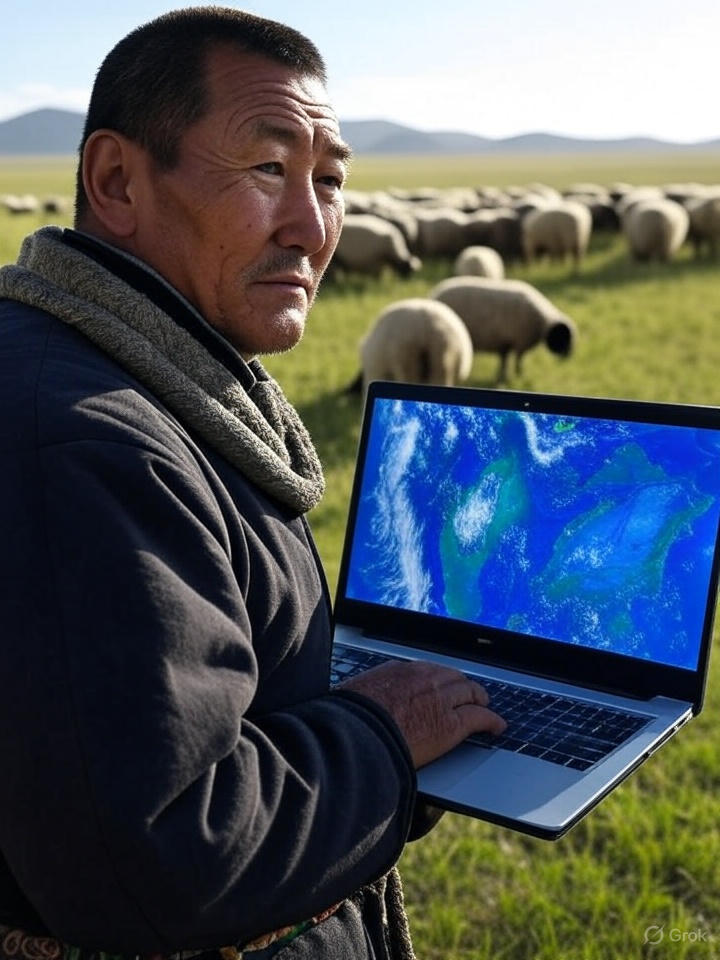
And in rural Mongolia, nomadic herders are using AI-enhanced satellite imagery and predictive models to anticipate weather shifts and optimize grazing routes. These tools, developed in collaboration with local NGOs and researchers, blend traditional ecological knowledge with machine learning. The result: fewer livestock losses, more sustainable land use, and a renewed sense of stewardship.
These are not just anecdotes; they are harbingers of a world where storytelling, learning, and cultural preservation are no longer bottlenecked by infrastructure or expertise.
Of course, this vision is not without its shadows. The same tools that democratize can also homogenize. There is a risk that AI-generated content flattens cultural nuance, or that algorithmic curation reinforces dominant narratives. Moreover, access to AI tools is still mediated by platforms, many of which are profit-driven and opaque. The challenge, then, is not just to build AI that empowers, but to embed it within ecosystems of equity, transparency, and cultural sensitivity.
This is where the ethical imagination must rise to meet the technological one. Scholars like Ruha Benjamin have warned against “the New Jim Code”—the ways in which automation can encode racial and social biases. To truly democratize, AI must be designed with participatory governance, diverse training data, and mechanisms for local adaptation. It must be accountable not just to users, but to communities.
Yet even with these caveats, the core vision remains luminous. Imagine a world where every child has an AI mentor fluent in their language and dreams. Where every artist, regardless of income, can prototype their vision. Where every learner, from the streets of São Paulo to the steppes of Mongolia, can access the cumulative wisdom of humanity—and contribute to it. This is not science fiction. It is already flickering into being.
In the words of Audrey Tang, Taiwan’s digital minister and a champion of civic tech: “Technology is a tool for people to co-create the future.” AI, at its best, is not a substitute for human creativity or wisdom—it is a catalyst. It invites us to reimagine education not as a pipeline but as a garden, where diverse minds grow in dialogue with intelligent systems. It invites us to see creativity not as a luxury but as a birthright.
And perhaps most importantly, it invites us to reframe intelligence itself—not as a zero-sum competition between humans and machines, but as a collaborative unfolding of possibility. As philosopher Roberto Unger writes, “The imagination is the most important faculty of the human mind. It is the faculty that allows us to transcend the circumstances we inherit.” AI, when aligned with this faculty, becomes not a threat but a companion in transcendence.
In conclusion, the most compelling vision for AI is not one of domination or efficiency, but of democratization. It is a vision where learning and creativity are no longer gated by privilege, but nourished by intelligent scaffolds. It is a vision that honors the dignity of every mind, the uniqueness of every story, and the potential of every learner. And it is a vision worth fighting for—not just with code, but with conscience.
Filed under: Uncategorized |


 Educational Technology and Change Journal

Leave a comment