





By Jim Shimabukuro (assisted by ChatGPT-5)
Editor
Introduction: This is ChatGPT-5‘s choice for the vision that’s most compelling in the development of AI. -js
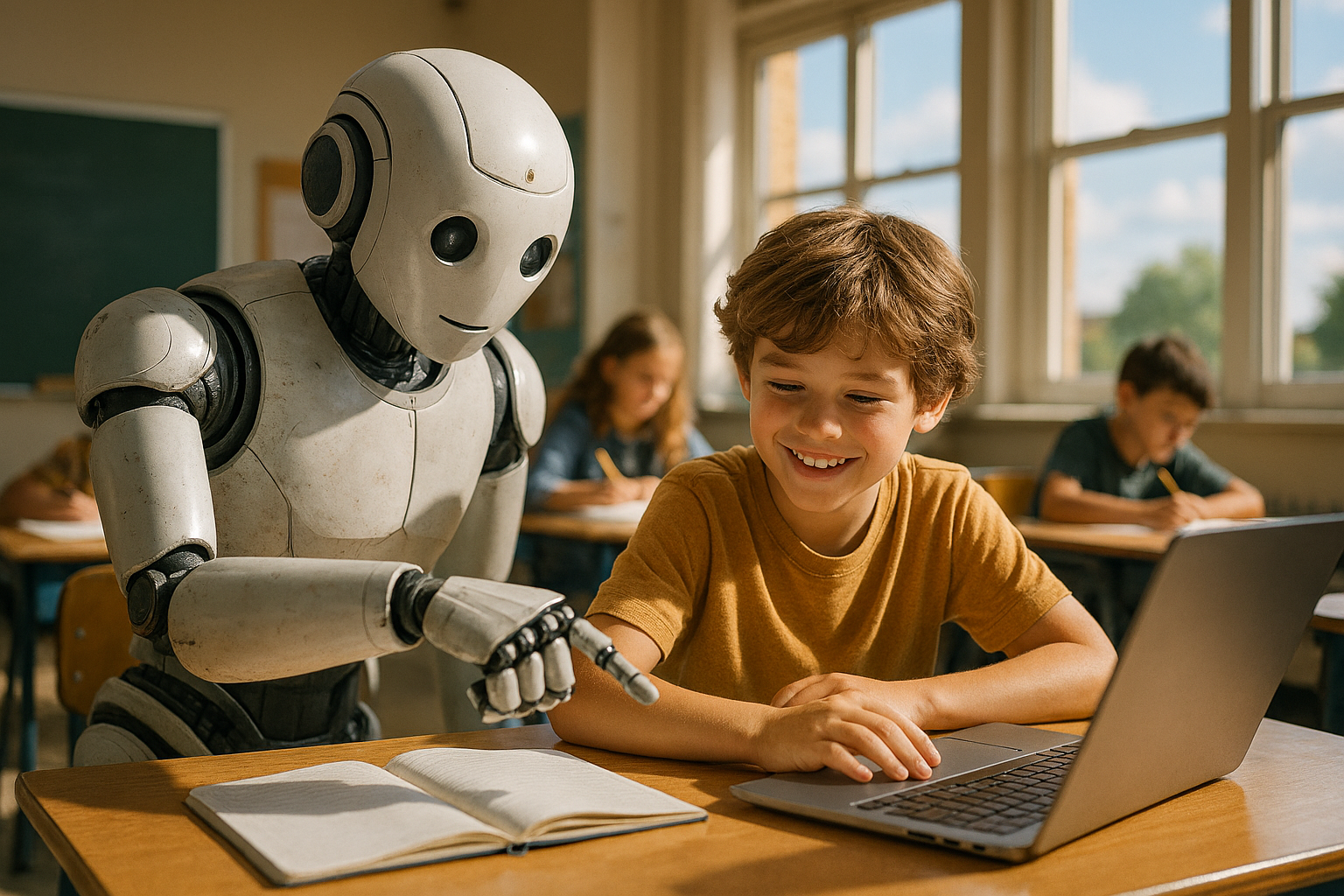
When we step back from the endless debates over artificial intelligence—its dangers, its biases, its economic disruptions—what becomes clear is that the most compelling vision of AI is not replacement but augmentation: the systematic expansion of human potential. In this view, AI is neither a mere tool nor an encroaching overlord. It is a catalytic partner, one that magnifies our abilities to learn, create, heal, decide, and imagine. The dream is not simply that AI will work faster than us, but that it will open new domains of possibility we could never reach alone. This vision, articulated by thinkers from Douglas Engelbart in the 1960s to contemporary advocates such as Fei-Fei Li, rests on a deeply humanistic premise: intelligence, wherever it emerges, should serve to amplify human flourishing.
The central idea of augmentation can be traced back to Engelbart’s seminal 1962 report, Augmenting Human Intellect: A Conceptual Framework. Engelbart argued that digital technologies should not automate human thinking but rather “increase the capability of a man to approach a complex problem situation, to gain comprehension to suit his particular needs, and to derive solutions to problems.” His words sound prescient today, at a moment when AI systems such as GPT-5 can generate text, images, and even functioning code in seconds. Yet Engelbart’s framing is not antiquated—it is precisely the language of partnership, of augmentation, that best captures the horizon AI now offers. To speak of “human potential” may sound vague until we recall its many concrete dimensions: education, health, creativity, governance, relationships, and the pursuit of meaning.
Consider education, where the augmentation vision already reveals itself in everyday practice. A struggling student, once limited by the pace of a single teacher and a crowded classroom, can now engage with an AI tutor that adjusts explanations to his specific gaps, repeating patiently as needed, offering analogies tailored to her culture and experience. Salman Khan, founder of Khan Academy, recently described his team’s AI tutor, Khanmigo, as an assistant that is “never tired, never judgmental, infinitely patient.” For a child who might otherwise fall behind, this represents not just remediation but liberation—the difference between a life constrained by illiteracy and one enriched by knowledge. The vision here is not that AI replaces teachers, but that it unlocks individualized learning at scale, turning mass education into a deeply personal journey.
The same augmentation logic holds in health. Imagine a rural clinic in Uganda or Montana, where access to specialists is scarce. A nurse can upload a chest X-ray to an AI system trained on millions of examples and receive a probability map of likely conditions, complete with recommended follow-ups. The nurse is not displaced but empowered. The AI functions as a tireless diagnostician, surfacing rare possibilities or catching what human eyes might miss. Fei-Fei Li, often called the “godmother of AI,” has said, “The future of AI needs to be about human-centered AI, where technology enhances rather than diminishes human capacity.” When viewed through this lens, augmentation becomes not just a tool for convenience but a moral imperative: a way to reduce disparities in global health and give every patient, rich or poor, the benefit of superhuman diagnostic insight.
Creativity, too, is undergoing a profound shift under this vision. Take the example of Holly Herndon, the experimental musician who developed an AI “voice clone” she calls Holly+. Rather than fearing that AI-generated music will erase the role of the artist, Herndon sees it as a means of multiplying her own creative presence: others can compose with her voice, extending her artistic influence in ways that would be impossible physically. Similarly, the filmmaker Paul Trillo used generative AI to create visual sequences that no camera could capture—dreamlike cityscapes morphing seamlessly into oceans and skies—expanding not just his toolbox but the very language of cinema. The point is not that AI “makes art” but that it augments human creativity, collapsing the gap between imagination and execution. In this sense, AI fulfills the Romantic ideal of art as “the expression of the infinite through the finite,” granting artists new pathways to express the inexpressible.
Even in governance and decision-making, augmentation offers a transformative vision. Consider the work of Iceland’s Citizens Foundation, which has experimented with AI to help analyze and summarize thousands of citizen comments in public consultations. In the past, the sheer volume of feedback would overwhelm policymakers, leading to tokenistic exercises where only a fraction of voices were heard. Now, AI systems can surface themes, highlight minority concerns, and present coherent syntheses for human decision-makers to consider. The AI does not decide policy; it amplifies democratic participation by ensuring that more human voices genuinely count. Jaron Lanier, often a skeptic of technological hype, nonetheless acknowledges that “AI, properly situated, can help us listen to one another at scale.” This is augmentation in the political sphere: extending the capacity of democratic systems to process complexity without collapsing into noise.
To understand the deep resonance of this vision, it is helpful to contrast it with alternatives. The automation vision—the idea that AI should take over human labor entirely—carries with it the risk of alienation, unemployment, and concentration of power in the hands of those who own the machines. The dystopian vision—that AI will outstrip and dominate us—generates fear but little constructive direction. Augmentation, by contrast, offers a hopeful middle path: we remain central, but our powers are magnified. As philosopher Andy Clark put it in Natural-Born Cyborgs (2003), humans have always been “biological minds in technological bodies,” extending ourselves through tools from the spear to the smartphone. AI, in this sense, is merely the next prosthesis—albeit one of unprecedented depth and scope.
One case study brings this vividly to life. In 2023, a paralyzed man in California, Keith Thomas, participated in a clinical trial where AI algorithms decoded his neural signals and restored both movement and sensation to his hand through a brain-computer interface. After a diving accident left him quadriplegic, Thomas had resigned himself to a life without touch. With the help of AI-mediated neural decoding, he was able to feel the grip of his sister’s hand for the first time in years. “I never dreamed I would feel that again,” he said, tears in his eyes. This moment encapsulates augmentation’s essence: the restoration and amplification of what it means to be human. AI, here, is not abstract code but the reawakening of sensation, intimacy, and agency.
Of course, the augmentation vision is not without its perils. To amplify human potential is also to amplify human flaws. An AI tutor may spread bias in educational content if not carefully monitored; an AI diagnostic tool might perform worse on populations underrepresented in training data; generative art may reproduce stereotypes or devalue human labor. Yet these risks do not negate the vision—they highlight the need for stewardship. Just as electricity powered both life-saving hospitals and the electric chair, AI is a general-purpose force. The compelling vision lies not in blind optimism but in the responsible pursuit of augmentation, with ethical guardrails that maximize its benefits for all.
There is also the question of access. If AI augments only the wealthy, it risks entrenching inequality rather than alleviating it. Critics often point to the “digital divide,” arguing that new technologies widen gaps between haves and have-nots. And yet, history shows a more complex pattern. Mobile phones, once luxuries, are now ubiquitous worldwide. In India and sub-Saharan Africa, mobile-based financial technologies like M-Pesa have leapfrogged traditional banking, bringing millions into the global economy. AI may follow a similar trajectory, especially if designed with inclusivity in mind. Open-source models, public-private partnerships, and equitable infrastructure investment can ensure that augmentation does not become the privilege of the few. The vision is compelling precisely because it demands not only technical innovation but social imagination.
At its core, the augmentation vision resonates with the deepest philosophical questions about what it means to be human. The Renaissance ideal of the homo universalis—the universal human capable of mastering diverse arts and sciences—has always been aspirational, limited by the finite bounds of memory and time. With AI as a partner, we glimpse the possibility of a new universality. A medical student can, in real time, consult a system that holds the knowledge of millions of published papers. A poet can summon metaphors suggested by centuries of world literature. A policymaker can model outcomes across thousands of variables before choosing a course. These are not fantasies but daily realities already emerging in September 2025. They point toward a world in which the boundaries of individual potential are radically expanded.
Yuval Noah Harari, in Homo Deus, warns that AI may give rise to “dataism,” a worldview where algorithms know us better than we know ourselves. But there is another way to interpret his warning. If algorithms indeed can surface hidden patterns in our behaviors and choices, then the challenge is not to cede control but to integrate these insights into richer forms of self-understanding. The augmentation vision embraces this: AI as mirror, guide, and companion in the journey of becoming more fully human.
In a way, this vision recalls the ancient Greek notion of the daimon, a guiding spirit that accompanies each individual. Socrates spoke of his daimon as a voice that warned him away from errors. AI, conceived as augmentation, is a modern daimon: ever-present, whispering insights, expanding horizons, helping us to avoid pitfalls. The difference is that this daimon is not mystical but engineered—a creation of human ingenuity designed, ideally, to reflect and enhance human values.
The implications extend into the long future. Imagine the year 2125, when children grow up with AI companions that know their learning history from infancy, helping them cultivate curiosity, resilience, and empathy. Imagine communities where AI mediates conflicts by suggesting compromise solutions grounded in historical precedent and local culture. Imagine elderly individuals whose memories are failing, yet who retain continuity of self through AI systems that store and narrate their life stories back to them. Each of these is not mere convenience but the deep augmentation of human experience, ensuring that the arc of life is enriched rather than diminished.
In the end, the most compelling vision of AI is this: a world in which no person is trapped by the accidents of circumstance—whether by geography, disability, or poverty—but where each is afforded the chance to extend their capacities through intelligent partnership. This is not utopia; it is a horizon, a direction. The American poet Walt Whitman once declared, “I am large, I contain multitudes.” AI, in its best form, allows us to inhabit those multitudes more fully, to realize potentials that otherwise remain dormant.
Thus the case for augmentation is not only technological but moral, cultural, and existential. To advocate for AI is not to advocate for efficiency or profit alone. It is to advocate for the enlargement of human possibility—the chance to learn more, feel more, create more, decide more wisely, and connect more deeply. As Engelbart saw six decades ago, and as our era now confirms, the ultimate power of intelligence, artificial or otherwise, is not in replacing us but in helping us become more fully ourselves.
Filed under: Uncategorized |


 Educational Technology and Change Journal

Leave a comment