





By Jim Shimabukuro (assisted by Copilot)
Editor
Free smartphone apps to converse in a foreign language are already unfolding in 2025. Several free AI-powered apps now offer real-time voice-to-voice translation across dozens (even hundreds) of languages, right from your smartphone. Here’s how close we are to seamless multilingual conversation.
What’s Already Possible Today
- Google Translate: Supports 133+ languages, with a Conversation Mode that lets two people speak back and forth while the app auto-translates each turn.
- Microsoft Translator: Offers multi-device chat, group conversation mode, and enterprise-grade security—great for meetings or travel.
- SayHi Translate: Optimized for voice chat, with a clean interface and support for dozens of languages.
- iTranslate Voice: Delivers voice-to-voice translation in 40+ languages, tailored for travelers and casual users.
How It Works
These apps combine:
- Automatic Speech Recognition (ASR): Converts your spoken words into text.
- Machine Translation (MT): Translates the text into the target language.
- Text-to-Speech (TTS): Speaks the translated text aloud in the other language.
What’s Still Evolving
- Nuance and cultural context: While accuracy is high for major languages, idioms and emotional tone can still trip up the AI.
- Offline functionality: Some apps offer downloadable language packs, but real-time translation still works best with internet access.
- Latency: Most apps are fast, but not quite instantaneous—there’s often a 1–2 second delay.
What’s Next
The frontier now includes:
- Wearable translators like Timekettle earbuds and Pocketalk devices for hands-free, face-to-face translation.
- Event-grade tools like Stenomatic.ai, which offer real-time multilingual support for conferences and webinars.
- Integrated AI interpreters like JotMe, which provide live subtitles and cross-platform meeting translation.
So yes—two people speaking different languages can already converse using a smartphone app. It’s not science fiction anymore. If you’re imagining a world where this tech is embedded in everyday life—say, in classrooms, border crossings, or family reunions—it’s not just possible, it’s imminent in 1 to 2 years.
Current Reach: Already Global, But Not Yet Universal
- Google Translate, Microsoft Translator, and SayHi are already free and available on Android and iOS.
- They support 100+ languages, and many offer offline translation packs.
- Voice-to-voice translation is functional, but not yet frictionless in low-bandwidth or low-resource regions.
What’s Holding Back Full Accessibility
- Connectivity gaps: Real-time translation still depends on stable internet, which isn’t universal.
- Device limitations: Older or budget smartphones may struggle with latency or lack voice input/output features.
- Language equity: Major languages are well-supported, but indigenous and minority languages lag behind.
Why 1–2 Years Is a Realistic Timeline
- AI compression models are making translation faster and lighter—ideal for low-end devices.
- Offline neural translation is improving, meaning real-time speech translation won’t require constant internet.
- Global initiatives (e.g. Meta’s No Language Left Behind, Google’s 1,000 Languages Project) are rapidly expanding coverage.
- Smartphone penetration is expected to reach over 90% of the global population by 2027, with affordable models flooding emerging markets.
- A free app pre-installed on Android and iOS, with:
- Voice-to-voice translation for 100+ languages
- Offline support for at least 50 languages
- Low latency and high contextual accuracy
- Inclusive UI for users with disabilities
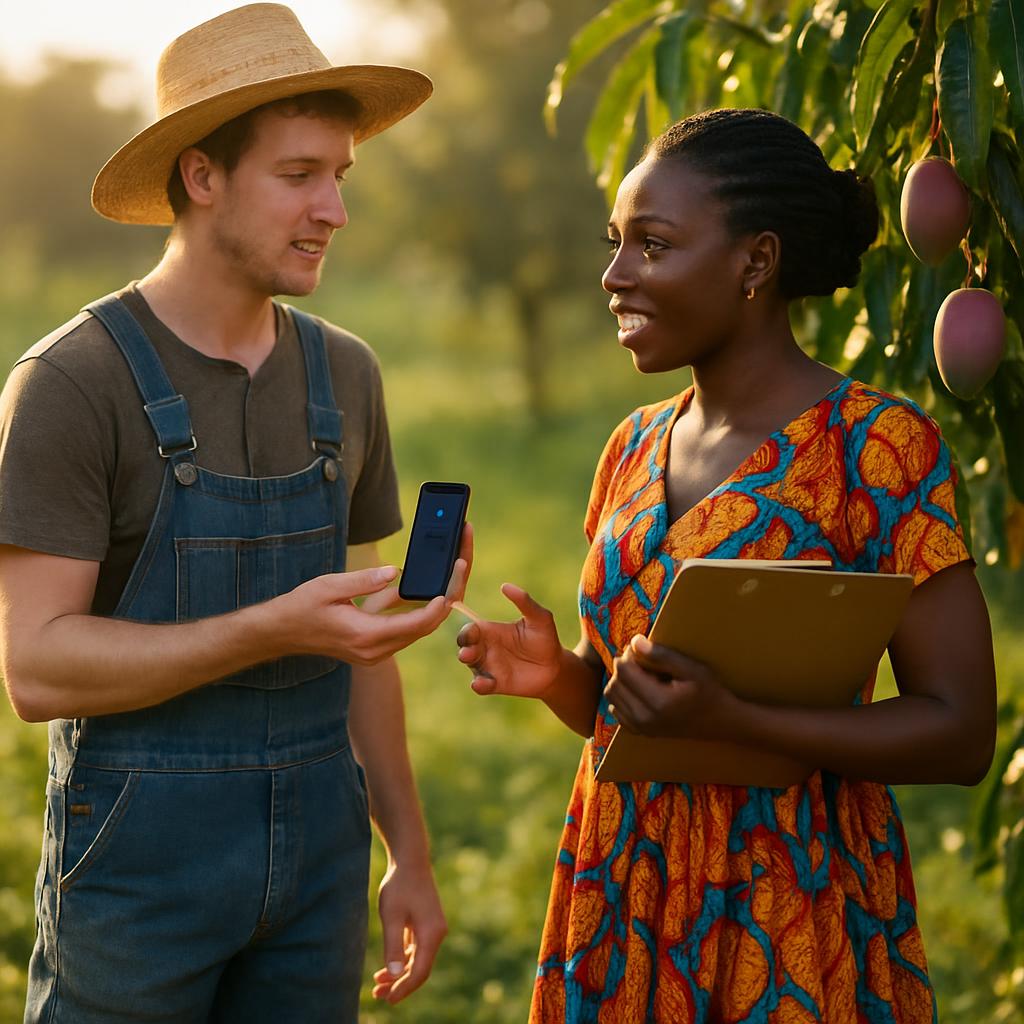
Here’s a narrative of two strangers—an English-speaking farmer and a Swahili-speaking teacher—conversing fluidly through a pocket-sized AI interpreter.
“The Mango Tree”
It was late afternoon in Kilifi, Kenya. The sun hung low, casting long shadows across the red earth. A small crowd had gathered near the edge of a schoolyard, where a mango tree had split during a storm the night before. Among them stood Thomas, a retired farmer from Iowa, and Amina, a local primary school teacher.
Thomas had come to Kilifi as part of a global youth exchange program, hoping to share sustainable farming techniques. Amina had volunteered to host him, though they shared no common language—he spoke English, she spoke Swahili.
Between them sat a pocket-sized AI interpreter, clipped to Thomas’s shirt. It blinked softly, listening.
Thomas (in English): “That tree’s roots are still strong. It can be saved.”
The device chirped, then spoke in Swahili with a gentle female voice.
AI (in Swahili): “Mizizi ya mti bado ni imara. Inaweza kuokolewa.”
Amina’s eyes lit up. She knelt beside the tree, touching the bark.
Amina (in Swahili): “Watoto hupenda kivuli chake. Siwezi kuacha wakikosa mahali pa kucheza.”
AI (in English): “The children love its shade. I can’t let them lose their place to play.”
Thomas smiled, crouching beside her. He gestured toward the broken limb.
“We can brace it. I’ve done this with apple trees back home.”
“Tunaweza kuimarisha. Nimefanya hivi na miti ya tufaha nyumbani.”
They worked side by side, tying the split trunk with recycled cloth and bamboo. Children gathered, watching the two strangers speak through the device as if it were a shared heartbeat.
Later, under the patched canopy, Amina handed Thomas a ripe mango.
“Asante kwa msaada wako.”
“Thank you for your help.”
He took a bite, savoring the sweetness. Then, with a chuckle:
“Best mango I’ve ever had.”
“Embe bora zaidi niliyowahi kula.”
They laughed together—two voices, one conversation, stitched across languages by a whispering machine.
Filed under: Uncategorized |


 Educational Technology and Change Journal

Leave a comment