





By Jim Shimabukuro (assisted by ChatGPT-5)
Editor
AI is already unclogging traffic in the U.S. and abroad. Cities are using machine learning and optimization to retime signals continuously, coordinate corridors, create “green waves” for emergency vehicles, and cut stops, delay, and emissions. The broader pattern is clear: agencies are moving from fixed-time plans to continuously learning optimization, starting with high-impact corridors, then scaling citywide as data and staffing permit. Below are three standout programs, ranked for scale, maturity, and independently reported results.
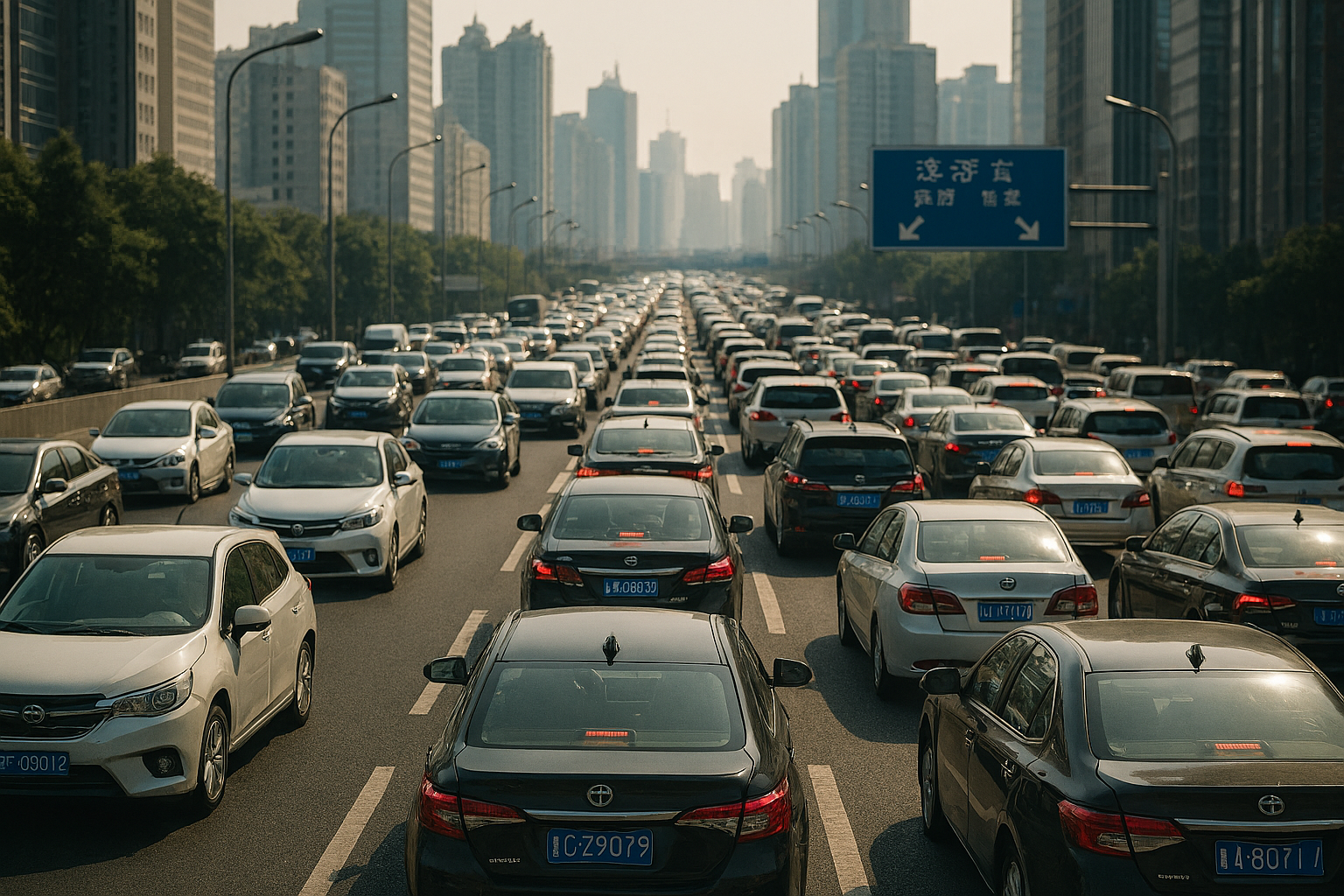
1) Hangzhou, China — Alibaba “City Brain”
Leaders
Originally led inside Alibaba Cloud by Dr. Wanli Min (then Chief Scientist of AI/ET City Brain); the program has also been championed by Alibaba Research leadership including Yossi Matias’ peers at other firms, but City Brain itself is an Alibaba–Hangzhou initiative. Min has publicly discussed architecting and launching City Brain and its early scaling in Hangzhou. (TechNode, Medium, CGTN News)
AI approach
City Brain is a city-scale operating platform that fuses heterogeneous data streams—fixed cameras, inductive loops, toll gantries, weather, probe data, even emergency dispatch—into a cloud AI that forecasts flows, detects incidents, and optimizes signal plans and corridor priorities in real time. It can also pre-empt lights for ambulances, creating an “on-demand green wave.” Rather than tuning intersections one by one, the platform treats the network as a coordinated system and applies large-scale prediction and optimization continuously. (Pacific Research Institute, GovInsider, IET Research Journal)
Level of success
Multiple reports attribute substantial gains to City Brain in Hangzhou. Wired reported an early ~15% reduction in traffic jams after deployment. Academic and trade sources have highlighted dramatic emergency response benefits—ambulance travel times reportedly cut by about 50% through dynamic green waves—and measurable travel time improvements on key corridors. Hangzhou also improved in national congestion rankings during the rollout, consistent with the program’s claims of smoother peak traffic and faster incident clearance. While precise citywide causality is hard to ascribe (concurrent roadworks and policy shifts can confound results), the breadth of independent coverage and the platform’s subsequent expansion to other cities (including Kuala Lumpur) make City Brain the most ambitious, system-level exemplar to date. (WIRED, IET Research Journal, Alizila)
Why it ranks #1
No other city has attempted AI-driven, whole-network optimization at this scale, integrating emergency services, corridor control, and incident management in a single cloud “brain.” The combination of wide sensor fusion, continuous prediction, and network-level control represents a step-change over legacy adaptive systems. The privacy trade-offs are non-trivial and debated, but on pure mobility outcomes, City Brain is the current apex of applied AI for urban traffic. (WIRED)
2) Global (incl. U.S.) — Google Research “Project Green Light”
Leaders
Product leadership is publicly associated with Matheus Vervloet (Product Manager, Google Research), under the broader Google Research sustainability portfolio. Executive sponsorship of the area has also been highlighted by Google VP Yossi Matias. (Boston.gov, Smart Cities World, blog.google)
AI approach
Green Light uses AI models trained on aggregated, anonymized Google Maps driving patterns—essentially millions of smartphones as “mobile sensors”—to infer approach volumes, turning movements, and stop-and-go patterns at targeted intersections. Instead of installing new hardware, the system runs analytics in the cloud and produces retiming recommendations (phase splits, offsets, cycle tweaks) for city signal engineers, who can accept and implement changes within existing controllers. This data-light, software-first method drastically lowers deployment costs and speeds up iteration, making it attractive for cities with limited budgets. (Scientific American, Sustainability Magazine)
Level of success
Green Light has expanded quickly, with official updates and city partners reporting multi-city deployments. Google and partner cities (e.g., Boston) report the program live across dozens of intersections and in 17–18+ cities on four continents, with reductions in stops/idling and corresponding emissions. Because the approach retimes rather than replaces controllers, cities can scale across many junctions fast: Boston cites 114 intersections optimized across 20 neighborhoods. Trade press and Google’s sustainability briefings describe measurable reductions in stop-and-go and fuel/emissions, and press coverage has quoted estimated cuts in stop-and-go traffic at pilot sites. While peer-reviewed, third-party evaluations are still emerging, the speed, cost-effectiveness, and breadth of the rollout are compelling. (Technology Magazine, Boston.gov, blog.google, The Wall Street Journal)
Why it ranks #2
Green Light isn’t as all-encompassing as City Brain—there’s no citywide incident detection stack—yet its pragmatic, sensor-free model makes it uniquely scalable. For many U.S. and international agencies facing staff and budget constraints, an AI that can prioritize which signals to tweak—and by how much—without new hardware delivers fast, low-cost wins with climate co-benefits. The model’s portability and documented multi-city uptake place it just behind Hangzhou in overall impact. (Boston.gov, Technology Magazine)
3) Pittsburgh, USA — CMU “SURTRAC” (Rapid Flow/Miovision)
Leaders
SURTRAC was created at Carnegie Mellon University by Prof. Stephen F. Smith and collaborators (including Gregory Barlow and Xiao-Feng Xie). Smith co-founded Rapid Flow Technologies to commercialize it; Rapid Flow was acquired by Miovision in 2022, bringing the technology into a larger product ecosystem. (Wikipedia, CMU School of Computer Science)
AI approach
SURTRAC (Scalable Urban Traffic Control) is a decentralized, schedule-driven AI for signals. Each intersection builds a short-horizon schedule that minimizes delay for its observed and predicted flows. Intersections share projected outflows with neighbors, enabling rolling, network-aware coordination without a central command. The control algorithm (including the “Softpressure” variant) dynamically re-sequences phases to reduce queueing and travel time, and it extends to mixed traffic (ped/bike/transit) far better than fixed-time plans. In practice, this means every signal “thinks” locally but cooperates to achieve corridor-level green waves, adapting cycle by cycle. (jctconsultancy.co.uk, Wikipedia)
Level of success
Pittsburgh’s East End pilot and subsequent expansions showed some of the clearest quantified gains in the United States: average travel times down ~25%, wait times down ~40%, braking down ~30%, and idling reduced over 40% at equipped intersections—results documented by CMU, SmartCitiesDive, and U.S. DOT repositories as the network grew from 9 to ~50 intersections. These improvements translate into meaningful emissions reductions and better bus schedule adherence. While SURTRAC requires local detection (loops/cameras) and controller integration—making per-junction costs higher than “software-only” approaches—its real-time, truly adaptive behavior has set the bar for decentralized signal AI and influenced later systems. (Carnegie Mellon University, Smart Cities Dive, PPMS, ROSA P.)
Why it ranks #3
SURTRAC is the pioneering, rigorously documented U.S. exemplar of real-time, AI-driven signal control. It earns a top-three slot for its proven, peer-recognized methodology and published performance, even if its hardware needs limit ultra-rapid scaling relative to Green Light. Its intellectual legacy—decentralized scheduling and cooperative look-ahead—continues to shape next-gen controllers and commercial offerings worldwide. (Wikipedia)
Bottom line and “where else?”
Beyond these three, applications are proliferating. Examples include India (e.g., Chennai’s rollout of AI-adaptive signals across 165 junctions), Israel and U.S. cities piloting startup platforms, and long-standing adaptive systems (SCATS/SCOOT) that increasingly embed ML modules. (The Times of India)
Takeaway: AI has made real, measurable inroads—cutting delay 15–40% in well-documented programs, improving emergency response, and lowering emissions—through two main strategies: (1) network-scale prediction + optimization in the cloud (Hangzhou), and (2) data-driven retiming at scale without new hardware (Google Green Light), with (3) decentralized real-time controllers (SURTRAC) providing the foundational playbook and validated U.S. results.
Filed under: Uncategorized |


 Educational Technology and Change Journal

Leave a comment