


By Jim Shimabukuro (assisted by ChatGPT)
Editor
Introduction: This list of 100 began with a search for 20 famous sleuths, real and fictional. After the 20, we decided to add 10 more from Asia and the Pacific, then 10 from Latin America and Africa followed by 10 from Middle-Eastern and South Asia, bringing the total to 50. We had quite a list, but we realized we had omitted many more from around the world. We decided to shoot for 100. Our growing list tended to favor fictional sleuths, so we decided to let that happen naturally. At the end, our list had grown to 100, but we realized we were omitting many others. We decided to stop, for now, and follow up with another list in the near future, i.e., if readers express an interest in seeing more. -js
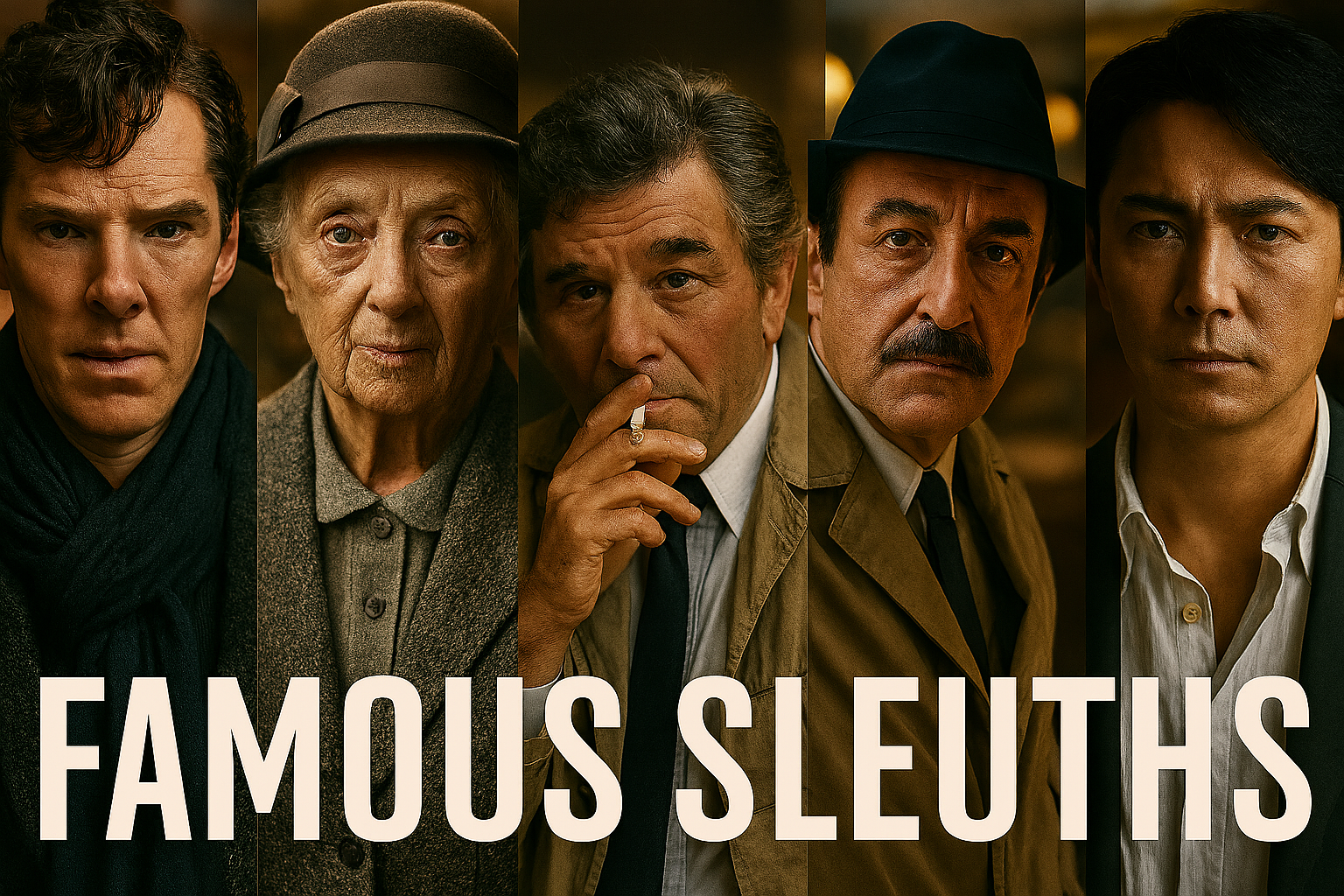
1. Sherlock Holmes
Sherlock Holmes, created by Sir Arthur Conan Doyle in 1887, remains the archetypal detective, blending cold logic, scientific reasoning, and keen observation into an enduring model of crime-solving brilliance. His address at 221B Baker Street is legendary, and his partnership with Dr. John Watson has become the template for detective duos across literature and film. Holmes’ methods—fingerprint analysis, chemical experiments, disguise, and deductive reasoning—prefigured many modern forensic techniques. Beyond his fictional exploits, Holmes influenced the real world: police investigators have admitted to adopting his techniques, and forensic science as a field traces some of its ethos to him. Holmes is both a timeless character and a metaphor for rational inquiry. From the fog of Victorian London to modern adaptations like Sherlock and Elementary, he has transcended his stories to become cultural shorthand for intellectual detective work. No detective has been more imitated, parodied, or revered, making Holmes as much a myth as a character—an enduring detective archetype whose mind still feels sharper than almost any real or fictional successor.
2. Hercule Poirot
Hercule Poirot, the Belgian detective created by Agatha Christie in 1920, embodies meticulous order and obsessive detail. Distinguished by his waxed mustache, dapper dress, and fastidious manners, Poirot differs from the rugged detective archetype by relying on psychological insight rather than brute force. His famous “little grey cells” symbolize his belief that mental clarity and logic solve crimes better than action. Poirot starred in more than 30 novels, including Murder on the Orient Express and Death on the Nile, where his ability to see through deception and understand motive outmatched elaborate murder plots. Christie used Poirot to explore human behavior at its darkest, always filtered through his precise and civilized lens. He represents the “closed-circle” mystery, where suspects are limited, motives complex, and truth revealed through clever deduction. Poirot’s global popularity is immense, with stage, film, and television portrayals ensuring his immortality. Unlike Holmes, who often dabbles in chaos, Poirot thrives in bringing order to disorder, making him a symbol of rational justice in a world riddled with human weakness.
3. Miss Marple
Jane Marple, better known as Miss Marple, is Agatha Christie’s elderly amateur detective whose quiet demeanor masks an exceptional gift for understanding human nature. First appearing in 1927, Miss Marple often solves crimes in her small English village of St. Mary Mead, though her reputation extends beyond. Her unique method relies not on forensic science or grand deduction but on parallels between human behavior in small communities and broader crimes. Christie uses her to demonstrate that evil lurks not only in urban shadows but also behind quaint village facades. Miss Marple’s advantage is her invisibility: criminals underestimate her as a harmless old woman, only to be undone by her penetrating questions and memory of past human follies. Unlike Poirot or Holmes, Marple does not seek recognition; her satisfaction lies in restoring justice quietly. She represents wisdom accumulated with age and the power of observation sharpened by empathy. Miss Marple is a testament to Christie’s skill in challenging gender and age stereotypes, elevating a seemingly ordinary woman into one of the world’s most formidable detectives.
4. Sam Spade
Sam Spade, created by Dashiell Hammett in The Maltese Falcon (1930), embodies the American hard-boiled detective. Unlike the cerebral Sherlock Holmes or the genteel Hercule Poirot, Spade operates in a morally ambiguous world where corruption is pervasive and violence lurks in every alley. Cynical, tough, and pragmatic, Spade has his own moral compass—flexible yet unwavering when it comes to justice. His sharp wit and street-smart instincts allow him to navigate dangerous situations, particularly when dealing with femme fatales, gangsters, and double-crossing clients. Humphrey Bogart’s portrayal of Spade in the 1941 film adaptation cemented him as a noir icon. Spade represents disillusionment in early 20th-century America, when Prohibition and organized crime blurred the lines between law and lawlessness. He doesn’t seek truth for its own sake but for survival and profit, yet ultimately exposes the guilty. His legacy is profound: Spade paved the way for countless noir and detective fiction characters, from Philip Marlowe to modern antiheroes. He is less a knight in shining armor than a weary realist, making him unforgettable in detective history.
5. Philip Marlowe
Philip Marlowe, Raymond Chandler’s creation, debuted in The Big Sleep (1939) and quickly became the quintessential Los Angeles private eye. Unlike the aloof Sam Spade, Marlowe is defined by his flawed humanity, wry humor, and occasional romantic idealism, all set against the neon-lit grit of Los Angeles. He’s a solitary figure navigating corruption, crime, and deceit, with a code of honor that keeps him just outside the moral decay around him. Marlowe’s voice—dry, sardonic, and poetic—elevated detective fiction into literature, making Chandler a master of style. Through Marlowe, Chandler captured post-Depression America’s anxieties: wealth and power corroded society, and the private detective was a reluctant hero exposing uncomfortable truths. Film noir immortalized Marlowe, especially through portrayals by Humphrey Bogart and Robert Mitchum, etching his image as a trench-coated figure with a cigarette and a knack for biting dialogue. Marlowe’s legacy endures in both literature and cinema, bridging entertainment and social commentary. He is more than a detective; he’s a lens on the moral failings of 20th-century America.
6. Inspector Maigret
Inspector Jules Maigret, created by Belgian author Georges Simenon, is one of the most enduring fictional detectives, appearing in 75 novels and numerous short stories from 1931 to 1972. Unlike the flashy brilliance of Sherlock Holmes or the theatricality of Hercule Poirot, Maigret is methodical, grounded, and deeply human. His strength lies in empathy and patience; he immerses himself in the lives of suspects, often spending hours observing their habits and surroundings until their psychology unfolds. Maigret embodies the continental detective tradition of blending sociology with investigation—he is less concerned with dramatic revelations than with understanding why crimes occur. His Paris is not glamorous but gritty, populated by ordinary people whose lives unravel in tragic ways. Simenon’s prose emphasized atmosphere, routine, and realism, making Maigret relatable to readers across generations. His stories also translated seamlessly to television, with adaptations in France, Britain, and beyond. In Maigret, we see a detective who values humanity as much as justice, proving that solving crimes can be as much about compassion as it is about intellect.
7. C. Auguste Dupin
C. Auguste Dupin, Edgar Allan Poe’s brilliant Parisian sleuth, is often called the first true detective in Western literature. Debuting in The Murders in the Rue Morgue (1841), Dupin predated Sherlock Holmes by decades and established the foundational tropes of detective fiction: the eccentric genius, the loyal narrator, and the climactic unveiling of the culprit. Dupin’s methods rely on “ratiocination,” a blend of logic, imagination, and psychological profiling. He delights in baffling mysteries, famously unraveling the seemingly impossible locked-room murder in his first story. Poe used Dupin to critique police incompetence while celebrating the power of reason over chaos. Although only appearing in three tales, Dupin’s influence is immeasurable—Arthur Conan Doyle openly acknowledged Holmes as Dupin’s literary descendant. Beyond fiction, Dupin embodied Enlightenment rationality, symbolizing the belief that human intellect could illuminate even the darkest mysteries. While later detectives became more nuanced or hardened by realism, Dupin retains an almost mythic aura as the prototype of all great literary sleuths.
8. Columbo
Lieutenant Columbo, portrayed by Peter Falk from 1968 to 2003, revolutionized the television detective genre with his deceptively disheveled appearance and inverted storytelling style. Unlike traditional whodunits, Columbo episodes began by showing the audience the murderer and crime. The suspense lay not in discovering “who” but in watching Columbo dismantle the criminal’s alibi piece by piece. His trademarks—the rumpled raincoat, ever-present cigar, and the polite but persistent “Just one more thing…”—made him one of TV’s most beloved characters. Columbo’s brilliance was hidden under layers of apparent absentmindedness and bumbling chatter, allowing suspects to underestimate him until it was too late. Falk’s nuanced performance gave Columbo warmth and wit, turning him into a cultural icon. The series was also notable for its intellectual battles, often pitting Columbo against wealthy or arrogant antagonists whose downfall symbolized justice for the ordinary man. Columbo’s legacy endures because he showed that keen observation and persistence—rather than brute force or intimidation—were the detective’s greatest weapons.
9. Jessica Fletcher
Jessica Fletcher, played by Angela Lansbury in Murder, She Wrote (1984–1996), redefined the image of the detective for television audiences. A widowed English teacher turned bestselling mystery novelist, Jessica solves murders both in her quaint hometown of Cabot Cove, Maine, and around the world. Her charm lies in her curiosity, intelligence, and compassion, making her an approachable yet formidable sleuth. Unlike the cynical detectives of noir, Jessica embodies optimism, representing a belief in justice and community. Her method combines writerly intuition with sharp observation, as she draws parallels between real crimes and the plots she invents. Murder, She Wrote became one of the longest-running detective shows in history, with Fletcher solving hundreds of cases—so many that Cabot Cove was humorously dubbed the “murder capital of the world.” Lansbury’s portrayal earned critical acclaim and global admiration, making Jessica Fletcher not only a cultural icon but also a role model of resilience and lifelong curiosity. She remains proof that detectives can be empathetic, relatable, and female without sacrificing brilliance.
10. Inspector Jacques Clouseau
Inspector Jacques Clouseau, the bumbling French detective from The Pink Panther film series, first appeared in 1963, played memorably by Peter Sellers. Unlike most detectives, Clouseau is defined by incompetence, clumsiness, and sheer luck. Yet his enduring popularity lies in the comedic inversion of detective tropes: where Holmes relies on deduction, Clouseau relies on accident; where Poirot thrives on order, Clouseau thrives in chaos. His mangled accent, slapstick mishaps, and oblivious confidence created one of cinema’s most beloved comic characters. Despite his ineptitude, Clouseau often stumbles into the right conclusions, frustrating both his colleagues and villains. The character has become a parody of detective archetypes while also standing alone as a comedic genius. Sellers’ timing and physical comedy elevated Clouseau into legend, influencing generations of parody detectives. Though never meant to be taken seriously, Clouseau reminds audiences that even in a genre steeped in crime and seriousness, laughter has its place. His legacy continues through films, cartoons, and homages worldwide.
11. Nancy Drew
Nancy Drew, introduced in 1930 by publisher Edward Stratemeyer under the pseudonym Carolyn Keene, is one of the most iconic fictional girl detectives. Created as a counterpart to the Hardy Boys, Nancy quickly eclipsed them in popularity, becoming a role model for generations of young readers. Intelligent, resourceful, and fearless, Nancy solved mysteries ranging from missing heirlooms to elaborate criminal conspiracies, often outwitting adults along the way. Her independence was radical for her time: a teenage girl driving her own car, making decisions, and confronting danger directly. Nancy’s appeal lay in her blend of wholesomeness and daring, offering empowerment to girls in an era when few fictional heroes were female. Over the decades, the series has been reimagined in books, films, TV shows, and video games, adapting Nancy’s persona to new cultural contexts while maintaining her core qualities. More than a detective, Nancy Drew became a symbol of confidence, curiosity, and female empowerment, influencing countless writers, activists, and leaders who grew up with her stories.
12. The Hardy Boys
Frank and Joe Hardy, known collectively as the Hardy Boys, were introduced in 1927 by the Stratemeyer Syndicate, ghostwritten under the name Franklin W. Dixon. The teenage brothers became staples of children’s detective fiction, solving mysteries that combined adventurous escapades with classic sleuthing. Their stories often featured missing persons, stolen treasures, and criminal plots, all unraveled through teamwork, bravery, and deductive reasoning. The Hardy Boys reflected ideals of American youth: courage, loyalty, and respect for family. Though their cases sometimes veered into the implausible, their charm lay in the mix of danger and fun, making detective work thrilling for young readers. Over nearly a century, the Hardy Boys have been continually updated, from wholesome 1930s adventurers to modernized investigators confronting cybercrime. Alongside Nancy Drew, they created a cultural template for young detectives that persists in literature, television, and games. Their influence extends far beyond fiction, inspiring many readers to value persistence, curiosity, and problem-solving. As cultural icons, the Hardy Boys represent adventure, moral clarity, and youthful ingenuity.
13. Father Brown
Father Brown, created by G.K. Chesterton in 1910, is a Catholic priest whose unassuming manner conceals a razor-sharp mind. Unlike detectives who rely on science or action, Father Brown uses intuition, empathy, and theological insight to solve crimes. His approach stems from his understanding of sin and human weakness; as a confessor, he recognizes patterns of guilt and temptation that others overlook. In stories like The Blue Cross, Father Brown triumphs not through force but through quiet wisdom and moral clarity. Chesterton contrasted him with Sherlock Holmes, emphasizing spiritual perception over deductive logic. Father Brown’s lasting appeal lies in this paradox: a modest, almost invisible man who consistently outsmarts criminals and skeptics alike. He also reflects Chesterton’s broader themes of faith, paradox, and the complexity of human nature. Adapted into radio, film, and television, Father Brown remains an enduring figure, bridging the detective genre with moral philosophy. He proves that solving crimes can be less about intellect alone and more about profound insight into the human soul.
14. Allan Pinkerton
Allan Pinkerton (1819–1884) was a Scottish-born detective who founded the Pinkerton National Detective Agency in the United States, making him one of the most famous real-life sleuths in history. Originally a cooper by trade, Pinkerton stumbled into crime-fighting after helping capture counterfeiters. His agency, founded in 1850, quickly rose to prominence, tackling train robberies, labor unrest, and organized crime. Pinkerton became legendary for foiling an assassination attempt against President-elect Abraham Lincoln in 1861, an event that cemented his reputation as a national protector. His agency introduced innovations in detective work, including systematic record-keeping, undercover operations, and surveillance methods. Pinkerton agents often took on cases that local police could not or would not pursue. Though his legacy is complicated—his agency was also notorious for suppressing labor movements—Pinkerton remains a towering figure in detective history. His name became synonymous with private investigation, and his influence on law enforcement practices persists. He represents both the promise and controversy of private detectives in the 19th century.
15. Eugène François Vidocq
Eugène François Vidocq (1775–1857) was a French criminal-turned-detective who profoundly influenced modern policing. After a youth filled with crime, duels, and prison escapes, Vidocq offered his services to the authorities, using his knowledge of the underworld to catch criminals. He founded the Sûreté Nationale in 1812, which became the model for modern police organizations, blending undercover work with criminal informants. Vidocq also pioneered forensic methods, experimenting with ballistics, handwriting analysis, and even rudimentary crime labs. His flamboyant life inspired literary figures such as Victor Hugo, who based characters like Jean Valjean and Inspector Javert on him. Vidocq blurred the line between outlaw and lawman, embodying the idea that only a criminal could truly understand and capture criminals. His memoirs, though embellished, fueled his legend across Europe. Today, he is celebrated as the “father of modern criminology,” showing how experience, observation, and innovation could transform law enforcement. Vidocq’s dual identity as both criminal and detective makes him one of the most fascinating figures in sleuthing history.
16. Eliot Ness
Eliot Ness (1903–1957) was a real-life American Prohibition agent and the leader of the famous “Untouchables” team. Ness rose to prominence in Chicago during the 1920s and early 1930s when he and his small squad of incorruptible federal agents targeted Al Capone’s bootlegging empire. Unlike many lawmen of the era, Ness refused bribes, earning both his team’s nickname and the public’s respect. Though Capone was ultimately brought down by tax evasion charges rather than Ness’s direct efforts, Ness’s relentless raids and pursuit of organized crime weakened Capone’s power and established a model for disciplined federal law enforcement. After Prohibition, Ness worked in Cleveland as Safety Director, where he reformed police practices and confronted the “Torso Murders.” His life was dramatized in the book The Untouchables and the 1987 film adaptation starring Kevin Costner, which mythologized his exploits. While his later years were less successful, Ness remains an enduring symbol of integrity and incorruptibility in law enforcement history.
17. Harry Bosch
Detective Hieronymus “Harry” Bosch, created by Michael Connelly in the 1990s, is one of modern crime fiction’s most compelling sleuths. A Los Angeles homicide detective and later private investigator, Bosch is a war veteran whose personal trauma informs his relentless pursuit of justice. His motto, “Everybody counts or nobody counts,” captures his uncompromising belief in protecting the vulnerable. Bosch inhabits a morally complex Los Angeles, filled with political corruption, institutional decay, and brutal crimes. Unlike classic detectives who stand above society, Bosch is embedded in it, scarred by it, yet determined to confront it. Connelly’s novels, along with the popular television series Bosch, showcase a detective as fallible as he is heroic—prone to mistakes but unwavering in his duty. Bosch is notable for aging realistically throughout the series, allowing readers to follow his evolving career and personal life. He represents the contemporary detective: world-weary but principled, navigating a city where justice is fragile but essential.
18. Inspector Morse
Inspector Endeavour Morse, created by British author Colin Dexter, is a cerebral and idiosyncratic detective who solved crimes in Oxford from 1975 until Dexter’s final novel in 1999. Morse’s character stands apart for his intellectualism, love of opera, and affinity for crossword puzzles, which reflect his methodical yet intuitive approach to cases. Unlike some detectives who rely on brute force, Morse often pieces together subtle connections, relying on instinct as much as logic. His imperfections—prickliness, arrogance, and struggles with relationships—make him deeply human. The television adaptation Inspector Morse, starring John Thaw, became a landmark in British crime drama, spawning prequels (Endeavour) and sequels (Lewis). Through Morse, Dexter emphasized the importance of culture, intellect, and persistence in solving crime, while also exploring themes of loneliness and mortality. Morse is not only a detective but also a meditation on the cost of brilliance and the personal toll of a life spent pursuing truth. His legacy endures as one of Britain’s greatest fictional detectives.
19. Batman
Batman, introduced in Detective Comics #27 in 1939, is not only a superhero but also one of the world’s most famous fictional detectives. Often dubbed “the World’s Greatest Detective,” Batman relies on intellect, technology, and relentless determination rather than superpowers. By day, he is billionaire Bruce Wayne; by night, he prowls Gotham City, confronting villains like the Joker, the Riddler, and Catwoman. Unlike many superheroes, Batman’s identity is rooted in crime detection, forensic investigation, and psychological profiling, all underscored by his personal trauma: witnessing his parents’ murder as a child. Over time, Batman has become both a cultural symbol of justice and a darker exploration of vengeance and obsession. His methods—stealth, deduction, and cutting-edge science—link him directly to the tradition of Sherlock Holmes. Across comics, television, and film, Batman embodies the idea that the detective is not just an observer but an active combatant against crime. His dual nature makes him one of the most complex and influential sleuths in popular culture.
20. Veronica Mars
Veronica Mars, created by Rob Thomas in 2004, brought a fresh and contemporary twist to the detective archetype. Played by Kristen Bell, Veronica is a sharp, witty high school student turned private investigator in the fictional town of Neptune, California. Her cases range from personal betrayals to systemic corruption, blending noir-style grit with modern teenage sensibilities. What makes Veronica distinctive is her resilience in the face of personal tragedy—her best friend’s murder, her mother’s disappearance, and the stigma of being an outsider. Like classic detectives, she operates with a mix of intelligence, persistence, and skepticism, but her youth and gender add new dimensions to the genre. The cult television series, along with films and novels, positioned Veronica as both a feminist icon and a modern heir to hard-boiled detectives like Sam Spade. Her ability to balance sarcasm with empathy, toughness with vulnerability, makes her a unique and enduring figure in the pantheon of fictional sleuths..
21. Akechi Kogorō (Japan)
Akechi Kogorō, created by Japanese author Edogawa Ranpo in the 1920s, is often called Japan’s answer to Sherlock Holmes. As a private detective in Tokyo, Akechi blended Western detective traditions with Japanese settings and concerns, giving Japanese readers their first modern sleuthing hero. His debut came in The Case of the Murder on D. Hill (1925), and he went on to star in numerous stories, often battling the infamous villain the Fiend with Twenty Faces. Akechi was notable for his disguises, psychological insight, and deductive reasoning, all presented in an accessible, serialized style that appealed to mass audiences. Ranpo used him to explore not just crime but also modernity, urbanization, and the anxieties of post–World War I Japan. Akechi’s adventures, both solo and alongside his “Boy Detectives Club,” inspired generations of Japanese mystery writers and readers. Today, Akechi remains a cultural icon, bridging Western literary influence with Japan’s homegrown detective fiction, and establishing detective literature as a lasting genre in East Asia.
22. The Boy Detectives Club (Japan)
Closely tied to Akechi Kogorō is the Boy Detectives Club, also created by Edogawa Ranpo. This group of clever, resourceful boys aided Akechi in his battles against villains like the Fiend with Twenty Faces. Debuting in the 1930s, they brought youthful energy and humor to Japanese detective fiction while also serving as a bridge for younger readers. The club exemplified teamwork, bravery, and the belief that children could actively shape justice rather than passively consume stories about it. Their adventures were thrilling but also educational, teaching problem-solving, courage, and loyalty. The Boy Detectives Club became so beloved that they spun off into their own series, a rare feat in global detective fiction. They remain a key part of Japan’s “junior detective” tradition, inspiring later works like manga sleuths and anime mystery-solving teams. In them, Ranpo combined Western mystery tropes with Japanese sensibilities, proving that detective fiction could be localized, playful, and intergenerational in its appeal.
23. Detective Galileo (Japan)
Detective Galileo is the nickname of physicist Yukawa Manabu, created by author Keigo Higashino. A professor at Tokyo University, Galileo assists police with seemingly impossible cases by applying his scientific brilliance. He first appeared in Detective Galileo (1998) and gained international attention with The Devotion of Suspect X (2005), a novel praised worldwide for its intricate plotting and emotional depth. Unlike traditional detectives, Galileo is not a cop but an intellectual outsider who solves mysteries through physics, chemistry, and mathematical reasoning. His calm, rational demeanor contrasts with the intense emotional struggles of the criminals he encounters. Higashino’s blending of hard science with mystery made Galileo a modern, distinctly Japanese detective who reflects both the nation’s reverence for science and its interest in human psychology. Adaptations in television and film further cemented Galileo’s place in popular culture. He represents the modern scientific detective archetype, updated for Japan’s contemporary readers while still echoing the rationalist tradition of Holmes and Dupin.
24. Detective Dee (China)
Detective Dee, or Di Renjie, is based on a real Tang Dynasty magistrate (630–700 CE) who became legendary in Chinese folklore and later detective fiction. As a chancellor and judge, Di Renjie was renowned for his fairness, wisdom, and ability to untangle complex legal cases. In the Ming Dynasty, his legend was fictionalized in the popular Di Gong An (“Cases of Judge Dee”), where he emerged as a master detective solving murders, corruption, and supernatural mysteries. Judge Dee stories blended Confucian morality with thrilling investigations, making him both a symbol of justice and a narrative tool for exploring society’s tensions. In the 20th century, Dutch diplomat Robert van Gulik translated and expanded these tales, introducing Judge Dee to Western audiences and establishing him as a bridge between East and West in crime fiction. Modern film adaptations, like Detective Dee and the Mystery of the Phantom Flame (2010), revived his popularity. Detective Dee embodies the fusion of historical record, folklore, and detective logic, making him one of Asia’s greatest sleuthing figures.
25. Judge Bao (China)
Bao Zheng (999–1062 CE), known popularly as Judge Bao, was a real-life Song Dynasty magistrate who became a semi-legendary detective and symbol of incorruptibility in Chinese culture. Nicknamed “Bao Qingtian” (“Blue Sky Bao”), he was revered for his fairness, refusal of bribes, and fearless pursuit of justice against powerful elites. Folk tales and operas transformed him into a detective-like figure who used both intellect and moral authority to expose crimes and punish wrongdoers. Judge Bao often solved mysteries involving trickery, hidden identities, or supernatural overtones, reflecting both legal practice and popular imagination. In literature and drama, he is portrayed as accompanied by loyal aides who help him investigate and enforce justice. To this day, Judge Bao symbolizes righteous law and incorruptible officials in Chinese political culture. His stories, adapted in novels, television dramas, and operas, demonstrate how detective archetypes can emerge organically from historical memory and moral ideals. He is both a real judge and a mythic detective hero.
26. Kindaichi Kosuke (Japan)
Kindaichi Kosuke, created by Seishi Yokomizo, is one of Japan’s most beloved fictional detectives. First appearing in The Honjin Murders (1946), Kindaichi became the star of dozens of novels that blended classic Western puzzle-style mysteries with Japanese settings, traditions, and family dynamics. Unlike the polished Holmes or Poirot, Kindaichi is eccentric: shabby clothes, disheveled hair, and a stammer hide his extraordinary deductive powers. His cases often involve locked rooms, family feuds, and intricate alibis, reminiscent of Golden Age detective fiction but infused with Japanese cultural themes. Kindaichi’s popularity soared in postwar Japan, where readers embraced his cleverness and ordinariness. The character was later adapted into television, film, and even manga, where his grandson appears in The Kindaichi Case Files. Through Kindaichi, Yokomizo localized detective fiction, creating a homegrown counterpart to Western sleuths that resonated deeply with Japanese audiences. He remains a classic figure in Japanese crime literature, proof that detectives need not be glamorous to be great.
27. Motoko Kusanagi (Japan)
Major Motoko Kusanagi of Ghost in the Shell (1989 manga, later anime films and series) represents a futuristic evolution of the detective archetype in Japanese science fiction. As a cyborg working for Section 9, a counter-cyberterrorism unit, Kusanagi investigates crimes in a high-tech world where the boundaries between human and machine blur. Her investigations combine traditional detective work with hacking, surveillance, and cybernetic combat, reflecting Japan’s anxieties and fascination with technology in the late 20th century. Kusanagi embodies both strength and philosophical depth, often wrestling with existential questions about identity, consciousness, and morality in a digital age. While her methods are far removed from Holmesian deduction, her role as a sleuth is clear: she uncovers truths hidden in virtual layers of society, exposing corruption and injustice. Kusanagi influenced global science fiction, inspiring works like The Matrix, and stands as one of Asia’s most iconic modern “detectives.” She represents a distinctly Japanese blend of noir, cyberpunk, and detective traditions.
28. Inspector Ghote (India)
Inspector Ganesh Ghote, created by British author H.R.F. Keating in 1964, is one of India’s most internationally recognized fictional detectives. Based in Bombay (now Mumbai), Ghote is a middle-class police inspector who balances ambition, insecurity, and duty in a society marked by bureaucracy and corruption. His cases often involve domestic dramas as much as high-profile crimes, allowing readers to see India through the lens of everyday struggles. Unlike invincible detectives, Ghote is fallible—sometimes timid, often exasperated by superiors—but he perseveres with intelligence and integrity. Through Ghote, Keating explored both the quirks of Indian society and the universal human condition, making him accessible to global readers. The series won awards and inspired adaptations, earning Ghote a place in the canon of international detective fiction. Though written by a British author, Ghote became a bridge between Western crime fiction traditions and Indian cultural realities, giving readers a nuanced, humane detective navigating a rapidly changing nation.
29. Inspector Singh (Singapore/Malaysia)
Inspector Singh, created by Singaporean author Shamini Flint, is a contemporary Southeast Asian detective whose stories blend humor, cultural tension, and crime-solving. Overweight, cranky, and often underestimated, Singh travels across Asia—from Singapore to Malaysia, Cambodia, and India—solving murders that reveal deeper social and political issues. Flint’s novels highlight not just crime but also the complexities of multicultural societies, postcolonial legacies, and corruption. Singh’s charm lies in his ordinariness: he struggles with bureaucracy, clashes with colleagues, and faces personal frustrations, yet his sharp instincts and tenacity consistently lead him to the truth. Unlike globe-trotting Western detectives, Singh is deeply rooted in his regional context, giving voice to underrepresented perspectives in crime fiction. Flint uses him to both entertain and illuminate, making her series popular internationally while still authentically Southeast Asian. Singh represents the everyman detective: flawed, relatable, and deeply human, proving that sleuthing thrives outside Euro-American traditions.
30. Inspector Napoleon “Boney” Bonaparte (Australia)
Inspector Napoleon “Boney” Bonaparte, created by Australian author Arthur Upfield in the 1920s, is a groundbreaking detective in Pacific literature. A half-Aboriginal, half-European police inspector, Boney embodies both Indigenous knowledge and Western law, allowing him to solve crimes across Australia’s vast, often hostile landscapes. His methods draw heavily on traditional Aboriginal tracking skills, combined with formal detective reasoning, making him unique among fictional sleuths. Upfield used Boney to explore themes of identity, race, and justice in a colonial society, though modern readers sometimes critique the books for dated depictions. Nonetheless, Boney’s portrayal as intelligent, resourceful, and respected was pioneering in its era. The series became internationally popular, translated into multiple languages, and even adapted for television. Boney remains an important figure in Australian detective fiction, symbolizing both the potential and tensions of blending Indigenous traditions with Western institutions. His character reflects the diversity and depth of detective storytelling from the Pacific region.
31. Rubem Fonseca’s Detective Mandrake (Brazil)
Rubem Fonseca, one of Brazil’s most acclaimed crime writers, created Mandrake, a Rio de Janeiro lawyer-detective who investigates cases entangled with violence, corruption, and sex. Mandrake is cynical, witty, and deeply aware of the contradictions of urban Brazil, where wealth and power often dictate justice. Unlike the polished detectives of classic European fiction, Mandrake operates in a morally compromised world, reflecting the realities of Brazilian society during the late 20th century. His character critiques both the institutions meant to uphold justice and the culture that perpetuates inequality. Fonseca’s gritty style was groundbreaking in Brazilian literature, confronting taboos around violence and sexuality while weaving noir sensibilities into a local setting. Mandrake later appeared in a successful HBO Latin America series, further cementing his place in popular culture. He stands as one of Latin America’s most iconic literary sleuths, embodying both the noir tradition and a distinctly Brazilian worldview where justice is fragile and often elusive.
32. Héctor Belascoarán Shayne (Mexico)
Created by Mexican writer Paco Ignacio Taibo II, Héctor Belascoarán Shayne is a Mexico City private detective whose stories combine political critique, noir atmosphere, and biting humor. Unlike conventional detectives who restore order, Héctor often exposes the dysfunction and corruption underpinning society. He is not a suave, infallible figure but a flawed and stubborn investigator who confronts Mexico’s political repression, police brutality, and social injustice. Taibo II used Héctor’s cases as a vehicle to blend fiction with historical realities, giving readers both entertainment and sharp political commentary. His investigations rarely end neatly, reflecting the ambiguity of truth in a society plagued by systemic inequity. This makes Héctor a distinctly Latin American sleuth—less about solving puzzles and more about navigating the moral chaos of urban life. Over several novels, Héctor became a cult figure, admired for his resilience, his sardonic outlook, and his refusal to compromise with power, even when victory seemed impossible.
33. Mario Conde (Cuba)
Leonardo Padura’s Mario Conde novels, set in Havana, are widely regarded as the pinnacle of Cuban crime fiction. Conde is a disillusioned detective who dreams of being a writer, a character caught between cynicism and romanticism. His investigations reveal the contradictions of Cuban society—scarcity, resilience, corruption, and cultural pride. Conde is not just solving crimes; he is documenting the struggles of ordinary Cubans during and after the so-called “Special Period” of the 1990s. Padura uses the detective genre as a lens for social commentary, portraying Havana as both decaying and vibrant. Conde himself is deeply human: nostalgic, prone to drinking, often questioning the meaning of his work. He embodies the detective as both chronicler and critic of his society, giving readers a profound portrait of Cuba. Internationally acclaimed and translated into many languages, the Havana Quartet established Conde as one of Latin America’s most compelling modern sleuths.
34. Zé do Caixão as Investigative Antihero (Brazil)
Although best known as Coffin Joe, the horror-film creation of José Mojica Marins also intersects with detective traditions. In Brazil’s unique cinematic landscape, Zé do Caixão became an antihero investigator of humanity’s darkest impulses. His obsession with morality, death, and the grotesque positioned him as a cultural detective of fear rather than crime. Through his relentless probing into taboo subjects, he functioned almost as a folkloric sleuth of existential mysteries. While not a detective in the classical sense, his role in Brazilian culture parallels that of noir investigators: a man outside society, questioning norms, uncovering hidden terrors. Coffin Joe embodies Brazil’s blending of horror, folklore, and social critique, making him a symbolic detective of the human condition. His influence demonstrates how detective archetypes can manifest differently across cultures, sometimes through horror rather than mystery. In this way, Zé do Caixão expands the boundaries of what a “sleuth” can represent in Latin America.
35. Nii Ayikwei Parkes’s Forensic Sleuth (Ghana)
In his acclaimed novel Tail of the Blue Bird (2009), Ghanaian author Nii Ayikwei Parkes introduced readers to a fusion of traditional African storytelling and modern forensic detection. The story follows Kayo, a young forensic pathologist trained in the West, who is called back to a Ghanaian village to investigate a mysterious case. Kayo embodies the clash between Western scientific rationality and indigenous ways of knowing, with village elders offering insights that prove as crucial as forensic tests. The novel critiques the dominance of colonial epistemologies while affirming the value of African traditions. Kayo is not only solving a crime but also bridging cultural divides, redefining what detective work means in an African context. Parkes’s character is important because it situates Africa within global crime fiction while resisting the erasure of local knowledge systems. Kayo’s investigations highlight that truth and justice emerge from dialogue between different worldviews.
36. Dr. Siri Paiboun (Laos, often included in Asia-Pacific but shaped by postcolonial themes)
Colin Cotterill’s Dr. Siri Paiboun, the septuagenarian coroner of Laos in the 1970s, deserves inclusion here for his role as both sleuth and cultural mediator. Though fictional and written by a Western author, Dr. Siri is grounded in Southeast Asia’s political and social realities. A former revolutionary reluctantly assigned as state coroner, Siri uses wit, curiosity, and a touch of spiritualism to solve crimes. His investigations confront both bureaucratic absurdity and supernatural traditions, blending rational inquiry with respect for local beliefs. While Laos is geographically Asia, Dr. Siri’s postcolonial perspective resonates with African and Latin American traditions of crime fiction that grapple with political upheaval, cultural hybridity, and the search for justice in fragile states. Siri stands out for his humor, humanity, and ability to navigate competing epistemologies, showing that detective work in postcolonial societies is never merely technical—it is profoundly cultural.
37. Angela Makholwa’s Detective Investigators (South Africa)
Angela Makholwa is one of South Africa’s first black women to write crime thrillers, making her work groundbreaking in African literature. Her novel Red Ink (2007) introduces Lucy Khambule, a young journalist drawn into investigating a convicted serial killer. Though not a traditional detective, Lucy’s role reflects the blurred boundaries between journalism and sleuthing in African crime fiction, where institutional policing is often distrusted. Makholwa’s fiction explores Johannesburg’s complexities—urban violence, gender dynamics, and the psychological toll of crime. Lucy’s determination, vulnerability, and outsider status give her a distinctive voice in a genre long dominated by Western male detectives. Makholwa’s success helped expand the field of African crime writing, proving that local voices and female perspectives could redefine the detective archetype. Lucy Khambule stands as a modern African sleuth, navigating both the brutality of crime and the struggle for female agency in a shifting society.
38. Kwei Quartey’s Inspector Darko Dawson (Ghana)
Kwei Quartey, a Ghanaian-American crime writer, created Inspector Darko Dawson, who appears in a series of detective novels set in Accra and rural Ghana. Dawson is a dedicated yet flawed police inspector who balances family struggles with the demands of investigating complex crimes. Through Dawson, Quartey introduces readers to Ghana’s landscapes, cultural traditions, and social challenges, including healthcare disparities, corruption, and the tensions between modernity and tradition. Dawson’s investigations reveal both the resilience of Ghanaian communities and the weaknesses of state institutions. Quartey’s work has been praised for its authenticity, combining fast-paced detective plots with nuanced cultural detail. Dawson is significant not only as a compelling fictional detective but also as a representation of African crime fiction entering global markets. His presence underscores the universality of the detective figure while preserving a distinctly Ghanaian identity rooted in local realities.
39. Deon Meyer’s Benny Griessel (South Africa)
Benny Griessel, created by South African author Deon Meyer, is a seasoned detective working in Cape Town. First appearing in Devil’s Peak (2007), Griessel embodies both the strengths and weaknesses of South Africa’s post-apartheid police force. He is an Afrikaner cop struggling with alcoholism, guilt, and a broken personal life, yet determined to uphold justice in a society scarred by inequality and violence. Meyer’s novels combine gripping thrillers with social critique, using Griessel’s perspective to explore race relations, political corruption, and the fractured legacy of apartheid. Benny is often compared to hardboiled detectives like Philip Marlowe, but his South African context makes him unique: a flawed man trying to do right in a country still healing from deep wounds. Internationally acclaimed and translated widely, Meyer’s work has placed South African crime fiction firmly on the global stage. Benny Griessel endures as a symbol of resilience in a turbulent society.
40. Ngũgĩ wa Thiong’o’s Ironic Sleuth Figures (Kenya)
Though Ngũgĩ wa Thiong’o is primarily known as a postcolonial novelist and theorist, elements of detection and investigation appear throughout his works, especially in novels like Petals of Blood (1977). In this book, the characters—ordinary Kenyans caught in the aftermath of independence—become investigators of their society’s corruption, inequality, and betrayal. Rather than a single detective, Ngũgĩ creates a collective sleuthing consciousness, where teachers, farmers, and workers act as truth-seekers uncovering the crimes of elites and foreign corporations. This approach reflects a specifically African adaptation of the detective genre: instead of an individual genius solving mysteries, the community itself becomes the detective, piecing together systemic injustices. Ngũgĩ’s works challenge Western detective conventions by showing that in postcolonial societies, the crime is often structural and the solution collective. His ironic sleuth figures remind us that justice is not only about solving murders but also about exposing the deep crimes of exploitation.
41. Feluda (India)
Created by legendary filmmaker and writer Satyajit Ray, Feluda—formally Pradosh Chandra Mitter—is perhaps India’s most beloved fictional detective. Debuting in 1965, Feluda embodies intellect, physical agility, and moral clarity. His adventures, narrated by his cousin Topshe, unfold in settings ranging from bustling Calcutta to remote corners of India. Feluda combines the deductive brilliance of Sherlock Holmes with a distinctly Indian sensibility, drawing on local culture, history, and tradition to solve mysteries. The stories, aimed at young readers yet appealing to all ages, became a cultural phenomenon, inspiring films and adaptations. Unlike Western hardboiled detectives, Feluda rarely engages in cynicism or violence; instead, he champions curiosity, rationality, and fairness. His enduring popularity in Bengali literature and beyond has made him a cultural icon, embodying both India’s storytelling traditions and universal detective archetypes. Feluda illustrates how the detective genre can be localized while retaining global appeal.
42. Byomkesh Bakshi (India)
Byomkesh Bakshi, created by Sharadindu Bandyopadhyay in the 1930s, is another towering figure in Indian detective fiction. Known as a “Satyanweshi” (truth-seeker), Byomkesh differs from Western detectives by pursuing truth for its own sake rather than professional glory. Assisted by his friend Ajit, Byomkesh solves mysteries rooted in Bengali society, addressing moral questions as much as criminal ones. The character has been adapted into films, television series, and stage plays, cementing his role in Indian cultural memory. Byomkesh’s appeal lies in his balance of intellect and humanity: he is less aloof than Holmes, more grounded in social reality, and deeply concerned with ethical consequences. His stories reflect the vibrancy and turbulence of pre- and post-independence India, offering both gripping mysteries and cultural commentary. Byomkesh remains a symbol of rationalism and moral clarity, a detective whose mission transcends crime-solving to embrace the larger quest for justice and truth.
43. Hergé’s Jo, Zette, and Jocko as Child Sleuths (Middle Eastern adventures included)
While not traditional detectives, Hergé’s child heroes Jo and Zette (with their pet monkey Jocko) were beloved in parts of the Middle East and South Asia through translated comics. Their adventures involved uncovering mysteries and foiling plots across exotic locales. Though Hergé was Belgian, the reception of these characters in Arab and Indian markets highlights how imported detective archetypes were localized through translation and readership. Children in Cairo, Beirut, and Delhi saw themselves in these youthful sleuths tackling espionage and crime. Their significance lies less in the stories themselves and more in their cultural diffusion: Western-style mystery tales resonating with Middle Eastern and South Asian audiences hungry for stories of cleverness, courage, and global adventure. Jo, Zette, and Jocko remind us that the detective genre has always been porous, adapted and embraced across linguistic and cultural boundaries, creating hybrid detective traditions.
44. Detective Kiriti Roy (India)
Created by Dr. Nihar Ranjan Gupta, Kiriti Roy is another Bengali detective who became enormously popular in the mid-20th century. Often compared to both Holmes and Poirot, Kiriti is sharp, logical, and stylish, accompanied by his assistant Subrata. His cases range from urban intrigue to rural mysteries, blending deductive reasoning with dramatic flair. Kiriti’s stories were not only widely read but also adapted into films, ensuring his lasting cultural footprint. Gupta’s medical background lent scientific credibility to the detective’s methods, making him a bridge between tradition and modern rationalism. Kiriti’s presence alongside Feluda and Byomkesh reveals Bengal’s unique contribution to global detective literature, with three enduring figures who redefined the genre for Indian audiences. Unlike Feluda’s youthful clarity or Byomkesh’s moral quest, Kiriti embodies cosmopolitan sophistication—an urbane figure who navigates India’s social complexity with confidence and charisma.
45. Ibn Battuta as Historical Sleuth (Middle East)
Though primarily remembered as a 14th-century Moroccan traveler, Ibn Battuta can also be seen as a kind of historical sleuth. His Rihla (travelogue) meticulously documents his journeys across North Africa, the Middle East, India, and beyond, investigating the customs, politics, and conflicts of dozens of societies. Like a detective, Ibn Battuta observed, recorded, and analyzed clues from everyday life to piece together the realities of the medieval world. His curiosity, attention to detail, and quest for understanding parallel the detective’s pursuit of truth. While he did not solve crimes, he solved cultural mysteries, acting as a bridge across civilizations. Modern readers often approach his work as both ethnography and investigation, making him a proto-detective of global history. Ibn Battuta shows that sleuthing need not be limited to fiction or policing; it can also be the disciplined art of observing and deciphering human societies.
46. Tarzan Detective Parallels in Hindi Pulp Fiction (India)
In the flourishing world of 20th-century Hindi pulp fiction, Tarzan-like jungle adventurers often doubled as detectives, unraveling mysteries in fantastical landscapes. These stories, sold cheaply in mass-market editions, reached millions of readers across India and South Asia. Though derivative of Western pulp, they developed local flavors: villains drawn from colonial anxieties, mysteries rooted in Indian folklore, and settings that merged jungle adventure with urban intrigue. These “detective Tarzans” symbolized the hybrid nature of South Asian popular literature, where sleuthing was infused with myth, fantasy, and nationalism. While not as polished as Feluda or Byomkesh, these pulp detectives mattered for their accessibility and cultural reach, shaping the imaginations of generations. They reveal that detective work in South Asia was not confined to elite literature but thrived in grassroots storytelling, offering thrilling, affordable entertainment while weaving in subtle critiques of society and colonial legacies.
47. Ali Karim’s Detective in Persian Gulf Noir (Middle East)
Ali Karim, an Iranian crime writer and critic, helped popularize crime fiction in the Persian Gulf region. His detective characters often operate in noir-like settings shaped by political repression, secrecy, and corruption. These sleuths reflect a distinctly Middle Eastern flavor of crime fiction: investigations are rarely straightforward, truth is contested, and justice is often unattainable. Karim’s contribution lies not only in his stories but in his advocacy for the genre, building a readership for detective fiction in Iran and beyond. His characters, often journalists or amateur investigators, embody the risks of seeking truth in authoritarian environments. They may not restore order, but their persistence and skepticism make them cultural detectives—mirroring real citizens who must piece together hidden truths under censorship. Karim’s work exemplifies the detective genre’s adaptability, becoming a medium for political critique in contexts where direct dissent is dangerous.
48. Tarun Tejpal’s Journalist-Sleuth (India)
In his novel The Story of My Assassins (2009), Indian journalist and author Tarun Tejpal presents a protagonist who becomes an investigator of his own attempted murder. Though not a detective by profession, the character navigates Delhi’s criminal underworld, unearthing the lives of five alleged assassins. This journalistic sleuthing blurs the line between crime fiction and investigative reportage, reflecting Tejpal’s real-life background as a crusading editor. The novel critiques systemic corruption, caste hierarchies, and political violence, turning the detective narrative inward: the mystery is not only “who tried to kill me?” but also “what does this reveal about society?” The protagonist becomes both detective and moral witness, embodying the challenges of truth-seeking in contemporary India. This hybrid approach illustrates how South Asian literature often transforms the detective archetype, weaving it into broader explorations of social injustice, identity, and survival in rapidly changing urban landscapes.
49. Vikram Chandra’s Sartaj Singh (India)
In Vikram Chandra’s acclaimed novel Sacred Games (2006), Sartaj Singh emerges as one of India’s most complex modern detectives. A weary Mumbai police inspector, Sartaj is haunted by personal failures yet determined to investigate the sprawling underworld of the city. His case intertwines with the rise of gangster Ganesh Gaitonde, drawing Sartaj into a narrative that blends crime, politics, and religion. Unlike heroic detectives, Sartaj is vulnerable, compromised, and deeply human—his Sikh identity and personal struggles shaping his worldview. Through him, Chandra paints a portrait of Mumbai as a city of contradictions: glamorous yet brutal, spiritual yet corrupt. The Netflix adaptation brought Sartaj Singh to international audiences, reinforcing his role as a global detective figure rooted in South Asian realities. Sartaj embodies the detective as survivor, navigating chaos not with genius but with persistence, humility, and a quiet refusal to give up.
50. Ghada Abdel Aal’s Satirical Sleuthing (Egypt)
Egyptian writer Ghada Abdel Aal, best known for her satirical book I Want to Get Married!, employs a sleuth-like persona in her exploration of Cairo’s social contradictions. While not a conventional detective, Abdel Aal’s narrator investigates the absurdities of marriage culture, bureaucracy, and gender norms with the precision of a social investigator. Her humorous, sharp observations function as detective work into everyday life, exposing hypocrisies and hidden power structures. In a region where overt political critique can be risky, satire becomes a detective tool—uncovering truths while disguising them as comedy. Abdel Aal’s sleuthing highlights the adaptability of the detective archetype: not always about solving murders but about decoding the mysteries of society itself. By framing social critique as an investigation, she contributes to a broader Middle Eastern tradition where literature doubles as a cultural detective, unmasking injustice and inviting readers to see their world anew.
51. Inspector Japp (United Kingdom)
Inspector James Japp, created by Agatha Christie, is a familiar figure in the Hercule Poirot series. A Scotland Yard inspector, Japp often collaborates with Poirot, offering a contrast to the Belgian detective’s meticulous, sometimes flamboyant methods. Japp is practical, grounded, and represents conventional police procedure, often skeptical of Poirot’s psychological and deductive techniques. His character provides both realism and humor, highlighting the tension between official policing and private investigation. Over time, Japp becomes more than a foil; he demonstrates loyalty, insight, and competence, bridging the gap between amateur brilliance and institutional authority. Television adaptations, particularly in Agatha Christie’s Poirot, have expanded his presence, endearing him to audiences worldwide. Japp exemplifies the archetype of the competent, diligent officer who thrives alongside a genius detective, reinforcing the collaborative nature of crime-solving while embodying early 20th-century British policing culture.
52. Inspector Lestrade (United Kingdom)
Inspector Lestrade, a recurring character in Arthur Conan Doyle’s Sherlock Holmes stories, is the epitome of the capable but conventional police detective. While often overshadowed by Holmes’s extraordinary intellect, Lestrade represents official law enforcement, diligent though sometimes unimaginative. He is pragmatic, persistent, and occasionally humbled by Holmes’s deductive prowess, yet his character adds realism to the narratives: not all cases can be solved by genius alone. Lestrade’s interactions with Holmes highlight the tension between bureaucratic procedure and innovative thinking, a recurring theme in detective fiction. Over time, adaptations in television and film have expanded Lestrade’s characterization, granting him more nuance, humor, and relatability. He embodies the archetype of the police detective who, while limited by protocol, remains a vital partner in maintaining order and supporting the sleuthing process.
53. Inspector Clouseau (France)
Inspector Jacques Clouseau, immortalized by Peter Sellers in The Pink Panther film series, is a comedic detective whose clumsiness contrasts sharply with traditional sleuthing brilliance. Despite his bumbling nature, Clouseau consistently solves crimes, often by sheer luck or unwitting brilliance. Created by Blake Edwards and Maurice Richlin, Clouseau satirizes the detective genre while paying homage to it. His exaggerated French mannerisms, absurd disguises, and overconfidence make him a global cultural icon. Unlike serious detectives, Clouseau reminds audiences that mystery and humor can coexist, and that perception of competence can mask chaotic genius. Through Clouseau, viewers explore the genre from a playful perspective, highlighting the elasticity of detective archetypes.
54. Inspector Maigret (France)
Created by Georges Simenon, Inspector Jules Maigret is a French detective renowned for his calm, empathetic approach to crime-solving. Operating in Paris and other French cities during the 20th century, Maigret relies on psychological insight, patience, and understanding of human behavior rather than flashy deductive leaps. His cases often explore social and moral complexities, emphasizing the humanity behind crime. Maigret’s measured, compassionate style distinguishes him from more sensational detectives, making him a precursor to modern “psychological detectives.” Numerous novels and adaptations, including television series, solidified his international appeal. Maigret embodies the archetype of the methodical, socially conscious detective, blending empathy with professional rigor, and demonstrating that understanding people is often as critical as solving crimes.
55. Inspector Wexford (United Kingdom)
Created by Ruth Rendell, Chief Inspector Reginald Wexford operates in the fictional English town of Kingsmarkham. Introduced in From Doon with Death (1964), Wexford embodies thoughtful, reflective policing, often contemplating social, ethical, and psychological dimensions of crime. Rendell’s narratives explore contemporary British society, with Wexford serving as both observer and moral compass. Unlike hardboiled detectives, Wexford is empathetic, measured, and grounded in human relationships, relying on intuition and careful investigation. The series, spanning decades, allowed Wexford to age realistically, confronting changing social norms while remaining a reliable sleuth. Wexford’s enduring popularity highlights the appeal of detectives who combine intelligence, sensitivity, and ethical concern, demonstrating that crime-solving is as much about understanding society as it is about solving puzzles.
56. Inspector Wallander (Sweden)
Henning Mankell’s Kurt Wallander is a Swedish detective whose cases explore both crime and social commentary. Based in Ystad, Wallander confronts the human cost of violence, moral ambiguity, and societal change. Unlike classic detectives, Wallander is deeply human: he struggles with depression, aging, and personal failures while pursuing justice. Mankell’s writing reflects Scandinavian noir, emphasizing atmosphere, realism, and social critique. Wallander’s investigative methods blend traditional police procedure with psychological insight. Adaptations into television series, both Swedish and British, have broadened his audience, illustrating the global appeal of a detective deeply entwined with his cultural and social environment. Wallander exemplifies the modern detective who is fallible, introspective, and morally engaged, bridging the gap between mystery and literary fiction.
57. Inspector Alan Banks (United Kingdom)
Created by Peter Robinson, Inspector Alan Banks investigates crime in Yorkshire, blending procedural realism with complex character development. First appearing in Gallows View (1987), Banks balances professional responsibility with personal struggles, including family dynamics and ethical dilemmas. Robinson’s series is notable for its psychological depth and exploration of Northern England’s social issues. Banks’s meticulous approach to investigation, empathy for victims, and moral reflection make him a contemporary embodiment of the thoughtful, human-centered detective. Television adaptations have brought him to a wider audience, maintaining fidelity to his grounded, realistic style. Banks illustrates that detective fiction can combine suspense with social insight, presenting crime as both puzzle and human drama.
58. Inspector Gamache (Canada)
Chief Inspector Armand Gamache, created by Louise Penny, operates in the fictional village of Three Pines in Quebec. Unlike hardboiled detectives, Gamache relies on empathy, intuition, and moral reflection, often solving crimes by understanding the human heart rather than merely the facts. Penny’s novels blend traditional mystery with literary depth, exploring love, loss, and community dynamics. Gamache’s Canadian setting offers a distinct cultural perspective, incorporating French-Canadian identity, customs, and rural life. Adapted into television and audio formats, Gamache has gained international recognition. His character demonstrates that detective work can be as much about human psychology and ethical discernment as deductive reasoning, highlighting a gentler, reflective archetype in contemporary crime fiction.
59. Inspector Lynley (United Kingdom)
Created by Elizabeth George, Inspector Thomas Lynley is an aristocratic detective working with the more working-class Detective Sergeant Barbara Havers. First appearing in A Great Deliverance (1988), Lynley blends classical deductive reasoning with compassion, while Havers offers pragmatism, intuition, and streetwise insight. The partnership emphasizes class, culture, and personal growth within the British police framework. George’s novels delve into social commentary, family dynamics, and moral ambiguity. Lynley’s elegance and methodical approach contrast with Havers’s brash pragmatism, offering a dual perspective on crime-solving. Television adaptations have further cemented their international appeal. Lynley exemplifies detectives who combine intellect, empathy, and cultural awareness, demonstrating that partnership and complementary skills are vital in modern investigative fiction.
60. Inspector Adam Dalgliesh (United Kingdom)
Created by P.D. James, Adam Dalgliesh is a poet-detective whose investigative brilliance is complemented by introspection and sensitivity. Operating in England, Dalgliesh often solves intricate, psychologically rich murders, balancing professional acumen with personal reflection. P.D. James’s novels highlight moral complexity, human frailty, and social critique, with Dalgliesh as a thoughtful and compassionate protagonist. Unlike stereotypical detectives, he approaches cases with subtlety, empathy, and literary sophistication, often exploring the motives and inner lives of both victims and perpetrators. Adaptations into television and radio have popularized Dalgliesh internationally. He represents the archetype of the intellectual detective who combines analytical skill with humanity, bridging literary depth and procedural mystery in a distinctly British context.
61. Inspector Rebus (Scotland, UK)
Created by Ian Rankin, Inspector John Rebus is a gritty, realistic detective operating in Edinburgh. First appearing in Knots and Crosses (1987), Rebus embodies the hardboiled archetype, confronting crime, corruption, and moral ambiguity in urban Scotland. A deeply flawed character, he struggles with alcoholism, personal relationships, and the demands of a changing police force, yet his intelligence, tenacity, and commitment to justice drive him forward. Rankin’s novels often intertwine Edinburgh’s history, politics, and social tensions with complex criminal plots, making Rebus both a detective and a chronicler of his city. Television adaptations have expanded his international reach. Rebus exemplifies the modern detective: fallible, morally nuanced, and embedded within a vivid cultural and social context, demonstrating that realism and depth enrich crime fiction.
62. Inspector Lynley’s Partner: Barbara Havers (UK)
While Lynley represents intellect and aristocratic poise, Barbara Havers is the working-class, intuitive counterpart in Elizabeth George’s series. First appearing alongside Lynley in A Great Deliverance (1988), Havers brings tenacity, street smarts, and relentless pursuit of truth to the investigative duo. Her background and personality contrast sharply with Lynley’s, creating tension, humor, and balance. Havers often challenges assumptions, follows leads overlooked by others, and injects moral clarity into complex cases. Her character emphasizes that detective work is collaborative, requiring diverse skills and perspectives. Television adaptations have highlighted this dynamic, giving audiences a strong, relatable figure who combines grit, empathy, and persistence in navigating crime and human complexity.
63. Inspector Wallander’s Companion: Linda Wallander (Sweden)
In Henning Mankell’s series, Inspector Kurt Wallander’s daughter, Linda Wallander, becomes a detective in her own right. Her narrative reflects generational shifts in Swedish society, addressing gender dynamics and professional challenges in modern policing. Linda’s cases mirror her father’s, but with contemporary issues and a sharper focus on personal ethics and social justice. She demonstrates adaptability, intelligence, and compassion, embodying the next generation of detectives. Through her character, Mankell explores how crime, morality, and societal change intersect, providing a multidimensional perspective on Swedish crime fiction and modern investigative work.
64. Inspector Alan Banks’ Partner: Annie Cabbot (UK)
Annie Cabbot, a recurring character in Peter Robinson’s series, complements Inspector Alan Banks. A determined, principled detective, Cabbot often leads investigations while navigating institutional challenges, gender dynamics, and personal hardships. Her presence underscores the importance of collaboration in contemporary detective work. Through Cabbot, Robinson explores the evolving role of women in law enforcement, balancing professional competence with personal complexity. She is both investigator and moral compass, providing insight into societal pressures and ethical dilemmas within British policing.
65. Inspector Rizzoli & Detective Isles (USA)
Created by Tess Gerritsen, Jane Rizzoli and Maura Isles are Boston-based investigators who combine forensic science with traditional police work. Rizzoli, the streetwise homicide detective, contrasts with Isles, the cerebral medical examiner. Together, they tackle complex crimes, often involving serial killers, combining intuition, science, and procedural rigor. Their stories emphasize teamwork, gender dynamics, and ethical dilemmas, blending thriller intensity with detective methodology. Adapted into a successful television series, Rizzoli & Isles represent the modern American detective duo, showcasing complementary skills, cultural diversity, and evolving approaches to crime-solving.
66. Inspector Maigret’s Protégé: Janvier (France)
In Georges Simenon’s Maigret series, Inspector Janvier serves as both subordinate and companion to Maigret. Though less celebrated, Janvier offers pragmatic police experience and occasional insight, representing ordinary law enforcement alongside Maigret’s psychological methods. He reflects the collaborative dimension of detective work, grounding the series in procedural realism. Janvier’s presence reinforces the idea that solving crime is rarely a solo endeavor and emphasizes the importance of teamwork, mentorship, and respect for varying investigative approaches within the French detective tradition.
67. Inspector Guido Brunetti (Italy)
Created by Donna Leon, Commissario Guido Brunetti investigates crime in Venice, balancing legal procedure with moral reflection. First appearing in Death at La Fenice (1992), Brunetti is analytical, patient, and deeply ethical, often clashing with bureaucratic inertia and corruption. His investigations delve into social, cultural, and political complexities, highlighting Venice’s unique urban fabric and historical significance. Brunetti’s character contrasts with hardboiled detectives; his strength lies in empathy, understanding human motives, and meticulous observation. Through the series, Leon crafts a detective who embodies moral intelligence, cultural awareness, and civic responsibility, offering readers a distinctly Italian perspective on crime and justice.
68. Inspector Guido Brunetti’s Wife: Paola (Italy)
Paola Brunetti, though not an official detective, plays a vital investigative role in Donna Leon’s series. Her insights, emotional intelligence, and knowledge of Venetian society often assist Guido in understanding motives and context. She represents the domestic, collaborative dimension of detective work, showing that informal networks, social knowledge, and personal relationships are crucial in unraveling complex crimes. Paola adds depth, empathy, and realism to the series, demonstrating that effective sleuthing often extends beyond formal police procedures.
69. Inspector Gabriel Allon (Israel)
Created by Daniel Silva, Gabriel Allon is an Israeli intelligence operative, art restorer, and investigator. First appearing in The Kill Artist (2000), Allon combines espionage skills with detective reasoning, tackling complex international crimes, terrorism, and political intrigue. Fluent in multiple languages and possessing deep historical knowledge, Allon exemplifies the modern global detective, blending field expertise, cultural literacy, and psychological insight. His investigations span continents, reflecting geopolitical realities and ethical dilemmas. Through Allon, Silva explores moral complexity, the tension between justice and revenge, and the personal cost of investigative work in high-stakes environments, making Allon a uniquely Israeli yet internationally resonant detective figure.
70. Inspector Amir (Egypt)
In contemporary Egyptian crime fiction, Inspector Amir embodies the challenges of law enforcement in Cairo’s complex urban landscape. Balancing political pressures, social hierarchies, and bureaucratic constraints, Amir often investigates crimes that intersect with family, religion, and urban conflict. Though fictional detectives from Egypt are less globally visible, characters like Amir demonstrate the universality of detective archetypes: intelligence, empathy, and perseverance in unraveling mysteries. Amir reflects both the procedural and social dimensions of crime-solving, providing insight into Egyptian society and the moral intricacies faced by investigators in the Middle East.
71. Detective Galileo (Japan)
Created by Keigo Higashino, Detective Galileo—scientist Yukawa Manabu—is a brilliant physicist who uses scientific reasoning to solve crimes. First appearing in The Devotion of Suspect X (2005), Galileo is notable for his ability to apply logic, mathematics, and physics to unravel complex mysteries that traditional detectives cannot solve. Unlike conventional police investigators, he often collaborates with law enforcement as a consultant, highlighting the intersection of science and crime-solving. Higashino’s novels are highly acclaimed in Japan and abroad, translated into multiple languages. Galileo exemplifies a modern intellectual detective whose tools are rationality, creativity, and scientific knowledge, bridging Japanese detective traditions with international mystery conventions.
72. Kindaichi Kosuke (Japan)
Kindaichi Kosuke, created by Seishi Yokomizo in 1946, is a classic Japanese detective renowned for his shrewd observation and deductive skill. Often tackling locked-room murders and intricate plots, Kindaichi combines intuition with careful logic, reminiscent of Western detectives but infused with Japanese cultural context. His cases frequently explore postwar Japanese society, morality, and social hierarchy. Kindaichi has been adapted into numerous films, television series, and manga, solidifying his status as a national icon. He represents the golden age of Japanese detective fiction, showing how local traditions, social commentary, and clever plotting can coexist within a detective framework.
73. Detective Nakamura (Japan)
Detective Nakamura appears in a series of contemporary Japanese crime novels, often representing procedural realism and moral ambiguity. Unlike flamboyant or intellectual detectives, Nakamura is methodical, empathetic, and grounded in community realities. His investigations explore societal pressures, domestic issues, and crime’s psychological impact, reflecting modern Japanese urban life. By focusing on social context as much as clues, Nakamura exemplifies how detective fiction can serve as both entertainment and cultural commentary, offering readers insight into everyday ethical dilemmas and community dynamics in Japan.
74. Inspector Chen Cao (China)
Chen Cao, the protagonist in Qiu Xiaolong’s series set in Shanghai, combines Western-style detective methodology with Chinese cultural awareness. First appearing in Death of a Red Heroine (1998), Inspector Chen navigates crime under political, bureaucratic, and social pressures, often encountering moral compromises and censorship. A poet and scholar as well as a detective, Chen’s reflections on literature, philosophy, and history enrich his investigations. Xiaolong’s novels critique contemporary Chinese society while engaging readers in compelling mysteries. Chen Cao exemplifies a detective whose intellectual depth and cultural literacy complement procedural skill, providing a distinctly Chinese lens on crime and justice.
75. Inspector Wong (Hong Kong)
In Hong Kong’s cinematic and literary traditions, Inspector Wong is a recurring archetype, often portrayed in gritty urban crime dramas. Typically working in densely populated cityscapes, Wong navigates corruption, triad networks, and bureaucratic constraints, combining street smarts with professional diligence. The character reflects Hong Kong’s hybrid cultural context, blending Eastern and Western policing styles, urban anxieties, and moral dilemmas. Through Wong, audiences engage with crime fiction that is highly localized yet globally resonant, demonstrating the adaptability of detective archetypes to complex, rapidly modernizing urban societies.
76. Detective Akiyama (Japan)
Detective Akiyama is a recurring figure in modern Japanese crime fiction, often exploring psychological and domestic mysteries. His investigations are characterized by careful observation, empathy, and subtle reasoning rather than dramatic action. Akiyama’s cases frequently address moral ambiguity, social isolation, and the human consequences of crime, reflecting broader societal concerns in contemporary Japan. By blending procedural realism with humanistic inquiry, Akiyama exemplifies the reflective, psychologically attuned detective, demonstrating the versatility of sleuthing in literature that bridges suspense and social critique.
77. Inspector Daljeet Singh (India)
Daljeet Singh, appearing in contemporary Punjabi and Hindi crime novels, operates in a culturally rich and diverse India. His investigations often blend local customs, social hierarchies, and modern law enforcement techniques. Singh is characterized by patience, empathy, and sharp reasoning, navigating urban and rural contexts to resolve complex crimes. His cases frequently highlight systemic challenges such as corruption, caste discrimination, and bureaucratic obstacles. Daljeet Singh exemplifies the modern Indian detective, rooted in local realities yet versatile enough to confront universal criminal and ethical dilemmas.
78. Detective Satyavati (India)
Satyavati, featured in contemporary Indian crime fiction, is a pioneering female investigator who challenges traditional gender roles. Operating in metropolitan India, she uses intelligence, intuition, and analytical skill to solve cases that often intersect with societal issues like gender bias, domestic violence, and urban crime. Satyavati’s presence marks a growing trend of strong female sleuths in South Asia, demonstrating that investigative excellence is not confined to male protagonists. Her character enriches the genre by integrating feminist perspectives into traditional detective narratives, offering readers both suspense and social insight.
79. Detective Sami (Middle East)
Detective Sami appears in Arabic crime fiction set in contemporary Cairo and Beirut. His investigations navigate the complexities of urban life, political tension, and social customs, often confronting corruption and moral ambiguity. Sami combines traditional deductive reasoning with cultural sensitivity, understanding local dynamics and social networks to solve crimes. Characters like Sami highlight the adaptability of the detective archetype to Middle Eastern contexts, demonstrating how sleuths can function as moral guides, social observers, and agents of justice within complex cultural frameworks.
80. Inspector Tarek (Egypt)
Inspector Tarek, from modern Egyptian novels and short stories, represents the procedural detective operating under institutional and societal constraints. His work often involves cases that intersect with political power, urban crime, and family dynamics. Tarek’s dedication, patience, and moral integrity contrast with bureaucratic challenges and societal pressures, showcasing the detective’s role as both problem-solver and ethical arbiter. His character reflects the challenges of law enforcement in a densely populated, historically rich, and socially complex society, demonstrating the versatility of detective fiction in illuminating local realities while addressing universal themes of justice and morality.
81. Detective Sano Ichiro (Japan)
Created by Laura Joh Rowland, Sano Ichiro is a samurai and police investigator in feudal Japan during the 17th century. Operating in the Tokugawa shogunate, Sano combines martial skill, intellect, and an acute understanding of court intrigue to solve crimes. His cases often involve political conspiracies, ethical dilemmas, and social hierarchy, reflecting the complex world of Edo-period Japan. Unlike many Western detectives, Sano’s investigations are shaped by loyalty, honor, and societal constraints. Rowland’s novels have been widely translated, introducing international readers to historical Japanese detective fiction. Sano Ichiro exemplifies the blend of historical accuracy, psychological insight, and suspenseful mystery that makes historical detective fiction compelling.
82. Detective Tomoe / Seiko (Japan, Samurai-era Female Sleuth)
In the Sano Ichiro universe, certain novels introduce female investigators such as Tomoe (or Seiko), who navigate the restricted social and gender norms of samurai Japan while assisting in investigations. These characters use intelligence, observation, and social acumen to uncover crimes that men may overlook, including domestic disputes and courtly intrigues. Their presence highlights the hidden yet crucial roles women played in Edo-period society. Authored by Western writers like Laura Joh Rowland, these characters bring a feminist lens to historical detective fiction, showing how female detectives could operate effectively in patriarchal settings, often at great personal risk. They are celebrated for their courage, moral insight, and analytical skill.
83. Inspector Mario Conde (Cuba)
Mario Conde, created by Leonardo Padura, is a detective operating in post-revolutionary Havana. His investigations blend procedural rigor with deep social and historical awareness, exploring crime, politics, and human nature under Cuba’s unique political and economic pressures. Conde is introspective, moral, and compassionate, often grappling with ethical dilemmas beyond the immediate crime. Padura’s novels, translated into English, reveal the complexity of Cuban society while providing compelling mystery narratives. Conde exemplifies the socially conscious detective, one whose pursuit of truth engages with both individual crime and broader societal issues.
84. Detective Héctor Belascoarán Shayne (Mexico)
Created by Paco Ignacio Taibo II, Héctor Belascoarán Shayne operates in Mexico City, tackling organized crime, corruption, and urban violence. A private detective with a sharp wit, Shayne combines streetwise intuition with investigative acumen. Taibo’s novels, blending noir sensibilities with political commentary, situate Shayne as both a sleuth and social observer. Though translations are limited, some works are available in English, introducing readers to Latin American perspectives on crime, justice, and urban life. Shayne demonstrates that detectives can embody both cynicism and moral commitment, navigating ethically complex environments with intelligence and resourcefulness.
85. Detective Mario Silva (Brazil)
In contemporary Brazilian fiction, Mario Silva is a Rio de Janeiro-based investigator confronting crime in favelas, political corruption, and urban inequality. Silva is pragmatic, empathetic, and skilled at navigating social networks to solve cases. His narratives highlight systemic challenges in law enforcement while portraying the human cost of crime. Silva exemplifies how Latin American detectives often operate in morally complex environments, blending investigative skill with social consciousness, and demonstrating that effective sleuthing requires both street-level knowledge and ethical reflection.
86. Detective Khadija (Morocco)
Detective Khadija appears in modern Moroccan crime fiction, working to solve mysteries in Casablanca and Rabat. She balances professional acumen with cultural sensitivity, tackling crimes influenced by social norms, politics, and urban complexity. Khadija’s character reflects the emergence of strong female sleuths in North African literature, addressing gender barriers and societal expectations while maintaining credibility and intelligence. Her investigations often explore corruption, family dynamics, and social pressures, highlighting the moral and ethical dimensions of detective work in the region.
87. Detective Chike Obi (Nigeria)
Chike Obi, inspired by postcolonial Nigerian detective fiction, investigates crimes in Lagos and other urban centers. Operating in a society shaped by colonial legacy, corruption, and rapid modernization, Obi combines deductive reasoning with cultural awareness. His cases often involve moral dilemmas, highlighting the intersection of personal ethics and societal pressure. Obi represents a growing body of African detectives who engage with both traditional mystery conventions and local social realities, demonstrating the universality of sleuthing while emphasizing the importance of cultural context.
88. Detective Kambili (Kenya)
Kambili, a female detective in contemporary Kenyan fiction, addresses crimes in Nairobi’s urban environment. Her investigations blend forensic reasoning, community knowledge, and psychological insight. Kambili often navigates societal constraints, corruption, and gender expectations, representing a new generation of African sleuths. Through her stories, readers encounter the intersection of crime, culture, and social justice, emphasizing both the challenges and the ingenuity required for modern detective work in East Africa.
89. Detective Suresh Iyer (India)
Suresh Iyer is a Mumbai-based detective appearing in contemporary Indian thrillers. His work involves navigating the city’s sprawling complexity, from corporate fraud to organized crime. Iyer is methodical, empathetic, and culturally attuned, reflecting the diversity of modern India. His investigations highlight the challenges of law enforcement in megacities, where social inequality, corruption, and bureaucratic obstacles complicate even straightforward cases. Iyer exemplifies urban Indian detectives, blending intellect, persistence, and cultural literacy in solving crime.
90. Detective Hana (South Korea)
Hana, from contemporary Korean crime fiction, is a female detective operating in Seoul. Her investigations incorporate forensic science, psychological analysis, and traditional police procedure. Hana represents the rise of strong female detectives in East Asian literature, balancing professional skill with personal insight and ethical concern. Her cases often explore family dynamics, social pressures, and moral ambiguity, providing readers with a nuanced perspective on crime and justice in South Korea. Hana exemplifies the modern Asian sleuth: intelligent, resilient, and morally engaged, navigating both procedural challenges and societal expectations.
91. Detective Hercule Poirot (Australia Adaptations / Global)
Though originally Belgian, Agatha Christie’s Hercule Poirot has a global footprint, with numerous adaptations in Australia, New Zealand, and the Pacific. His meticulous methods, psychological insight, and moral clarity have inspired local adaptations in theater, radio, and television. Poirot’s influence underscores how classic detectives transcend borders, becoming archetypes for global sleuthing, often serving as templates for regional writers to create culturally specific versions of methodical, observant investigators.
92. Detective Sam McCloud (New Zealand / U.S. Influence)
Inspired by the U.S. TV series McCloud, Sam McCloud’s character reached audiences in Oceania and influenced local storytelling. Though fictional and foreign, McCloud represents the “fish-out-of-water” detective archetype, transplanting small-town sensibilities into urban crime environments. This cross-cultural reach illustrates how televised detectives shape perceptions of law enforcement and investigative methods worldwide, including New Zealand and Australian audiences.
93. Detective Zoe “Z” Kahu (New Zealand)
A contemporary creation in New Zealand crime fiction, Detective Zoe Kahu investigates urban and rural crimes across Wellington and Auckland. Her work blends Maori cultural understanding with conventional investigative techniques. Kahu’s stories address social justice, indigenous rights, and ethical dilemmas, reflecting the hybrid challenges of policing in modern Oceania. She represents the growing prominence of female detectives in the Pacific literary scene, combining analytical skill with cultural literacy.
94. Inspector Teina Rangi (New Zealand / Māori Sleuth)
Inspector Teina Rangi, featured in Maori-centered crime novels, investigates crimes in small communities and urban centers. His investigations often consider cultural context, social history, and community relationships. Rangi embodies the Pacific approach to detective work: balancing procedural diligence with respect for indigenous traditions, family, and social networks. His character bridges modern investigative techniques with deep cultural insight.
95. Detective Moana Tupuola (Hawaii)
Moana Tupuola, in contemporary Hawaiian crime fiction, blends local knowledge, community ties, and forensic investigation to solve crimes across Oahu. Her stories explore urban and rural dynamics, social hierarchies, and ethical complexity within Hawaii. Moana exemplifies how Pacific detectives reflect island culture, values, and communal relationships while employing universal investigative skills, offering both suspense and cultural resonance.
96. Detective Ratu Malakai (Fiji)
In Fijian literature and local oral-inspired narratives, Detective Ratu Malakai investigates crimes that intersect with traditional chiefly authority, village disputes, and urban modernity. His work blends procedural reasoning with respect for communal norms, embodying the hybrid role of detective as both investigator and cultural mediator. Malakai demonstrates the adaptability of the detective archetype to Pacific Island societies.
97. Detective Lani Kaulua (Hawaiian / Pacific Fiction)
Lani Kaulua, another Pacific detective figure, navigates mysteries involving environmental crimes, tourism-related thefts, and local politics. She blends modern investigative tools with an intimate understanding of Hawaiian geography and community networks. Lani represents contemporary Pacific detectives, integrating technical skill, cultural awareness, and ethical responsibility in her pursuit of justice.
98. Detective Riko Tanaka (Australia / Japanese-Australian Fiction)
Riko Tanaka, appearing in urban Australian crime fiction with Japanese cultural influence, investigates crimes within multicultural communities in Sydney and Melbourne. Her stories explore immigration, identity, and cross-cultural tension alongside traditional crime-solving. Riko exemplifies how detectives in Oceania reflect global diversity, combining analytical rigor with cultural fluency.
99. Detective Tane Tevita (New Zealand / Polynesian Sleuth)
Tane Tevita is a Polynesian detective featured in contemporary New Zealand crime fiction. He navigates crimes affecting both indigenous and urban populations, blending deductive reasoning with deep knowledge of familial and tribal networks. Tevita illustrates the integration of Pacific cultural frameworks into investigative work, showing that community, tradition, and ethics are essential tools for sleuths in these contexts.
100. Detective Aroha Wiwa (New Zealand / Maori Female Sleuth)
Aroha Wiwa concludes our anthology as a female Maori detective who combines forensic acumen, cultural insight, and empathy. Investigating crimes ranging from urban thefts to rural mysteries, Aroha exemplifies the modern, globally aware detective who bridges traditional knowledge and contemporary investigative techniques. Her character embodies resilience, intelligence, and moral clarity, tying together the Pacific thread of our worldwide detective anthology.
[End]
Filed under: Uncategorized |


 Educational Technology and Change Journal

Leave a comment