


By Jim Shimabukuro (assisted by ChatGPT)
Editor
We’re closer than most people think to decoding limited, structured content (words, intentions, simple images, commands) from the noninvasive scalp or head surface; but we are still far — likely years to decades — from accurately “reading” rich, unconstrained thoughts the way science-fiction imagines. The most realistic near-term progress will come from combining better sensors + multimodal recording + large self-supervised AI models and careful personalization. Below is a summary of what’s already possible, the promising technical paths, the hard limits, and a realistic timeline — with the most important recent work cited.
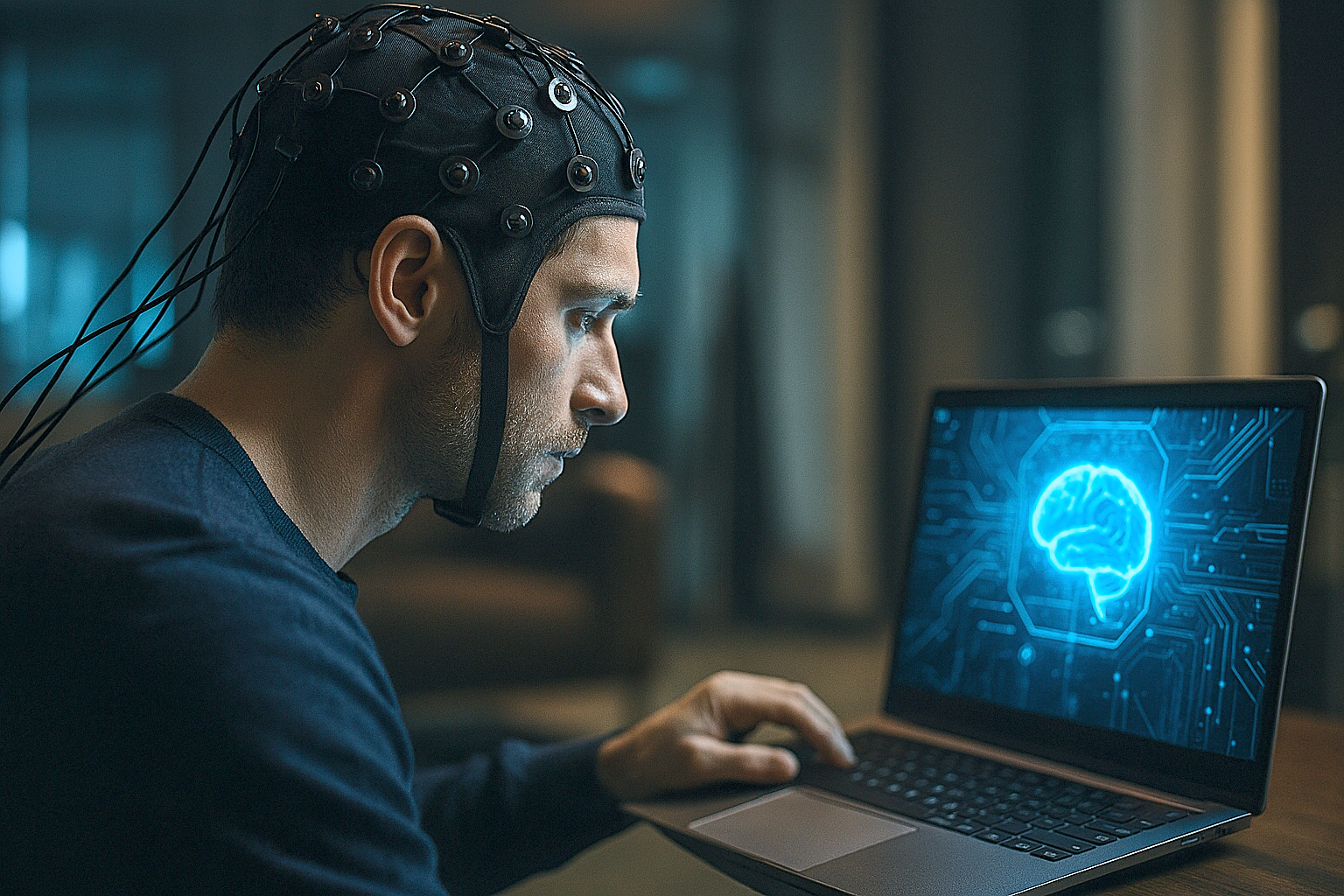
What “reading” currently means (and what we can actually do)
• Current wins (narrow, structured decoding): Researchers have produced convincing noninvasive decoders for perceived speech and limited inner/attempted speech, for classification of visual categories, and for reconstructing coarse images or intended text when the task is constrained and models are trained on lots of data. These results have advanced rapidly in 2023–2025 with new deep-learning and self-supervised methods. (Nature)
• What’s not happening yet: Noninvasive systems cannot reliably read free-form, private, multi-topic internal monologue at human level. Reconstructions are noisy, often task-constrained (e.g., choose one of a set), and need subject-specific training data. Reviews through 2024–25 emphasize that EEG/fNIRS remain low-resolution and that better imaging (MEG, ultrasound) plus ML is needed to close the gap. (PMC)
Most promising strategies (technical directions)
- Multimodal sensing (EEG + MEG + fNIRS + functional ultrasound): Each modality trades off temporal vs spatial resolution. Combining them (or using hybrid sensors that are increasingly wearable) gives richer information than any single one. Functional ultrasound (fUS) and high-density MEG (and mobile MEG research) are especially promising because they bridge spatial resolution gaps of EEG. (PMC)
- Scaling AI with self-supervised & transfer learning: Large models trained across many subjects and tasks can learn representations that generalize, reducing per-subject calibration. Recent work shows self-supervised scaling across hundreds of hours / many subjects substantially improves noninvasive decoding. (ICML)
- High-density, wearable sensor hardware: More electrodes/sensors, better amplifier electronics, improved shielding and preprocessing raise SNR and spatial resolution for scalp measurements — enabling more informative inputs to AI decoders. Advances in portable MEG and dense EEG arrays matter here. (ScienceDirect)
- Ultrasound imaging & focused-ultrasound neuromodulation: fUS can image hemodynamics noninvasively with promising spatial precision; transcranial focused ultrasound (tFUS) is also being explored both to modulate and to enhance BCI signals. These may be a step-change if safety, skull-penetration and device engineering are solved. (Science Advances)
- Closed-loop systems and personalization: Closed-loop feedback (the system adapts in real time to user signals and the user learns to produce better control) plus per-user fine-tuning of models improves practical performance far beyond one-time offline decoders. This is key for assistive applications. (BioMed Central)
Major obstacles (scientific, technical, social)
- Signal quality & physics limits: Noninvasive measures (EEG, fNIRS) are filtered through scalp/skull and dominated by noise and mixed sources; this fundamentally limits spatial resolution and the separability of nearby cortical signals. Even with clever algorithms, you can’t conjure detail that the sensors never captured. (PMC)
- Inverse problem & source localization: Mapping from surface potentials to precise neural sources is ill-posed — many brain source configurations explain the same scalp signal. That ambiguity makes fine-grained decoding (e.g., detailed inner speech content) intrinsically hard.
- Inter-subject variability and training data needs: Brain patterns vary across people and across time within a person. High-performance decoders so far often require lots of labeled data from each subject (or very large multisubject datasets + transfer learning). Collecting that data is slow, expensive, and privacy-sensitive. (arXiv)
- Temporal vs spatial tradeoffs: EEG is very fast but spatially coarse; hemodynamic methods (fMRI/fUS/fNIRS) have better spatial maps but are slower. Meaningful “thoughts” have both fast dynamics and spatially distributed representation—reconciling the tradeoff is hard.
- Ethics, privacy, consent, and misuse risk: Even imperfect decoders raise privacy concerns (accidental leaks of private thoughts, coercion). There are also regulatory and legal issues (who owns brain data, how to consent, safeguards). Recent trials and media coverage emphasize the social dimension. (The Guardian)
- Ground-truth labeling problem: For many internal states you want to decode (e.g., imagery, intention, semantic thought), it’s hard to obtain objective ground truth to train and evaluate models. That limits supervised learning.
Realistic timelines (best estimate, with uncertainty)
• Skillful, constrained decoding (commands, limited brain-to-text in constrained vocab, imagined speech detection, communication aids for locked-in patients): these are already demonstrable and will improve substantially within 1–5 years as models, datasets, and sensor hardware improve. (Examples: noninvasive brain-to-text demos and MEG/EEG speech-decoding papers in 2023–2025.) (Nature)
• Robust, generalizable noninvasive “brain-to-text” nearing implant-level performance for many users: this is plausible in 5–15 years in constrained domains (e.g., typing with imagined words, limited free-form text for trained users) if fUS/advanced MEG/AI scaling succeed. (ICML)
• Truly unconstrained, accurate “read any thought” noninvasive decoding: probably decades away (20+ years) if even possible — because of fundamental physics limits, privacy/ethical barriers, and the need to build massive, representative datasets and safe governance. Be cautious: timelines are speculative and depend strongly on breakthroughs in sensor tech and computation.
Practical recommendations (if you’re a researcher, builder, or policy maker)
For researchers/builders:
- Invest in multimodal datasets (EEG+MEG+fUS+behavioral alignment) and open, privacy-preserving shared corpora.
- Emphasize self-supervised pretraining across large heterogeneous brain datasets, then fine-tune per user. (ICML)
- Explore ultrasound (fUS/tFUS) engineering for safety, skull-coupling, and miniaturization — it may give a big jump in spatial fidelity. (PMC)
- Design robust gating and consent mechanisms (e.g., explicit user “password” mental gestures to enable decoding) to reduce accidental privacy violations — some implant studies already proposed such protections. (Financial Times)
For policy makers and ethicists:
- Create governance frameworks addressing brain data ownership, consent, data minimization, and permissible uses (medical vs consumer).
- Mandate transparency and auditing for systems that infer cognitive states or internal speech.
Bottom line
Noninvasive BCIs + AI are already decoding narrow, useful signals (speech perception, limited inner/attempted speech, intent classification). The near future (1–5 years) will expand practical assistive uses; the mid-future (5–15 years) may yield robust constrained brain-to-text in many users if hardware and AI scale together. But reading rich, unconstrained thought noninvasively faces hard physical, data, and ethical limits and — barring a disruptive sensor breakthrough — remains a multi-decade project.
Sources for state-of-the-art noninvasive decoding and fUS methods
Here are eight influential papers/reviews (2022–2025) that together capture the state-of-the-art in noninvasive neural decoding (speech/imagery/words) and functional-ultrasound (fUS) neuroimaging. For each I give a 1–3 sentence summary of why it matters and what the main advance is. If you want, I can fetch PDFs or pull key figures/quotes next.
- G. Montaldo et al., “Functional Ultrasound Neuroimaging” (2022) — an authoritative review that summarizes fUS theory, capabilities (very high spatio-temporal resolution compared with standard hemodynamic methods), species applications, and the technical challenges for translation to humans. A foundational primer for anyone assessing fUS as a next-generation noninvasive sensor. (PubMed)
- H. Zheng et al., “The Emergence of Functional Ultrasound for Noninvasive …” (2023) — a clear survey of the development and practical adoption of fUS, with emphasis on instrumentation, signal interpretation, and early non-rodent applications; useful for understanding maturity and engineering barriers. (PMC)
- C. Rabut et al., “Functional ultrasound imaging of human brain activity” (Science Translational Medicine, 2024) — a human proof-of-principle demonstrating fUS imaging of cortical activity through sonolucent skull replacement materials, showing that fUS can produce human-relevant signals and pointing to clinical translation routes. This is one of the most concrete steps toward human fUS. (Science)
- R. M. Jones et al., “Non-invasive 4D transcranial functional ultrasound and …” (2024) — demonstrates 4D (volumetric + time) transcranial fUS approaches and reports spatial/temporal resolution benchmarks achievable without craniectomy; advances the engineering case for noninvasive fUS imaging. (Nature)
- A. Défossez et al., “Decoding speech perception from non-invasive brain… ” (Nature Machine Intelligence, 2023) — a high-impact demonstration that MEG/EEG combined with modern deep representations (e.g., wav2vec embeddings) can decode continuous speech representations from noninvasive signals, moving beyond simple classification to richer perceptual decoding. It’s a milestone for noninvasive speech decoding with modern self-supervised model methods. (Nature)
- “Non-Invasive Speech Decoding with 175 Hours of EEG Data” (preprint, 2024) — large-scale single-subject EEG dataset and self-supervised training that substantially improves open-vocabulary speech segment classification from EEG; highlights how scale and long recordings improve noninvasive decoding. Valuable for methodology and for thinking about dataset requirements. (arXiv)
- S. d’Ascoli et al., “Decoding individual words from non-invasive brain …” (arXiv, 2024) — introduces a deep learning pipeline for decoding individual words from EEG/MEG; notable for tackling the hard problem of word-level decoding with noninvasive sensors and for contributing model/benchmarks others can build on. (arXiv)
- Meta AI / collaboration, “Brain-to-Text Decoding: A Non-invasive Approach via Typing” (Feb 2025 technical report) — a recent large effort that combines noninvasive recording, self-supervised pretraining, and clever behavioral paradigms (typing proxies) to demonstrate practical sentence-level decoding approaches; signals how industrial-scale data + ML practices are being applied to noninvasive BCIs. (Corporate research note / preprint style release; important for methods and scale.) (Meta AI)
What’s realistic now, what’s on the horizon, and what the key constraints are.
1. What “typing with imagined words” means in practice
- Motor imagery BCIs (oldest line): Users imagine moving their hand/finger, and an EEG system translates this into cursor movement or letter selection. This is reliable enough for very slow typing (1–5 words/minute).
- Imagined speech (inner speech) BCIs (newer line): Instead of motor movements, users silently imagine saying words. Systems try to decode phonemes, words, or at least classify which word was intended. Accuracy is still limited, but progress is steady.
- Hybrid approaches: Some recent work combines EEG/MEG signals with language models. The BCI decoder doesn’t need to resolve every phoneme; it just needs to give enough signal that an AI model can “autocomplete” to the intended word or phrase.
The idea is to compose text without vocalizing — by either thinking the word, imagining the sound, or using brain-triggered cues to select from AI-suggested completions.
2. Communicating with AI chatbots
- Near term (today–5 years): You could already imagine issuing prompt-like commands to a chatbot through EEG/MEG by slowly “typing” them, either via motor imagery or inner speech classification. A trained user could produce short instructions like “open email” or “summarize document”.
- Medium term (5–15 years): With better decoders + large language models, it becomes feasible to generate limited free-form prompts: the BCI outputs noisy guesses of imagined words, but the chatbot uses context and autocomplete to reconstruct the intended text. This could feel like “thinking a sentence into ChatGPT.”
- Longer term (15+ years, speculative): Drafting entire essays or papers directly from internal monologue without overt actions. To get there, researchers need breakthroughs in decoding continuous inner speech and handling the brain’s natural variability.
3. Drafting a paper with thoughts vs. vocalized words
- What works best now: If you subvocalize (quietly “say it in your head”), decoders can sometimes pick up correlates, especially with high-resolution sensors like MEG or ultrasound.
- Full internal silent thought (“raw concepts”): This is much harder. Inner monologue isn’t a simple audio stream; it’s distributed, abstract, and idiosyncratic. AI can help bridge the gap, but physics and signal-quality limits make this decades-away.
- Practical near-future model: You “think” words → BCI guesses fragments → AI fills in gaps → you confirm/correct with another modality (eye gaze, minimal muscle twitches, or corrections via the same BCI).
4. Key obstacles
- Signal quality: EEG/fNIRS are noisy and spatially coarse. MEG and fUS are better but still nontrivial to miniaturize.
- Speed: Current systems are slow (words per minute). Even with AI assistance, speed may remain 5–10× slower than typing for years.
- Training: Each user needs calibration. Imagined speech is idiosyncratic, so models need personal fine-tuning.
- Privacy & fatigue: “Always on” brain typing raises risks (unintended thoughts decoded, mental exhaustion).
Prompting an AI chatbot with brainwaves and drafting with imagined words are both real research trajectories. Today, they’re slow and clunky. Within ~5–15 years, we might see practical versions for assistive users (locked-in patients, severe motor impairments), where you could indeed draft prompts and short documents directly from thought. The leap to unconstrained “thought-to-essay” systems will take longer and require breakthroughs in both sensing and AI language models.
Filed under: Uncategorized |


 Educational Technology and Change Journal

Leave a comment