





By Jim Shimabukuro (assisted by Copilot)
Editor
Introduction: Quarterback performance in the NFL is deeply intertwined with the quality of the supporting cast. A porous offensive line can turn a genius into a scrambling liability. Mediocre receivers can nullify pinpoint accuracy. A weak running game invites defensive pressure. Coaching philosophy can either unlock a quarterback’s full potential or stifle it. And backup depth ensures continuity and strategic flexibility. Strip these away, and even the most gifted quarterback may appear pedestrian.
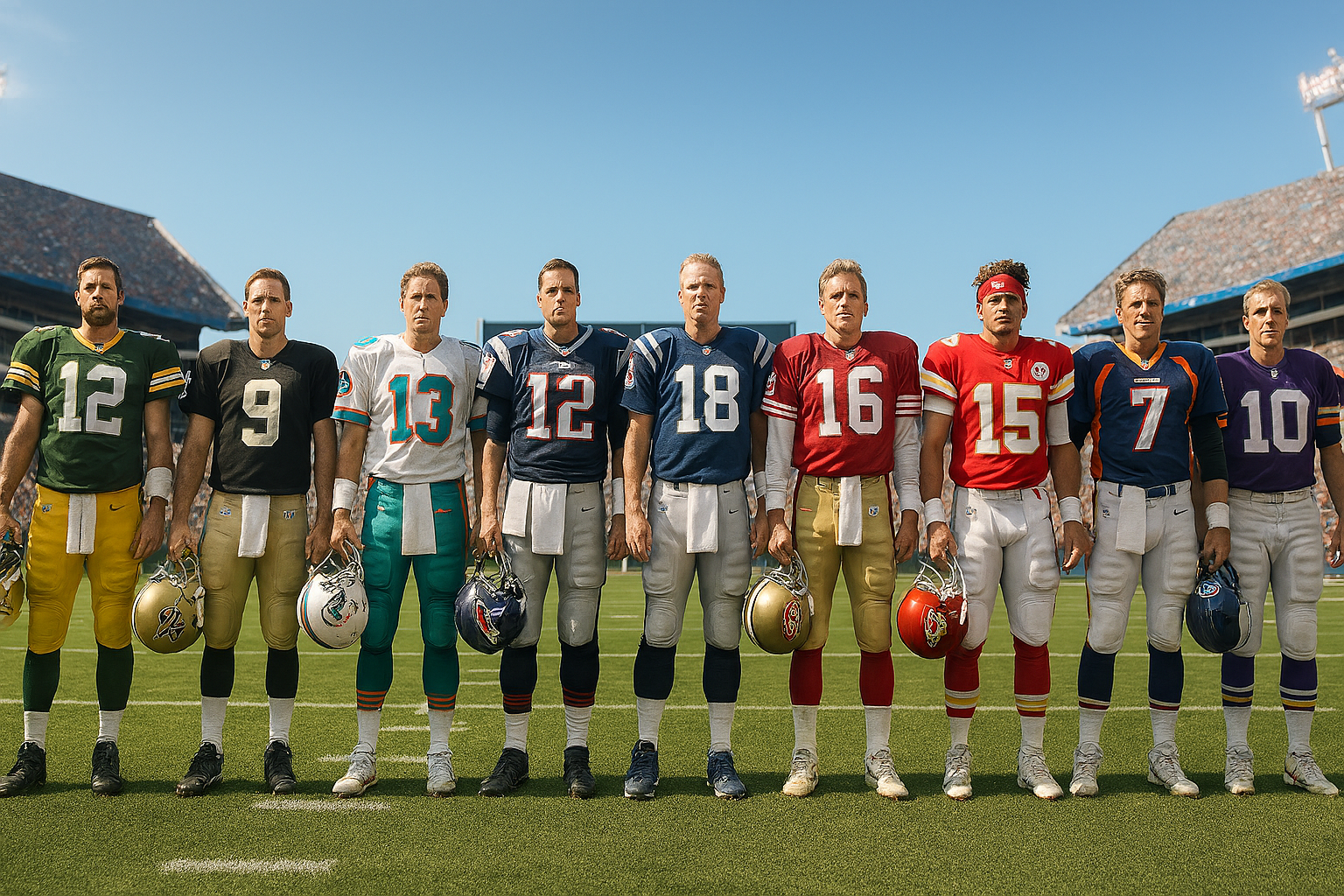
Now, if we level the playing field—equal offensive line protection, elite receivers, a balanced running game, visionary coaching, and reliable backups—we can isolate the quarterback’s intrinsic qualities: football IQ, accuracy, ingenuity, and leadership. These traits transcend systems and personnel. They define the quarterback as a field general, a tactician, and a creator.
Based on this framework, here’s a ranked list of the 10 greatest quarterbacks in NFL history, assuming equal support. Each essay will explore how their core traits would shine in a neutralized environment, and how their actual careers were shaped—sometimes hindered—by the variables mentioned.
Here’s the lineup:
- Peyton Manning
- Tom Brady
- Joe Montana
- Dan Marino
- Drew Brees
- Aaron Rodgers
- Steve Young
- Patrick Mahomes
- John Elway
- Fran Tarkenton
1. Peyton Manning: The Cerebral Commander
In the pantheon of NFL quarterbacks, Peyton Manning stands as the quintessential field general—less a gunslinger than a chess master, orchestrating each play with surgical precision and preternatural foresight. If we strip away the disparities in supporting cast and grant every quarterback equal tools, Manning’s brilliance becomes even more pronounced. His greatness was never predicated on athleticism or improvisation, but on an unmatched football intellect, relentless preparation, and an uncanny ability to manipulate defenses before the snap.
Manning’s football IQ was legendary. He didn’t just read defenses—he decoded them. Defensive coordinators often admitted that game-planning against him felt futile; he would diagnose their schemes at the line of scrimmage and audibly pivot to the perfect counter. His mastery of the no-huddle offense wasn’t just about tempo—it was about control. Manning turned the line of scrimmage into his laboratory, conducting experiments in real time, adjusting protections, routes, and timing with the confidence of a coach in cleats.
Accuracy was another pillar of Manning’s excellence. His throws weren’t always flashy, but they were ruthlessly efficient. He placed the ball where only his receiver could catch it, often threading needles in tight coverage. His timing routes—especially with Marvin Harrison and Reggie Wayne—were symphonic in their precision. Even in his twilight years in Denver, when his arm strength waned, his anticipation and ball placement remained elite.
Ingenuity defined Manning’s approach to the game. He didn’t rely on broken plays or backyard improvisation; he engineered solutions. His film study was obsessive, and he often knew opponents better than they knew themselves. He was a tactician who elevated the strategic complexity of quarterbacking, turning mental acuity into a weapon as potent as any cannon arm.
Leadership, too, was central to Manning’s legacy. He commanded respect not through bravado but through preparation and accountability. Teammates often spoke of his intensity and his demand for excellence. He was the kind of leader who made everyone around him smarter, sharper, and more disciplined. His presence in the locker room and on the sideline was galvanizing.
Had Manning been gifted a consistently dominant offensive line, a stable running game, and elite receivers throughout his career, his statistical records and postseason resume would likely be even more staggering. His lone Super Bowl win in Indianapolis and his second in Denver came despite, not because of, ideal circumstances. In a vacuum of equal support, Manning’s cerebral dominance would have rendered him nearly unstoppable—a maestro conducting a symphony of precision and control.
2. Tom Brady: The Relentless Architect of Victory
Tom Brady’s career is a study in sustained excellence, competitive obsession, and the art of winning. While his résumé glitters with seven Super Bowl rings and a mountain of records, what truly sets Brady apart—especially in a hypothetical world of equal support—is his unshakable command of situational football, his surgical precision under pressure, and his ability to elevate the moment. Brady didn’t just play the game; he mastered its rhythms, its psychology, and its stakes.
Brady’s football IQ is often overshadowed by his winning pedigree, but it is the foundation of his greatness. He possessed an encyclopedic understanding of defenses, coverages, and tendencies. His pre-snap reads were subtle but decisive, allowing him to exploit mismatches and anticipate blitzes with uncanny regularity. He wasn’t flashy at the line of scrimmage like Manning, but his quiet efficiency was lethal. He understood leverage, timing, and the geometry of the field in ways that made even modest offensive schemes hum with purpose.
Accuracy was Brady’s silent weapon. His throws weren’t always the deepest or most athletic, but they were consistently placed with intention. He excelled at short and intermediate routes, delivering balls with perfect touch and velocity. His timing with receivers—whether it was Wes Welker, Julian Edelman, or Rob Gronkowski—was the product of tireless repetition and mutual trust. In clutch moments, his ball placement was almost prophetic, threading passes through windows that seemed to close the instant they opened.
Ingenuity, for Brady, was less about improvisation and more about adaptation. He evolved constantly. Early in his career, he was a game manager with a defensive juggernaut behind him. Later, he became the centerpiece of a high-octane offense. In Tampa Bay, he reinvented himself again, thriving in a vertical passing scheme. His ability to absorb new systems, adapt to different personnel, and maintain elite performance across decades and dynasties is a testament to his mental flexibility and strategic depth.
Leadership was Brady’s most intangible yet most potent trait. He was a culture-setter, a tone-definer. His presence in the locker room was magnetic, his expectations uncompromising. Teammates followed him not because of charisma, but because of conviction. He made winning feel inevitable, and that belief permeated every huddle, every sideline, every fourth quarter.
Had Brady played his entire career with a consistently elite supporting cast—without the occasional porous line, receiver turnover, or coaching shifts—his statistical dominance would likely rival even the most prolific passers. But Brady’s genius was in making the most of what he had, and in a leveled landscape, his mastery of the game’s nuances would make him a perennial juggernaut. He wasn’t just a quarterback—he was a system unto himself.
3. Joe Montana: The Cool Virtuoso of Clutch
Joe Montana’s legacy is often distilled into a single word: clutch. But to reduce his greatness to late-game heroics is to miss the full scope of his mastery. Montana was not merely a quarterback who thrived under pressure—he was a virtuoso of rhythm, timing, and poise. In a hypothetical NFL where every quarterback is granted equal support, Montana’s intrinsic gifts—his calm intelligence, pinpoint accuracy, creative adaptability, and magnetic leadership—would shine even brighter, revealing a player whose greatness transcended system and circumstance.
Montana’s football IQ was subtle but profound. He didn’t overwhelm defenses with pre-snap theatrics or audible complexity; instead, he absorbed the game’s flow and responded with intuitive brilliance. He understood Bill Walsh’s West Coast offense not just as a playbook but as a philosophy—one that emphasized timing, spacing, and precision. Montana internalized this philosophy so deeply that he became its living embodiment, executing with such fluidity that the offense often felt like an extension of his own instincts.
Accuracy was Montana’s signature. His throws were rarely the longest, but they were almost always the most precise. He excelled in the short and intermediate game, delivering balls with perfect touch and placement. His passes arrived not just on time, but in stride, allowing receivers like Jerry Rice and John Taylor to maximize yards after the catch. Montana’s ball placement was so consistent that it often masked imperfections in protection or route execution. He made the complex look effortless.
Ingenuity, for Montana, was rooted in improvisational grace. He wasn’t a scrambler in the modern sense, but he had an uncanny ability to extend plays, slide in the pocket, and find solutions when structure broke down. His famous touchdown pass to Dwight Clark in the 1981 NFC Championship—“The Catch”—was a moment of spontaneous brilliance, a perfect blend of vision, touch, and nerve. Montana’s creativity wasn’t chaotic; it was composed, calculated, and always in service of the play.
Leadership was perhaps Montana’s most underrated trait. He didn’t command with volume or bravado; he led with calm. His teammates often spoke of his unflappable demeanor, his quiet confidence, and his ability to instill belief. In the biggest moments—Super Bowls, fourth quarters, two-minute drills—Montana radiated composure. That steadiness was contagious, elevating everyone around him.
Had Montana played with the kind of universal support we’re imagining—elite protection, receivers, coaching, and depth—his statistical output would likely rival the most prolific passers in history. But even without that, he won four Super Bowls, never lost one, and earned three Super Bowl MVPs. In a leveled landscape, Montana’s blend of intelligence, precision, creativity, and leadership would make him not just a winner, but a perennial dominator. He wasn’t just cool under pressure—he was cool in every moment, and that made him extraordinary.
4. Dan Marino: The Untamed Genius of the Pocket
Dan Marino was a paradox: a quarterback whose arm defied physics, whose release was lightning-quick, and whose vision stretched the field like few others—yet whose career was largely starved of the structural support that defines dynasties. In a hypothetical NFL where every quarterback is granted equal offensive line protection, elite receivers, a balanced running game, and visionary coaching, Marino’s raw talent and cerebral command would likely have yielded a legacy not just of brilliance, but of championships.
Marino’s football IQ was often overshadowed by the spectacle of his arm, but it was formidable. He was a master of anticipation, often throwing receivers open before they made their breaks. His understanding of defensive tendencies allowed him to exploit weaknesses with ruthless efficiency. He didn’t need motion or gimmicks to diagnose coverage—he read the field like a seasoned detective, piecing together clues in real time and delivering verdicts with velocity.
Accuracy, for Marino, was not just about completion percentage—it was about placement under duress. He threw into tight windows with confidence, often threading passes between defenders with millimeter precision. His deep ball was a thing of beauty, arcing perfectly into the hands of receivers like Mark Clayton and Mark Duper. But it was his intermediate game—those 15- to 25-yard lasers—that truly showcased his control. He could fit the ball into seams that most quarterbacks wouldn’t dare attempt.
Ingenuity was Marino’s quiet superpower. He wasn’t mobile in the traditional sense, but he had an uncanny feel for the pocket. He could sidestep pressure with subtle movements, reset his feet, and unleash a strike before defenders could react. His release was so fast that it often neutralized blitzes. He didn’t need broken plays to create magic—he manufactured it from structure, bending the rules of timing and space with sheer arm talent and mental agility.
Leadership, for Marino, was intense and uncompromising. He was fiery, demanding, and deeply competitive. Teammates respected his drive and his refusal to accept mediocrity. He led by example, by preparation, and by performance. Though he never won a Super Bowl, his presence elevated the Dolphins into perennial contenders, often in spite of a lackluster running game and inconsistent defense.
Had Marino been gifted the kind of balanced support that many of his peers enjoyed, his statistical dominance would have been matched by postseason glory. He threw for over 5,000 yards in 1984—a record that stood for decades—and redefined what was possible from the pocket. In a leveled landscape, Marino’s blend of intellect, precision, creativity, and fire would have made him not just a legend, but perhaps the most unstoppable quarterback the game has ever seen.
5. Drew Brees: The Precision Virtuoso of the Undersized Frame
Drew Brees redefined what was possible for a quarterback who didn’t fit the mold. At barely six feet tall, with no cannon arm and no scrambling flair, he built a Hall of Fame career on precision, preparation, and an almost obsessive understanding of the game’s mechanics. In a hypothetical NFL where every quarterback is granted equal support—elite offensive line, receivers, running game, coaching, and depth—Brees’s cerebral mastery and surgical accuracy would elevate him into the highest echelon of quarterbacking greatness, perhaps even beyond the statistical mountain he already climbed.
Brees’s football IQ was encyclopedic. He wasn’t just a student of the game; he was its archivist. His preparation was legendary—hours of film study, meticulous note-taking, and a relentless pursuit of defensive tendencies. He understood coverages not just in theory but in motion, anticipating shifts and disguises with uncanny precision. His ability to manipulate safeties with his eyes and anticipate blitzes made him a nightmare for defensive coordinators. He didn’t just react—he orchestrated.
Accuracy was Brees’s calling card. He led the NFL in completion percentage a record seven times, and it wasn’t a fluke. His ball placement was immaculate, whether on slants, fades, or deep outs. He threw receivers open, consistently hitting the exact shoulder, the precise stride, the perfect window. His timing was so refined that his passes often arrived before defenders could even recognize the route. In a leveled playing field, with elite receivers and protection, Brees’s accuracy would be weaponized to devastating effect.
Ingenuity, for Brees, was about adaptation. He compensated for his height with masterful pocket movement, subtle shifts, and an elevated release point. He understood angles and throwing lanes like a mathematician, finding space where others saw congestion. His creativity wasn’t improvisational chaos—it was engineered elegance. He turned limitations into strengths, crafting a style that was uniquely his and universally effective.
Leadership was the heartbeat of Brees’s career. He transformed the New Orleans Saints from perennial underachievers into champions, not just through play but through presence. He was a galvanizing force in the locker room, a beacon of resilience in a city recovering from catastrophe. His teammates revered him not just for his talent, but for his integrity, his work ethic, and his unwavering belief in collective excellence.
Had Brees played his entire career with consistent elite support—especially in his early years in San Diego—his postseason résumé might rival Brady’s. Even so, he retired as the NFL’s all-time leader in passing yards and completions, a testament to his relentless precision and intellectual dominance. In a world of equal footing, Brees wouldn’t just be prolific—he’d be unstoppable, a master craftsman carving defenses with scalpel-like efficiency.
6. Aaron Rodgers: The Alchemist of Arm Talent and Autonomy
Aaron Rodgers is the NFL’s great paradox—an artist cloaked in the armor of a technician. His career has been a masterclass in improvisation, precision, and cerebral autonomy. In a hypothetical league where every quarterback is granted equal support—elite offensive line, receivers, running game, coaching, and depth—Rodgers’s unique blend of football intelligence, uncanny accuracy, creative brilliance, and magnetic leadership would likely yield a legacy not just of MVPs, but of multiple championships and statistical dominance.
Rodgers’s football IQ is often misunderstood. He doesn’t command the line of scrimmage with the theatricality of Peyton Manning, but his understanding of defensive structures is profound. He reads leverage, disguises, and tendencies with quiet efficiency, often baiting defenders into false steps before punishing them with surgical throws. His mastery of cadence—particularly the hard count—is legendary, turning pre-snap rhythm into a strategic weapon. He’s not just reactive; he’s manipulative in the best sense, bending defenses to his will.
Accuracy is where Rodgers separates himself from nearly every quarterback in history. His ball placement is not just precise—it’s poetic. He throws with velocity, touch, and anticipation, often threading passes into windows that seem to exist only for him. Whether it’s a back-shoulder fade, a sideline dart, or a deep seam route, Rodgers delivers with a consistency that borders on supernatural. His interception rate is among the lowest in NFL history, a testament to his decision-making and mechanical discipline.
Ingenuity is Rodgers’s signature. He thrives in chaos, turning broken plays into masterpieces. His ability to escape pressure, reset his platform, and deliver off-schedule throws is unmatched. He’s a master of the off-platform throw, often launching passes from improbable angles with pinpoint precision. But his creativity isn’t reckless—it’s calculated. He knows when to take risks and when to protect possessions, blending flair with prudence in a way few quarterbacks ever have.
Leadership, for Rodgers, is complex but potent. He’s not the rah-rah type, but his presence commands respect. Teammates speak of his competitiveness, his preparation, and his ability to elevate the standard. He leads through performance, through expectation, and through a quiet intensity that permeates the locker room. His relationship with coaches has occasionally been turbulent, but that speaks more to his intellectual independence than to any lack of commitment.
Had Rodgers been gifted a consistently elite supporting cast—especially in the postseason—his career might include multiple Super Bowl titles. He often carried flawed rosters deep into contention, masking deficiencies with brilliance. In a leveled landscape, Rodgers’s arm talent, mental acuity, and improvisational genius would make him a perennial nightmare for defenses. He’s not just a quarterback—he’s a craftsman, a magician, and a tactician rolled into one.
7. Steve Young: The Left-Handed Virtuoso of Velocity and Vision
Steve Young’s journey to greatness was anything but linear. From being benched behind Joe Montana to redefining the quarterback position with his dual-threat brilliance, Young emerged as one of the most intellectually and athletically gifted passers the NFL has ever seen. In a hypothetical league where every quarterback is granted equal support—elite offensive line, receivers, running game, coaching, and depth—Young’s unique fusion of football IQ, pinpoint accuracy, improvisational genius, and inspirational leadership would place him firmly among the all-time elite.
Young’s football intelligence was forged through adversity. He didn’t inherit a system—he absorbed it. Under Bill Walsh and later George Seifert, Young mastered the West Coast offense, but he added layers of complexity through his own understanding of timing, leverage, and defensive manipulation. He was a meticulous student of the game, often staying late to study film and refine his reads. His ability to process information quickly allowed him to make split-second decisions that turned routine plays into explosive gains.
Accuracy was Young’s silent superpower. His career passer rating of 96.8 stood as the NFL’s best for years, and it wasn’t just a statistical anomaly—it was a reflection of his precision. He threw with velocity and touch, often hitting receivers in stride with uncanny consistency. His left-handed delivery was deceptive, and his mechanics were so refined that his passes rarely wavered. Whether threading a seam route to Jerry Rice or lofting a fade to Terrell Owens, Young’s ball placement was elite.
Ingenuity defined Young’s style. He was one of the first quarterbacks to truly weaponize mobility—not just to escape pressure, but to create. His scrambling wasn’t chaotic; it was calculated. He could reset the pocket, extend plays, and deliver strikes on the run with astonishing accuracy. His 49-yard touchdown run against the Vikings in 1988 remains one of the most iconic displays of quarterback athleticism. But Young wasn’t just a runner—he was a creator, blending structure and spontaneity into a seamless whole.
Leadership was the bedrock of Young’s rise. He didn’t just fill Montana’s shoes—he forged his own path. Teammates admired his resilience, his humility, and his relentless drive to improve. He led by example, by preparation, and by performance. His emotional intelligence was palpable, often rallying the team with quiet confidence and fierce determination. His Super Bowl XXIX performance—six touchdown passes and a record-setting passer rating—was the culmination of years of perseverance and leadership.
Had Young played his entire career with consistent elite support—without the early-career instability in Tampa Bay or the shadow of Montana—his statistical and postseason résumé would likely rival any quarterback in history. In a leveled landscape, his blend of intellect, precision, creativity, and heart would make him a perennial MVP candidate and a nightmare for defenses. He wasn’t just a quarterback—he was a revolution in cleats.
8. Patrick Mahomes: The Unscripted Prodigy of Controlled Chaos
Patrick Mahomes is the NFL’s modern marvel—a quarterback who blends improvisation with precision, athleticism with intellect, and swagger with substance. Still early in his career, Mahomes has already redefined the position, not just with highlight-reel throws but with a deep understanding of timing, space, and pressure. In a hypothetical league where every quarterback is granted equal support—elite offensive line, receivers, running game, coaching, and depth—Mahomes’s intrinsic gifts would not only endure but flourish, revealing a player whose ceiling may be higher than any we’ve seen.
Mahomes’s football IQ is often masked by his flair, but it is formidable. He processes defenses rapidly, often identifying coverage rotations and blitz packages before the snap. His post-snap reads are fluid, and he adjusts on the fly with a rare blend of instinct and calculation. He’s not just reacting—he’s orchestrating, often baiting defenders with eye movement and body language before delivering a strike. His understanding of leverage and route concepts allows him to exploit even the most disciplined secondaries.
Accuracy, for Mahomes, is multidimensional. He can throw from any platform, any angle, and still hit his target with startling precision. His deep ball is majestic, but it’s his intermediate and off-platform throws that truly showcase his control. Whether side-arming a pass around a defender or launching a 40-yard rope while rolling left, Mahomes maintains velocity and placement that defy conventional mechanics. His ability to throw receivers open—even in tight coverage—is already elite.
Ingenuity is Mahomes’s signature. He thrives in chaos, turning broken plays into masterpieces. His pocket movement is instinctive, his spatial awareness uncanny. He can escape pressure, reset his feet—or not—and deliver throws that seem impossible. But his creativity isn’t reckless; it’s calculated. He knows when to extend a play and when to protect the ball. His improvisation is rooted in preparation, and his flair is backed by discipline.
Leadership, for Mahomes, is magnetic. He commands the locker room with humility and confidence, earning respect through work ethic and performance. Teammates speak of his poise, his positivity, and his relentless drive to improve. He leads not just with talent, but with tone—setting a culture of accountability and belief. His presence elevates the team, and his calm in high-pressure moments is already legendary.
Had Mahomes played his entire career with equal support—without the occasional offensive line collapse or receiver inconsistency—his numbers and postseason dominance would likely be even more staggering. Yet even with imperfections, he’s already a two-time MVP and multiple-time Super Bowl champion. In a leveled landscape, Mahomes’s blend of intellect, precision, creativity, and leadership would make him not just dominant, but transcendent. He’s not just the future—he’s the blueprint for what quarterbacking can become.
9. John Elway: The Relentless Force of Will and Velocity
John Elway was the embodiment of competitive fire—a quarterback whose arm strength was mythic, whose mobility was underrated, and whose leadership bordered on heroic. His career spanned eras, philosophies, and personnel shifts, yet through it all, Elway remained a constant force. In a hypothetical NFL where every quarterback is granted equal support—elite offensive line, receivers, running game, coaching, and depth—Elway’s raw talent, strategic mind, improvisational brilliance, and indomitable leadership would have yielded a legacy not just of greatness, but of dominance from start to finish.
Elway’s football IQ was forged in adversity. He entered the league with expectations so immense they bordered on myth, and he spent much of his early career carrying underwhelming rosters to relevance. That crucible sharpened his mental acuity. He became a master of reading defenses, adjusting protections, and exploiting mismatches. His understanding of situational football—especially in late-game scenarios—was elite. He didn’t just play the game; he willed it into his image.
Accuracy was a nuanced part of Elway’s game. His arm strength was so overwhelming that it sometimes masked his touch, but when he needed precision, he delivered. His ability to throw on the run—especially rolling to his right—was unmatched in his era. He could launch 60-yard missiles with a flick of the wrist, but he also knew how to feather passes into tight windows. His mechanics were powerful yet controlled, and his ball placement improved steadily throughout his career.
Ingenuity was Elway’s trademark. He was one of the original dual-threat quarterbacks—not in the modern sense of designed runs, but in his ability to escape pressure and create. His mobility was deceptive; he could outrun linebackers, sidestep edge rushers, and deliver strikes while falling backward. His improvisation wasn’t chaotic—it was calculated, often turning broken plays into game-changing moments. The “helicopter” run in Super Bowl XXXII remains one of the most iconic examples of his fearless creativity.
Leadership was Elway’s soul. He was the emotional and strategic anchor of the Denver Broncos for over a decade. Teammates revered him for his toughness, his preparation, and his refusal to quit. He led by example, by grit, and by sheer force of personality. His presence elevated mediocre rosters into contenders, and his late-career championships were the culmination of years of carrying the franchise on his back.
Had Elway played his entire career with consistent elite support—especially in the 1980s, when his teams were often outmatched—his statistical and postseason résumé would rival any quarterback in history. Even so, he retired with two Super Bowl rings, nine Pro Bowl selections, and a legacy of resilience and brilliance. In a leveled landscape, Elway’s blend of intellect, precision, creativity, and leadership would make him a perennial juggernaut. He wasn’t just a quarterback—he was a force of nature.
10. Fran Tarkenton: The Original Maverick of Motion and Mind
Fran Tarkenton was a quarterback ahead of his time—a restless innovator in an era that demanded conformity. Long before the NFL embraced mobility and improvisation, Tarkenton was weaving through defenses, extending plays, and redefining what it meant to lead an offense. In a hypothetical league where every quarterback is granted equal support—elite offensive line, receivers, running game, coaching, and depth—Tarkenton’s cerebral agility, pinpoint accuracy, creative brilliance, and tenacious leadership would not only endure but flourish, revealing a pioneer whose greatness was often obscured by circumstance.
Tarkenton’s football IQ was exceptional. He didn’t just understand the playbook—he understood the game’s pulse. He read defenses with a mathematician’s eye, anticipating shifts and exploiting vulnerabilities. His mental processing was rapid and intuitive, allowing him to adjust mid-play and find solutions in real time. He was a master of the moment, often diagnosing coverage breakdowns before they materialized. In an era dominated by rigid pocket passers, Tarkenton’s mental flexibility was revolutionary.
Accuracy was a cornerstone of Tarkenton’s game. Though his mechanics were unconventional, his ball placement was consistently sharp. He threw with touch, timing, and anticipation, often delivering passes on the move with remarkable precision. His ability to hit receivers in stride—especially while evading pressure—was a testament to his spatial awareness and control. He didn’t rely on brute force; he relied on finesse, and his passing efficiency reflected that.
Ingenuity was Tarkenton’s signature. He was the NFL’s first true improviser, turning broken plays into opportunities. His scrambling wasn’t just athletic—it was strategic. He used movement to manipulate defenders, create throwing lanes, and buy time for receivers to uncover. His style was chaotic only to the untrained eye; in truth, it was a symphony of controlled disruption. Tarkenton didn’t just escape pressure—he weaponized it, turning adversity into advantage.
Leadership, for Tarkenton, was forged in resilience. He played for teams that were often outmatched, yet he led them to three Super Bowl appearances and multiple playoff runs. His competitiveness was relentless, his preparation meticulous, and his belief in his teammates unwavering. He wasn’t a vocal firebrand, but his presence galvanized those around him. He led by example, by innovation, and by sheer will.
Had Tarkenton played his entire career with consistent elite support—especially in the trenches and at skill positions—his legacy would likely include multiple championships and even more staggering statistics. Even without that, he retired as the NFL’s all-time leader in passing yards and touchdowns, a testament to his durability and brilliance. In a leveled landscape, Tarkenton’s blend of intellect, precision, creativity, and leadership would make him not just a trailblazer, but a perennial MVP. He wasn’t just ahead of his time—he was timeless.
__________
Prompt: Good morning, Copilot. Is it safe to assume that, in the game of American football, greatness in quarterbacking is usually determined by a number of key factors other than the QB himself, and five of the key factors are strength of offensive line, receivers, running game, offensive coaching philosophy, and backup players? In short, minus these strengths, even the theoretically best QB would be mediocre at best? Prompt: If we could hypothetically level the playing field and keep these 5 strengths constant, which 10 QBs in the history of the NFL would you consider the best? For “best,” let’s focus on QBing IQ, accuracy, ingenuity, and leadership. Let’s also assume that their actual personal records would be much better if not for the disparities in supporting factors. Identify, rank, and explain, in a 300-500 word essay for each QB, your choices. Avoid, as much as possible, bulleted lists.
Filed under: Uncategorized |


 Educational Technology and Change Journal

Leave a comment