




By Jim Shimabukuro (assisted by ChatGPT)
Editor
[Also see Status of DEI in Higher Education: November 2025]
Introduction: DEI in U.S. higher education is under intense pressure and rapid change. Two simultaneous forces are shaping the landscape: (1) political and legal attacks from state governments and the federal administration that are removing funding, outlawing certain DEI expenditures, and pressuring institutions to dismantle offices or change practices; and (2) campus conflicts (notably protests around Gaza/Israel and related free-speech/antisemitism claims) that have provoked federal probes and heightened scrutiny of how universities manage speech, safety, and inclusion.
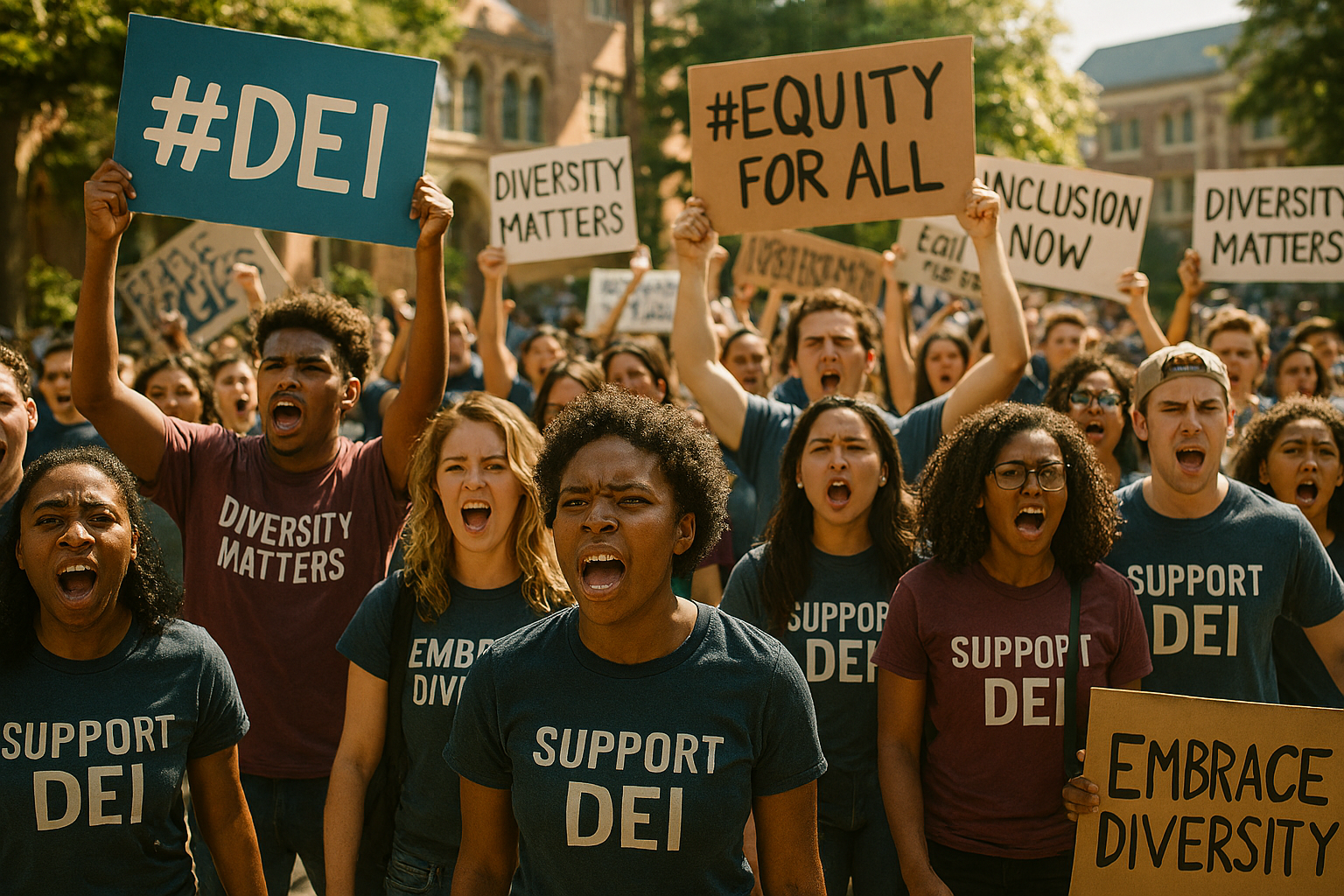
The result is a patchwork — some institutions are shrinking or eliminating DEI infrastructure, others are defending or reframing equity work, and many campuses are scrambling to preserve student support while complying with new legal and political constraints. (Reuters) In rank order, these are the five most troublesome issues:
1. Political & legal assault on DEI (laws, executive actions, federal leverage)
Brightest flashpoints: Florida public universities (system actions and state bans), Harvard and other elite universities facing federal threats to research funding, California State University under federal probe. (WUFT)
What the difficulty is:
State laws and executive policies now directly restrict the use of public funds for programs labeled “DEI,” ban certain trainings or requirements, or empower trustees/boards to remove DEI offices. At the federal level, agencies are using compliance and funding mechanisms to pressure campuses over how they handle allegations (e.g., antisemitism or alleged discrimination). These are not merely rhetorical attacks — they are using statutes, budget levers, subpoenas, and litigation that can remove funding or force institutional restructuring. (WUFT)
Why it matters:
Funding & legal status shape what colleges can actually staff and sustain. When the law or funding rules forbid DEI spending or make institutions vulnerable to loss of grants, universities may dismantle programs, lay off expert staff, and curtail student services — with direct harm to under-represented and marginalized students. At scale, the patchwork of restrictions fractures national norms about equal access, anti-discrimination obligations, and the role of higher education in preparing citizens for a diverse society. (The Chronicle of Higher Education)
Suggested strategies to resolve it:
- Legal & policy defense coordinated nationally. Universities should pool litigation resources, pursue constitutional and statutory defenses where appropriate, and coordinate amicus briefs to push back on overbroad application of funding sanctions. (Harvard and other institutions have litigated and negotiated on related matters.) (Reuters)
- Reframe DEI in operational, compliance, and student-success language. Translate DEI programs into compliance, safety, accreditation, Title IX/VI/ADA mitigation, student mental-health and retention initiatives, and workforce readiness — making them less ideologically framed and more plainly tied to core institutional missions. (AGB)
- Decentralize and embed services. Rather than single “DEI” silos that are easy targets, embed equity practices into admissions, student affairs, HR, and curriculum (so eliminating one office doesn’t remove supports).
- Transparency and data. Publish clear accounting showing cost-benefit (student retention, graduation, grant compliance) to reduce political narratives about waste.
- Legislative engagement. Invest in bipartisan messaging and local legislative outreach that explains how equity work supports workforce pipelines and state economic goals.
2. Campus protest, speech, and safety conflicts — antisemitism/pro-Palestine protests and federal probes
Brightest flashpoints: California State University system (federal subpoena/probe after pro-Palestine protests), UC Berkeley, Columbia, and other campuses that drew national attention in 2024–25. (Reuters)
What the difficulty is:
Large, emotional protest movements — particularly surrounding Israel-Gaza — have led to clashes about permissible speech, safety, harassment, and when protest becomes conduct that triggers Title VI or other civil-rights scrutiny. Federal agencies and administrations have responded with investigations and threats to funding, which in turn press campuses to police speech and protest more tightly or else face sanctions. Administrators are caught between protecting free expression, ensuring student safety, and complying with civil-rights obligations — a near-impossible triad in practice. (Reuters)
Why it matters:
These conflicts create polarized campus environments where students from different communities feel unsafe or unfairly treated, eroding trust and educational mission. They also provide political leverage to those who want to reduce academic autonomy. And when federal probes are launched, the legal and financial exposure for institutions skyrockets. (Reuters)
Suggested strategies to resolve it:
- Clear, pre-agreed protest/playbooks created with students. Co-authored codes of conduct for protests, clearly explained consequences, and rapid fact-finding protocols — created with student leaders, so legitimacy isn’t merely top-down.
- Rapid, impartial investigatory teams. Universities should have pre-trained neutral teams (faculty + counsel + ombud) able to investigate incidents quickly and publish findings, lowering the pressure for external actors to intervene.
- Targeted restorative practices. Use mediated dialogues, restorative circles, and community healing resources after protests to rebuild relationships.
- Legal preparedness & communication. Proactively brief funders and regulators on procedures and show evidence of consistent process to reduce the chance of punitive funding actions.
- Focused training on harassment vs. protected speech. Practical, example-based trainings for staff/students on when speech crosses into harassment that violates policies — to reduce misclassification and confusion.
3. Operational collapse: loss of DEI staff, offices, and institutional memory
Brightest flashpoints: University of Texas system (closures of DEI offices in 2024), University of Florida’s elimination of a chief diversity office and mass DEI staff reductions, Harvard and other elite schools replacing or shrinking diversity offices. (Scholars at Risk)
What the difficulty is:
When universities dismantle DEI units or lay off experienced staff, the tacit knowledge, community relationships, supplier contracts, and trained programming disappear. Rebuilding that capacity is slow and costly. Moreover, staff cutbacks often remove the people who answer student crises, manage accommodations, and handle bias incidents — creating immediate gaps in student support and compliance. (The Independent Florida Alligator)
Why it matters:
This is the operational “how” of equity — the people who implement policies, monitor outcomes, and provide services. Without them, policies exist on paper but not in practice, and students’ real needs (accommodation, reporting, advising) go unmet. It also heightens reputational risk because institutions that touted inclusion suddenly can’t deliver. (The Chronicle of Higher Education)
Suggested strategies to resolve it:
- Safeguard core student services from political labeling. Protect specific roles (e.g., bias response, accommodations, first-year inclusion programs) as essential student-service roles rather than “DEI” specialists.
- Cross-train related units. Equip student affairs, counseling, HR, accessibility services, and career centers to absorb essential functions so capacity isn’t all in one politically vulnerable office.
- Document and open-source playbooks. Create public operational manuals and handbooks so that essential functions can be rapidly redeployed even if one office is removed.
- Private philanthropy and partnerships. Where public funding is restricted, seek private donors or foundations (with transparency rules) to finance student supports that are framed as mental-health/retention investments.
4. Polarization in faculty hiring, tenure, and academic freedom (diversity statements, ideological litmus tests)
Brightest flashpoints: Harvard (public fights over diversity statements and the role of OEDIB), and other selective institutions where hiring language and required statements have been contested. (The Harvard Crimson)
What the difficulty is:
Debates over whether to require or weight diversity statements in hiring—plus pressures to change tenure standards or remove faculty for controversial speech—create chilling effects on hiring and scholarship. Universities risk losing top scholars who view the environment as politically risky; at the same time, critics argue diversity statements can be ideological gatekeeping. The underlying difficulty is balancing commitment to inclusive pedagogy with protection for open inquiry and non-discrimination. (The Harvard Crimson)
Why it matters:
Faculty hiring and tenure set the intellectual character of departments for decades. If processes become politicized or inconsistent, academic quality, faculty diversity, and trust in peer review suffer. Extremes either hollow out DEI commitments or invite retaliation against scholars. Both outcomes degrade teaching and research. (Harvard Law Forum)
Suggested strategies to resolve it:
- Clear, narrowly tailored evaluation rubrics. If institutions use statements, define precise criteria tied to teaching, mentoring, outreach, and evidence of practice — not ideological conformity.
- Independent review panels. Use disciplinary peers (including external reviewers) to separate academic assessment from political litmus tests.
- Due process guarantees. Strengthen institutional policies that protect academic freedom while also enforcing professional conduct standards consistently.
- Faculty governance engagement. Faculty senates and shared governance bodies should have lead roles in crafting and defending hiring criteria to ensure legitimacy.
5. Student belonging, mental health, and retention consequences
Brightest flashpoints: Numerous large public systems and selective campuses where reductions in services and harsher climates are reported (examples aggregated in national coverage; see Chronicle tracking). (The Chronicle of Higher Education)
What the difficulty is:
When DEI capacity shrinks and campus climates become more hostile or polarized, students from historically marginalized groups report worse belonging, higher attrition risk, and mental-health strain. This is worsened when bias incidents are perceived as mishandled. The difficulty is the lag time: negative climate effects show up in retention/graduation years later, whereas the political pressure to cut DEI is immediate. (The Chronicle of Higher Education)
Why it matters:
Student success metrics (retention, graduation, job placement) are core to institutional missions and funding models. Equity gaps in outcomes have real economic impacts on students and states. Losing students because campus supports were removed undermines both social mobility and institutional finances. (AGB)
Suggested strategies to resolve it:
- Protect essential student supports (counseling, accommodations, crisis response). Frame these as mental-health and safety investments rather than ideological programs.
- Targeted retention programs. Use data to direct limited resources to where gaps are largest (first-gen, Pell recipients, certain departments) — a narrow, evidence-based approach that is harder to veto politically.
- Peer networks and mentoring. Scale low-cost, high-impact peer mentoring and cohort programs that improve belonging without large DEI infrastructure.
- Measure and report outcomes transparently. Publicly report how changes affect retention and equity metrics so decisions are evidence-based.
Conclusion
DEI at colleges now sits at an intersection of law, politics, campus life, and basic student services. Some institutions will comply with restrictive laws and replace formal DEI offices with embedded, compliance-framed functions; others will litigate and resist. The risk for higher education is a bifurcated system: places that lose capacity to serve marginalized students, and places that preserve or reframe equity work but must do so defensibly and transparently. Policymakers, trustees, administrators, faculty, students, and the public will have to negotiate whether equity work is a partisan add-on or an integral function of higher education’s core missions (student success, compliance, and public service). (The Chronicle of Higher Education)
[End]
___________
Prompt 120325: On October 30, 2025, we wrote a report, “Status of DEI in Higher Education: November 2025.” Please review that report and update it for December 2025. Does the list of five issues remain the same? If not, update the changes. For each of the five, in a 250-to-500-word essay, pinpoint the brightest flashpoints in terms of specific college campuses. Identify key individuals if possible. Avoid bulleted lists as much as possible. For eachquoted source, include a clickable link. For each issue, (1) explain what, exactly, the difficulty is and why it matters; (2) share, in your opinion, the best possible strategy for resolving it; (3) include a sentence-length direct quote that reflects the problem.
Filed under: Status of DEI in Higher Education |


 Educational Technology and Change Journal

Leave a comment