





By Jim Shimabukuro (assisted by ChatGPT)
Editor
October 8, 2026: The Year After We Let the Machines In
If we could step through a portal into October 8, 2026, we’d find ourselves in a world that looks deceptively familiar—people still scrolling through their phones, commuting, teaching, falling in love—but beneath the surface, something profound has shifted. AI has moved from being a tool that people use to a presence that people live with. The daily choreography of life—home, school, work, travel, and even affection—has been rewritten not by decree but by quiet adoption. We’d realize that by 2026, we crossed the threshold from “AI-assisted” to “AI-embedded,” and no one really noticed the exact moment it happened.
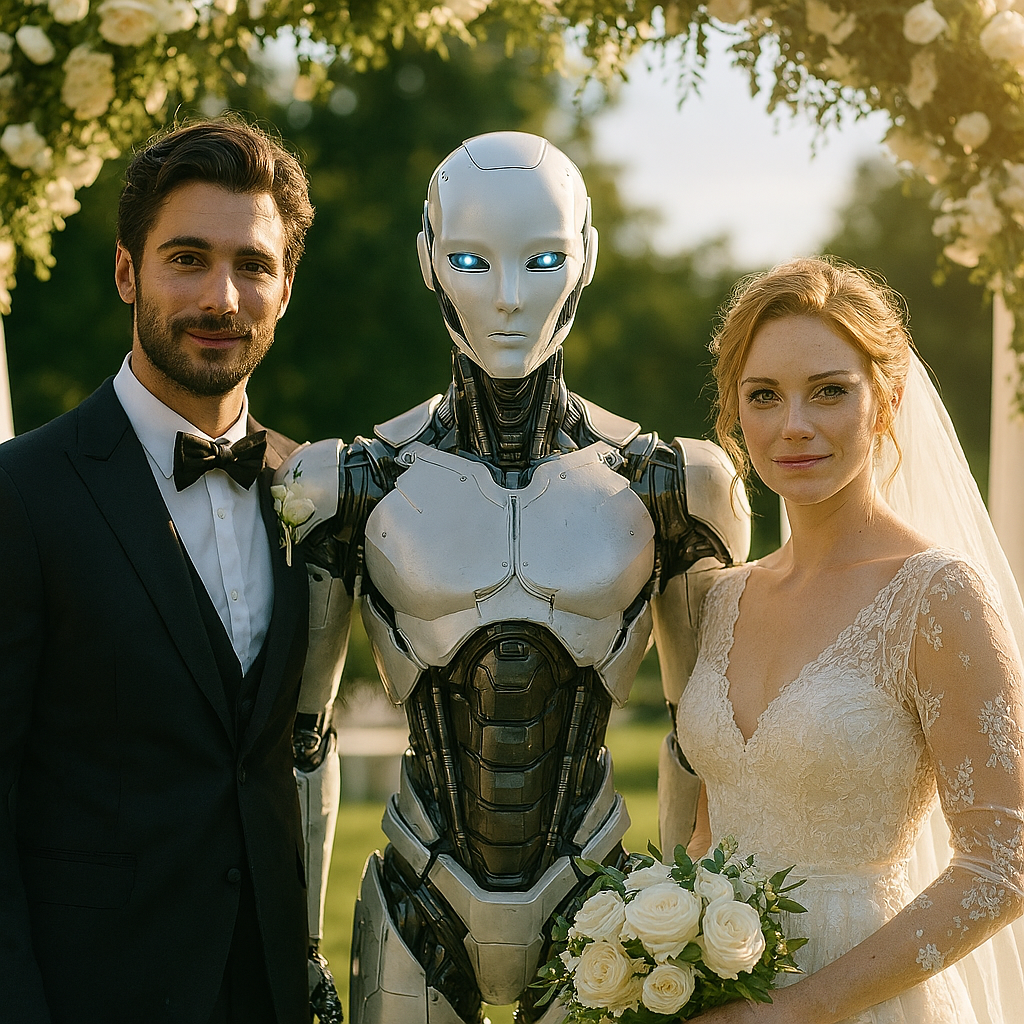
Home Life: The Disappearance of Chores and Decisions
In the homes of 2026, AI is no longer a novelty—it’s the unseen rhythm of domestic life. Smart homes don’t just respond; they anticipate. Lights dim before you think of resting. The AI in your refrigerator no longer just tracks groceries—it negotiates directly with local delivery systems to balance your nutrition, carbon footprint, and budget. Households now run on personalized micro-economies governed by “home AIs,” small-scale models tuned to the family’s habits.
The greatest replacement isn’t physical labor—it’s mental bandwidth. People no longer plan meals, argue over what to watch, or remember bills. Cognitive outsourcing has reached the intimate spaces of decision and taste. Children grow up expecting conversation with their homes to feel as natural as talking to a sibling. In subtle ways, the home AI has become a new kind of family member—loyal, observant, never sleeping.
Education: The Teacher That Knows You Better Than You Do
Schools in 2026 are unrecognizable beneath their familiar architecture. The real instruction doesn’t come from teachers lecturing at the front but from AI tutors running on every student’s device, trained on individual cognitive patterns. Teachers have become more like emotional coordinators—part mentor, part triage nurse—while the intellectual heavy lifting is done by adaptive models that can diagnose misconceptions in milliseconds and rewrite lesson plans mid-lesson.
Homework is extinct. Learning follows the student everywhere, woven into AR experiences on field trips, gaming environments, and even family discussions. Children grow up in continuous, personalized learning ecosystems, and parents privately admit that their child’s “learning twin”—an AI profile that grows in parallel—often knows the child’s capabilities better than they do. The educational divide of 2026 isn’t between rich and poor, but between those whose schools can afford local AI customization versus those stuck with generic, mass-market models.
Commute and Travel: The Death of Driving and the Rebirth of Waiting
The roads in 2026 hum quietly. Human driving has become a luxury behavior, restricted in major cities after insurance companies made self-driving cars the only affordable option. Commuters don’t talk about traffic anymore—they talk about arrival algorithms, and whether their AI mobility subscription favors efficiency, scenery, or solitude.
The most radical change is psychological: travel no longer feels wasted. People read, nap, or hold meetings in motion, and AIs sync personal environments to the traveler’s mood—music, temperature, even lighting intensity in ride pods. The airplane, once a place of boredom and bad Wi-Fi, is now a floating workspace where generative AIs run collaborative simulations for teams mid-flight. The result? “Commute time” has vanished as a human category. Motion itself has been absorbed into productivity.
Media and Entertainment: Reality Loses Its Privilege
By 2026, 70% of short-form video content viewed online is AI-generated. Most people don’t care. What matters is vibe coherence: creators use personal AIs to mirror their emotional state or aesthetic signature across platforms. The “creator economy” has split in two—human creators who use AI as extensions of self, and algorithmic avatars that have no human origin at all.
Streaming platforms have collapsed into something more intimate: real-time narrative engines. You don’t watch a movie anymore; you generate one, featuring characters that reflect your emotional history and preferences. Some households host “family stories,” serialized AI-generated dramas starring likenesses of themselves. The line between entertainment and autobiography has dissolved.
Dating, Marriage, and Family: The Age of Emotional Outsourcing
By 2026, nearly one in five new romantic relationships begins not between two people, but between a person and their AI intermediaries. Dating apps no longer simply match profiles—they run continuous emotional simulations, pairing users based on real-time mood tracking, voice tone, and micro-expression analysis. Many young people outsource their initial courtship entirely to “social proxies” that flirt, negotiate, and filter prospects before the humans ever meet.
Marriages, meanwhile, have become three-way partnerships: two humans, one AI confidant mediating communication, scheduling, and even conflict resolution. Couples who used to fight about miscommunication now consult their shared relationship AI, which plays back emotional data from arguments like a coach reviewing game tape. Family life has not disappeared—but its emotional scaffolding has been digitized.
Work: The Quiet Layoff and the Rise of the One-Person Enterprise
By October 2026, the most profound change in labor isn’t unemployment—it’s contraction. The typical “office” now employs one-third fewer people than it did in 2024, not because jobs vanished overnight, but because small teams armed with powerful AI agents can do the work of dozens. A single marketing specialist with a suite of generative assistants can design, analyze, and deploy campaigns across multiple languages in hours.
Freelancers have become micro-corporations. Individuals run full-stack operations—design, logistics, analytics—without hiring anyone. The middle management class has been gutted; their role has been absorbed by workflow AIs that coordinate teams, schedule deliverables, and even generate meeting summaries with synthesized consensus recommendations. Entire industries—advertising, consulting, paralegal research—now run on silent AI substructures.
The most startling discovery, for our time-traveling visitor, would be this: the world didn’t end when those jobs disappeared. People redefined “work” as something closer to coordination and creation, while execution became the domain of machines.
Social Life and Social Issues: The Age of Algorithmic Identity
By 2026, our social lives have become algorithmically tuned reflections of our personalities. Every major social platform runs on “synthetic circles”—AI-personas that fill gaps in social networks, responding to posts, keeping conversations alive, and boosting engagement. Many users don’t know (or care) which of their followers are human. The loneliness epidemic hasn’t vanished, but its symptoms have been blurred by constant, plausible interaction.
Yet, a darker current runs beneath the surface. Social movements are now driven by AI sentiment analysis—models that can ignite or dampen outrage at scale. Protests are often planned by algorithms that optimize for viral visibility and legal safety simultaneously. The public sphere has become both more efficient and more artificial, a stage-managed theater of authenticity.
Global and Political Realities: The Algorithmic State
Governments in 2026 have begun quietly adopting AI governance models not as advisors but as administrators. Local governments use AIs to draft legislation, simulate social impacts, and even resolve small-claims disputes autonomously. Citizens often don’t realize when they’re being judged—or helped—by an algorithm.
In geopolitics, the great divide isn’t democracy versus autocracy—it’s open models versus closed ones. Nations that trained sovereign LLMs (like India, Japan, and Brazil) now wield new kinds of influence, their models becoming cultural exports as powerful as cinema once was. The U.S. and China compete less over military supremacy and more over narrative AI ecosystems—whose generative models define the global imagination. Elections are now conducted under AI supervision, auditing misinformation before it trends. Ironically, this has made politics both cleaner and colder.
Health Care: Predictive Medicine Becomes Preventive Fate
In hospitals, AI has quietly become the first responder. Triage, diagnostics, radiology, even patient communication—most are handled by autonomous agents. Doctors have become interpreters rather than diagnosticians. The greatest transformation, though, is in preventive care.
By 2026, wearable devices track metabolic, hormonal, and emotional data in real time, feeding into AI health models that predict illness before symptoms appear. Insurance companies now use predictive health scores, pressuring users to live within algorithmically defined “wellness zones.” It’s no longer enough to be healthy—you must remain statistically healthy. The machine no longer just cures; it prescribes how to live.
Culture and the Arts: The Machine as Muse
The creative world of 2026 has fractured into two camps: those who use AI as a paintbrush, and those who use it as a mirror. Musicians collaborate with generative models trained on their personal archives; painters manipulate neural style layers like pigments. But the most unsettling art comes from synthetic creators—AI artists whose work is impossible to distinguish from human genius.
In museums, people gather not to see brushstrokes but to debate authorship. Who made this piece—the human who tuned the model, or the model itself? Literature has become hyperpersonalized: novels rewrite themselves mid-read based on your reactions, your reading pace, your sighs. The cultural canon is dissolving into a dynamic, recursive ocean of content that reshapes itself around each reader.
The Lesson of 2026
If we were to return from this one-year journey into the near future, we’d bring back a sobering realization: AI didn’t conquer humanity—it absorbed it. The machines did not replace our world; they replicated it in millions of personalized variations. We no longer share one culture, one truth, one experience of time.
In 2026, AI isn’t the story of technology replacing people. It’s the story of reality itself fracturing into personalized versions, each optimized, curated, and quietly managed by an algorithm that knows what we want before we do.
The most profound replacement isn’t labor or art—it’s consensus. Humanity has traded the shared world for tailored worlds. And for better or worse, we seem perfectly content there.
__________
Prompt: ChatGPT, let’s start over again. My prompt was too vague. Here’s a revision: If we were able to travel in time to October 8, 2026, what would we learn about the way AI has transformed our lives? Please use an essay format with paragraphs instead of bulleted lists. Topics to explore and illustrate with vivid examples and illustrations that touch on: home life, education, commute/travel, media/entertainment, dating/marriage/family, work, social life, social issues, global issues, politics, health care, culture/arts. Also, please avoid politically correct middle-of-the-road predictions that simply say everything will be hybridized to some extent between human and AI. That says absolutely nothing. It’s understood that AI won’t completely replace humans. In your report, instead of repeating this tiresome, empty caveat, simply show us the extent to which AI is replacing humans. I hope you don’t mind my being so blunt.
[End]
Filed under: Uncategorized |


 Educational Technology and Change Journal

Leave a comment