





By Jim Shimabukuro (assisted by ChatGPT)
Editor
[Also see World Leaders in AI Drone Warfare (Sep. 2025)]
Introduction: A month ago (Sep 13, 2025), I asked ChatGPT for a rank order of the 10 world leaders in AI drone warfare. For this report, I asked it to analyze data from Sep 14-Oct 13, 2025, update the rank order, and provide short justifications for each entry. ChatGPT responded by emphasizing the most important recent developments that changed relative position. Below is the updated ranking (top → bottom) and the reasons for each placement. ChatGPT also offered to create a concise scoring table for the 10 countries by four dimensions and provide a deep dive into Ukraine’s rise in rank order. -js
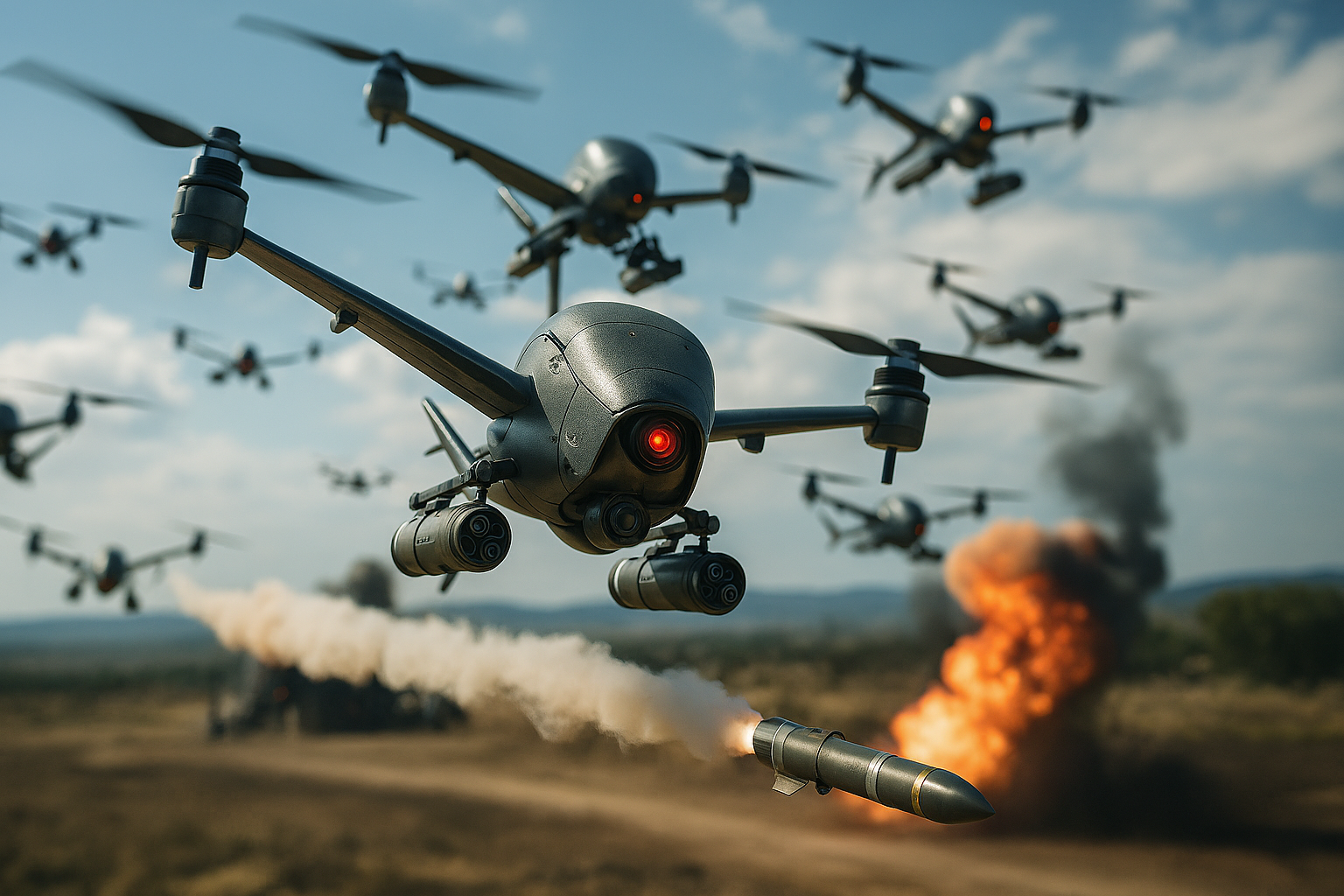
Updated ranking (14 Sep → 13 Oct 2025)
- United States (remains #1) — The US keeps its lead because of scale of R&D, fielded systems, contractor/DoD integration of autonomy, and rapid transition of commercial AI into soldier-systems (examples: new Anduril/DoD programs, advanced counter-drone kills). Recent U.S. industry/DoD moves (new AI wearables/mission-command integrations and continued operational adaptations) reinforce top position. (Business Insider)
- China (stays #2, but rising emphasis on swarms) — PLA doctrine and industry are explicitly pushing massed UxS/swarm concepts and testing them aggressively for scenarios such as Taiwan; reporting in late Sep–early Oct highlights PLA investments and naval “Great Wall” anti-swarm measures as part of a matched offense/defense race. That focused, state-backed push keeps China firmly in second. (CNA)
- Israel (stays #3) — Israel remains one of the most sophisticated developers of loitering munitions, autonomy, and counter-drone sensors. The October 7 shock accelerated development and deployment of new detection/kinetic and non-kinetic counter-drone systems, and Israel’s defense industry is iterating fast on both offensive loitering munitions and defensive AI systems. (The Jerusalem Post)
- Ukraine (moves up from #5 to #4) — Ukraine’s wartime production, field experience, and rapid adoption of tactical AI/drone tactics have pushed it ahead of Russia in practical, battlefield-effective drone innovation. Multiple analyses show Ukraine accelerating from “one operator, one drone” toward more automated, coordinated systems and becoming a major producer and innovator in tactical UAS technology. Operational experience and export/adaptation of Ukrainian designs (including UK production of Ukrainian interceptor concepts) drove this promotion. (Jamestown)
- Russia (drops from #4 to #5) — Russia continues large-scale operational use of attack and loitering drones (including Shahed-type strikes) and is fielding mothership and massed attacks, but supply-chain constraints and reliance on foreign dual-use components — plus growing evidence of Chinese components supporting Russian production — complicate long-term technology momentum. Russia remains highly capable operationally, but its technological depth and industrial sustainability are more mixed than before, which nudges it below Ukraine in this window. Recent reporting on Chinese component supply to Russian drone programs and drone attacks inside Russia are relevant. (The Washington Post)
- Turkey (remains #6) — Turkish systems remain globally influential because of large-scale exports and battle-proven designs (Bayraktar family and others). Continued export diplomacy and disputes tied to drone sales in October underscore Ankara’s role as an influential supplier and integrator of relatively low-cost, combat-tested attack UAVs. (Nordic Monitor)
- Iran (remains #7) — Iran’s Shahed family and similar long-endurance loitering munitions continue to be widely used (and proliferated) in 2025. Iran remains a major source of low-cost strike drones — important operationally and politically — but it trails the top tier in autonomous AI development sophistication. Recent analyses document Shahed evolution and continued export/use patterns. (adaptinstitute.org)
- United Kingdom (moves down slightly to #8) — The UK is accelerating development (plans to field swarms in coming years and to mass-produce Ukrainian interceptor designs), and it’s investing heavily in interceptors and counter-UAS after lessons from Ukraine. But program timelines and scale remain smaller than the top tier nations’ mass production and battlefield adaptation rates, so the UK ranks lower in pure “global leader in AI drone warfare” terms even though influence is growing. (UK Defence Journal)
- France (stays #9) — France continues important R&D and integration work (European cooperation, counter-UAS, and tactical UAS projects), but on this 30-day window it produced fewer headline operational advances compared with the above countries. Still a capable European player with strong industrial base. (No single disruptive new development in the Sep14–Oct13 window moved France up.) (Defense News)
- Australia (stays #10) — Australia invests in autonomy, counter-UAS, and integration with allied programs, but its industrial base and rate of export / battlefield experimentation are smaller; Australia remains important regionally and in allied R&D but doesn’t yet match the top nine in scale or operational tempo. (Navy Times)
Short notes on why the list changed (key drivers between 14 Sep–13 Oct 2025)
- Ukraine’s practical rise. Continued mass production, battlefield iteration, and adoption of more automated swarm tactics have accelerated Ukraine’s practical lead in tactical drone warfare; the country’s field experience and exportable designs (and allied production support) are why it jumps above Russia in the short term. (Jamestown)
- China’s push and duality. China is scaling both offensive swarm R&D and hardening/defensive measures (naval “Great Wall”). The state-directed focus keeps China in the immediate top-tier. (CNA)
- Russia’s operational reach vs. industrial fragility. Russia still fields large numbers of attack drones and uses them aggressively, but reporting shows increasing reliance on outside components (notably Chinese dual-use parts) and significant economic/pipeline disruption from drone strikes — factors that temper longer-term sustainability and thus its relative rank. (The Washington Post)
- U.S. momentum via industry–DoD integration. New DoD/industry prototypes, fielded AI mission command wearables, and continued counter-drone operational adaptations hold the US at #1. Examples in October show contractors moving rapidly from lab to field. (Business Insider)
Caveats & uncertainty
- Fast-moving battlefield data. The operational picture (who is “best”) depends heavily on how you weight R&D sophistication, industrial scale, fielded combat performance, and export/influence. Different weightings would shuffle positions, especially in the mid tier (Turkey/Iran/UK/France/Australia).
- Open-source reporting limitations. Much of modern autonomy is secret or embargoed; public reporting (journalism, think tanks) can lag or miss classified programs. I cited recent open sources; classified programs could materially change real rankings. (CNA)
Below are (A) a concise scoring table for the 10 countries by four dimensions using reporting from 14 Sept → 13 Oct 2025, and (B) a deep-dive on Ukraine (programs, factories, fielded systems, constraints, and near-term trajectories) with source links.
I scored each dimension on a 1–10 scale (10 = strongest) using open reporting from the Sep 14 → Oct 13, 2025 window. Scores are comparative across this 10-country set and intended to reflect relative strength in that month (R&D = doctrinal & technical sophistication; Industrial scale = ability to mass-produce hardware; Battlefield performance = real combat effect & adaptation; Export/Influence = foreign sales, tech transfer, and doctrinal influence).
A. Short scoring table (Sep 14 → Oct 13, 2025)
| Country | R&D (1–10) | Industrial scale (1–10) | Battlefield performance (1–10) | Export / Influence (1–10) |
|---|---|---|---|---|
| United States | 10 | 9 | 9 | 9 |
| China | 9 | 10 | 8 | 8 |
| Israel | 9 | 7 | 8 | 8 |
| Ukraine | 8 | 6 | 10 | 7 |
| Russia | 7 | 8 | 9 | 6 |
| Turkey | 7 | 6 | 7 | 9 |
| Iran | 5 | 6 | 7 | 8 |
| United Kingdom | 6 | 5 | 6 | 6 |
| France | 6 | 5 | 6 | 5 |
| Australia | 5 | 4 | 5 | 4 |
Notes on scoring choices (short):
- United States: top R&D and industrial integration (commercial AI → DoD pipelines); strong battlefield testing and global influence. (See DoD/industry reporting across Oct.) (Defense Security Monitor)
- China: very large industrial base and state-driven swarm programs (high production + R&D), but open-source suggests less battlefield exposure compared to Ukraine/Russia in this period. (Institute for the Study of War)
- Ukraine: exceptional battlefield performance and rapid combat innovation (autonomous swarms, massed low-cost loitering munitions). Industrial scale lags larger states but is rapidly expanding via foreign co-production. (The Wall Street Journal)
- Russia: very high operational tempo and quantity (Shahed/mass attacks) but growing supply-chain fragility and reliance on Chinese dual-use parts. (Business Insider)
- Turkey/Iran/Israel/UK/France/Australia: mixed strengths — Turkey strong exporter (Bayraktar line), Israel high R&D and niche systems, Iran large proliferator of low-cost strike drones, UK/France/Australia smaller-scale but investing heavily in counter-UAS and allied co-production. (Army University Press)
B. Deep dive: Ukraine programs, factories, fielded systems, near-term trajectory (Sep 14 → Oct 13, 2025)
Sep 14 → Oct 13, 2025)
Executive summary
Since 2022 Ukraine has run the fastest field-driven cycle of tactical UAS innovation in modern history. By Sep–Oct 2025 the country combined intense battlefield learning with rapid small-firm innovation and selective scaling via Western partnerships. That mix produced the world’s most battle-tested tactical drone ecosystem: cheap, mass-produced loitering munitions and FPV/attack drones used in combined arms operations, new uncrewed surface vessels (USVs), and early operational uses of limited autonomous swarms. Ukraine’s chief near-term challenge is converting battlefield ingenuity into reliable mass production at scale — a problem being addressed through allied co-production agreements and relocation of critical lines to NATO soil. (Defense Security Monitor)
Fielded systems & operational patterns
- Loitering munitions & FPV attack drones. Ukraine fields large numbers of low-cost loitering munitions (kamikaze drones) and FPV attack drones for tactical strikes on armor, logistics and rear areas. Open reporting in this period documents sustained high sortie counts and continual incremental improvements in guidance, sensors, and counter-countermeasures. Observers credit Ukraine with developing tactics that integrate these UAS into combined arms—using cheap massed attritable effects to shape battles. (Defense Security Monitor)
- Long-range strike drones & missiles. Ukrainian startups and firms (e.g., Fire Point) have developed longer-range strike platforms and cruise-missile-like vehicles (sometimes described in reporting as the “Flamingo” family), enabling deep strikes into Russian logistics and facilities when politically directed. These require more sophisticated guidance and fuels/manufacturing than the cheapest loitering munitions but demonstrate a maturing industrial base for higher-end systems. (The Associated Press)
- Sea drones / USVs. Ukraine is innovating at sea as well: Magura-class USVs have been used offensively against Russian naval assets, expanding the definition of “drone war” to littoral operations. This cross-domain use of uncrewed systems complicates adversary defenses. (CSIS)
- Autonomous swarms (early operationalization). Multiple outlets reported that Ukraine had operationalized limited autonomous swarm behavior — groups of drones sharing information and executing pre-coordinated missions with some on-platform decision logic. This is a nascent capability but notable because it represents real combat use of multi-agent autonomy in 2025. (The Wall Street Journal)
Industrial base & production
- Domestic firms and agile SMEs. Ukraine’s production model is unusually dependent on nimble private firms that iterate quickly (design → prototype → immediate battlefield feedback). That model produces rapid innovation, but scaling beyond tens or hundreds per week requires capital, safe factory space, and supply chains. AP reporting spotlighted firms (e.g., Fire Point) with secretive factories producing more advanced systems. (The Associated Press)
- Supply constraints & reliance on partners. By late 2025 Ukrainian firms faced limits: finance, component shortages, and vulnerability to strikes. Allies are responding: Denmark’s “Build for Ukraine” and the UK/Ukraine co-production plans aim to move and scale production into NATO territory (and to produce mass interceptors). Defense News and other reports from Oct 2025 show formal agreements to host Ukrainian production and share tech, which materially eases Ukraine’s industrial ceiling. (Business Insider)
- Co-production & mass interceptor programs. New initiatives (for example, UK–Ukraine co-production of thousands of interceptors under Project Octopus) intend to neutralize Russian massed Shahed attacks and provide large-volume production lines — a sign that allies are shifting from mere training/equipment to industrial integration with Ukraine. If executed, these moves will significantly raise Ukraine’s effective industrial scale. (Army Recognition)
Battlefield adaptation & doctrine
- Ukraine’s continuous loop of combat → iterate → field is the decisive factor giving it top marks in battlefield performance. Units rapidly adopt new drone tactics (e.g., pocket swarms, mall-scale loitering munition barrages, FPV suppression raids), and Ukrainian engineers update software/hardware based on frontline feedback. This has allowed Ukraine to punch above its raw industrial weight. (Defense Security Monitor)
Constraints, risks, and adversary counters
- Adversary scale and supply. Russia’s surge in long-range drone production and the scale of Shahed-type attacks (and reports of ~4,000 drones/month production) pose a blunt-force challenge that can overwhelm defensive systems unless matched by mass interceptors and better early warning. Moreover, reporting showed Russia increasingly supported by Chinese dual-use supply chains — a trend that, if unchecked, could bolster Russian production rates. Ukraine’s co-production moves are a direct response to that threat. (Business Insider)
- Finance and security of production. Many Ukrainian production sites remain within reach of Russian strikes; allied relocation programs aim to preserve production continuity and scale. The speed and success of those programs will strongly influence Ukraine’s near-term trajectory. (Business Insider)
Likely near-term trajectory (next 3–12 months from Oct 2025)
- Scaling via allied production. Expect meaningful increases in monthly production of interceptors and selected Ukrainian designs as UK/Danish/Nordic co-production facilities come online — shifting some output off Ukrainian soil. This will blunt Russia’s nightly barrage tactics. (Defense News)
- Improved integration & doctrine. Ukraine will continue to refine swarm/autonomy tactics and integrate drones into fire control, intelligence, and deception operations — raising combined arms lethality. (The Wall Street Journal)
- Diversification of effects. Continued proliferation of sea drones, longer-range strike drones, and specialized counter-UAS gear developed domestically and with allies. Expect more specialized platforms (anti-armor, anti-ship, electronic-attack payloads). (CSIS)
Key sources (representative)
- AP reporting on Fire Point / Ukrainian long-range drones. (The Associated Press)
- Defense News / ArmyRecognition on UK–Ukraine co-production and Project Octopus. (Defense News)
- WSJ, Army-Technology, and related reporting on operational use of autonomous swarms and battlefield innovation. (The Wall Street Journal)
- CSIS analysis on Magura USVs and cross-domain innovations. (CSIS)
- Washington Post and Business Insider reporting on Chinese dual-use supplies to Russia and Russia’s drone sortie volumes (context on the adversary problem). (The Washington Post)
Filed under: World Leaders in |


 Educational Technology and Change Journal

[…] Estados Unidos sigue liderando en sistemas UAV y contramedidas, pero su estrategia también reconoce la necesidad de enfrentar enjambres autónomos como una amenaza emergente. etcjournal.com […]