





By Jim Shimabukuro (assisted by Claude)
Editor
The headline that greeted readers on October 28, 2025, felt both shocking and inevitable: Amazon, one of the world’s largest employers, was eliminating 14,000 corporate positions.* Yet this announcement represents far more than a single company’s cost-cutting measure. It is the latest and most dramatic chapter in a fundamental transformation sweeping through American industry, where artificial intelligence is not merely changing how work gets done but redefining which jobs exist at all.
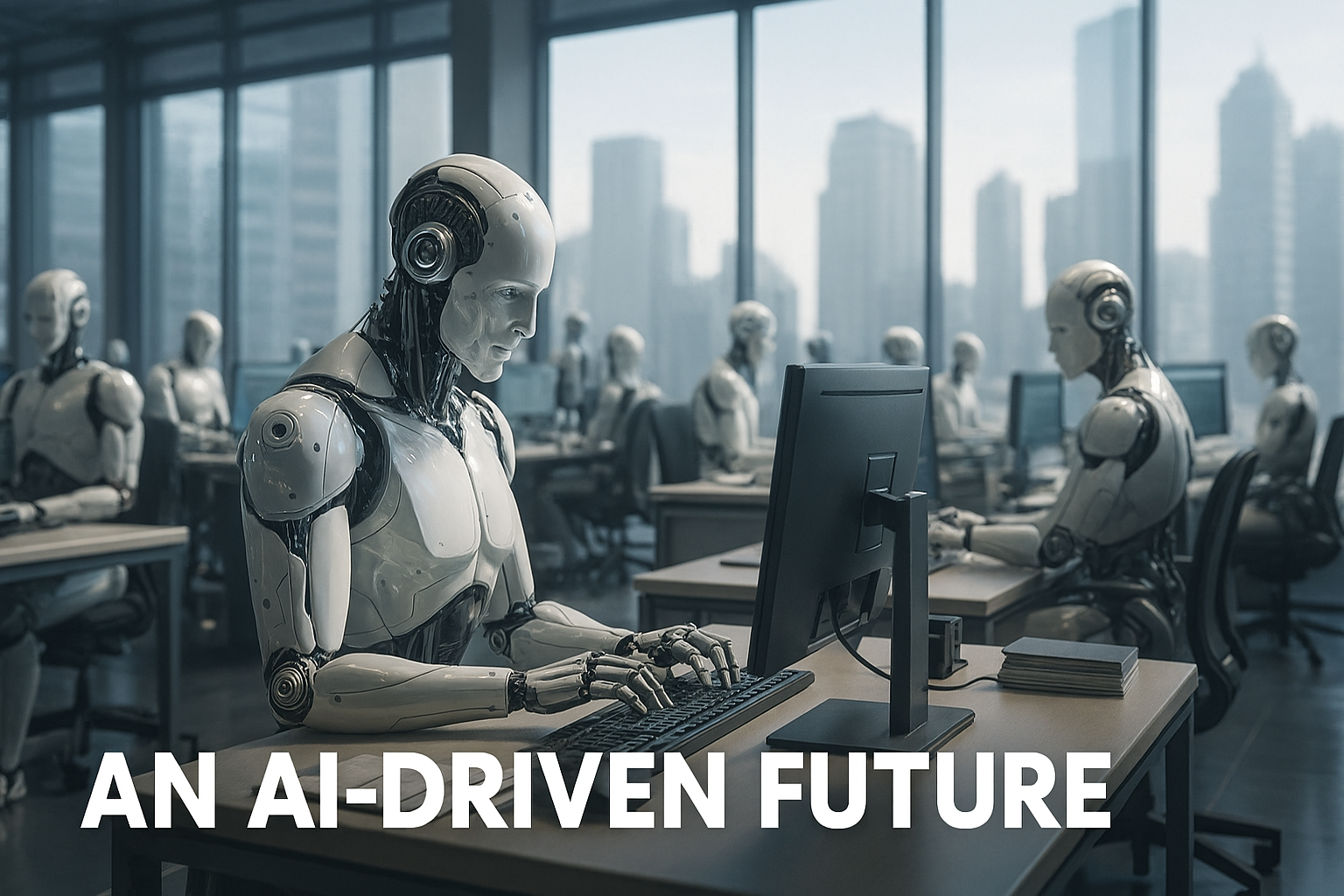
Amazon’s announcement comes amid what has become the largest sustained wave of technology sector layoffs since the dot-com crash of the early 2000s. According to industry trackers, more than 98,000 technology workers have lost their jobs across over 200 companies in 2025 alone, following more than 150,000 cuts in 2024. What distinguishes this wave from previous downturns is not its scale but its cause. These companies are not struggling financially. Instead, they are deliberately restructuring their workforces to align with an AI-driven future that their own CEOs describe as inevitable and transformative.
Amazon: The October Earthquake
The Amazon layoffs announced on October 28, 2025, affecting approximately 14,000 corporate roles, represent the company’s largest single workforce reduction since the pandemic-era adjustments of 2022-2023. Beth Galetti, Amazon’s senior vice president of people experience and technology, framed the cuts as necessary to create “the world’s largest startup,” removing bureaucratic layers and increasing individual ownership. The timing proved particularly significant, coming just months after CEO Andy Jassy warned employees in June that artificial intelligence would fundamentally alter the company’s staffing needs.
Jassy’s memo, published on Amazon’s website, pulled no punches about what the future holds. Those who embrace AI would be “well-positioned to have high impact and help us reinvent the company,” he wrote, but this transformation meant Amazon would “need fewer people doing some of the jobs that are being done today, and more people doing other types of jobs.” The 14,000 positions being eliminated represent a substantial portion of Amazon’s roughly 350,000 worldwide corporate employees, and add to the more than 27,000 corporate jobs the company has eliminated in waves since 2022.
Initial reports from Reuters and The Wall Street Journal had suggested the cuts could reach as high as 30,000 positions, though Amazon’s official announcement settled on the 14,000 figure. Regardless of the exact number, economic historian Carl Frey of Oxford University characterized the move bluntly: Amazon is “freeing up cash to fund astronomical AI infrastructure spend—and AI, in turn, enables organizations to run leaner.” Frey drew parallels to the computer revolution of previous decades, when firms similarly slimmed down and stripped out management layers not just to cut costs but to react faster to rapid technological change.
The Amazon cuts specifically target middle management and administrative roles, positions that artificial intelligence tools can increasingly handle through automation and sophisticated algorithms. Customer service representatives, human resources personnel, and layers of project management find themselves particularly vulnerable as AI chatbots, automated workflow systems, and machine learning algorithms demonstrate increasing capability to handle tasks that once required human judgment.
Microsoft: The Steady Drumbeat of Reduction
If Amazon’s October announcement provided the headline-grabbing moment, Microsoft has been orchestrating perhaps the most sustained and systematic workforce transformation in the technology sector. The company has eliminated approximately 15,000 positions throughout 2025, with major cuts announced in May (nearly 6,000 employees) and July (another 9,000), representing roughly four percent of its global workforce.
CEO Satya Nadella characterized these reductions as “reorganization rather than performance” issues, a distinction that actually makes the situation more unsettling for workers. These are not layoffs driven by poor quarterly earnings or economic downturns. Instead, Microsoft is deliberately restructuring around a flatter organizational hierarchy with fewer middle managers and more engineers focused on artificial intelligence development. The company is reportedly targeting non-technical roles and program manager positions that don’t directly contribute to engineering output, while simultaneously expanding its AI research and development teams.
The strategy reflects a fundamental rebalancing. Microsoft has publicly stated that its AI tools, including Copilot, now generate approximately thirty percent of the company’s code. This productivity multiplier means the company can accomplish more with fewer people per project, particularly in routine development tasks. The cuts have hit gaming divisions, cloud computing administrative roles, and layers of middle management that once coordinated between teams but now find their coordinating functions increasingly handled by AI-powered project management systems.
Intel: Crisis Management Meets AI Pivot
Intel’s workforce reductions in 2025 tell a more complex story, mixing traditional crisis management with strategic AI repositioning. The struggling chipmaker has eliminated approximately 24,000 positions throughout the year, representing roughly twenty percent of its workforce and marking the company’s most dramatic downsizing in its history. The cuts began in April under new CEO Lip-Bu Tan, who inherited a company that had fallen behind competitors AMD and Nvidia in both the mobile processor revolution and the current AI chip boom.
Intel’s July earnings report revealed the scope of the transformation. The company announced plans to end 2025 with just 75,000 core employees, down from approximately 108,900 at the end of 2024. Worker Adjustment and Retraining Notification filings showed thousands of positions eliminated across California, Oregon, Arizona, and Texas, with particularly severe cuts at the company’s manufacturing and engineering facilities. Intel also announced it was scrapping major facility construction projects in Germany and Poland, consolidating operations in Costa Rica by moving them to Vietnam, and winding down its entire automotive chip division.
The Intel cuts differ from Amazon and Microsoft in an important respect: Intel is genuinely struggling financially, posting a quarterly net loss of $2.9 billion in its second quarter earnings, nearly double its loss during the same period in the prior year. CEO Tan described the workforce reduction as designed to create “a faster-moving, flatter and more agile organization” better positioned to compete in an AI-driven semiconductor market. The company’s legacy position as the dominant PC processor manufacturer has eroded dramatically as competitors captured the smartphone and AI accelerator markets that now drive industry growth.
Yet even Intel’s crisis-driven cuts reflect the broader AI restructuring pattern. The company is eliminating non-core operations like human resources, marketing, and back-office staff while attempting to refocus engineering talent on AI-optimized chip designs. The challenge Intel faces is whether it can execute this pivot quickly enough, having already lost crucial years to competitors while the AI boom exploded around it.
Meta: Performance Purges with AI Objectives
Meta’s approach to workforce reduction in 2025 has been perhaps the most explicitly performance-driven, though the underlying strategic driver remains artificial intelligence investment. The company eliminated approximately 3,600 employees at the start of 2025, characterizing the cuts as performance-based restructuring. Additional reductions throughout the year, including over 100 positions in the Reality Labs division responsible for virtual reality development, have continued the downsizing trend.
CEO Mark Zuckerberg has been unusually candid about his workforce philosophy, telling employees that 2025 would be “an intense year” and making clear he wanted “the best people on our teams” focused on AI, smart glasses as the next computing platform, and the future of social media. In statements that echoed throughout the industry, Zuckerberg suggested that AI could be ready within the year to function “effectively as a sort of mid-level engineer, capable of writing code.”
This comment revealed the fundamental disruption underway. If artificial intelligence can perform mid-level engineering work, then companies need fewer mid-level engineers. Meta’s layoffs have coincided with the company simultaneously offering $100 million bonuses for new AI hires and rapidly constructing AI data centers. The message could not be clearer: Meta is not reducing its ambitions or its investments, but rather reallocating resources from traditional roles to AI-focused positions and infrastructure.
The Reality Labs cuts proved particularly telling. Virtual reality and augmented reality represented Meta’s big bet on the future of computing just a few years ago. Now, with artificial intelligence demonstrating more immediate potential for revenue and user engagement, those teams find themselves vulnerable despite working on supposedly cutting-edge technology. The lesson: in the current environment, not even “future-focused” technology roles are safe if they don’t align with the AI priority.
IBM: The HR Automation Experiment
IBM’s workforce transformation in 2025 provided perhaps the most vivid illustration of artificial intelligence directly replacing human workers. The company eliminated approximately 8,000 positions, with the majority concentrated in human resources departments. IBM replaced approximately 200 HR roles with AI agents capable of handling repetitive administrative tasks such as responding to employee queries, processing paperwork, and organizing HR data. These software-driven agents, deployed through IBM’s AskHR platform, require minimal human supervision and demonstrate the practical application of AI automation in corporate back-office functions.
CEO Arvind Krishna defended the strategy, insisting the company’s total employment had actually increased despite the HR cuts. IBM was not simply eliminating positions to reduce headcount, Krishna argued, but rather modernizing by shifting resources from process-driven administrative roles to positions requiring human creativity, strategic thinking, and people management. Chief Human Resources Officer Nickle LaMoreaux reinforced this framing, stating that “very few roles will be completely replaced” and that AI would primarily “take over the repetitive parts of the job, freeing up employees to focus on areas that need human judgment and decision-making.”
The AskHR platform that enabled these cuts processed over 11.5 million internal interactions in 2024, handling approximately ninety-four percent of routine HR inquiries. The system’s net promoter score surged from negative thirty-five to positive seventy-four, a dramatic improvement that IBM cited as evidence that automation could enhance rather than diminish service quality. Yet six percent of inquiries still required human intervention, typically involving sensitive workplace issues, ethical dilemmas, or emotionally charged conversations that required empathy and discretion.
IBM’s experience proved more nuanced than the headlines suggested. Some reports circulated claims that the company had replaced 8,000 HR workers with a chatbot, but the reality involved cuts across multiple departments beyond HR, with automation enabling rather than entirely replacing human roles. Moreover, IBM subsequently hired extensively in software engineering, sales, and marketing positions—areas where the cost savings from automation provided capital for expansion into higher-value work. The company’s transformation illustrated both the promise and limitations of AI: it excels at routine tasks but struggles with the complexity and emotional intelligence that characterize many human interactions.
The AI Imperative: Funding the Future by Cutting the Present
These five companies—Amazon, Microsoft, Intel, Meta, and IBM—represent more than isolated cases of corporate downsizing. Together they reveal a fundamental pattern reshaping American business: companies are restructuring their workforces not because they cannot afford current employees, but because they cannot afford not to invest massively in artificial intelligence infrastructure, and those investments require redirecting resources from human capital to computational capital.
The numbers behind AI investment are staggering. Microsoft, Meta, Amazon, and Google have collectively committed hundreds of billions of dollars to building AI data centers, training massive language models, and developing the computational infrastructure necessary to deploy AI at scale. These investments demand immediate capital, and the fastest way to free up that capital is reducing payroll expenses through workforce reductions. Industry expert Deedy Das of Menlo Ventures characterized the situation succinctly: these layoffs are “less about AI replacing workers and more about freeing up capital for AI investments.”
This distinction matters less to displaced workers than to corporate strategists, but it helps explain why profitable, growing companies are nonetheless making such dramatic cuts. Microsoft is not eliminating 15,000 positions because it cannot afford them; it is eliminating those positions to fund the AI initiatives it believes will determine competitive success over the next decade. The same logic applies to Amazon’s cuts, Meta’s restructuring, and even parts of Intel’s dramatic downsizing.
The trajectory extends beyond the five major companies examined here. Google has reduced hundreds of roles in its Android, Pixel, and Chrome teams while redirecting resources toward its Bard and Gemini AI projects. Salesforce cut approximately 1,000 employees in restructuring exercises throughout 2025. Tesla eliminated 14,000 workers. Cisco reduced its headcount by 9,600. SAP let go of 9,500 employees. Even companies outside the traditional technology sector have followed similar patterns, with firms like PwC cutting approximately 1,500 jobs and education technology company Chegg reducing its workforce by twenty-two percent as students increasingly turn to free AI-powered study tools.
The pattern reveals itself across virtually every major technology company: flatten management structures, eliminate administrative and support roles, automate routine tasks through AI systems, and redirect the resulting savings into AI research, development, and infrastructure. The World Economic Forum projects that approximately 92 million jobs will be displaced by AI by 2030, though it simultaneously forecasts the creation of roughly 170 million new roles, yielding a net gain of 78 million positions. Whether individual workers displaced in 2025 will successfully transition to those new roles remains an open and troubling question.
Understanding the AI Disruption: Beyond Simple Automation
The current wave of AI-driven workforce transformation differs fundamentally from previous automation waves. Earlier automation primarily replaced manual labor and routine physical tasks. Robots assembled cars, automated systems handled manufacturing processes, and computerization streamlined basic clerical work. But the jobs eliminated typically involved repetitive physical actions or simple data processing—work that, while valuable, did not require complex reasoning, creativity, or interpersonal skills.
The current generation of AI disrupts white-collar work precisely because it demonstrates unprecedented capability in areas previously considered definitively human: language processing, pattern recognition, creative content generation, and even aspects of reasoning and judgment. Large language models can draft correspondence, summarize documents, write code, analyze data, and respond to customer inquiries with a fluency that would have seemed impossible just five years ago. Computer vision systems can review images and video with accuracy rivaling human observers. Machine learning algorithms can identify patterns in vast datasets that no human could practically analyze.
These capabilities directly threaten middle-management positions, administrative roles, customer service representatives, entry-level programmers, content moderators, and various other positions that involve processing information, making routine decisions, or communicating within defined parameters. Microsoft’s revelation that AI now writes thirty percent of its code illustrates the disruption: if AI handles the routine coding tasks, companies need fewer junior developers to do that work, even as they may need more senior engineers to design systems and guide AI outputs.
The flattening of organizational hierarchies represents another crucial dynamic. Traditional corporate structures featured layers of middle management that coordinated between teams, compiled reports, managed projects, and served as information conduits between senior executives and front-line workers. AI-powered project management systems, automated reporting tools, and sophisticated communication platforms increasingly handle these coordinating functions. Companies like Amazon and Microsoft explicitly cite the removal of management layers as a goal, creating flatter organizations where fewer people directly connect senior leadership with individual contributors.
Customer service and administrative functions face particularly acute disruption. IBM’s AskHR platform, handling 11.5 million interactions and resolving ninety-four percent of routine inquiries, demonstrates AI’s capability to replace entire departments of human workers handling repetitive questions. Amazon’s cuts target similar roles: customer service representatives fielding routine inquiries, HR personnel processing standard requests, administrative assistants scheduling meetings and managing correspondence. These positions, once entry points for career development, increasingly cease to exist as AI systems demonstrate they can handle the work faster, cheaper, and at unlimited scale.
The Coming Months: Acceleration and Anxiety
The trajectory for the coming months suggests acceleration rather than stabilization. The technology enabling this disruption continues improving rapidly. GPT-4, Claude 3, Gemini, and other large language models demonstrate expanding capabilities with each iteration. Multimodal AI systems that can process images, video, and audio alongside text open new categories of work to automation. Agent-based AI systems that can execute complex multi-step tasks with minimal human supervision represent the next frontier, potentially automating work that currently requires sustained human attention and judgment.
Corporate incentives point toward continued workforce restructuring. Companies that fail to invest aggressively in AI risk falling behind competitors who do, creating a prisoner’s dilemma dynamic where each firm feels compelled to match or exceed rivals’ investments regardless of the social costs. The massive capital requirements for competitive AI infrastructure—billions of dollars for data centers, computing resources, and talent—demand finding savings elsewhere, and payroll represents the largest controllable expense for most technology companies.
The labor market data already reflects these pressures. The Federal Reserve Bank of New York reports unemployment among recent college graduates aged 22-27 has surged from 3.9 percent in 2022 to 5.8 percent in early 2025, outpacing the general unemployment rate. Entry-level technology roles, once reliably available for new graduates, have contracted dramatically as companies eliminate junior positions and expect AI tools to augment the productivity of remaining workers. Oxford Economics attributes much of this increase to the disappearance of routine tech roles, particularly in IT and computer services, which have seen an eight percent decline in employment for this age group since 2022.
Industry leaders’ public statements suggest they view current disruption as merely the beginning. Ford CEO Jim Farley and Anthropic CEO Dario Amodei have separately predicted that AI will displace essentially half of all white-collar positions. Amazon’s Andy Jassy has warned employees directly that AI will reduce the need for workers in many current roles. Meta’s Mark Zuckerberg envisions AI functioning as mid-level engineers. These are not fringe predictions from technology skeptics but rather projections from the very executives making decisions about hiring, firing, and investment.
The automation will likely accelerate because AI capabilities expand while costs decline. Training large language models required hundreds of millions of dollars just two years ago; costs have fallen dramatically as techniques improve and computing becomes more efficient. This cost reduction makes AI economically viable for increasingly routine tasks, expanding the range of jobs vulnerable to automation. Moreover, as companies deploy AI systems and observe their effectiveness, confidence grows about eliminating additional human roles.
The psychological and social impacts may prove as significant as the economic disruption. Workers across white-collar professions face fundamental uncertainty about career trajectories that previously seemed stable. Entry-level positions that once served as stepping stones to middle-management roles are vanishing, creating questions about how workers develop expertise and advance professionally. The social contract between employers and employees, already frayed by decades of declining job security and benefits, faces further erosion as companies explicitly state their intention to replace human workers with AI wherever economically feasible.
Conclusion: The Restructuring Imperative
The layoffs announced by Amazon on October 28, 2025, along with the concurrent cuts at Microsoft, Intel, Meta, and IBM, represent neither temporary setbacks nor typical economic cycle downturns. They mark instead the visible manifestation of a fundamental restructuring of work itself, driven by artificial intelligence capabilities that are expanding faster than most workers can adapt. These companies are not failing; they are transforming, deliberately and systematically shifting resources from human labor to computational infrastructure they believe will determine competitive advantage in the coming decades.
The pattern is clear: eliminate layers of middle management, automate administrative and routine cognitive work, redirect savings into AI research and infrastructure, and reshape organizations around smaller groups of highly skilled workers augmented by increasingly capable AI systems. This transformation will continue through 2025 and beyond, accelerating as AI capabilities expand and costs decline. The 98,000 technology workers laid off in 2025 will likely be joined by hundreds of thousands more across technology and other sectors as the restructuring spreads.
Whether this transformation ultimately creates more opportunities than it destroys depends on factors beyond current visibility: the pace of AI capability growth, the types of roles that emerge, the effectiveness of workforce retraining, and the policy responses governments implement. The World Economic Forum’s projection of net job creation by 2030 offers some hope, but the transition period promises to be wrenching, particularly for workers whose skills align with precisely the roles AI handles most effectively.
For now, the message from October 28, 2025, echoes across corporate America with uncomfortable clarity: the jobs that seemed secure yesterday may not exist tomorrow, and the transformation has only begun. Andy Jassy’s warning to Amazon employees applies broadly: those who embrace AI may thrive, but the company—and the broader economy—will need fewer people doing the jobs being done today. The great restructuring is not coming; it has arrived, and its acceleration in the coming months seems all but certain.
__________
* Ramishah Maruf, “Amazon just cut 14,000 jobs, and it’s not done,” CNN, 28 Oct. 2025.
Prompt: Good morning, Claude. I have a whopper for you. CNN published a story this morning (10/28/25) with the headline “Amazon just cut 14,000 jobs, and it’s not done.” Assuming this a recent growing trend for big companies in the US, in an essay-style format that avoids bulleted lists and charts, identify other major companies that have also announced similar cuts in 2025. In 1000-to-3000 words, summarize the key details, including the announced dates of the layoffs, regarding the Amazon cuts as well as cuts in the other companies. If there are many companies, then select the top 5 with the most layoffs with an eye toward exposing a trend or common thread that’s causing it. Assuming that the cause is AI, dig a bit deeper in your analysis of AI causes and its trajectory in the coming months.
Filed under: Uncategorized |


 Educational Technology and Change Journal

Leave a comment