





By Jim Shimabukuro (assisted by ChatGPT)
Editor
[Also see AI Will Transform College Architecture and Environment in the Next 3 to 5 Years]
Introduction: As of November 4, 2025, AI is reshaping college campus architecture and environment. Taken together, these changes show that AI’s influence on campus is not merely an IT or curricular update: it is a material, spatial and governance transformation. New hubs and instrumented labs concentrate AI resources and change campus traffic and program adjacency; AI-responsive classrooms require different structural and finish choices (raised access floors, networked ceilings, acoustic zoning); instrumented building operations change façades, mechanical systems and commissioning practices; and AI surveillance reshapes public space and triggers new policy/ethics design work.
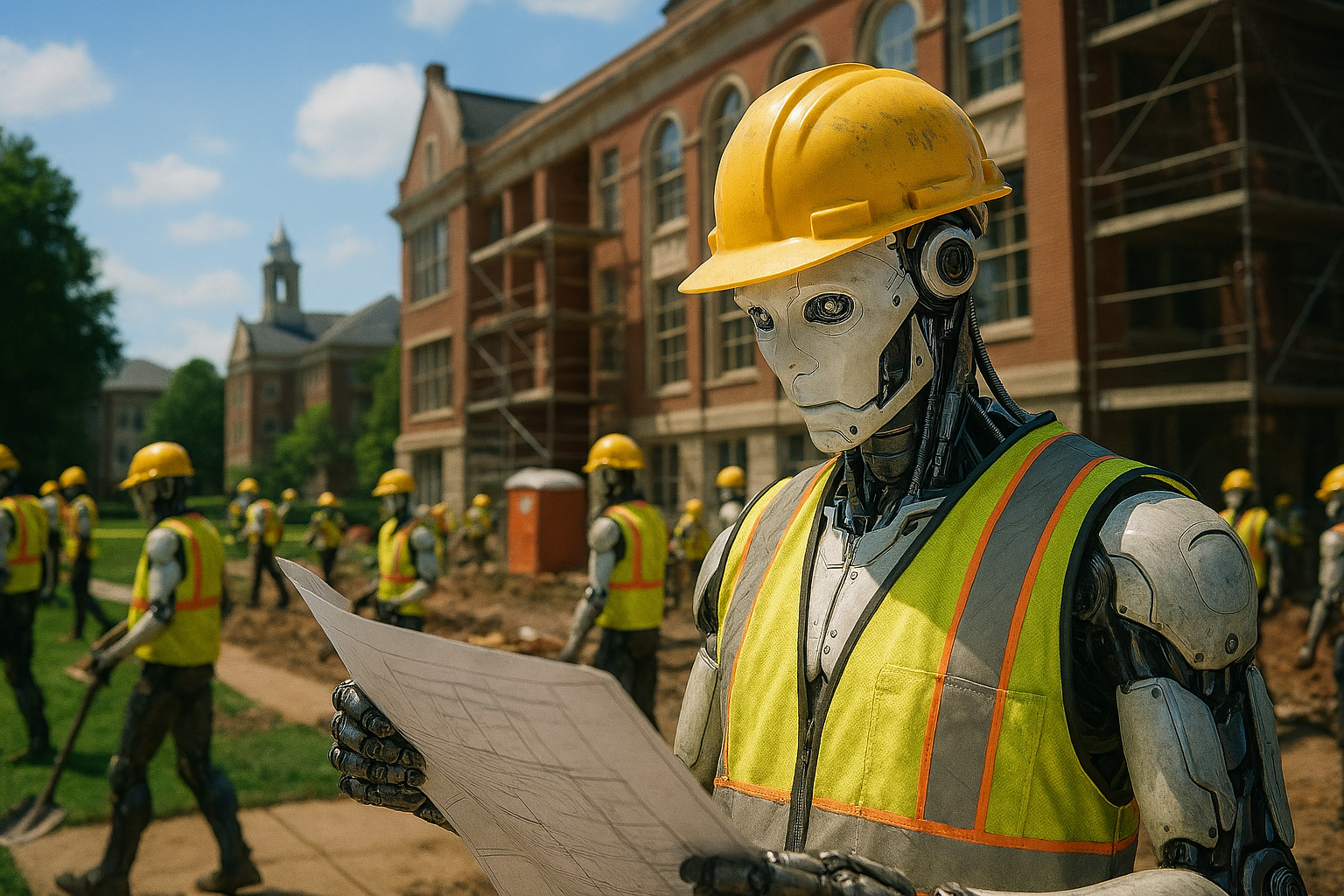
Colleges are building centralized, multi-disciplinary AI hubs that reshape physical campus organization and program flow. In the autumn of 2025 many universities announced large, university-wide AI centers intended to knit together research, curriculum, shared compute and industry partnerships into a single physical and administrative “hub.” For example, on October 1, 2025 The Ohio State University announced the launch of its AI(X) Hub, described as a university-wide facility spanning 15 colleges and intended to provide shared infrastructure, computing clusters, and cross-disciplinary space.
Key individuals named in the release include President Walter “Ted” Carter Jr., Provost Ravi V. Bellamkonda, and lead researcher Ness Shroff. The release explains the purpose and the intended campus effect: “With the launch of the AI(X) Hub, Ohio State is not just embracing the future – we are creating it. The hub will be a catalyst for groundbreaking research and transformative innovation in artificial intelligence,” said President Carter. (COLLEGE OF ENGINEERING)
AI is changing the design of classrooms and teaching spaces into responsive, AI-aware “studios” and hybrid learning environments. Professionals and campuses are rethinking fixed lecture halls in favor of rooms built for real-time sensing, edge compute, reconfigurable walls and broadcast-quality audio/video so AI systems can personalize and mediate learning at scale. Industry analysis published October 7, 2025 (NV5) lays out these architectural changes and names the practical elements—embedded sensors, edge nodes, micro-environments and privacy zones—that designers must include. The article’s author summarizes how designers should think about classrooms as responsive systems: “Ideally, classrooms should be flexible and adaptable enough to be reprogrammed for different instructional modes, enhanced by AI and responsive systems.” (Author: John Cook, NV5.) (nv5.com)
Laboratories, makerspaces and applied research facilities are being refitted (or newly built) with AI-connected instrumentation—supercomputing nodes, robot-integrated fabrication equipment, and integrated 3D scanning/printing—so physical fabrication and experimentation become tightly coupled with on-site AI workflows. Several campus announcements in October 2025 illustrate this shift: Rowan University (DEHub) opened an advanced manufacturing lab combining 3D metal printing and a “supercomputer” to integrate intelligent systems with manufacturing workflows (news release dated October 16, 2025; director Antonios Kontsos named), and Harvard SEAS announced the APEX+ initiative (September 16, 2025) to reimagine agentic AI that can interface directly with instruments and robotics.
Rowan’s release highlights the practical change: “The rapid development of artificial intelligence and the usability of large language models have promised to transform industries on a large scale,” and Rowan’s lab is an example of that integration. Harvard’s APEX+ leaders (Professors Jia Liu and Na Li) framed the problem similarly: their goal is “to reimagine the architecture of agentic AI to create a general-purpose AI platform that can be used across scientific disciplines and interface directly with physical systems such as laboratory instruments or robotics.” (Rowan Today)
Campus buildings and infrastructure are being instrumented and controlled by AI for energy, comfort and resilience—changing not only mechanical systems but also the kinds of rooms and façades architects plan. On November 4, 2025 the University of Nebraska published a news release about a three-year NSF-funded project using the HIBO (Human-centered Integrated Building Operations) lab and an AI algorithm that merges sensor data, engineering knowledge and human feedback to run building systems more efficiently and with better occupant comfort.
Researchers Iason Konstantzos and Xiaoqi (Clare) Liu describe how the lab is a prototype for smarter, transferable control systems: “Usually, these AI algorithms are more data driven… But in real-world settings, high-quality data can be difficult to collect. For our approach, we’re infusing our fundamental knowledge of engineering into the AI to optimize the operation of the building’s equipment, save energy and provide comfort requiring the minimum amount of data possible.” Practically, this is changing campus master-planning (façade choices, sensor networks, commissioning processes and even where common spaces are placed) so that buildings become active, networked agents in campus life. (Nebraska Today)
Colleges are increasingly deploying AI video analytics, license-plate readers, and other automated surveillance tools—altering campus circulation, sightlines, and the placement of poles/cameras, control rooms and access zones—while provoking privacy and governance debates. Reporting and investigations throughout 2025 show both the technology roll-out and the backlash. A Pulitzer Center report (July 8, 2025) documented how campuses (including Michigan State) and other institutions are using automated video analytics and license-plate readers, noting matter-of-factly: “AI security systems are being implemented on college campuses across the country.” (Pulitzer Center)
Industry pieces (e.g., Campus Safety Magazine, October 13, 2025) highlight the operational case—AI analytics “can proactively detect threats, enhance compliance, and optimize resources”—but both reporters and privacy advocates stress that architectural and landscape choices now routinely accommodate cameras, analytics nodes, and campus command centers, changing how public spaces are framed and policed. These design and governance shifts are tangible: camera sightlines, mounting infrastructure, and data control rooms are now part of campus capital planning.
[End]
Filed under: Uncategorized |


 Educational Technology and Change Journal

Leave a comment