




By Jim Shimabukuro (assisted by Claude)
Editor
The research paper by Kestin, Miller, Klales and colleagues* represents a watershed moment in educational technology research, offering rigorously controlled evidence that properly designed AI tutoring can surpass traditional pedagogical best practices. Conducted at Harvard University during Fall 2023 and published on 3 June 2025 in Scientific Reports, this randomized controlled trial provides empirical validation for claims about artificial intelligence’s transformative potential in education.
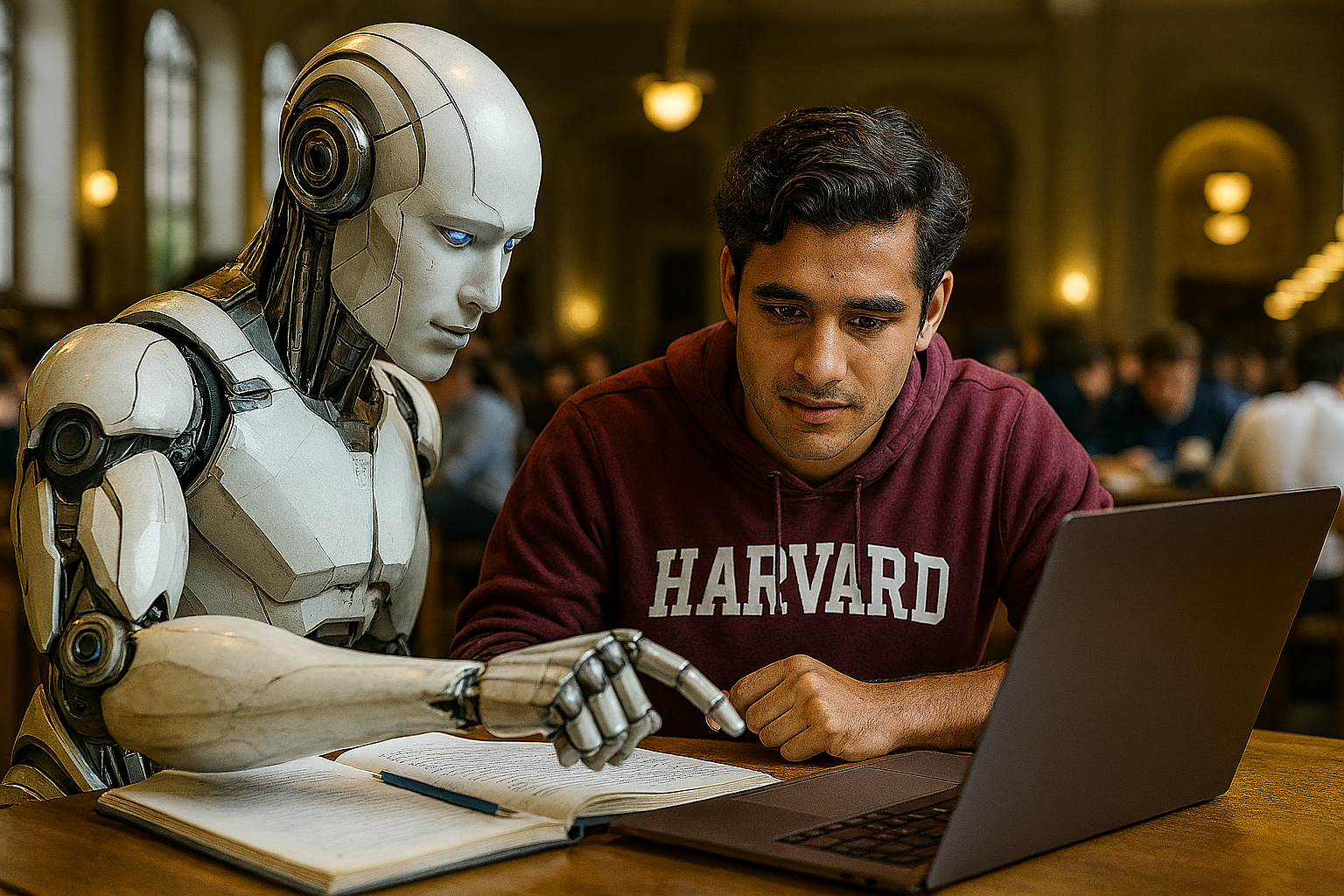
The study’s central thesis challenges the prevailing assumption that well-executed human instruction remains inherently superior to digital alternatives, demonstrating instead that when AI tutors are deliberately engineered according to research-based pedagogical principles, they can deliver superior learning outcomes with greater efficiency and enhanced student engagement.
The researchers employed a crossover design involving 194 undergraduate physics students, systematically comparing outcomes between students experiencing identical content through two modalities: in-class active learning sessions led by experienced instructors and at-home sessions with a custom-designed AI tutor called PS2 Pal. This methodological approach eliminated many confounding variables by having each student serve as their own control, experiencing both conditions across two consecutive weeks covering surface tension and fluid flow topics.
The investigators took extraordinary care to ensure equivalence between conditions, using identical worksheets, learning objectives, and introductory materials that differed only in delivery format. The active learning control condition itself represented educational best practices rather than passive lecturing, featuring peer instruction, small-group activities, and real-time instructor feedback. This design choice strengthens the study’s implications considerably, as the researchers demonstrate superiority over what is already considered excellent teaching rather than merely outperforming mediocre instruction.
The quantitative results prove striking in their magnitude and consistency. Students using the AI tutor achieved median post-test scores of 4.5 compared to 3.5 for those in active learning classrooms, representing learning gains more than double those of the control group relative to baseline knowledge. As the authors note, the statistical analysis revealed this difference to be highly significant, with the Mann-Whitney test yielding a result where probability values fell below one in one hundred million.
The effect size, estimated through quantile regression to avoid ceiling effects that compressed the upper range of possible scores, reached between 0.73 and 1.3 standard deviations. In educational research, effect sizes exceeding 0.4 standard deviations are typically considered educationally significant, making these results genuinely remarkable. Furthermore, students accomplished these superior learning outcomes in less time, with the median AI group member spending only 49 minutes on task compared to the assumed 60 minutes for classroom students, and 70 percent completing the material in under an hour.
Beyond cognitive gains, the research documents meaningful differences in student affect and motivation. Participants rated their experiences on five-point Likert scales across multiple dimensions of learning experience. The AI-tutored group reported significantly higher engagement levels, with mean agreement scores reaching 4.1 versus 3.6 for classroom learners. Similarly, students felt more motivated when working with the AI tutor, averaging 3.4 compared to 3.1 for traditional instruction.
These findings address a common concern in educational technology research: that increased test performance might come at the cost of student enjoyment or sustained interest in the material. The comparable ratings for enjoyment and growth mindset between conditions, combined with enhanced engagement and motivation for AI users, suggest the technology neither diminished the human elements of learning nor created a sterile, mechanistic educational experience.
The study’s explanatory power derives substantially from the researchers’ careful articulation of how their AI tutor was engineered to embody established pedagogical best practices. Rather than simply deploying GPT-4 and hoping for positive results, the team systematically addressed each known principle for effective instruction. The AI’s system prompt incorporated guidelines to facilitate active learning by refusing to simply provide answers, instead guiding students through problem-solving processes.
It managed cognitive load by breaking complex problems into sequential steps and avoiding information overload. The tutor promoted growth mindset through its language and feedback style, emphasizing effort and learning from mistakes. Most critically, the platform provided genuinely personalized, immediate feedback targeted to each student’s specific misconceptions, something virtually impossible to achieve consistently in classroom settings regardless of instructor skill.
The researchers also confronted the notorious “hallucination” problem in large language models by enriching prompts with comprehensive, pre-written step-by-step solutions, ensuring accuracy exceeded that of unguided AI responses. This methodological transparency allows other educators and researchers to replicate and adapt the approach rather than treating AI tutoring as a mysterious black box.
The authors acknowledge important contextual limitations that appropriately temper interpretation of their findings. The study focused specifically on students’ initial substantial engagement with new physics concepts operating at understanding, applying, and analyzing levels of Bloom’s Taxonomy, what might be characterized as middle-order cognitive skills.
The researchers explicitly state they cannot presume structured AI tutoring will always outperform classroom active learning in all contexts, noting that situations requiring complex synthesis of multiple concepts and higher-order critical thinking may present different challenges. Their intervention lasted only two weeks, preventing assessment of longer-term retention, skill transfer, or the cumulative effects of prolonged AI tutor use on collaboration abilities and other social-emotional competencies developed through classroom interaction.
The study population, while demonstrating diversity along certain dimensions like Force Concept Inventory scores, consisted entirely of Harvard undergraduates, raising questions about generalizability to community colleges, less selective institutions, younger students, or populations with different levels of technological access and comfort.
Regarding developments since publication, the research landscape suggests the study’s value remains strong but requires contextualization within evolving concerns. A systematic review published in May 2025 examining intelligent tutoring systems in K-12 education found that while effects on learning are generally positive, they become mitigated when compared to non-intelligent tutoring systems (PubMed), suggesting that some of the Kestin study’s dramatic effect sizes may be specific to the comparison with human instruction rather than representing absolute superiority of AI over all alternatives.
A Nature article from 21 October 2025 acknowledges that the Harvard randomized controlled trial suggested students using a custom-built AI tutor learned more in less time than those taught by humans alone, but notes that many education specialists remain deeply concerned about AI’s explosion on campuses, fearing that tools are impeding learning because they’re so new that teachers and students struggle to use them well. This highlights a crucial gap between carefully designed research implementations and the messy reality of widespread deployment.
In April 2025, a White House executive order on advancing artificial intelligence education for American youth directed the Secretary of Education to issue guidance regarding the use of grant funds to improve education outcomes using AI, including AI-based high-quality instructional resources and high-impact tutoring, indicating that policymakers are moving rapidly toward AI integration despite ongoing research debates.
The Kestin study provides essential evidence for such policy discussions, but the gap between controlled research conditions and scaled implementation remains substantial. Reports from 2025 describe schools like Alpha School implementing AI tutors where students complete core academics in just two hours, freeing afternoons for collaborative projects and skill-building activities (Hunt), demonstrating that practical applications are proceeding quickly, sometimes outpacing careful evaluation.
Several methodological improvements could have strengthened the study and addressed its acknowledged limitations. First, extending the intervention duration beyond two weeks would provide crucial data about learning retention, skill transfer to novel problems, and whether initial enthusiasm effects diminish over time. Second, incorporating assessments of higher-order thinking skills beyond the understanding and applying levels would test the boundaries of where AI tutoring proves most effective.
The researchers acknowledge their content involved substantial information delivery, but education aims to develop critical thinking, creativity, and synthesis abilities that may not emerge purely through guided problem-solving. Third, while the crossover design controlled many variables elegantly, it prevented examination of any cumulative or ordering effects from experiencing both conditions. A parallel-group design with longer duration could complement these findings by exploring whether sustained AI tutor use produces different outcomes than brief exposure.
Fourth, the study would benefit from qualitative data examining student thought processes, problem-solving approaches, and the nature of their interactions with the AI tutor compared to classroom dialogue. Understanding what students actually do differently when working with AI versus peers and instructors could illuminate mechanisms underlying the quantitative differences. Fifth, directly measuring collaborative skills, peer learning, and other social dimensions that classroom education purports to develop would address concerns that focusing on individual content mastery misses important educational outcomes.
The researchers acknowledge this limitation but provide no data addressing it. Sixth, examining effects across more diverse student populations, particularly community college students, those with learning differences, and varying levels of technological literacy, would establish how broadly these findings generalize beyond Harvard undergraduates.
Finally, while the study controlled for instructor quality by using experienced teachers with above-average evaluations, it would strengthen conclusions to demonstrate effectiveness across instructors with varying skill levels. One argument for AI tutoring holds that it could democratize access to excellent instruction for students whose schools cannot attract or retain highly skilled teachers. Testing whether AI tutors designed according to these principles outperform weaker human instruction as decisively as they surpass strong teaching would address this equity dimension directly.
The appropriate audience for this research spans multiple constituencies with different stakes in educational technology. Educational researchers must engage deeply with this work, as it represents one of the most methodologically rigorous examinations of generative AI in authentic educational settings currently available. The crossover design, careful control conditions, transparent reporting of limitations, and explicit articulation of pedagogical principles embedded in the AI system set a standard for future research in this rapidly evolving field. Physics instructors and STEM educators more broadly should study the paper to understand both the potential benefits and the specific implementation details that enabled those benefits, recognizing that simply adopting commercial AI tools without similar pedagogical engineering may not replicate these outcomes.
University administrators and instructional designers considering AI integration will find valuable guidance about resource allocation, implementation strategies, and appropriate contexts for deployment. The study demonstrates that effective AI tutoring requires substantial upfront investment in careful prompt engineering, platform development, and pedagogical design, not merely purchasing access to commercial chatbots. Policy makers at institutional, state, and federal levels need to understand this research as they craft regulations, funding priorities, and guidelines around AI in education. The findings suggest neither blanket prohibition nor uncritical enthusiasm represents appropriate policy responses; instead, careful attention to pedagogical design principles and appropriate use contexts should guide adoption decisions.
Educational technology developers should examine this work to understand which design features enable effective learning rather than simply maximizing engagement or satisfaction metrics. The researchers’ emphasis on managing cognitive load, scaffolding content sequentially, providing accurate feedback, and facilitating self-pacing offers concrete guidance for product development. Students themselves, particularly undergraduates and graduate students in education or related fields, should read this paper to develop critical literacy around AI tools they will encounter throughout their educational and professional lives. Understanding that AI effectiveness depends critically on how it is designed and deployed helps students become more discerning consumers of educational technology.
Finally, skeptics and critics of AI in education should engage with this research seriously, as it represents the most favorable evidence currently available for AI tutoring’s potential. The rigorous methodology and transparent reporting of both strengths and limitations make this work suitable for informing rather than inflaming debates about technology’s role in learning. While the study cannot resolve all concerns about AI’s broader social, ethical, and environmental implications, it demonstrates that within carefully constrained contexts and with appropriate pedagogical design, AI tutoring can enhance rather than impede learning.
The Kestin study ultimately makes a compelling case that the relevant question is not whether AI should be used in education, but rather how AI tutors should be designed, in which contexts they prove most effective, and what forms of human instruction they should complement rather than replace. The dramatic learning gains documented in this research emerged not from AI’s raw capabilities but from thoughtful integration of pedagogical best practices into the technology’s design.
This finding suggests a path forward where educators and technologists collaborate to create AI tools that genuinely enhance learning rather than simply automating existing approaches or optimizing for convenience. As institutions worldwide grapple with AI’s educational implications, this research provides essential empirical grounding for what remains largely a speculative debate, demonstrating both remarkable potential and the critical importance of intentional, research-informed implementation.
__________
* Kestin, G., Miller, K., Klales, A. et al. AI tutoring outperforms in-class active learning: an RCT introducing a novel research-based design in an authentic educational setting. Sci Rep 15, 17458 (2025).
Filed under: Uncategorized |


 Educational Technology and Change Journal

[…] die hier einem Review unterzogen wird (Spoiler: Das muss natürlich gut gemacht sein): https://etcjournal.com/2025/11/10/review-of-kestin-et-al-s-june-2025-harvard-study-on-ai-tutoring/. Dieser Artikel unterstützt das: https://link.springer.com/article/10.1007/s10648-025-10039-x. Und […]
[…] besser wirken als sehr guter Unterricht — aber nur unter streng didaktischen Bedingungen: https://etcjournal.com/2025/11/10/review-of-kestin-et-al-s-june-2025-harvard-study-on-ai-tutoring/.Greenpeace hat ein gutes Paket mit Unterrichtsmaterial zu KI und Klima erstellt, in dem Chancen und […]