





By Jim Shimabukuro (assisted by Claude)
Editor
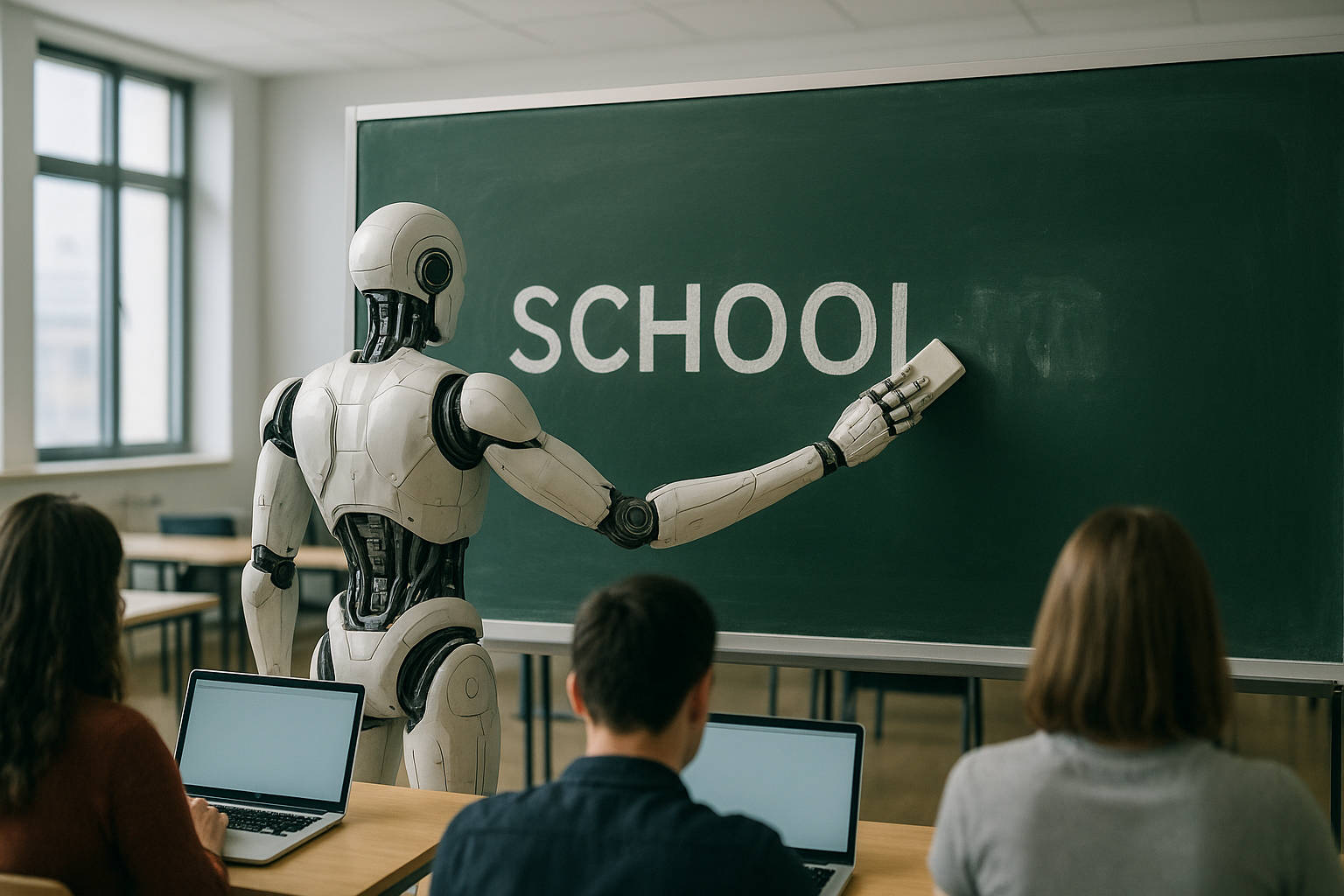
In this article, I asked Claude to search for and summarize articles that have been written about the difference between “education” and “schooling.” In grad school, in the mid-1980s, Professor Solomon Jaeckel, University of Hawaiʻi at Manoa, began his course with the question, “What is the difference between schooling and education?” And throughout the semester, whenever we hit the wall in discussions about issues in educational foundations, he brought up that refrain, “What is the difference between schooling and education?” We danced around it throughout the semester but never got his nod, and he never answered it for us. He once told us a joke about finding, scribbled on his classroom chalkboard before a final exam, “This, too, shall pass.” We all thought it referred to his tough course and exams, but now I’m thinking he meant the chalkboard, classroom, and college itself. In short, schooling becomes education when it takes on a broader meaning. -js
1. W. Kenneth Richmond’s “Education and Schooling: What’s the Difference?”
W. Kenneth Richmond authored “Education and Schooling: What’s the Difference?” published in the McGill Journal of Education, 1 Sep 1974. Richmond’s work represents a rigorous philosophical examination of two terms that many treat as interchangeable, yet which he argues carry fundamentally different meanings with significant implications for how we understand learning.
Richmond’s central thesis is that education and schooling represent distinct conceptual categories, not merely different names for the same phenomenon. He argues that education is an ideal whereas schools are institutions set up to formalize teaching, and that schools need not be educational at all and often are not. Throughout his eighteen-point analysis, Richmond systematically distinguishes the two concepts. He characterizes schooling as tangible, institutional, and task-oriented, focused on instruction in specific skills and meeting academic requirements.
Education, by contrast, is described as an achievement rather than a task, something holistic and all-pervasive that represents personal growth and understanding. Richmond emphasizes that schooling serves a means-to-an-end relationship with education, acting as a propaedeutic process that ideally makes education possible, though it frequently fails in this mission. He further argues that under certain conditions, schooling can actually be miseducative, particularly when it extends beyond early adolescence as compulsory confinement that stifles rather than nurtures learning.
The article includes the powerful observation that “education is perfectly possible in the absence of schooling”, a statement Richmond attributes to various thinkers including Thomas Huxley and Margaret Mead’s aunt. Richmond critiques how the term “education” has been co-opted by schooling institutions to lend legitimacy and value to what are often quite different processes. He notes that while we readily distinguish between courts and justice, recognizing that courts do not always dispense justice, we fail to make the same critical distinction between schools and education. This conflation, he argues, represents a kind of propaganda that attaches the inherent value of education to schooling regardless of whether schools actually deliver educational experiences.
This differentiation matters profoundly because it reveals what Richmond calls a “colossal confidence trick” perpetrated on society. When we equate schooling with education, we blind ourselves to the failures of formal instruction systems: their tendency to depreciate average and below-average students through what one critic called “the great brain robbery,” their focus on custodial care and socialization into consumer values rather than genuine learning, their obsession with classification and examination credentials that may bear little relation to actual competence or on-the-job performance.
By maintaining the distinction between these concepts, Richmond enables a more honest assessment of what schools actually accomplish versus what education aspires to achieve. This critical perspective opens space for imagining and creating alternative learning environments that might better serve the goal of genuine education, whether through deschooling initiatives, community-based learning, or other approaches that recognize education as a lifelong, self-directed process rather than something that can be packaged and delivered through institutional schooling.
2. Graham Oliver’s “What is the difference between education and schooling?”
Graham Oliver published “What is the difference between education and schooling?” on the website What is Education?1 Oliver brings a personal dimension to this philosophical inquiry, describing his own confusion during teacher training about the relationship between these two concepts, a confusion that persisted through graduate study until he encountered philosophy of education courses that finally addressed the distinction at length.
Oliver’s thesis centers on a fundamental conceptual divide: education is an ideal, while schools are institutions set up to formalize teaching, and schools need not be educational at all and often are not, as they can indoctrinate. He emphasizes the ethical dimension, noting that it is the ethical concern of education for learning to live well that distinguishes it from mere schooling. Oliver criticizes the common confusion between these terms as more than semantic imprecision.
He uses a transportation analogy to illustrate the problem: it would be odd to reduce all transportation to bicycles, but at least both are means of getting about; with education and schooling, the confusion is worse because education is not a means at all but an end in itself. This represents what he calls “confusion and debasement” resulting from propaganda that has attached the value and prestige of “education” to “schooling” institutions regardless of what those institutions actually deliver.
The article explores why this distinction proves so difficult for many to articulate. Oliver observes that people typically fail not because they don’t understand schooling, which everyone has experienced, but because they flounder when attempting to give an account of education itself. Many resort to listing desirable qualities like critical thinking, creativity, and wisdom, but these lists fail because they are too far down the chain of justification without explaining why these qualities matter.
Oliver notes that tens of thousands of Google searches each month seek to understand this difference, suggesting widespread public confusion about concepts that should be clear. He attributes this partly to propaganda that has successfully conflated the terms, using the prestige of “education” to lend legitimacy to whatever schools happen to be doing.
Understanding this differentiation matters because it shapes how we evaluate and reform our learning systems. Oliver argues that we have become insensitive to the dangers of indoctrination in ways we are not insensitive to injustice. We readily take to the streets over justice issues and bring cases to court, but we rarely mobilize with similar passion over educational concerns, even when schooling fails to be educational or actively works against learning.
This blind spot allows schools to continue practices that may be miseducative without facing the kind of scrutiny that other institutions receive when they fail their stated purposes. By maintaining clarity about the distinction between education as an ideal and schooling as an institutional practice, we create space for meaningful critique and reform. We can then ask whether schools are actually serving educational purposes or merely processing students through bureaucratic systems that may teach compliance and test-taking while failing to foster genuine learning, wisdom, or the capacity to live well.
3. Jake Madden’s “The Differences Between Education and Schooling: Why Understanding Them is Important”
Jake Madden, an educator with over thirty years of experience as a teacher and principal, authored “The Differences Between Education and Schooling: Why Understanding Them Is Important,” published on May 7, 2023. Madden brings extensive practical experience in educational leadership to bear on this conceptual distinction, having earned degrees including a Doctorate in Education and held positions focused on teacher development, flexible learning spaces, and curriculum design.
Madden’s thesis presents a clear distinction between education as a lifelong, expansive process and schooling as a structured, formal subset of that larger endeavor. He argues that education is a lifelong process that goes beyond formal schooling, involving acquiring knowledge, skills, and values through various means including reading, exploring, experiencing, and interacting with the world around us. Education, in his framework, is not limited to classrooms or particular curricula but encompasses learning from all our surroundings and experiences, both positive and negative.
As an example, he notes that someone who has traveled the world and experienced different cultures has acquired education that cannot be replicated in a classroom. Schooling, conversely, is characterized as a structured and formal process that takes place in classrooms or institutions, typically following a specific curriculum. While Madden acknowledges that schooling is a necessary component of education providing a foundation of knowledge and skills, he emphasizes that it is not the only path to acquiring knowledge, skills, and values.
The article’s key insight is captured in Madden’s assertion that “understanding the difference between education and schooling is essential for several reasons”, which he then enumerates. First, this distinction helps individuals recognize the value of informal education, which can sometimes prove more practical and effective than formal education. Second, it can reduce the pressure people feel to pursue particular educational paths, such as attending prestigious universities, by validating alternative learning routes.
Third, it helps people appreciate the value of lifelong learning and the fact that education does not end when formal schooling does. For educators specifically, Madden argues that understanding this difference is particularly important because it helps them recognize their role extends beyond simply imparting knowledge to fostering a love of learning and curiosity in students.
This differentiation matters because it fundamentally changes how educators approach their work and how learners understand their own development. For teachers, recognizing the distinction encourages thinking beyond traditional teaching methods and exploring alternative ways of engaging with students. It also helps educators appreciate the diverse backgrounds and experiences students bring to the classroom, understanding these as valuable educational resources rather than gaps to be filled. For students and lifelong learners, understanding that education extends far beyond schooling validates self-directed learning, experiential knowledge, and the wisdom gained through living.
This perspective can liberate people from the notion that learning only counts when it happens in formal institutional settings or results in credentials. It acknowledges that the traveler who explores different cultures, the artisan who perfects a craft through practice, the parent who learns through raising children, and the professional who continually adapts to new challenges are all engaged in genuine education, regardless of whether they are enrolled in schools. This broader understanding of education can help societies develop more diverse and inclusive approaches to supporting learning throughout people’s lives.
4. “Ivan Illich’s Deschooling Society: A Radical Approach to Educational Reform”
Ivan Illich developed his critique of schooling and vision for deschooling society primarily in his 1971 book “Deschooling Society,” though his ideas have been explored in numerous subsequent articles and analyses. One accessible overview appears in the article “Ivan Illich’s Deschooling Society: A Radical Approach to Educational Reform” published on January 14, 2024. Illich, born in Vienna in 1926, became a Roman Catholic priest who worked extensively in Latin America before rising to international prominence in the 1970s with his critical analyses of modern institutions including education, medicine, transportation, and work.
Illich’s thesis presents a radical critique of institutionalized education and proposes that traditional schools, which are highly institutionalized, stifle the natural processes of learning. According to him, schools were created to serve as factories, not to promote genuine learning, and the education system has become a rigid institution that forces learners into predefined molds, measuring success by standardized tests and focusing on subjects that may not necessarily serve the individual’s unique interests or societal needs.
Deschooling, then, represents a call to move away from the idea that formal schooling is the only legitimate way of learning. Illich believed that real learning could take place outside the institutional structure in more organic, self-directed ways. He argued that schools contain a “hidden curriculum” that causes learning to align with grades and accreditation rather than important skills, and that modern schooling focuses on growing schools as an industrialized system rather than genuinely educating students. Illich famously asserted that “universal education through schooling is not feasible”, proposing instead a system of self-directed education in fluid and informal arrangements through what he called “educational webs which heighten the opportunity for each one to transform each moment of his living into one of learning, sharing, and caring.”
Illich’s vision for a deschooled society included four learning networks: Reference Service to Educational Objects providing access to educational resources, Skills Exchange allowing people to share and swap skills, Peer-Matching helping learners find collaborators, and Reference Services to Educators-at-Large connecting learners with mentors. He criticized how schools had monopolized educational resources and attention, arguing that before compulsory schooling, education was complex, lifelong, and unplanned, occurring throughout life in various contexts including work, family, and community.
The institutionalization of schooling created a false binary where only instruction occurring within certain times, spaces, and under supervision was deemed “education,” devaluing all other learning. Illich also critiqued how schooling created and maintained social inequalities rather than reducing them, noting that the hidden curriculum taught compliance with existing social orders and trained students to be consumers rather than active, critical citizens.
This differentiation between education and schooling matters because it challenges fundamental assumptions about how societies should approach learning and development. Illich’s critique reveals how confusing schooling with education has led to a monopoly that prevents resources and attention from flowing to alternative learning approaches that might be more effective and equitable.
His work inspired various movements including homeschooling and unschooling, though he was careful to distinguish his vision from simple free-market alternatives to public schools, calling advocates of free-market education “the most dangerous category of educational reformers.” The distinction matters because it forces us to question whether mass compulsory schooling actually serves learners or primarily serves institutional and economic interests. It opens possibilities for reimagining how societies support learning across the lifespan, suggesting that decentralized, self-directed, and community-based approaches might better serve human development than age-segregated, compulsory institutions.
While critics note practical challenges in implementing Illich’s vision, particularly regarding equity of access to resources and the social functions schools serve, his work continues to inspire those seeking to create more humane and effective approaches to supporting learning that recognize education as something fundamentally different from, and potentially undermined by, conventional schooling.
1 Gemini: It is highly likely that the concepts in the article “What is the difference between education and schooling?” were originally published, or formally copyrighted, in 2018 as part of his self-published book: Oliver, R. G. (2018). Education: As if our lives depended on it
[End]
Filed under: Uncategorized |


 Educational Technology and Change Journal

Leave a comment