





By Jim Shimabukuro (assisted by Perplexity)
Editor
[Related reports: Jan 2026, Nov. 2025, Oct. 2025]
Three critical educational technology issues for higher education in December 2025 are: (1) AI governance and institutional trust, (2) cybersecurity and digital resilience, and (3) AI policy, assessment, and student mental health. Each is already sharply defined in November 2025 articles that document why these problems matter for the coming term.etcjournal+3
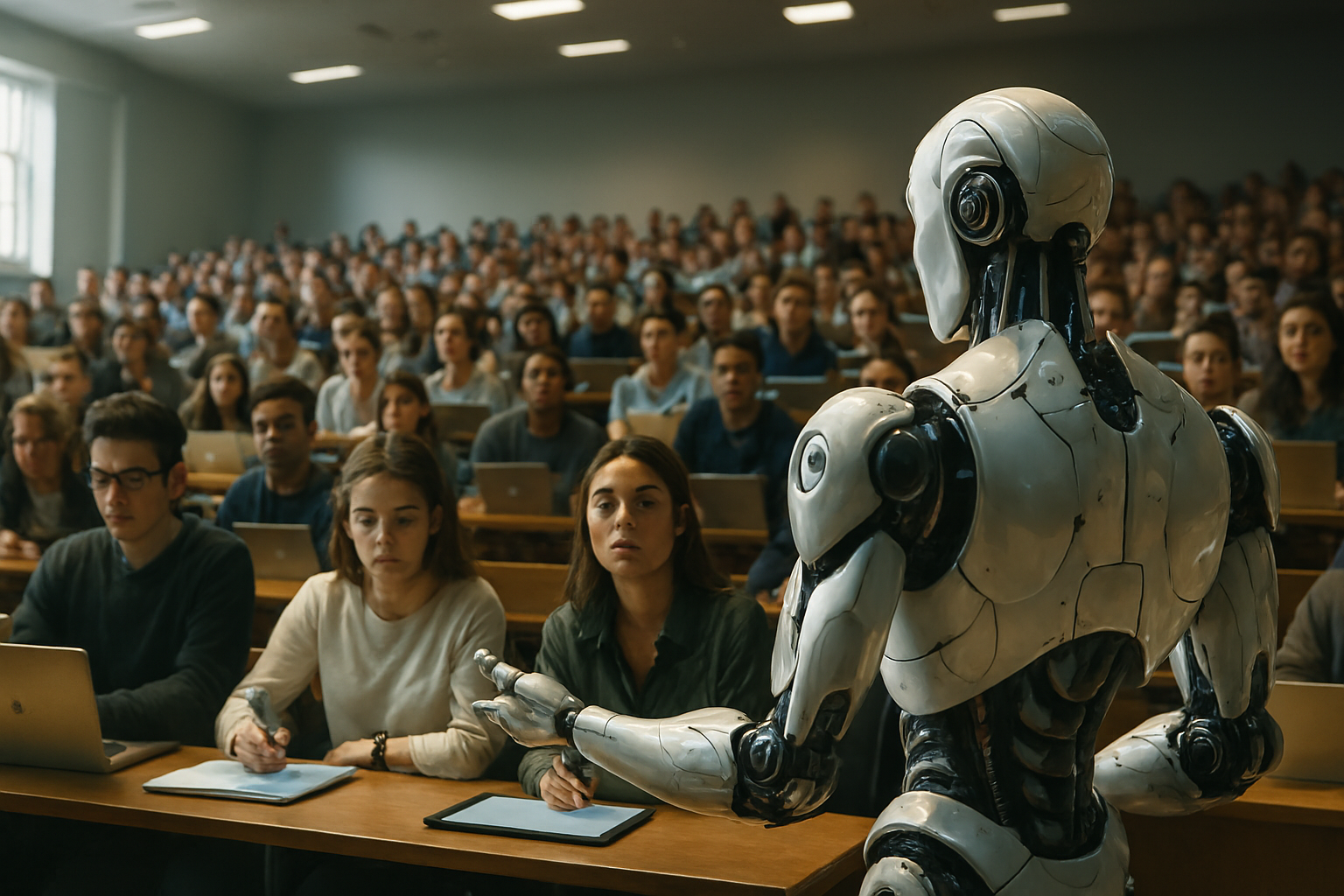
Issue 1: AI governance and institutional trust
A November 29, 2025 Forbes article by Aviva Legatt, “AI Is Now Fundable In Higher Ed—But Only With Real Governance,” argues that rapid AI investment is outpacing coherent governance and eroding student trust. The piece centers on a government-funded coding apprenticeship at the University of Staffordshire in which students discovered that a substantial portion of their “instruction” consisted of AI‑generated slides, synthetic voiceover, and generic content that could have been assembled for free outside the university. Students described feeling deceived, particularly because the same institution enforced strict anti‑AI rules for student work while quietly relying on AI for its own teaching materials. One quoted student captures the breach of trust: the cohort felt “robbed of knowledge and enjoyment” when they realized that a course marketed as expert-led training was largely assembled by machines.forbes+1
The article’s significance lies in how it reframes AI in higher education from a technical adoption question to a governance and legitimacy crisis. Legatt emphasizes that, with new public and philanthropic funding streams earmarked for AI, institutions can scale AI‑mediated instruction quickly—without equally robust policies about transparency, quality assurance, and student consent. The Staffordshire case becomes a cautionary tale: AI governance is not just about academic integrity codes for students, but about how institutions themselves use AI in core academic functions. The article notes that when universities deploy AI primarily as a cost‑cutting device—replacing rather than augmenting human teaching—students begin to question the value proposition of tuition and the authenticity of their learning experiences.etcjournal+1
Legatt argues that meaningful governance must move beyond high‑level strategy documents and into enforceable standards that cover procurement, instructional design, and disclosure to students. She highlights emerging expectations from funders that AI projects include demonstrable safeguards around equity, transparency, and human oversight, suggesting that poorly governed deployments may soon jeopardize grants and public support. The article also stresses that governance must address asymmetries of power: universities cannot credibly discipline students for “misuse” of AI while quietly embedding undisclosed AI throughout courses. Instead, Legatt calls for shared norms where both staff and students are required to disclose AI use, and where AI is positioned as a tool for co‑creation rather than an invisible engine behind low‑cost content.forbes+1
This issue is critical for December 2025 because many institutions are finalizing spring 2026 AI initiatives and budgets, often under intense pressure to appear innovative. Without clear governance structures—including oversight committees, impact assessments, and student representation—universities risk replicating the Staffordshire pattern at scale: tuition‑paying students learning after the fact that much of their instruction has been outsourced to generative systems. Legatt’s article warns that such missteps can trigger not only reputational damage but also regulatory scrutiny and legal exposure, especially where public funds are involved. In that sense, AI governance has become a precondition for sustainable AI funding. As she notes, AI may now be “fundable,” but only when universities can show that they are embedding it within accountable, transparent governance frameworks that protect students’ educational interests.etcjournal+1
Key identifying details:
- Article: “AI Is Now Fundable In Higher Ed—But Only With Real Governance”forbes
- Author: Aviva Legattforbes
- Source: Forbes (online article)forbes
- Date of publication: November 29, 2025forbes
- Representative quotation: Students reported feeling “robbed of knowledge and enjoyment” when they learned that AI‑generated slides and a synthetic voice had replaced the expert‑led teaching they were promised.etcjournal+1
Issue 2: Cybersecurity, ransomware, and digital resilience
A November 21, 2025 News article in Nature, “Cyberattacks’ harm to universities is growing — and so are their effects on research,” by Holly Else, documents how escalating cyberattacks on universities are disrupting not only operations but also teaching and research. The article opens with a series of recent incidents, including a November breach at Princeton University that exposed personal data for students, alumni, and donors, alongside similar incidents at the University of Pennsylvania and Harvard University. These attacks forced staff to operate for weeks or even months without access to critical digital services such as email and research software, making clear that universities’ dependence on digital infrastructure now turns ransomware and data theft into direct threats to educational continuity. As one security expert quoted in the piece warns, “the number of cyberattacks is not relenting,” and universities remain “a really attractive target.”nature
The article explains that higher education’s vulnerability is structural. Universities hold valuable personal and research data, run heterogeneous and sometimes outdated IT systems, and maintain open networks designed for collaboration rather than tight perimeter control. In the current geopolitical climate, the piece notes, state‑linked groups and opportunistic criminals alike see universities as soft targets for ransomware and data exfiltration. A UK government survey cited in the article found that 91% of higher education institutions and 85% of further education colleges had experienced a cybersecurity incident in the prior 12 months, underscoring that these are no longer rare, exceptional events. The article quotes David Batho of Jisc, who argues that “prevention is no longer enough” and that “building resilience is essential,” signaling a shift from perimeter defenses to strategies that assume compromise and focus on rapid recovery and continuity.nature
For educational technology in December 2025, this issue is critical because nearly every aspect of higher education now runs through networked systems: learning management platforms, AI‑powered advising tools, digital libraries, and research computing clusters. A serious attack can instantly disable online classes, lock students out of coursework, halt experiments, and delay thesis submissions. The article makes clear that the cost is not just financial; it includes lost research opportunities, diminished student trust, and severe stress for staff forced into manual workarounds over extended periods. As universities expand their use of AI, the attack surface increases: new integrations, cloud services, and data pipelines must all be secured, yet many institutions already struggle with staffing and funding for cybersecurity.nature
Else’s reporting emphasizes that resilience demands both technical and organizational responses. On the technical side, universities must modernize identity management, segment networks, and enforce patching practices that address unpatched software—an identified entry point in many attacks. On the organizational side, the article highlights the importance of cyber‑incident planning, cross‑campus communication strategies, and training that prepares faculty and students for phishing and social engineering threats. These steps are particularly urgent as examination periods and major assignment deadlines approach, when disruptions can derail student progress. The article’s central message for higher‑education leaders is that cybersecurity can no longer be treated as a back‑office IT concern; it is now a core condition for delivering stable, trustworthy digital learning environments.govtech+1
Key identifying details:
- Article: “Cyberattacks’ harm to universities is growing — and so are their effects on research”nature
- Author: Holly Elsenature
- Source: Nature (News article on nature.com)nature
- Date of publication: November 21, 2025nature
- Representative quotation: As one security leader cautions, “Prevention is no longer enough. Building resilience is essential,” reflecting the shift toward assuming breaches and focusing on rapid recovery.nature
Issue 3: AI policy, assessment, and student mental health
A November 5, 2025 article from Government Technology’s higher‑education section, “EDUCAUSE ’25: How AI Policies Affect Student Mental Health,” by Abby Sourwine, examines how institutional responses to generative AI are shaping students’ well‑being and their relationships with educational technology. Reporting from the EDUCAUSE 2025 conference, the article describes how some universities have reacted to AI with sweeping bans, high‑stakes detection tools, and inconsistent course‑level rules, leaving students anxious about being falsely accused of misconduct. Ashley Dockens, associate provost of digital learning at Lamar University, notes that her own pre‑AI dissertation was flagged by an AI detector as “98 percent AI‑generated,” a vivid example the article uses to illustrate how unreliable tools can become sources of chronic stress when linked to disciplinary processes. The article warns that punitive, fear‑driven AI rules “can deepen mistrust, stress and disconnection among students,” and that policies built around suspicion tend to undermine educational relationships rather than support learning.govtech
Sourwine’s piece argues that the problem is not AI itself, but the combination of unclear expectations, surveillance‑style assessment practices, and underdeveloped support structures. Traditional‑age students, as Dockens explains, are still developing the neural systems responsible for impulse control and long‑term planning, and they operate under intense academic, financial, and family pressures. In that context, turning to AI tools for help often appears rational rather than malicious, especially when institutional messaging is inconsistent or absent. The article highlights that students frequently juggle a patchwork of course‑specific AI rules and struggle to discern when using AI is acceptable, making every assignment feel like a potential trap. Fear of being misjudged by detectors can lead students to avoid helpful technologies altogether or to hide legitimate use, both of which erode the possibility of open, formative conversations about AI‑supported learning.govtech
For December 2025, as instructors finalize syllabi and assessment strategies for the next term, the article identifies AI policy and student mental health as a central edtech governance challenge. It calls for a shift from purely punitive models to “restorative processes” that treat AI misuse as an opportunity for education and growth rather than solely as grounds for punishment. Dockens is quoted as saying that universities must be places where students can “fail in a safe space” and learn from mistakes, including misjudgments about AI use. This stance implies that AI policies should be accompanied by explicit instruction on ethical use, transparent explanations of when and why detectors are used, and support services that address the mental‑health impacts of constant monitoring.govtech
The article also frames AI policy as an equity issue. Students with less prior exposure to AI, or with greater fear of institutional authority, may be disproportionately deterred from experimenting with tools that could benefit their learning, widening existing achievement gaps. Conversely, students who feel confident navigating opaque rules may be more willing to take risks, potentially leading to uneven enforcement and perceptions of unfairness. By documenting these dynamics, Sourwine positions AI governance not only as a question of academic integrity but also as a determinant of campus climate and psychological safety. The piece urges higher‑education leaders to replace adversarial stances with approaches that emphasize empathy, clarity, and shared responsibility between students and staff.govtech
Key identifying details:
- Article: “EDUCAUSE ’25: How AI Policies Affect Student Mental Health”govtech
- Author: Abby Sourwinegovtech
- Source: Government Technology, Higher Education section (govtech.com)govtech
- Date of publication: November 5, 2025govtech
- Representative quotation: The article concludes that punitive, fear‑driven AI rules “can deepen mistrust, stress and disconnection among students,” and advocates for restorative approaches that recognize most misuse as “not malicious and [possibly] rational.”govtech
- https://etcjournal.com/2025/11/22/10-critical-articles-on-ai-in-higher-ed-for-nov-2025-institutional-cowardice/
- https://www.govtech.com/education/higher-ed/educause-25-how-ai-policies-affect-student-mental-health
- https://www.nature.com/articles/d41586-025-03484-9
- https://www.forbes.com/sites/avivalegatt/2025/11/29/ai-is-now-fundable-in-higher-ed-but-only-with-real-governance/
- https://www.govtech.com/education/higher-ed/despite-gains-ransomware-still-strains-education-sector
- https://morningsidepost.com/articles/2025/10/29/no-artificial-ingredients-higher-education-grapples-with-ai
- https://www.centraleyes.com/top-cybersecurity-tools-for-higher-education-protecting-institutions/
- https://www.edweek.org/technology/teens-should-steer-clear-of-using-ai-chatbots-for-mental-health-researchers-say/2025/11
- https://www.edweek.org/technology/rising-use-of-ai-in-schools-comes-with-big-downsides-for-students/2025/10
- https://www.edweek.org/technology/how-schools-can-balance-ais-promise-and-its-pitfalls/2025/11
- https://www.nature.com/articles/s41599-025-05982-7
- https://erasmusnostrum.org/etn/ai-digital-transformation-in-higher-education-nov-2025/
- https://srheblog.com/2025/04/02/will-genai-narrow-or-widen-the-digital-divide-in-higher-education/
- https://www.govtech.com/education/higher-ed/opinion-how-to-balance-learning-analytics-with-data-privacy
- https://gardnerinstitute.org/event/a-symposium-on-transforming-the-postsecondary-experience-2025/
- https://pmc.ncbi.nlm.nih.gov/articles/PMC8460315/
- https://www.oculusit.com/balancing-learning-analytics-with-student-privacy-in-edtech/
- https://conf.researchr.org/series/gaia/
- https://www.edtechdigest.com/2025/11/05/closing-the-digital-design-divide-setdas-new-framework-reimagines-professional-learning-for-the-ai-era/
- https://aihub.org/2025/11/03/forthcoming-machine-learning-and-ai-seminars-november-2025-edition/
[End]
Filed under: Uncategorized |


 Educational Technology and Change Journal

Leave a comment