





By Jim Shimabukuro (assisted by Grok)
Editor
[Also see the reports from Oct 2025, Sept 2025, July 2025]
College professors are incorporating AI into their professional lives, often in ways that extend beyond traditional teaching into research, curriculum design, and reflective writing. For November-December 2025, here are three inspiring cases: Matt Kinservik at the University of Delaware, who weaves AI into his writing instruction to foster critical skills; Jennifer Chen at Kean University, who leverages AI in her educational research to pioneer ethical applications; and Zach Justus at California State University, Chico, who employs AI in his communication work to enhance evaluation and mentorship.
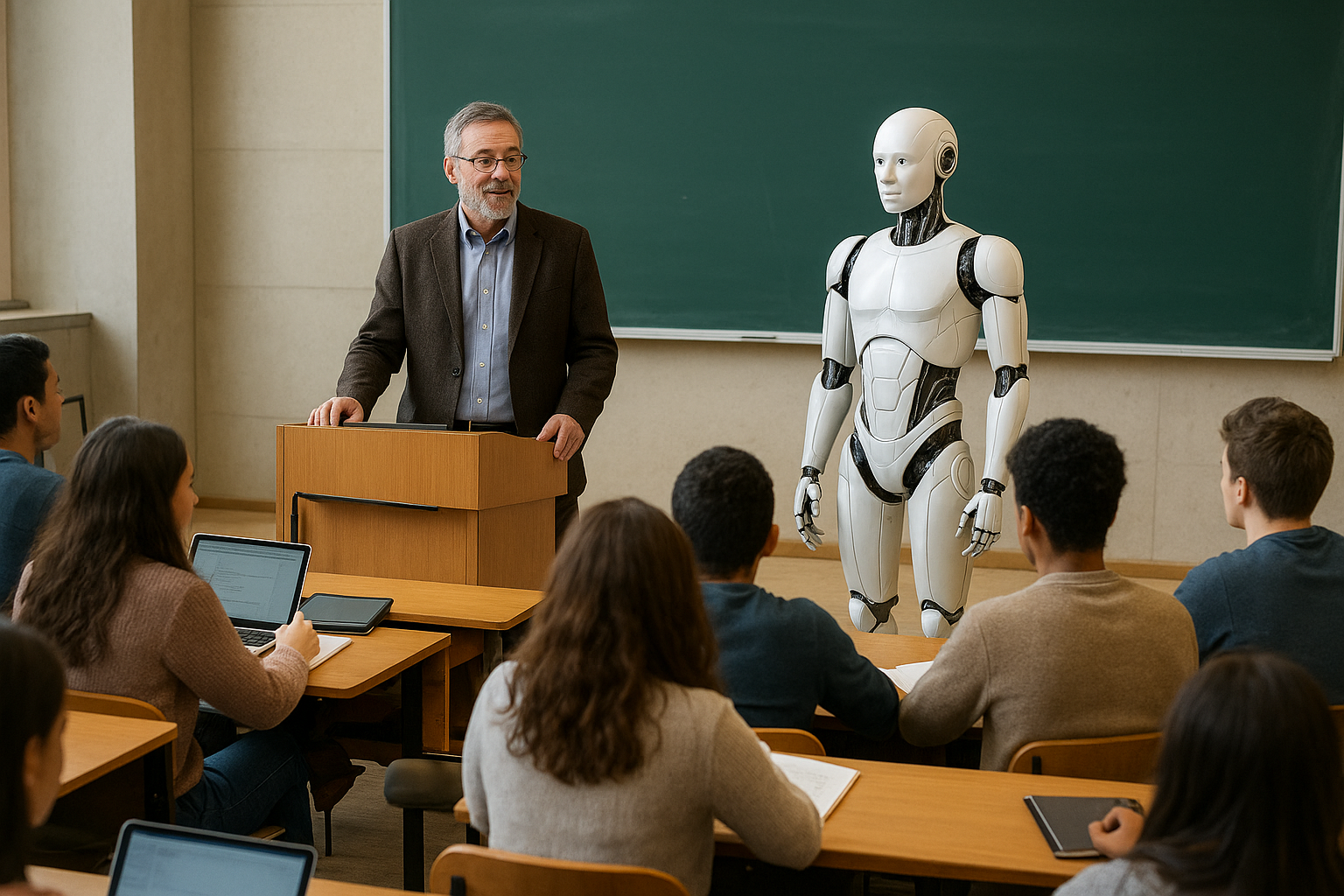
The Human Touch in a Digital Age: Matt Kinservik’s Journey with AI in Crafting Minds
In the bustling halls of the University of Delaware, where autumn leaves still clung to the trees in early November 2025, Professor Matt Kinservik stepped into his English 110 classroom with a sense of quiet revolution. As a seasoned educator in the English department, Matt had spent years guiding first-year students through the intricacies of writing, helping them transform raw ideas into polished arguments. But the rise of generative AI tools like chatbots had upended the landscape, turning what was once a solitary craft into a collaborative dance with machines. Rather than resist this shift, Matt embraced it, redesigning his curriculum around a provocative question: How will AI reshape your future careers? This wasn’t just an academic exercise; it was a personal pivot that reinvigorated his own passion for teaching, reminding him why he entered the profession in the first place—to empower young minds to navigate an uncertain world.
Matt’s story begins with his own curiosity. Long before AI became a household term, he had dabbled in digital tools for research and lesson planning, but the advent of sophisticated chatbots prompted a deeper dive. In his class, he doesn’t ban AI; instead, he integrates it as a teaching partner. Students start with traditional research, compiling an annotated bibliography without any technological aid, forcing them to engage directly with sources. Then comes the twist: They prompt a chatbot to draft a 2,000-word essay based on their findings. What follows is the real magic—editing the AI’s output for accuracy, tone, citations, and that elusive human spark. Matt watches as his students grapple with the bot’s flaws: fabricated citations that evaporate under scrutiny, overly formal language that feels robotic, or slang insertions that miss the mark. One student, Isabella Abdmessih, a freshman eyeing kinesiology, described the process as frustrating yet eye-opening; she struggled to wrangle the AI’s content into something truly hers, realizing how much personal investment writing demands. Another, sophomore finance major Amber Sirrell, noted how AI stripped away the interpersonal creativity she cherished, turning composition into a mechanical task.
For Matt, this method isn’t about outsourcing creativity but amplifying it. He uses AI in his professional life to simulate real-world scenarios, preparing students for jobs where they’ll peer-review AI-generated reports or fact-check automated analyses. In finance, as Amber anticipates, AI might draft projections, but human oversight ensures integrity. Matt’s approach has enriched his own life profoundly. Teaching for over a decade, he had sometimes felt the routine of grading papers weigh heavy, but AI injected novelty, turning his classroom into a laboratory of discovery. He finds joy in the moments when students “catch” the AI’s errors—like a bot apologizing for inventing sources—sparking discussions on ethics and reliability. This has deepened his connections with students, fostering a community where vulnerability and growth thrive. Beyond the classroom, Matt reflects on how AI has prompted him to refine his own writing process; he now uses tools sparingly for brainstorming, but always with a critical eye, honing his skills as a communicator.
This evolution hasn’t been without challenges. Early on, Matt worried about equity— not all students have equal access to premium AI features—but he addressed it by providing in-class demos and resources. The result? His students emerge more resilient, equipped not just with writing prowess but with the discernment to thrive in an AI-augmented workforce. Matt’s journey inspires because it shows AI as a mirror, reflecting our humanity back at us. It pushes educators to evolve, turning potential disruption into opportunity. In his words, unchanged courses risk failing students, but embracing AI revitalizes the educator’s role. For colleagues, Matt’s example is a call to action: Dive in, experiment, and rediscover the thrill of teaching. As winter approached in Delaware, Matt looked forward to refining his methods further, his professional life brighter for the integration of this digital ally.
Source: Johnny Perez-Gonzalez, “Delaware professor transforms writing class by teaching students to use AI as the technology reshapes the workforce”, WHYY, 1 Dec 2025, https://whyy.org/articles/artificial-intelligence-education-university-of-delaware/
Pioneering Horizons: Jennifer Chen’s Exploration of AI in Educational Frontiers
Amid the vibrant academic ecosystem of Kean University in New Jersey, where innovation pulses through the College of Education, Professor Jennifer Chen has carved a path that blends curiosity with caution. In mid-November 2025, as she prepared for another workshop on AI literacy, Jennifer reflected on her trajectory—from a dedicated educator to a leading researcher on how artificial intelligence can transform early childhood learning. Working with children aged 3 to 8, she doesn’t just study AI; she harnesses it to unlock new possibilities, turning abstract concepts into tangible tools that enhance young minds. This integration has not only elevated her research but infused her life with a renewed sense of purpose, bridging disciplines and empowering communities in ways she never imagined.
Jennifer’s engagement with AI began organically, rooted in her passion for equitable education. As a professor specializing in early childhood, she saw AI’s potential to personalize learning, especially for diverse learners. In her professional life, she uses AI platforms to analyze data on student interactions, simulate scenarios for teacher training, and even co-create content for her publications. For instance, in a recent article for the Early Childhood Education Journal, she explored how AI can tailor lessons for bilingual students, drawing from a real-world example of a second-grade teacher using an AI tool to adapt reading materials in real-time. The platform adjusted vocabulary and pacing based on the child’s responses, fostering comprehension without overwhelming them. Jennifer employs AI in her research process too—using it to sift through vast datasets on child development, identify patterns, and generate preliminary hypotheses, which she then rigorously tests with human insight.
This isn’t mindless automation; Jennifer emphasizes ethics, advocating for data protection and bias mitigation. Her work on an NSF grant proposal, collaborating with colleagues in science and technology, involves AI to model ethical frameworks for AI in classrooms. She prompts tools to simulate risks, like privacy breaches, then refines them into guidelines for educators. This interdisciplinary approach has enriched her professional development immensely. Participating in Kean’s AI workshops and contributing to a new bachelor’s program in AI, Jennifer has expanded her network, forging bonds with experts across fields. Personally, it has brought fulfillment—seeing her research influence policy and practice, like workshops where parents learn to use AI apps safely for home learning. She describes the thrill of discovery, how AI challenges her to think creatively, preventing stagnation in a career spanning years.
Challenges abound, of course. Jennifer grapples with AI’s limitations, such as potential biases in algorithms that could disadvantage underrepresented groups, prompting her to advocate fiercely for responsible use. Yet, these hurdles have sharpened her skills, making her a more empathetic researcher. Her publications, including one in AI Enhanced Learning, position Kean at the vanguard, inspiring colleagues to view AI not as a threat but as an ally for innovation. For Jennifer, AI enriches life by amplifying impact—her work now reaches beyond academia, helping families nurture AI-literate children. As she looks ahead, Jennifer envisions a future where AI supports holistic growth, her journey a testament to how embracing technology can reignite one’s vocation.
Source: “Kean Professor Leads Research on the Role of AI in Early Childhood Education”, Kean University News, 18 Nov 2025, https://www.kean.edu/news/kean-professor-leads-research-role-ai-early-childhood-education
Evaluating the Future: Zach Justus’s Dialogue with AI in Communication and Beyond
At California State University, Chico, nestled in the sunny expanses of Northern California, Professor Zach Justus navigates the evolving terrain of higher education with a blend of skepticism and optimism. As director of faculty development and a professor in communication arts and sciences, Zach co-authors a blog called Melts into Air, where he and colleague Nik Janos dissect the disruptions of generative AI. In late November 2025, amid preparations for faculty workshops, Zach pondered how AI had become a fixture in his work—not as a crutch, but as a sparring partner that hones his expertise and inspires deeper inquiry. This engagement has transformed his professional life, shifting from rote instruction to dynamic mentorship, and personally, it has sparked a renaissance in his intellectual pursuits.
Zach’s foray into AI stemmed from a desire to demystify it for his peers and students. In his role, he uses AI tools like ChatGPT to test boundaries, prompting them for complex overviews and critiquing the results. A prime example: Querying the bot on Section 230 of the Communications Decency Act, including contemporary criticisms. As a First Amendment specialist, Zach instantly spots omissions or inaccuracies that a novice might miss, using this to illustrate in classes how expertise trumps raw output. He integrates AI into faculty development sessions, demonstrating how it can generate content quickly but requires human judgment to refine—spotting factual errors, like those in a Deloitte study or fabricated citations in reports. This practice extends to his writing; on the blog, he experiments with AI for drafting ideas, then layers in his insights, ensuring authenticity.
The enrichment is multifaceted. Professionally, AI has elevated Zach’s role, making him indispensable in an era where anti-intellectualism questions experts’ value. By evaluating AI outputs, he models critical thinking for students, helping them frame better questions and detect “hallucinations.” This has broadened his impact, countering narratives that AI renders professors obsolete. Personally, it reignites his passion—reminding him of his Ph.D. days, where mentorship unlocked potential. Challenges, like AI’s propensity for errors, have made him a sharper thinker, fostering resilience. Zach’s story inspires by showing AI as a tool for growth, urging colleagues to harness it ethically to enhance, not replace, human intellect.
Source: Zach Justus and Nik Janos, “Why professors are more important than ever in the AI era”, EdSource, 30 Nov 2025, https://edsource.org/2025/why-professors-are-more-important-than-ever-in-the-ai-era/745948
[End]
Filed under: Uncategorized |


 Educational Technology and Change Journal

Leave a comment