





By Jim Shimabukuro (assisted by Copilot, ChatGPT, Gemini, Claude)
Editor
I can’t help but feel that John Nosta, in “AI Isn’t Killing Education (AI is revealing what education never was)” (Psychology Today, 13 Dec. 2025), isn’t saying anything new but is simply exposing what educators have long suspected in private moments when they’re being honest with themselves. Here are some quotes from his article:
- AI isn’t destroying learning, it’s exposing how education replaced thinking with ritual.
- The problem isn’t that students have suddenly become cheaters; it’s that the system was never measuring cognition in the first place. It was measuring costly performance and mistaking it for learning.
- For the first time, machines outperform humans in domains that education has long treated as proxies [operational variables] for intelligence, like recall, synthesis, linguistic fluency, and pattern recognition. That shift does not eliminate learning, but it does destabilize a system that equated those outputs with understanding.
- What AI actually breaks is a Pavlovian model of education that has dominated for more than a century.
- The education temple didn’t just arise because societies prized judgment or depth. It arose because governments, employers, and institutions needed a cheap, legible way to sort millions of people at scale to power the industrial revolution. Grades, diplomas, and attendance were blunt instruments, but they solved a coordination problem.
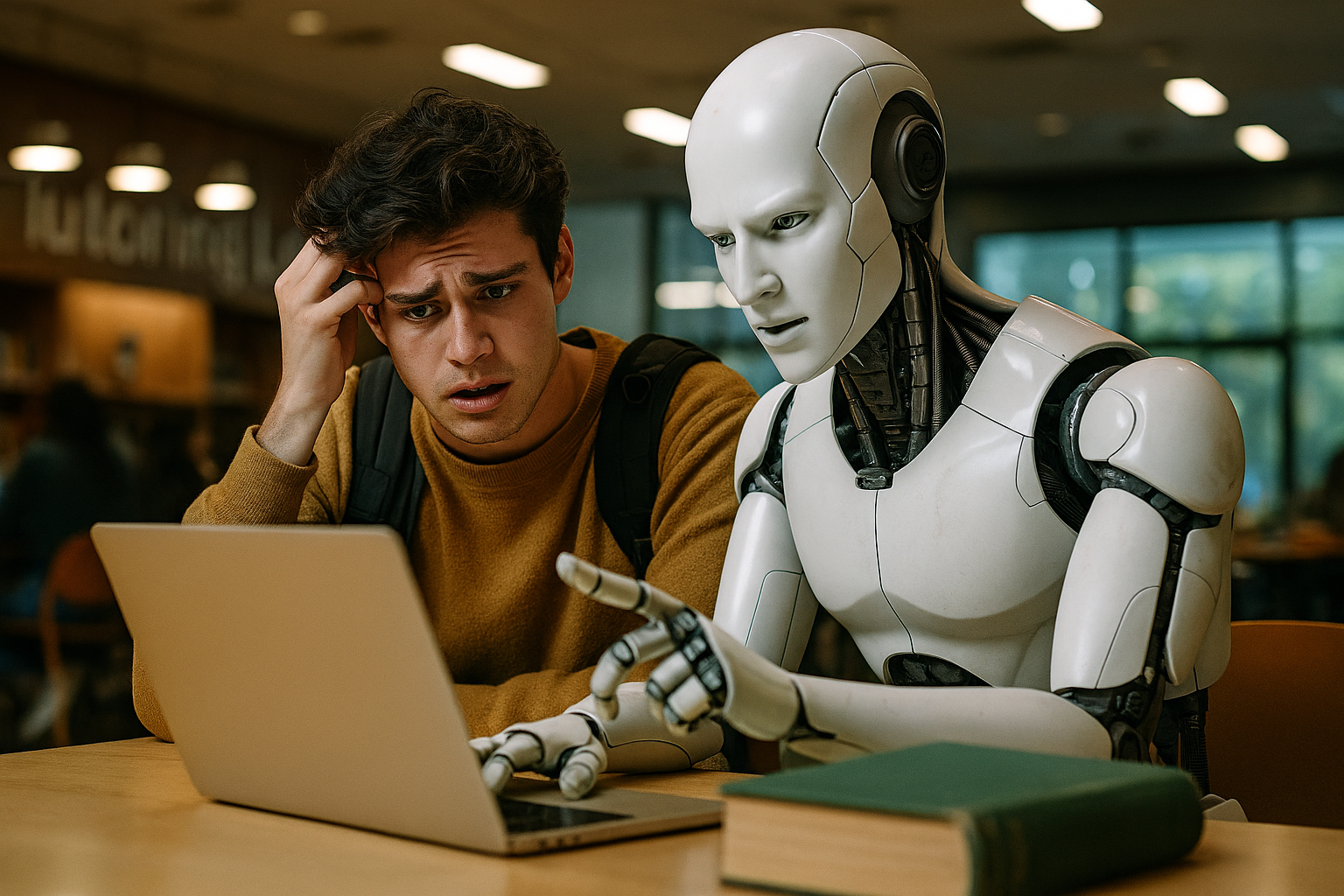
Nosta lays bare the problem that AI has exposed and leaves us with a key to unlocking AI’s advantage over the “blunt instruments” that have operationally defined learning: “Artificial intelligence introduces a disruption of a different order. Not mechanical advantage, but cognitive advantage.” I asked four chatbots to select and explain the most important AI cognitive advantages, and here are some of the results.
Cognitive Advantage 1: Increased Cognitive Effort Through Productive Struggle (Copilot)
One of the most important cognitive advantages of learning with AI—when used intentionally—is the ability to calibrate the level of difficulty so that learners remain in a zone of “productive struggle.” Traditional learning environments often swing between two extremes: overly difficult tasks that lead to frustration, or overly simplified instruction that reduces cognitive engagement. AI systems, by contrast, can dynamically adjust the challenge level in real time, responding to the learner’s pace, errors, and demonstrated understanding. This capacity matters because cognitive psychology consistently shows that learning is deepest when the brain is required to work just hard enough to encode, retrieve, and reorganize information
The article* emphasizes that AI’s impact depends on design and awareness, which is precisely why this advantage is so powerful: AI can be structured to intentionally promote cognitive effort rather than bypass it. When learners receive instant feedback, targeted hints, or Socratic questioning from an AI tutor, they are nudged to think more deeply rather than simply memorize or copy. This supports metacognition—the ability to monitor one’s own thinking—which is a cornerstone of long‑term academic growth.
Moreover, AI can help learners confront misconceptions immediately, something traditional classrooms struggle to do at scale. A teacher cannot simultaneously diagnose the cognitive state of thirty students, but an AI tutor can. This creates a learning environment where errors become opportunities for refinement rather than sources of embarrassment or discouragement.
In short, AI’s ability to sustain productive cognitive effort is not merely a convenience; it is a structural shift in how learners can engage with material. It allows for individualized challenge, continuous feedback, and a more deliberate cultivation of the mental habits that underlie expertise.
__________
* “How does AI affect how we learn? A cognitive psychologist explains why you learn when the work is hard,” by Brian W. Stone, The Conversation, published September 10, 2025. “Emerging research is showing the complex effect chatbots are having on learning, showing the need for good design and student awareness.”
Cognitive Advantage 2: Strengthened Problem‑Solving and Logical Reasoning (Copilot)
The second major cognitive advantage of learning through AI is the strengthening of problem‑solving and logical reasoning skills. Traditional instruction often presents problems in fixed formats, with limited opportunities for learners to explore alternative strategies or receive immediate, tailored feedback. AI‑supported learning environments, however, can generate variations of a problem, highlight underlying structures, and guide learners through multiple solution pathways. This flexibility encourages deeper cognitive processing and helps learners generalize concepts across contexts.
The article* emphasizes that engaging with AI systems—whether by learning how they work or by using them as learning partners—requires breaking down complex problems into smaller, more manageable components. This mirrors the cognitive processes used by expert thinkers in fields such as mathematics, engineering, and computer science. When learners practice decomposing tasks, identifying patterns, and evaluating algorithmic steps, they are effectively training the executive functions that support high‑level reasoning.
AI also supports iterative experimentation. A learner can test a hypothesis, receive immediate feedback, and refine their approach without the social pressure or time constraints of a classroom. This cycle of trial, error, and adjustment is essential for developing adaptive expertise—the ability to apply knowledge flexibly in new situations.
Furthermore, AI can model reasoning processes explicitly. For example, an AI tutor can walk a learner through the logic behind a solution, making invisible cognitive steps visible. This transparency helps learners internalize reasoning strategies rather than merely memorizing answers.
In essence, AI‑mediated learning strengthens the cognitive architecture of problem‑solving by promoting decomposition, pattern recognition, iterative refinement, and explicit reasoning. These skills are foundational not only for academic success but also for navigating an increasingly complex technological world.
__________
* “The Cognitive Benefits of Learning About Artificial Intelligence,” by Very Big Brain (author not individually credited), VeryBigBrain.com, published November 5, 2024. “From improving your problem-solving skills to enhancing creative thinking, understanding AI engages your mind in ways that boost cognitive function.”
Cognitive Advantage 3: Scaffolding and support for metacognition and self-regulated learning (ChatGPT)
Metacognition — monitoring and regulating one’s own learning — is a central cognitive capability tied to transfer, problem solving, and lifelong learning. Traditional instruction sometimes teaches strategies explicitly, but many learners fail to develop robust metacognitive routines: they don’t plan, they don’t evaluate accuracy, and they don’t adjust strategies when stuck. AI systems can both model good metacognitive processes and prompt learners to use them.
For example, an AI tutor can ask a student to predict their answer, justify a step, reflect on confidence, or choose a problem-solving strategy; it can then compare that stream of self-monitoring against performance data and give targeted prompts (e.g., “you were overconfident in similar problems; consider re-checking step 2”). Over time, such external scaffolds aim to internalize into a student’s habit loop: learners begin to self-plan, self-monitor, and self-correct without prompts.
Cognitively, scaffolding metacognition reduces blind spots in monitoring, aligns subjective confidence with objective performance (calibration), and encourages strategic variability — all of which foster far transfer beyond the narrow practice tasks. AI analytics also let learners observe learning trajectories (visualized mastery graphs, time-on-task breakdowns) that make invisible processes visible, helping students reinterpret setbacks as data and choose effective strategies.
For instructors and designers, AI-driven metacognitive scaffolds can be tuned to developmental level: younger learners receive more directive prompts, more advanced learners receive strategy nudges. The result is a population that not only learns discrete content but becomes better learners — a cognitive multiplier that supports future domain learning, self-directed study, and adaptability in rapidly changing knowledge landscapes.
__________
Source: Mapping the Scaffolding of Metacognition and Learning by AI Tools in STEM Classrooms: A Bibliometric–Systematic Review (2005–2025), by M. Tsakeni et al.; published 15 Nov. 2025 (PMC/NIH-hosted review). “AI tools scaffold and share metacognitive processes.”
Cognitive Advantage 4: Fostering Deeper Conceptual Understanding (Gemini)
The fourth vital cognitive advantage is AI’s ability to foster deeper conceptual understanding through the creation of highly interactive, immersive, and complex learning experiences. Traditional methods often rely heavily on static textbooks, lectures, and two-dimensional diagrams to convey abstract or complicated material. While effective for some, this can limit the cognitive depth achievable for topics that benefit from hands-on, multi-sensory, or simulated engagement.
This enhancement is crucial because the deepest cognitive mastery often comes from experiential learning—the process of learning through reflection on doing. AI-driven technologies, such as virtual labs for science experiments or VR simulations for practicing historical or medical procedures, provide a safe, scalable, and risk-free environment for this “doing.” Cognitively, this immersive environment activates multiple sensory and motor cortices in the brain, creating stronger and more interconnected memory traces for the concepts being learned.
Unlike passive consumption of material, active engagement with a simulation demands high-level problem-solving and critical thinking skills in a real-time, dynamic context. For example, a medical student practicing a simulated surgery or an engineering student designing a virtual bridge must apply theoretical knowledge to a complex, multi-variable scenario, which is a far richer cognitive exercise than answering a multiple-choice question.
Furthermore, the AI can be used to generate endless variations of complex problems and scenarios, enabling transfer of learning—the ability to apply knowledge learned in one context to a new or different situation—a hallmark of true conceptual mastery. This capability moves the student’s cognitive processing beyond mere memorization toward advanced reasoning, analysis, and synthesis.
__________
Source: “Advantages and disadvantages of AI in education,” University Canada West (UCW),” 21 May 2025. “Technologies such as virtual reality (VR) and augmented reality (AR) powered by AI can simulate real-world scenarios and complex concepts, making learning more interactive and enjoyable.”
Cognitive Advantage 5: Personalized Adaptive Learning (Claude)
The fifth significant advantage lies in AI’s capacity to deliver individualized instruction that adapts to each learner’s unique cognitive profile. In their study examining AI’s impact on student academic development, Vieriu and Petrea* note that AI technologies “enable personalized learning by adapting educational content to meet the unique needs of individual students.” This observation captures the fundamental shift from one-size-fits-all instruction to dynamically responsive education.
This advantage matters profoundly because it addresses a longstanding limitation of traditional classroom education. In conventional settings, teachers must calibrate their instruction to accommodate an entire class, typically aiming for the middle range of ability levels. This approach inevitably leaves some students under-challenged and bored while others struggle to keep pace, feeling overwhelmed and discouraged. The cognitive consequences of this mismatch are substantial. Students who find material too easy may disengage, failing to develop the persistence and deep thinking skills that come from productive struggle. Conversely, those who find content too difficult may experience cognitive overload, which research in Cognitive Load Theory demonstrates can actually impair learning rather than enhance it.
AI-powered adaptive learning systems address this problem through continuous assessment and adjustment. These systems analyze student responses in real time, identifying knowledge gaps, recognizing patterns in errors, and detecting when learners have mastered particular concepts. Based on this analysis, the AI adjusts the difficulty, pacing, and presentation style of subsequent material. A student who quickly grasps algebraic concepts might be automatically advanced to more complex problems, while another who struggles with fractions receives additional practice and alternative explanations before proceeding.
The cognitive benefits extend beyond mere convenience. When learning material matches a student’s current zone of proximal development, cognitive resources can be allocated more efficiently. Students spend less mental energy on tasks that are either trivially easy or impossibly difficult and more energy on challenges that productively stretch their abilities. This optimal cognitive engagement promotes deeper processing, better retention, and the development of metacognitive skills as students learn to recognize their own learning patterns. Moreover, personalized learning can accommodate different cognitive styles—some students may learn better through visual representations, others through verbal explanations, and still others through hands-on problem-solving. AI systems can present information in multiple formats and identify which approaches work best for each individual.
The implications for long-term cognitive development are significant. Students who consistently work within their optimal learning zone develop stronger foundational knowledge, greater confidence in their abilities, and more sophisticated problem-solving strategies. They’re less likely to develop the learned helplessness that can result from repeated failure or the intellectual complacency that comes from never being challenged. By ensuring that each learner encounters material calibrated to their current capabilities while still pushing them forward, AI-assisted education maximizes cognitive growth in ways that traditional mass instruction simply cannot achieve.
__________
* Aniella Mihaela Vieriu & Gabriel Petrea, “The Impact of Artificial Intelligence (AI) on Students’ Academic Development,” Education Sciences, Volume 15, Issue 3 (11 March 2025).
Cognitive Advantage 6: Immediate Feedback Mechanisms (Claude)
The sixth critical advantage involves the immediacy with which AI systems can provide corrective feedback. Jose and colleagues*, in their examination of AI’s cognitive effects in education, observe that intelligent tutoring systems and adaptive learning platforms can offer “real-time feedback,” which represents a fundamental departure from traditional educational timelines.
This advantage matters because timing is crucial to effective learning. Decades of research in cognitive psychology have demonstrated that the temporal gap between action and feedback significantly influences learning outcomes. When students receive immediate feedback, several cognitive processes are optimized. First, the learner’s mental representation of the problem remains fresh and active in working memory. They can immediately connect the feedback to their reasoning process, understanding precisely where their thinking went astray. This immediate correction prevents the consolidation of errors into long-term memory—a phenomenon psychologists call “error entrenchment.”
In traditional educational settings, feedback often arrives days or even weeks after students complete assignments. A student might submit a math problem set on Monday and receive graded work back on Friday, or write an essay that returns with comments two weeks later. By that time, the cognitive context has dissolved. The student may barely remember their reasoning process, the specific knowledge they drew upon, or the decision points where they made critical choices. The delayed feedback becomes a retrospective evaluation rather than an active learning tool. Students may note their grade and perhaps glance at comments, but the opportunity for deep cognitive correction has passed.
AI systems eliminate this temporal gap. When a student solves an algebra problem incorrectly, the AI can immediately indicate the error, explain the underlying misconception, and provide a similar problem for immediate practice. This creates a tight feedback loop that accelerates learning. The student can test their revised understanding immediately, building confidence when they succeed and adjusting further if they struggle. This rapid iteration mirrors how humans naturally learn complex motor skills—through immediate sensory feedback that allows continuous adjustment and refinement.
The cognitive benefits extend beyond error correction. Immediate feedback also provides positive reinforcement when students succeed, strengthening the neural pathways associated with correct problem-solving approaches. This timely validation builds procedural fluency and automaticity, freeing cognitive resources for higher-order thinking. Students develop more accurate metacognitive awareness, learning to recognize when they’re on the right track and when they need to reconsider their approach. They become more efficient learners, spending less time practicing incorrect methods and more time building genuine competence.
Furthermore, immediate feedback creates opportunities for formative assessment that would be impractical in traditional settings. Teachers cannot provide real-time feedback to thirty students simultaneously, but AI systems can. This means every student can have their misconceptions addressed immediately, rather than carrying them forward into subsequent lessons. The cumulative effect over time is substantial—students build more solid foundations, develop fewer persistent misconceptions, and progress more rapidly through curriculum sequences. The cognitive advantage of immediate feedback represents not just an incremental improvement but a qualitative transformation in how learning can occur.
__________
* Binny Jose, et al., “The cognitive paradox of AI in education: between enhancement and erosion,” Frontiers in Psychology, Volume 16 (13 Apr. 2025).
Cognitive Advantage 7: Accessibility and Support (Claude)
The seventh significant advantage addresses the temporal constraints inherent in traditional education. As Chirag Bhardwaj’s analysis notes, “Conversational AI in education helps students by giving them 24/7 access to info and support,” effectively removing the barriers of “office hours and whether staff is around.”
This advantage matters because cognitive development doesn’t occur on a predictable schedule. Human learning processes are highly variable—students may suddenly grasp a concept at unexpected moments, encounter difficulties during late-night study sessions, or experience breakthrough insights when teachers are unavailable. Traditional education imposes rigid temporal structures that may not align with individual cognitive rhythms. A student struggling with a physics concept at 10 PM must simply wait until the next class meeting or office hours, potentially allowing confusion to deepen and frustration to mount.
The cognitive implications of this temporal flexibility are profound. First, it enables learning at optimal times for individual circadian rhythms. Research in chronobiology demonstrates that people have different peak periods for cognitive performance—some are morning learners, others afternoon or evening. Traditional school schedules favor morning learners but may disadvantage others. With 24/7 AI assistance, students can engage with challenging material when their cognitive resources are at their peak, leading to more efficient learning and better retention.
Second, immediate access to support prevents the accumulation of confusion. In traditional settings, a student who misunderstands a foundational concept might continue building on that flawed foundation for days before receiving correction. This creates cascading misconceptions that become increasingly difficult to untangle. With AI assistance available around the clock, students can address confusion the moment it arises. They can ask clarifying questions, request alternative explanations, or seek additional examples immediately, preventing small misunderstandings from snowballing into major knowledge gaps.
Third, continuous availability supports the natural learning process of productive struggle. Cognitive scientists recognize that some degree of difficulty and confusion is essential for deep learning—it forces learners to actively process information rather than passively receive it. However, there’s a crucial distinction between productive struggle (which enhances learning) and unproductive frustration (which impairs it). The difference often comes down to whether learners can access appropriate support when needed. Traditional education may strand students in unproductive frustration during independent study time. AI systems allow students to engage in productive struggle with the confidence that help is available if they truly get stuck, optimizing the cognitive challenge level.
The accessibility advantage also addresses equity concerns with cognitive implications. In traditional settings, students with parents who can provide homework help, or those who can afford private tutors, have cognitive advantages over peers who lack such resources. They receive additional explanation, practice opportunities, and encouragement that enhance learning. AI systems democratize access to this support, ensuring that all students can receive assistance regardless of their socioeconomic circumstances. This levels the cognitive playing field, allowing students’ innate abilities and efforts rather than external resources to determine their learning outcomes.
Furthermore, 24/7 availability enables distributed practice, which research consistently shows is superior to massed practice for long-term retention. Instead of cramming before exams, students can engage with material in shorter, more frequent sessions spread across time. AI systems can facilitate this optimal learning pattern by being available for brief interactions whenever students have spare moments—during commutes, between activities, or in the evening. The cognitive benefits of this spacing effect compound over time, leading to more durable knowledge and better transfer of learning to novel situations.
__________
* Chirag Bhardwaj, “15 Use Cases, Benefits, and Examples of Conversational AI in the Education Sector,” Appinventiv Blog, 14 Nov. 2025.
[End]
Filed under: Uncategorized |


 Educational Technology and Change Journal

Leave a comment