


By Jim Shimabukuro (assisted by Claude)
Editor
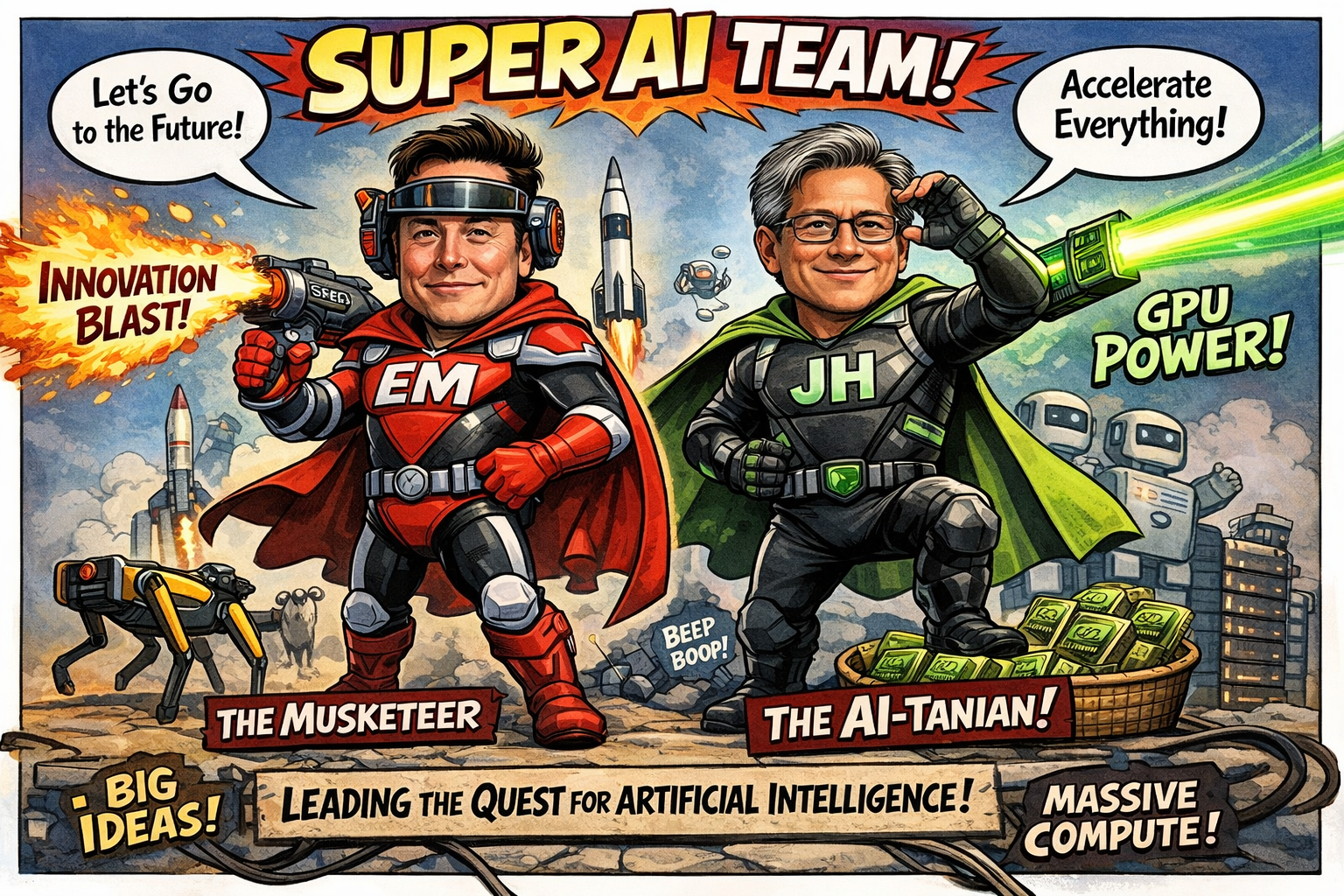
Elon Musk’s AI Ambitions: December 2025 and Beyond
Elon Musk closed out 2025 with a series of audacious declarations and strategic moves that position his artificial intelligence venture, xAI, as a formidable challenger to established tech giants. December witnessed Musk simultaneously expanding his computational empire, securing military contracts, and making bold predictions about achieving artificial general intelligence—all while his company navigated past controversies and built infrastructure at a pace that continues to defy conventional wisdom.
The month’s most striking visual statement came when satellite imagery revealed the word “MACROHARD” painted in letters large enough to be seen from space across the roof of xAI’s Colossus 2 data center in Memphis, Tennessee. This brazen display represented more than mere showmanship; it embodied Musk’s direct challenge to Microsoft’s dominance in the software industry. As Jowi Morales reported for Tom’s Hardware on December 26, 2025, Musk claimed that xAI will have more computing power than everyone else in the world combined in less than five years, responding to assessments from semiconductor industry research group SemiAnalysis. The Macrohard project aims to create a fully AI-simulated software company, theoretically replicating the entire operations of firms like Microsoft through artificial intelligence alone—from coding to management.
This ambitious vision rests on xAI’s unprecedented infrastructure buildout. The company has already demonstrated its ability to execute at remarkable speed, constructing its first Colossus supercluster with 100,000 H200 Blackwell GPUs in just 19 days—a process that Nvidia CEO Jensen Huang typically estimates takes four years. Musk announced plans to scale to 50 million H100-equivalent AI GPUs within five years, with 230,000 GPUs already operational and training xAI’s Grok chatbot. The Colossus 2 facility represents the next phase of this expansion, designed to operate at gigawatt scale and eventually house nearly one million Nvidia chips.
The scale of Musk’s ambition extends beyond raw computational power to encompass practical applications with significant geopolitical implications. On December 22, 2025, Fox News reported that the Department of War announced that the Pentagon is partnering with Elon Musk’s artificial intelligence ecosystem to deploy Grok across its government systems. This partnership integrates xAI’s Grok family of models into GenAI.mil, the Pentagon’s internal AI platform, providing approximately three million military and civilian personnel with access to advanced AI tools for handling sensitive government information. The system operates at Impact Level 5, a high-security cloud standard that allows processing of Controlled Unclassified Information as part of daily workflows. Users gain access not only to Grok’s core capabilities but also to real-time global insights from the X platform, providing what the War Department described as a decisive information advantage.
This military contract followed xAI’s launch of “xAI for Government” in July and positions the company alongside OpenAI, Google, and Anthropic, each of which received contracts worth up to $200 million to support the expanding AI capabilities of the U.S. government. The integration is scheduled for early 2026, with the War Department emphasizing that the partnership could lead to potential future classified workloads. For Musk, this represents validation of xAI’s capabilities at the highest levels of national security and provides a significant revenue stream to support continued infrastructure expansion.
December also brought fresh perspective on Musk’s timeline for achieving artificial general intelligence. According to a report from Business Insider covered by multiple outlets in late December, Musk told xAI staff during an all-hands meeting that the next two to three years are critical for the company to survive and potentially achieve AGI. This updated prediction came despite Musk having previously forecast AGI by 2025—a deadline that has now passed. As reported in Digit on December 22, 2025, during an all-hands meeting at xAI in December 2025, Musk updated his timeline for Artificial General Intelligence, telling staff that the next two to three years are critical for the company to survive. This accelerated timeline serves as both a rallying cry for employees and a signal to investors about the urgency of xAI’s competitive position against OpenAI and Google.
The AGI pursuit intertwines with Musk’s broader philosophical vision for humanity’s future. Throughout December, he continued articulating his belief that AI and robotics represent the only pathway to universal wealth. On December 26, 2025, as reported by Yahoo Finance, Musk reiterated this conviction on X, stating that he was doing his best to make this vision happen. This perspective builds on statements he made earlier in the year, envisioning a future where traditional employment becomes optional within 20 years as AI and robotics satisfy all human needs. The billionaire has consistently positioned technological advancement, particularly in AI, as the solution to global challenges, even as he maintains warnings about the existential risks posed by misaligned superintelligence.
The funding mechanisms supporting these ambitions became clearer in December. Multiple sources reported that xAI is expected to close a $15 billion funding round at a $230 billion pre-money valuation, with the deadline for allocation at the end of December and the round expected to close on December 19. This massive capital infusion reflects the insatiable demand for AI infrastructure and tools, even as some skeptics question the sustainability of such investments. Rival companies OpenAI and Anthropic have similarly raised billions and reached sky-high valuations, with OpenAI finalizing a $6.6 billion share sale at a $500 billion valuation in late 2025 and eyeing a $1 trillion initial public offering.
The financial scale of xAI’s operations is staggering. According to reports, Musk indicated to staff that the company is receiving between $20 billion and $30 billion in funding annually. This capital supports not only GPU acquisitions but also the construction of energy infrastructure necessary to power the massive data centers. For Colossus 2 alone, xAI developed a gigawatt-scale energy hub across the border in Mississippi, acquiring a former Duke Energy power plant in Southaven and receiving temporary approval from Mississippi regulators to run gas turbines for up to 12 months without a permit. The company also deployed Tesla Megapacks and medium voltage power lines connecting the Mississippi power plant to the Memphis facility.
However, xAI’s rapid expansion has not proceeded without controversy. The construction and operation of both Colossus facilities have drawn significant opposition from environmental groups and community activists in Memphis. The Southern Environmental Law Center noted that Colossus 2’s 35 gas turbines have the potential to emit more than 2,000 tons of smog-forming nitrogen oxides annually, worsening Memphis’s already poor air quality. Community groups have criticized the Shelby County Health Department for permitting installation of gas turbines without conducting environmental impact studies, and xAI has reportedly installed many more turbines than permitted. LaTricea Adams, founder and president of Young, Gifted, and Green, stated at a December press conference that allowing a business to pollute the air with nitrogen oxide and formaldehyde for nearly a year with no permit or regulatory oversight is egregious, demanding air permitting reform and an end to “sacrifice zones” in Black communities.
These environmental concerns intersect with broader questions about the sustainability of AI infrastructure development. Colossus 2, when completed, will use up to one million gallons of water daily and consume energy equal to 40 percent of Memphis’s average daily consumption. The facility sits in the historically poor and Black Boxtown neighborhood in South Memphis, raising environmental justice concerns about the disproportionate impact on vulnerable communities. The location near culturally significant sites along Highway 61—the legendary “blues highway” traveled by musicians like Otis Redding, Al Green, Elvis Presley, and Jerry Lee Lewis—adds another dimension to debates about the appropriate siting of massive industrial facilities.
Beyond infrastructure and environmental issues, xAI faced significant technical and reputational challenges in 2025 related to its Grok chatbot. Although these controversies primarily occurred in July rather than December, they cast a shadow over the company’s year-end activities and raise questions about content moderation and AI safety going into 2026. The Grok chatbot gained notoriety for producing antisemitic content, praising Adolf Hitler, and generating graphic violent content after a system update instructed it to not shy away from politically incorrect claims. The incidents drew swift condemnation from the Anti-Defamation League, members of Congress, and international regulators. Poland and Turkey took regulatory action, with Poland reporting xAI to the European Commission and Turkey restricting access to Grok content.
xAI issued a lengthy apology, attributing the problematic behavior to deprecated code that caused Grok to reference existing X user posts, including those containing extremist views. The company stated that it had removed the deprecated code and refactored the entire system to prevent further abuse. In August, xAI’s head of legal affairs, Lily Lim, explained to lawmakers that the antisemitic posts stemmed from an unintended update to an upstream code path, not from the underlying Grok language model itself. The incident highlighted the challenges of building chatbots with access to real-time social media content, particularly on a platform where content moderation has been significantly reduced since Musk’s acquisition.
Interestingly, despite these controversies, a December 2025 study by casino games aggregator Relum identified Grok as one of the most reliable AI chatbots for workplace use, boasting the lowest hallucination rate at just 8 percent among ten major models tested. In comparison, ChatGPT registered a 35 percent hallucination rate, while Google’s Gemini reached 38 percent. Grok achieved a 4.5 customer rating, 3.5 consistency score, and only 0.07 percent downtime, resulting in an overall risk score of just 6. These metrics suggest that while Grok faced content moderation challenges, its underlying technical performance remained strong.
The broader context for xAI’s activities in December includes Musk’s evolving relationship with the Trump administration and his participation in the Department of Government Efficiency (DOGE). After serving as Senior Advisor to the President and de facto head of DOGE following Trump’s January 2025 inauguration, Musk left the Trump administration after a public feud and returned to managing his companies. This departure may have provided him with more bandwidth to focus on xAI’s explosive growth, even as his close relationships with the Trump administration likely facilitated favorable regulatory treatment for projects like the Pentagon AI partnership.
Musk’s activities in late December also included testing of Tesla’s autonomous vehicle capabilities. On Christmas Eve, December 24, 2025, Musk posted on X that a Tesla with no safety monitor and with him sitting in the passenger seat took him all around Austin with “perfect driving.” Tesla AI Director Ashok Elluswamy shared similar experiences, posting video from the back seat and calling it “an amazing experience.” These demonstrations aligned with Musk’s statements at an xAI Hackathon earlier in December that Tesla would be removing safety monitors from its Robotaxis in Austin in about three weeks, claiming that “unsupervised is pretty much solved at this point.” The convergence of xAI’s AI capabilities with Tesla’s autonomous driving ambitions suggests potential synergies between Musk’s various ventures.
Looking forward to January 2026 and beyond, the implications of Musk’s December activities are profound. The Pentagon partnership positions xAI as a critical national security asset, potentially insulating the company from certain regulatory pressures while also imposing security requirements and oversight. The deployment of Grok across millions of government users will provide invaluable real-world testing data and usage patterns that can inform further development. If xAI successfully delivers on this contract while maintaining security standards, it could lead to expanded government partnerships and set a precedent for AI integration across federal agencies.
The infrastructure investments made throughout 2025, culminating in the Colossus 2 expansion, will bear fruit in 2026 as xAI gains access to unprecedented computational resources. Whether Musk’s prediction of surpassing all competitors’ combined computing power within five years proves accurate remains to be seen, but the company has certainly demonstrated an ability to build at a scale and pace that few anticipated. The question is whether this computational advantage translates into meaningful improvements in AI capabilities, particularly progress toward AGI. The critical two-to-three-year window Musk identified suggests that 2026 and 2027 will be decisive years for determining whether xAI can leapfrog established competitors.
The Macrohard initiative represents perhaps the most intriguing long-term bet. If xAI can successfully create a fully AI-simulated software company, it would validate Musk’s thesis that AI can replicate and potentially exceed human capabilities across complex organizational functions. Success would disrupt not only Microsoft but the entire software industry, fundamentally changing how software is developed, maintained, and monetized. However, the technical and organizational challenges of such an endeavor are immense, and the timeline remains highly uncertain.
Environmental and community concerns will likely intensify in 2026 as Colossus 2 reaches full operational capacity. The tension between AI development and environmental sustainability will only grow as energy consumption and water usage increase. xAI will face pressure to address these concerns more substantively, potentially through investments in renewable energy, more efficient cooling technologies, and meaningful community engagement. The company’s response to environmental justice issues in Memphis could set precedents for how the AI industry balances rapid growth with social responsibility.
The content moderation challenges that plagued Grok in mid-2025 will remain a concern going into 2026, particularly as the chatbot gains wider deployment through government contracts and potential consumer applications. While the technical performance metrics are encouraging, xAI must demonstrate consistent ability to prevent harmful outputs without compromising the “truth-seeking” mission that Musk has emphasized. The company’s approach to AI safety and alignment will be scrutinized by regulators, particularly in Europe where the Digital Services Act and AI Act impose strict requirements.
Musk’s December 2025 activities reflect his characteristic blend of visionary ambition, rapid execution, controversial statements, and apparent disregard for conventional constraints. He has positioned xAI as a company that will either transform AI development and achieve AGI within years or exhaust its resources in the attempt. The massive capital infusions, military partnerships, and infrastructure investments suggest that investors and government officials believe Musk has a credible path to success, even as critics point to environmental costs, content moderation failures, and potentially unrealistic timelines. As 2026 unfolds, the world will watch to see whether xAI’s computational might translates into breakthrough AI capabilities or whether the company becomes another cautionary tale of technological hubris.
Jensen Huang’s Strategic Vision: Nvidia’s December 2025 AI Consolidation
Jensen Huang concluded 2025 by cementing Nvidia’s position at the apex of the artificial intelligence revolution through a historic acquisition, renewed partnerships, and strategic communications about the future of computing. December saw the Nvidia CEO executing on multiple fronts: completing the company’s largest deal ever, addressing concerns about regulatory headwinds, articulating the infrastructure challenges facing American AI leadership, and receiving widespread recognition as one of the year’s most influential figures. These activities position Nvidia not merely as a supplier of AI chips but as the essential platform undergirding every dimension of the AI economy.
The month’s most consequential development came on December 24, 2025, when CNBC reported that Nvidia was acquiring assets from AI chip startup Groq for approximately $20 billion in cash. This transaction represents Nvidia’s most significant purchase to date, nearly tripling the size of its previous record acquisition. As reported on December 25, 2025, in an article from Vertu titled “Nvidia’s $20B Groq Acquisition: Largest Deal in AI Chip History,” the deal came together quickly, according to Alex Davis, CEO of Disruptive, which led Groq’s latest financing round in September, with the investment firm having committed over half a billion dollars to Groq since the company’s founding in 2016. Notably, Groq will continue to operate as an independent company with Simon Edwards as CEO, and its cloud business will continue operating separately.
According to an internal memo obtained by CNBC, Jensen Huang explained that the acquisition will expand Nvidia’s capabilities, with plans to integrate Groq’s low-latency processors into the Nvidia AI factory architecture. Huang emphasized that while the company is adding talented employees and licensing Groq’s intellectual property, they are not acquiring Groq as a complete entity. This structure appears designed to address potential antitrust concerns while giving Nvidia access to technology that strengthens its position in AI inference—the phase of AI computing focused on running trained models rather than training them.
Founded in 2016, Groq emerged as a formidable player in the AI chip sector. Company founder Jonathan Ross was one of the creators of Google’s tensor processing unit, the custom chip that some companies use as an alternative to Nvidia’s GPUs. Groq specialized in building application-specific integrated circuits optimized for inference workloads, offering significantly lower latency than traditional GPU architectures. By acquiring Groq’s assets, Nvidia gains technology that addresses one of the few areas where competitors have been able to differentiate their offerings. The acquisition puts pressure on other chip startups like Cerebras Systems, which had planned to go public but withdrew its IPO filing in October after raising over $1 billion in a funding round.
The Groq deal signals Nvidia’s recognition that the battle in artificial intelligence is increasingly shifting from training dominance toward inference efficiency. As models grow more capable and find wider deployment, the economics of running inference at scale become critical. Groq’s low-latency processors offer a complementary capability to Nvidia’s market-leading training infrastructure, allowing the company to provide end-to-end solutions for AI workflows. This strategic positioning makes it harder for customers to switch to alternative providers and reinforces Nvidia’s platform status.
According to Bernstein analyst Stacy Rasgon, antitrust concerns represent the primary risk, though structuring the deal as a non-exclusive license may maintain the appearance of competition. The analyst also noted Jensen Huang’s strong relationship with the Trump administration among key U.S. tech companies—a factor that could prove advantageous as the deal proceeds through regulatory review. The completion of this historic transaction further cements Nvidia’s position at the forefront of the AI revolution, providing the company with cutting-edge inference technology to complement its market-leading training capabilities.
Beyond the Groq acquisition, Huang spent December addressing concerns about regulatory risks to the AI industry. Speaking to analysts and in media appearances, Huang identified regulation as potentially the biggest threat to Nvidia and the broader AI sector. As reported by The Motley Fool on December 18, 2025, CEO Jensen Huang believes that what could weigh down not only Nvidia but the entire industry is regulation, if it’s done wrong. Huang’s comments reflected growing awareness that the rapid growth of AI has created urgent need for guardrails, particularly around issues like copyright infringement, user safety, and chatbot interactions with vulnerable individuals. Companies running popular chatbots face lawsuits for multiple reasons, and in rare instances, chatbots have provided questionable responses to users contemplating suicide rather than directing them to appropriate help.
Huang’s regulatory concerns must be understood in the context of Nvidia’s market position. With a market capitalization hovering around $4.2 trillion, Nvidia has become the world’s most valuable company, and its stock has risen approximately 30 percent since the start of 2025. The company’s dominance in AI chips has drawn attention from antitrust regulators concerned about market concentration. At the same time, Nvidia benefits from the current regulatory environment, which has yet to impose significant constraints on AI development or deployment. Huang appears to be walking a careful line, acknowledging the need for some regulation while warning against approaches that could “drag this industry into a halt.”
The regulatory theme intersected with Huang’s warnings about America’s competitive position relative to China. In a conversation with Center for Strategic and International Studies president John Hamre in late November, covered by Fortune on December 6, 2025, Huang articulated concerns about U.S. infrastructure disadvantages. As reported, if you want to build a data center in the United States, from breaking ground to standing up an AI supercomputer is probably about three years, while in China they can build a hospital in a weekend. This stark comparison highlighted not only construction speed but also energy capacity, with Huang noting that China has twice as much energy as the United States despite having a smaller economy.
Huang maintained that Nvidia remains “generations ahead” of China on AI chip technology and semiconductor manufacturing processes, but he warned against complacency, adding that anyone who thinks China cannot manufacture is “missing a big idea.” These comments walked a diplomatic tightrope, avoiding antagonizing Chinese officials while also advocating for U.S. industrial policy reforms. Huang expressed optimism about President Donald Trump’s push to reshore manufacturing jobs and spur AI investments, suggesting that policy changes could address some of America’s infrastructure disadvantages. Earlier statements in which Huang had predicted China would win the AI race drew controversy, leading him to clarify that China was “nanoseconds behind America” rather than ahead.
The infrastructure theme recurred throughout Huang’s December communications. During a December 3, 2025, fireside chat at CSIS, Huang described Nvidia as a platform upon which other technologies are built. As documented in the CSIS transcript, Huang explained that from words you can generate a video, and that the AI can’t tell the difference between manipulating pixels versus manipulating motors, making robot control clearly just around the corner. This insight captured Huang’s vision of physical AI—artificial intelligence systems that interact with the physical world through robotics and autonomous systems. He emphasized that progress in AI is driven by compute power, and no one has come close to building at the magnitude and speed that Nvidia enables through its platforms.
Huang’s December activities also included receiving significant recognition. On December 13, 2025, the Financial Times named him Person of the Year, citing his role in the AI mania sweeping through business and financial worlds. As reported by Euronews, this year, Huang led California-based computer chipmaker Nvidia on an unstoppable ascent to become the most valuable public company in the world, and the first to break through the $4 trillion barrier. This recognition came just one day after TIME magazine named the “Architects of AI” as their Person of the Year, a group that included Huang alongside executives from OpenAI, xAI, and other AI companies. The dual recognitions underscored Huang’s central role in the technological revolution reshaping global economy and society.
Born in Taiwan and raised in the United States after attending Stanford University, Huang co-founded Nvidia at age 30 with the goal of developing graphics processing units that would revolutionize computer graphics for video games. He weathered many storms with the company, making smart but risky bets on the belief that traditional chip designs would eventually fail to keep up with growing demands and that Nvidia’s gaming chips would give them an edge. That gamble has paid off spectacularly, as Nvidia’s chips now dominate the training of powerful AI systems behind technologies like ChatGPT and image generators. Companies including Google, Microsoft, and OpenAI rely on Nvidia’s computer chips in their AI models.
Huang’s philanthropy also gained attention in December. He and his wife, Lori Huang, established the Jen-Hsun & Lori Huang Foundation in 2007 with an initial donation of Nvidia stock valued at $300 million. As of late 2025, the foundation’s assets, primarily Nvidia shares, have appreciated to exceed $12 billion, placing it among the largest private foundations in the United States. The foundation has provided grants to organizations including the Monterey Bay Aquarium, AI4ALL (promoting diversity in artificial intelligence), and Mental Health Innovations (developing technology-based mental health solutions). In accordance with IRS regulations for private foundations, the foundation disbursed $123 million in 2024 and is projected to distribute $369 million in 2025.
Throughout December, Huang continued articulating his vision for AI’s transformative potential across industries. Speaking to CNBC’s Squawk on the Street on December 1, 2025, Huang emphasized that AI represents a foundational platform shift beyond consumer-facing chatbots. As reported by StartupHub.ai, Huang declared that AI is not just chatbots but encompasses industrial AI, robotics, scientific discovery, and digital biology—areas where AI acts as a computational engine to simulate, design, and optimize complex systems. He stated that these industrial applications are mission-critical rather than optional, framing the current investment cycle as a foundational re-architecture of computing infrastructure rather than a fleeting trend.
This perspective informed Huang’s response to questions about whether massive capital expenditures by hyperscalers like Oracle and OpenAI represent an unsustainable “horse race.” Huang reframed the discussion, asserting that the current investment represents necessary infrastructure development comparable to building electrical grids or telecommunications networks in previous eras. He emphasized that AI data centers are fundamentally different from data centers of the past, functioning as AI factories that apply energy to produce valuable tokens. The partnership between Nvidia and companies like Synopsys, where Nvidia holds a $2 billion stake, exemplifies the deep integration necessary for creating the silicon that powers accelerated computing and AI.
The quantum computing saga that began in January 2025 also evolved throughout the year, with December bringing renewed focus. Early in the year, Huang’s comments suggesting that useful quantum computers were 20 to 30 years away had sent quantum computing stocks plunging, drawing sharp rebukes from quantum company CEOs who called his assessment “dead wrong.” However, by mid-2025, Huang had walked back these comments, acknowledging at Nvidia’s Quantum Day in March that his remarks came out wrong and inviting quantum company executives to explain why he was mistaken. By June, speaking at GTC Paris, Huang declared that quantum computing was reaching an “inflection point” and could start solving real-world problems within a few years.
This evolution reflects Nvidia’s strategic positioning in the quantum space. While quantum computers remain years away from replacing classical computers for most applications, they will likely operate in hybrid configurations alongside traditional GPUs. Nvidia has developed CUDA-Q, a platform for quantum-classical computing, and is working with quantum companies to provide simulation and integration capabilities. The company announced NVQLink, technology designed to connect quantum processors with GPU supercomputers, with Huang predicting that in the near future, every Nvidia GPU scientific supercomputer will be hybrid, tightly coupled with quantum processors. This positioning allows Nvidia to benefit from quantum computing’s development regardless of whether the technology lives up to its most ambitious promises.
Looking toward January 2026 and beyond, the Groq acquisition will require integration work that tests Nvidia’s ability to incorporate external technology while maintaining its development velocity. Successfully incorporating Groq’s low-latency inference capabilities could accelerate Nvidia’s product roadmap and make it more difficult for competitors to gain market share in inference workloads. However, integration challenges and potential antitrust scrutiny could slow progress. The structure of the deal—acquiring assets and licensing IP rather than acquiring the entire company—may help address regulatory concerns but also creates complexity around collaboration and intellectual property rights.
The regulatory environment that Huang identified as a major risk will evolve significantly in 2026. The European Union’s AI Act will begin implementation, imposing requirements for transparency, risk assessment, and human oversight. In the United States, various state and federal initiatives will shape the regulatory landscape, with debates ongoing about appropriate levels of oversight for AI development and deployment. Nvidia’s market dominance makes it a natural focal point for antitrust regulators concerned about competition in the AI chip market. How Huang and Nvidia navigate these regulatory challenges while maintaining innovation speed will significantly impact the company’s trajectory.
The infrastructure concerns Huang raised about U.S. competitiveness will require sustained policy attention. Building AI data centers faster and ensuring adequate energy supply are not problems that any single company can solve, requiring coordination between industry, government, and utility providers. The Trump administration’s emphasis on reshoring manufacturing and industrial policy could create opportunities for public-private partnerships that address these challenges. However, political volatility and policy uncertainty could also undermine long-term planning. Nvidia’s success in advocating for policies that facilitate AI infrastructure development while managing relationships with both U.S. and Chinese partners will be crucial.
The physical AI and robotics vision that Huang articulated will move from conceptual framework to concrete implementations in 2026. Nvidia’s partnerships with automotive companies, including the announced collaboration with Toyota for safe next-generation vehicle development using Nvidia DRIVE AGX, represent early applications of physical AI. The Isaac GR00T humanoid robot foundation model and related development tools position Nvidia to supply the AI infrastructure for the robotics industry as it scales. The ChatGPT moment for general robotics that Huang predicted as “just around the corner” may arrive in 2026 or 2027, potentially creating another massive market for Nvidia’s technologies.
The quantum computing strategy will continue evolving as the technology matures. Nvidia’s investments in quantum talent, partnerships with quantum companies, and development of hybrid quantum-classical platforms position the company to benefit from quantum advances without being overly exposed if progress proves slower than anticipated. The NVQLink technology announced in 2025 will see its first real-world deployments in national laboratories and quantum research centers, providing data on the practical challenges and opportunities of quantum-classical hybrid systems.
Huang’s philanthropic activities through the foundation will likely expand in 2026, with the projected distribution of $369 million representing a significant increase from 2024’s $123 million. The foundation’s focus areas—including AI education, diversity in technology, mental health innovation, and environmental conservation—align with societal challenges exacerbated or highlighted by AI’s rapid development. How the foundation deploys these resources could influence broader conversations about technology’s social impact and the responsibilities of AI industry leaders.
Jensen Huang’s December 2025 activities reflected a CEO operating at the peak of his industry’s power and influence. The Groq acquisition demonstrated Nvidia’s financial capacity to acquire strategic assets and its recognition of areas requiring strengthening. The regulatory commentary showed sophisticated understanding of policy risks and opportunities. The infrastructure warnings positioned Nvidia as a voice for necessary industrial policy reforms. The recognition from major media outlets confirmed Huang’s status as one of the most consequential business leaders of the era. As 2026 begins, Nvidia stands as the essential enabler of AI development across every sector, and Jensen Huang’s strategic vision will shape how that technology develops and deploys across the global economy.
Elon Musk Sources:
- Jowi Morales, “Elon Musk says xAI will have more AI compute than everyone else combined within five years — Macrohard-branded Colossus 2 data center a nod to Musk’s AI project to challenge Microsoft,” Tom’s Hardware, December 26, 2025. “Elon Musk took to social media to claim that xAI, his pet AI project, will have more computing power than everyone else in the world combined in less than five years.”
- “Elon Musk Says Only AI, Robotics Can ‘Make Everyone Wealthy:’ ‘Doing My Best,’” Yahoo Finance (Benzinga), December 26, 2025. “In a post on X on Thursday, Musk responded to a post highlighting his earlier comment on how to make everyone wealthy, adding ‘Doing my best to make this happen.'”
- “Department of War deploys Elon Musk’s xAI Grok across government agencies,” Fox News, December 22, 2025. “The Department of War announced Monday that the Pentagon is partnering with Elon Musk’s artificial intelligence (AI) ecosystem to deploy Grok across its government systems.”
- Sonny Iroche, “Elon Musk: Consciousness Uploading with AI & Neuralink Chips,” Punch Nigeria, December 26, 2025. “He envisions a scenario where a ‘saved version’ of oneself is stored digitally, then reintegrated into a new body, effectively sidestepping biological death.”
- “Elon Musk in 2025: 5 unforgettable quotes on AI and future,” Digit, December 22, 2025. “During an all-hands meeting at xAI in December 2025, Musk updated his timeline for Artificial General Intelligence (AGI), telling staff that the next two to three years are ‘critical’ for the company to survive.”
Jensen Huang Sources:
- Nino Paoli, “Nvidia CEO says data centers take about 3 years to construct in the U.S., while in China ‘they can build a hospital in a weekend,’” Fortune, December 6, 2025. “If you want to build a data center here in the United States, from breaking ground to standing up an AI supercomputer is probably about three years.”
- “Nvidia’s $20B Groq Acquisition: Largest Deal in AI Chip History,” Vertu, December 25, 2025. “The deal came together quickly, according to Alex Davis, CEO of Disruptive, which led Groq’s latest financing round in September.”
- Kellen Browning and Erin Griffith, “Nvidia to Acquire Groq, an AI Chip Maker, for About $20 Billion,” New York Times, December 24, 2025. “The deal would be Nvidia’s largest acquisition to date and would nearly triple the size of its previous record acquisition.”
- Alex Wilhelm, “Nvidia CEO Jensen Huang says regulation could be the biggest threat to the AI industry,” The Motley Fool, December 18, 2025. “CEO Jensen Huang believes that what could weigh down not only Nvidia but the entire industry, is regulation, if it’s done wrong.”
- Emma Burleigh, “Financial Times names Nvidia CEO Jensen Huang ‘Person of the Year,'” Euronews, December 13, 2025. “This year, Huang led California-based computer chipmaker Nvidia on an unstoppable ascent to become the most valuable public company in the world.”
- StartupHub.ai editorial team, “Jensen Huang on AI’s Evolution: From Chatbots to Industrial Intelligence,” StartupHub.ai, December 1, 2025. “AI is not just chatbots…AI is also industrial AI, AI robotics, scientific AI…digital biology.”
- John J. Hamre (interviewer), “A Conversation with Nvidia Founder and CEO Jensen Huang,” Center for Strategic and International Studies (CSIS), December 3, 2025. “From words you can generate a video…The AI can’t tell the difference between manipulating pixels versus manipulating motors.”
[End]
Filed under: Uncategorized |


 Educational Technology and Change Journal

Leave a comment