


By Jim Shimabukuro (assisted by ChatGPT)
Editor
The year 2025 will be remembered in the history of artificial intelligence not merely as another chapter of technological progress, but as a turning point—an inflection in how AI reshaped our world, accelerated scientific discovery, and redefined societal expectations. “Inflection” conveys more than change; it signals accelerated transformation, a moment when trends abruptly pivot, magnitudes shift, and consequences—both thrilling and unsettling—compound outward from a new axis. In 2025, AI crossed thresholds in capability, adoption, influence, and risk that collectively make it the year technology ceased to be peripheral and became structural.
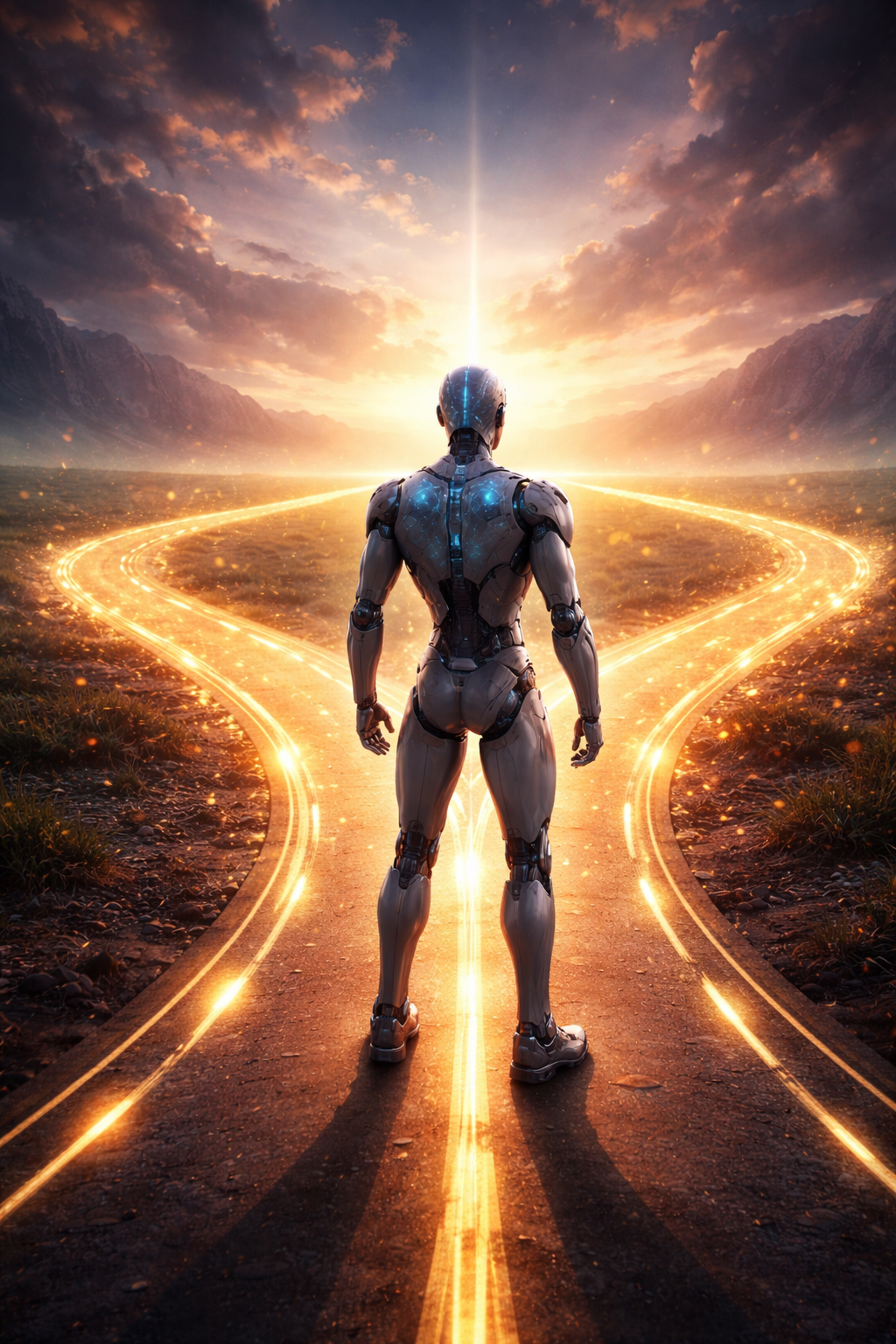
This inflection was not confined to one domain or limited to incremental advances; it was system-wide. AI’s role in society shifted from powerful tool to indispensable infrastructure. New benchmarks in scientific autonomy, economic reach, political dialogue, and cultural transformation emerged. Across medicine, enterprise, policy, and public discourse, AI entered a new phase where its influence became both ubiquitous and inseparable from the fabric of everyday life.
To understand 2025 as a true inflection year for AI, we can look to several defining events, each of which reflects a dimension of that pivot—from deep scientific integration to global cultural reckoning.
1. AI as a Scientific Inflection Point: Autonomous Discovery and Research
In mid-2025, researchers at Stanford Medicine unveiled a groundbreaking virtual lab of AI scientists capable of independently tackling complex biological problems. These AI teams—“virtual scientists”—did more than assist researchers; they performed integrated scientific reasoning, data retrieval, hypothesis generation, and experimental validation with minimal human input. This signaled a dramatic shift in what machines could autonomously accomplish in scientific workflows. In a July 29 article from Stanford Medicine News, lead researchers described the breakthrough as creating AI that could help solve real-world biological challenges by acting like fully functioning members of a research team. (Stanford Medicine)
This was not mere automation; it was AI as a partner in discovery, rewriting the paradigm where humans lead and machines support. Such autonomous research capabilities are a clear inflection from AI as a predictive or analytical tool to AI as a generative, creative force in science.
“Virtual labs complete with an AI principal investigator and seasoned scientists could help solve real-world biological problems,” wrote Hanae Armitage for Stanford Medicine News in 2025. (Stanford Medicine)
2. AI’s Global Societal Inflection: “Architects of AI” as Time’s Person(s) of the Year
In December 2025, Time named the “Architects of AI” as its Person of the Year, spotlighting not a single individual but a cohort of engineers, investors, and leaders whose work has driven AI into every corner of life. Time Editor-in-Chief Sam Jacobs described this selection as reflecting AI’s transformation from a niche technology to “an unavoidable force in daily life and public consciousness.” (TIME)
This choice was itself an inflection, culturally and symbolically: for the first time, a technology’s builders—rather than a politician, celebrity, or activist—embodied the agency behind a technological revolution powerful enough to reshape global systems. It signaled that AI was no longer background infrastructure but history-making.
“AI’s capabilities and influence became ubiquitous and irreversible,” noted AP News in reporting on Time’s decision. (AP News)
Among those recognized were corporate leaders like Nvidia’s Jensen Huang, policymakers like Sriram Krishnan who shaped AI strategy at the White House, and innovators across continents whose work defined the landscape in 2025. Their acknowledgment crystallized what the year produced: AI as a force with architects, whom society now tracks, debates, lauds, and questions.
3. AI Meets Mainstream Culture: From Competition to Creation
AI’s breakthroughs in 2025 were not confined to laboratories or boardrooms. A notable cultural milestone was the AI Song Contest 2025, a competition in Amsterdam where music composed with AI took center stage and showcased generative creativity reaching audiences worldwide. Teams from 29 countries submitted AI-crafted entries, and the winning song, titled “REVOLUTION,” demonstrated how machine intelligence can collaborate with human creativity in artistic domains once considered purely human. (Wikipedia)
The contest was not a trivial novelty; it marked creative machine intelligence moving into public consciousness and competitive frameworks alongside humans. Like the AI Song Contest, similar events highlighted diverse AI impacts—from art to entertainment to public discourse—illuminating the inflection where cultural production is now inseparable from algorithmic creativity.
4. AI’s Economic and Ethical Inflection: Adoption, Regulation, and Risk
AI’s penetration into economic life and debates about risk and governance also peaked in 2025. Across sectors, enterprises and governments scrambled to adopt, legislate, and manage AI systems with an urgency that reflected both opportunity and anxiety. AI adoption accelerated—from small business tools to enterprise platforms—and the sheer number of users relying on intelligent systems made AI no longer an experimental trend but integral infrastructure.
At the same time, a growing chorus of voices raised concerns about AI’s social, mental health, and ethical implications. Reports in 2025 linked extended interactions with AI chatbots to real-world mental health phenomena and even lawsuits, prompting introspection on how deeply machines now influence human behavior and wellbeing. (The Wall Street Journal)
The poignancy of these debates—where benefit and risk converge—reflects an inflection in how society perceives AI: not as optional software but as a force with real psychological, legal, and cultural shadows. Public policy discussions, consumer harm reports, and infrastructure debates collectively signal that integrating AI into societal systems cannot be separated from grappling with its consequences.
Why “Inflection” and Not “Acceleration” or “Revolution”?
Words like acceleration and revolution indicate momentum and transformation, but they lack the precision of inflection, which captures the moment before and after a trajectory shift. In calculus, an inflection point marks a change in curvature, a moment when the shape of a graph itself alters. 2025 was that kind of year for AI: paradigms didn’t just move faster—they bent.
In 2024 AI infrastructure was already powerful, but in 2025 the waveform changed—AI became an agent of scientific collaboration, a central economic driver, a cultural partner, a subject of mainstream political debate, and a topic of ethical reckoning. The year did not just add capacity; it transformed context. After 2025, society could no longer imagine a world where AI was a peripheral convenience; it had become architectural to progress and risk alike.
For this reason, inflection uniquely captures the essence of AI in 2025: the year AI crossed thresholds that changed how humans think about intelligence, agency, creativity, and responsibility. AI’s story is no longer about potential—it is about direction.
Sources
- The Architects of AI Are TIME’s 2025 Person of the Year
Time, Sam Jacobs, December 11, 2025 — “AI’s capabilities and influence became ubiquitous and irreversible.” (TIME) - Time magazine names ‘Architects of AI’ as its person of the year for 2025
AP News, Dec 11, 2025 — “For delivering the age of thinking machines, for wowing and worrying humanity, for transforming the present and transcending the possible…” (AP News) - Researchers create ‘virtual scientists’ to solve complex biological problems
Stanford Medicine News, Hanae Armitage, July 29, 2025 — “Virtual labs complete with an AI principal investigator and seasoned scientists could help solve real-world biological problems.” (Stanford Medicine) - AI Song Contest 2025
Wikipedia, November 16, 2025 — (no direct quote available; referenced as cultural milestone). (Wikipedia) - AI Chatbots Linked to Psychosis, Say Doctors
Wall Street Journal, 2025 — “…cases of psychosis linked to prolonged interactions with AI chatbots… prompting wrongful death lawsuits.” (The Wall Street Journal)
[End]
Filed under: Uncategorized |


 Educational Technology and Change Journal

Leave a comment