


By Jim Shimabukuro (assisted by Copilot)
Editor
[Related reports: Dec 2025, Nov 2025, Oct 2025]
Issue 1: AI shifting from experiments to core institutional strategy
A defining edtech issue for January 2026 is the transition from scattered AI experiments to AI as a pillar of institutional strategy. Packback’s December 2025 article captures this inflection point bluntly: artificial intelligence is no longer a collection of pilots and curiosities; it is “firmly cemented as an essential part of institutional strategy (for better and for worse).” This shift fundamentally changes the stakes. Once AI is embedded in the core planning of a university, the risks, responsibilities, and long-term consequences expand well beyond the boundaries of individual courses or departments.
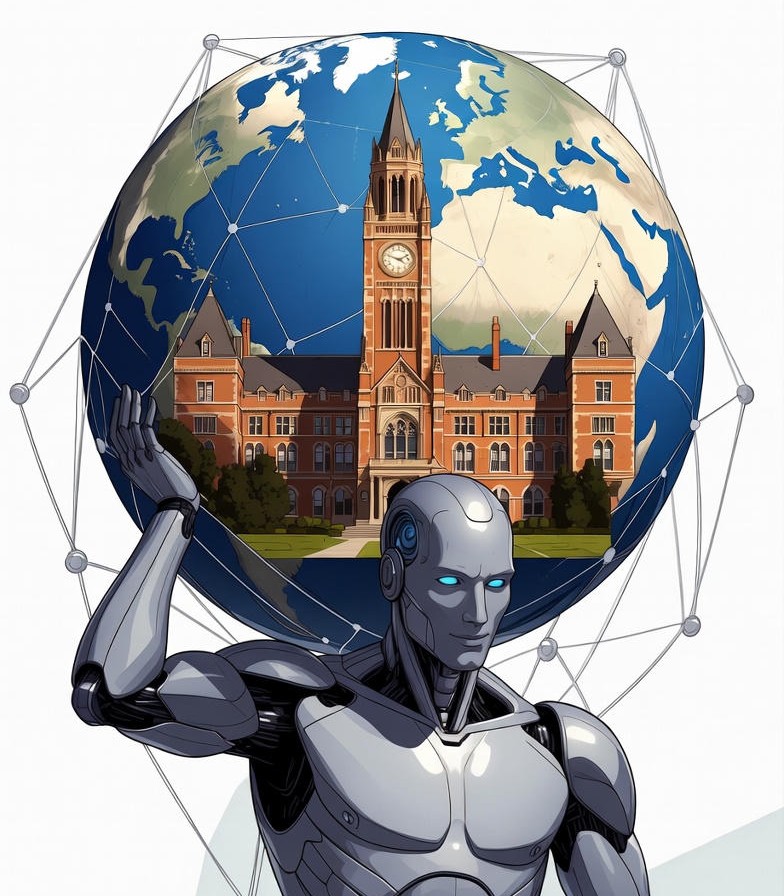
In many institutions, the past two years have been dominated by rapid responses to generative AI and ad hoc experimentation. According to Packback’s analysis, those reactive phases are giving way to more intentional, cross-campus planning in 2026, in which AI is evaluated alongside enrollment, finance, and academic program strategy. Framed this way, AI is no longer just an instructional tool; it becomes a lever for institutional transformation. That includes redesigning assessment, rethinking faculty workload, and reconsidering the student experience across the entire lifecycle—from recruitment to alumni engagement.
This transition raises new governance and capacity challenges that go beyond earlier concerns about integrity or individual tool adoption. When AI is woven into institutional strategy, decisions about vendor selection, data sharing, and long-term dependencies acquire strategic weight. The Packback article notes a “dramatic shift from anxiety and reaction to strategy and intentionality,” which implies that leaders are now under pressure to articulate clear visions of what AI is supposed to accomplish and how its success will be measured. Without such clarity, AI risks becoming an expensive, opaque layer of infrastructure that reinforces existing inequities or inefficiencies rather than solving them.
The strategic embedding of AI also intensifies the need for broad-based faculty and staff engagement. If AI is something an institution “plans alongside,” then instructional designers, IT, advising, student affairs, and faculty governance bodies all need a voice in how it is deployed. Otherwise, strategy risks becoming top-down and misaligned with classroom realities. The article’s emphasis on AI as an institutional tool highlights the danger of a growing gap between executive-level AI roadmaps and the day-to-day practices of teaching and learning. Where that gap widens, faculty resistance and student mistrust are likely to grow.
Moreover, treating AI as strategic infrastructure amplifies long-term affordability and sustainability questions. Strategic investments in AI-enhanced platforms, analytics suites, and instructional tools often involve multi-year contracts and complex integrations. The Packback piece hints at the “for better and for worse” dimension of this reality: AI can unlock new efficiencies and learning gains, but it can just as easily lock institutions into proprietary ecosystems that are difficult and costly to exit. In an era of demographic shifts and financial pressure, strategic AI choices may either enhance institutional resilience or exacerbate vulnerability.
For students, the strategic turn in AI integration will shape everything from how they are advised and assessed to how they interact with support services. If AI is embedded into the institutional fabric, it will influence which courses are recommended, how at-risk students are identified, and how feedback is delivered at scale. The issue in January 2026 is not merely whether AI is present in higher education—it decidedly is—but whether institutions are prepared to govern and align it with their missions when it becomes part of the strategic core. As Packback puts it, AI in 2026 “will stop being the thing higher education talks about and become the thing it plans alongside,” raising the bar for thoughtful leadership, transparent planning, and sustained faculty involvement.
Source: Peter Lannon, “2026 Predictions for AI in Higher Education,” Packback Blog, 10 Dec 2025: “Artificial intelligence is no longer a myriad of experiments in higher education – it has been firmly cemented as an essential part of institutional strategy (for better and for worse).” “In 2026, that shift will deepen. AI will stop being the thing higher education talks about and become the thing it plans alongside, repositioning it as a tool to drive institutional strategy.”
Issue 2: Balancing rapid AI-led innovation with equity, student support, and pedagogical integrity
Another critical issue in January 2026 is how higher education navigates the tension between accelerating AI-driven innovation and its commitments to equity, student support, and sound pedagogy. In her New Year’s piece for eCampus News, Laura Ascione frames 2026 as a moment when “next-generation ed-tech tools are not just optional enhancements—they are rapidly becoming the backbone of modern higher education.” At the same time, she underscores that colleges and universities must balance this innovation with “equity, student support, and pedagogical integrity” as they reshape themselves. This tension is not abstract; it touches every decision about which technologies to adopt, for whom, and to what end.
The article situates edtech within a wider landscape of affordability pressures, shifting student expectations, staffing constraints, and demand for lifelong learning. In such a context, AI-powered tools often promise efficiency and personalization, presenting themselves as solutions to overburdened advising systems, oversized classes, and limited support staff. Yet, when these tools become infrastructural rather than experimental, the risks of deepening inequities and eroding educational quality increase. Students who are already marginalized by cost, bandwidth, or prior educational experiences may find themselves subject to more automated interactions and less human attention if institutions adopt AI primarily as a cost-saving measure.
Ascione’s predictions highlight that institutions are juggling multiple imperatives at once: staying competitive, appealing to nontraditional learners, and demonstrating “innovation” to stakeholders, while also ensuring that the learning experience remains humane and intellectually rigorous. The issue is not whether AI and edtech can support learning—they clearly can—but whether their deployment is guided by a coherent pedagogical vision. Pedagogical integrity involves more than academic honesty; it encompasses the design of learning experiences that foster critical thinking, autonomy, and deep engagement. If AI tools are introduced primarily to speed grading or automate feedback without thoughtful integration into course design, they risk narrowing learning to what is easily measurable.
The article also surfaces concerns about student support in an increasingly digital ecosystem. As edtech systems become the backbone of higher education, students’ everyday interactions—registering for classes, accessing materials, seeking help—are mediated by platforms that may or may not reflect universal design principles or culturally responsive practices. When AI is layered onto these platforms, algorithmic nudges and recommendations can either connect students to timely support or, if poorly designed, amplify existing biases and misclassifications. The balance Ascione describes requires institutions to interrogate how AI-infused systems treat students at the margins: first-generation students, working learners, students with disabilities, and those navigating multiple responsibilities.
Another dimension of this issue lies in faculty work and academic culture. Innovation narratives often celebrate early adopters and showcase pilot projects, but the article’s framing suggests that in 2026 these innovations are increasingly part of everyday expectations. When AI-enhanced tools become default, faculty may feel pressure to adopt systems that do not align with their pedagogical values or that require significant unpaid labor to implement. Protecting pedagogical integrity therefore means not only designing responsible uses of technology but also ensuring that faculty are supported, trained, and given genuine choices rather than being swept along by institutional branding demands.
Ultimately, Ascione’s piece positions 2026 as a year when higher education must decide what kind of digital backbone it wants to build. The critical issue is whether institutions can keep innovation tethered to equity, student support, and robust pedagogy rather than allowing AI and edtech to drive priorities by default. That means interrogating whose problems the technology is really solving, whose voices are included in decision-making, and how success is defined. The balance described in the article is not a static compromise but an ongoing negotiation; as tools and pressures evolve, so too must the frameworks that protect the core values of higher education.
Source: Laura Ascione, “13 predictions about edtech, innovation, and–yes–AI in 2026,” eCampus News, 1 Jan 2026: “Higher education is balancing innovation with equity, student support, and pedagogical integrity as institutions reshape themselves for a new era of learning.”
Issue 3: Addressing stakeholder concerns about AI’s opportunities and risks in real higher education practice
A third critical issue for January 2026 is how institutions confront the concrete opportunities and concerns that emerge as AI moves from discourse to daily practice. In their article in Research and Practice in Technology Enhanced Learning, Babu George and Kunal Y. Sevak present a qualitative study that “investigates the opportunities and concerns regarding the integration of artificial intelligence (AI) in higher education.” Their work underscores that enthusiasm for AI’s potential coexists with deep unease about its ethical, pedagogical, and institutional implications. Understanding and responding to these mixed stakeholder perspectives is itself a core challenge for edtech leaders.
The study is situated at a moment when AI tools are already embedded in learning management systems, tutoring platforms, assessment tools, and administrative workflows. Rather than debating whether AI should be used at all, George and Sevak focus on how it is being used and how different stakeholders perceive the resulting benefits and risks. This orientation reflects the reality of 2026: the key question is not adoption, but alignment. AI’s “opportunities” include personalized learning, adaptive feedback, and data-informed decision-making across the institution. However, those same capabilities raise concerns about surveillance, bias, and the erosion of academic judgment if systems are overtrusted or poorly governed.
One of the article’s contributions is to map the concerns raised by various stakeholders—faculty, students, and administrators—about the integration of AI. Ethical worries feature prominently, with stakeholders expressing apprehension about opaque algorithms, potential discrimination, and the commodification of student data. These concerns go beyond abstract principles and touch lived experience: students wonder how their data will be used; faculty question whether AI-generated analytics will be used to monitor or evaluate their performance; administrators weigh efficiency gains against reputational risks. In 2026, these questions are no longer hypothetical case studies; they are embedded in procurement decisions and rollout plans.
At the same time, the article documents a recognition that AI can meaningfully enhance teaching and learning when thoughtfully implemented. Stakeholders see value in systems that provide timely, tailored feedback, identify struggling students earlier, and support more flexible learning pathways. The issue, then, is not a simple pro‑AI versus anti‑AI divide, but a demand for conditions under which AI is trustworthy, transparent, and aligned with educational values. George and Sevak’s emphasis on “policy implications” in their keywords signals that institutions must translate these stakeholder concerns into concrete guidelines, guardrails, and accountability mechanisms.
This duality of opportunity and concern has practical consequences for institutional decision-making. If institutions ignore or minimize stakeholder worries, they risk pushback, low adoption, and erosion of trust in both technology and leadership. If they focus only on risk avoidance, they may miss out on meaningful improvements to student learning and support. The article’s qualitative lens highlights that navigating this terrain requires active dialogue and participatory governance: faculty and students need to be involved not only in implementing AI tools but in shaping the principles and policies that govern their use.
For educational technology in higher education, the critical issue in January 2026 is how to make these stakeholder discussions ongoing, structured, and influential. As AI tools evolve rapidly, one-off consultations or static policy documents will not suffice. Institutions need mechanisms for continuous feedback and revision as new capabilities emerge and unanticipated consequences surface. George and Sevak’s study, by centering stakeholder perspectives, implicitly calls for a culture in which AI integration is accompanied by systematic listening and learning, not just technical deployment.
In sum, the article crystallizes a key challenge: AI in higher education carries real promise, but realizing that promise requires institutions to treat stakeholder concerns as central design inputs, not peripheral objections. The opportunities and worries documented in their January 2026 study exemplify why ethical, pedagogical, and institutional questions must be addressed in concert. Educational technology leaders cannot simply champion AI’s benefits; they must also build structures that acknowledge and respond to the complex, context-specific concerns that accompany its integration into the heart of academic life.
Source: Babu George & Kunal Y. Sevak, “Artificial intelligence in higher education: Opportunities and concerns,” Research and Practice in Technology Enhanced Learning (RPTEL), 1 Jan 2026: “This qualitative study investigates the opportunities and concerns regarding the integration of artificial intelligence (AI) in higher education.”
[End]
Filed under: Uncategorized |


 Educational Technology and Change Journal

[…] Rise, But Is Guidance Keeping Pace? (RAND Study) 5 AI Trends Universities Can't Ignore in 2026 Three Critical Issues for Higher Ed: AI as Institutional Strategy AskThePhD: Higher Ed AI Resources Daily AI Briefing for Educators HigherEd AI Daily Thursday, […]
[…] AI în învățământul superior devine strategie instituțională […]
[…] Jim Shimabukuro argues in Ed Tech in Higher Ed: Three Issues for Jan 2026, the era of the pilot project is over. For the past few years, university administrators have […]
interesting to see AI becoming a core part of institutional strategy – wonder how that’ll play out in smaller colleges 🤔
Good question. A number of possibilities come to mind. Larger better endowed institutions may be able to muster a full-blown response. However, any response, however grand, might not be able to control the AI tsunami. Smaller institutions, with little cemented in place to manage the deluge, might actually be in a better position to adjust. The assumption that the tsunami can and must be controlled may be unrealistic or unwise. Think of personal computers, smartphones, internet access, and online learning. Colleges tried to control them but were eventually forced to adjust to the fact that the world outside higher ed, including their students and faculty, had fully embraced and moved on with these technologies. The only recourse left to colleges has been to accept and incorporate these outside-in changes. I sense that circumstances in the larger world will determine the role of AI in higher ed, and not the other way around. Thus, perhaps the best preparation may be an open stance to the rapidly evolving ways AI is actually developing outside the colleges’ sphere of influence. The question may not be how can colleges control AI on their campuses but how can they seamlessly anticipate and grow with evolving AI technology in the global context. This switch in perspective will probably force colleges to replace administrators and campus leaders who see AI as a threat with counterparts who view it as a wave of the future. -js