


By Jim Shimabukuro (assisted by Gemini)
Editor
The emergence of Nvidia’s Alpamayo platform marks a significant shift in the competitive landscape of autonomous driving, setting up a clash of philosophies between the established, data-driven approach of Tesla and Nvidia’s new, reasoning-based vision. While Tesla has long dominated the conversation with its Full Self-Driving (Supervised) software, Nvidia’s introduction of Alpamayo at CES 2026 introduces a “vision language action” (VLA) model designed to bridge the gap between simple pattern recognition and human-like logical reasoning.
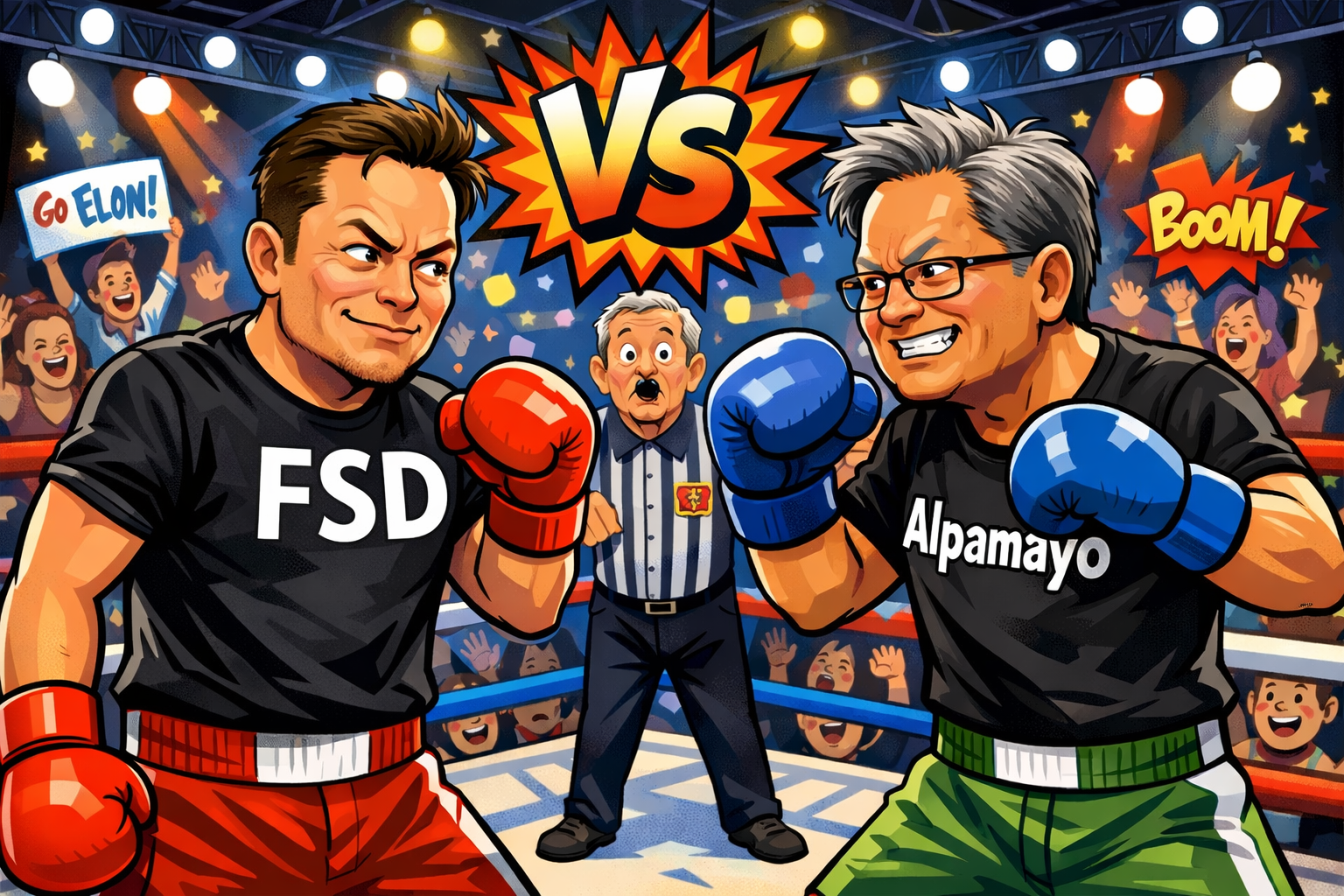
Tesla’s FSD technology is built on a foundation of massive scale and real-world experience. For years, the company has leveraged its fleet of millions of vehicles to collect billions of miles of driving data, which is then used to train end-to-end neural networks. This approach relies on the idea that if a model sees enough examples of driving behavior, it can eventually handle almost any situation. However, as Elon Musk recently noted, the “long tail” of the distribution—those rare and unpredictable edge cases that occur only once in a million miles—remains the most difficult hurdle to clear. Tesla’s strategy focuses on “scaling up” this existing infrastructure, with the belief that their established head start in data collection and integrated hardware provides a moat that competitors will not be able to cross for several years.
In contrast, Nvidia’s Alpamayo is designed as a “thinking” model that uses chain-of-thought reasoning to navigate the world. Rather than just predicting the next move based on historical data, Alpamayo is intended to reason through novel scenarios step-by-step, much like a human driver would when encountering an unfamiliar construction zone or a complex traffic-light outage. Nvidia CEO Jensen Huang has described this as a “ChatGPT moment” for physical AI, emphasizing that the system can explain its logic, which improves transparency and safety auditing. Crucially, Nvidia does not intend to build the cars themselves; instead, Alpamayo serves as a high-level “teacher model” and a suite of open-source tools—including the AlpaSim simulation framework—that other automakers like Mercedes-Benz, Lucid, and Jaguar Land Rover can use to build their own autonomous stacks.
The tension between these two giants lies in their timeline and deployment strategy. Musk has dismissed the immediate threat of Nvidia’s system, predicting it will take at least five or six years before such models provide serious competition to Tesla. His skepticism stems from the belief that while it is relatively easy to reach 99% functionality in a lab or a limited demo, the final 1% required for true safety is “super hard” to solve without the massive, real-world data loop that Tesla already possesses. Furthermore, while Nvidia provides the “brains” of the system to various partners, Tesla maintains total control over its entire vertical stack, from the silicon and the software to the vehicles themselves.
Ultimately, the competition between Tesla FSD and Nvidia Alpamayo represents two different paths to the same goal of Level 4 autonomy. Tesla is doubling down on its massive data advantage and integrated fleet to refine its end-to-end models, while Nvidia is betting that open-source “reasoning” models will empower a broad ecosystem of manufacturers to catch up. Whether reasoning-based AI can overcome the data deficit fast enough to challenge Tesla’s dominance remains the central question as these technologies begin to hit the roads in 2026.
Sources:
- NVIDIA Announces Alpamayo Family of Open-Source AI Models
- Tesla CEO Musk brushes off Nvidia self-driving competition
- Building Autonomous Vehicles That Reason with NVIDIA Alpamayo
- Jensen Huang Clarifies Distinctions Between Tesla FSD and Alpamayo
- Elon Musk drops surprise take as Nvidia unveils new Tesla FSD rival
Tesla’s AI4 (Hardware 5) vs. Nvidia’s Vera Rubin
The contrast between Tesla’s AI4 (Hardware 5) and Nvidia’s Vera Rubin platform reflects a fundamental split in how “intelligence” is delivered to a vehicle. While both systems aim to solve the same problem, they represent two different architectures: one optimized for efficiency and lean, vision-only data (Tesla), and the other optimized for massive, redundant computational power and multi-modal “reasoning” (Nvidia).
Tesla’s AI4: The Integrated Lean Machine
Tesla’s AI4 is an evolution of its custom silicon strategy, designed specifically to run the company’s “end-to-end” neural networks. Unlike general-purpose chips, Tesla’s hardware is stripped of components that aren’t necessary for driving, allowing it to dedicate more surface area to the matrix multiplication required for computer vision.
Tesla remains firmly committed to a vision-only approach. The sensor suite for AI4-equipped vehicles, such as the 2026 Model Y, typically consists of nine high-resolution cameras. Recent upgrades include the transition to 5-megapixel Sony IMX sensors, which provide significantly better dynamic range and low-light performance compared to the older 1.2-megapixel sensors. By focusing strictly on cameras, Tesla minimizes the “computational tax” required to fuse data from different sensor types (like LiDAR or Radar), allowing the AI4 chip to process visual data at high frame rates with very low latency. This “lean” philosophy relies on the belief that if a human can drive with eyes alone, a sufficiently powerful AI should be able to do the same.
Nvidia’s Vera Rubin: The Mobile Supercomputer
Nvidia’s Vera Rubin platform, unveiled at CES 2026, represents the “belt-and-suspenders” approach to autonomy. The Rubin GPU delivers a massive 50 Petaflops of inference performance, which is nearly five times that of its predecessor. This hardware is designed to support the “Alpamayo” reasoning model, which doesn’t just predict a path but actually “thinks” through scenarios using a Vision-Language-Action (VLA) model.
To feed this massive computational engine, Nvidia-powered vehicles like the 2026 Mercedes-Benz CLA use a dense, multi-modal sensor suite. This stack typically includes 30 sensors: 10 cameras, 5 radar sensors, and 12 ultrasonic sensors. For higher-level Level 4 “Hyperion” configurations, Nvidia adds high-definition LiDAR from partners like Hesai. This creates a “redundant” system where the AI can cross-reference what it sees on camera with laser-accurate depth data from LiDAR. The Vera Rubin chip has the raw horsepower to manage this “sensor fusion” in real-time, allowing the car to build a more certain, mathematically verified model of its surroundings than a camera-only system might achieve in difficult weather or lighting.
The Computational Edge
If the metric is raw computation, Nvidia’s Vera Rubin is the superior platform. It is a datacenter-grade chip that turns the car into a mobile AI factory capable of running 10-billion-parameter models. This allows for “Chain-of-Thought” reasoning—the ability for the car to verbalize and logic-check its own decisions before executing them.
However, if the metric is operational efficiency, Tesla’s AI4 may have the edge. Tesla’s software is “hand-in-glove” with its hardware, meaning it can achieve high-level performance using significantly less power and at a lower cost per vehicle. While Nvidia provides the most powerful “brain” available, Tesla’s system is arguably the most specialized, designed to extract every possible drop of performance from its camera-only data stream.
Sources:
- Tesla AI4 vs. Hardware 4: Understanding the Transition
- Nvidia Debuts Vera Rubin AI Platform at CES 2026
- Mercedes-Benz CLA Launches with Nvidia Alpamayo Stack
- Nvidia DRIVE Hyperion 10 Sensor Reference Architecture
[End]
Filed under: Uncategorized |


 Educational Technology and Change Journal

[…] IMX 센서로 업그레이드되어 더 넓은 동적 범위와 저조도 성능을 제공한다etcjournal.com. 카메라만으로 인식하기 때문에 라이다나 레이더와 같은 다른 센서를 […]