





By Jim Shimabukuro (assisted by Perplexity)
Editor
Relying solely on embodied AI humanoids to explore Earth-like planets raises deep concerns about science quality, ethics, and robustness, but each concern has a nontrivial counterargument from the pro-humanoid side. This answer examines five of the strongest objections and then offers the best counterarguments to each, with open, freely accessible sources linked inline throughout.(autonews.gasgoo+5)
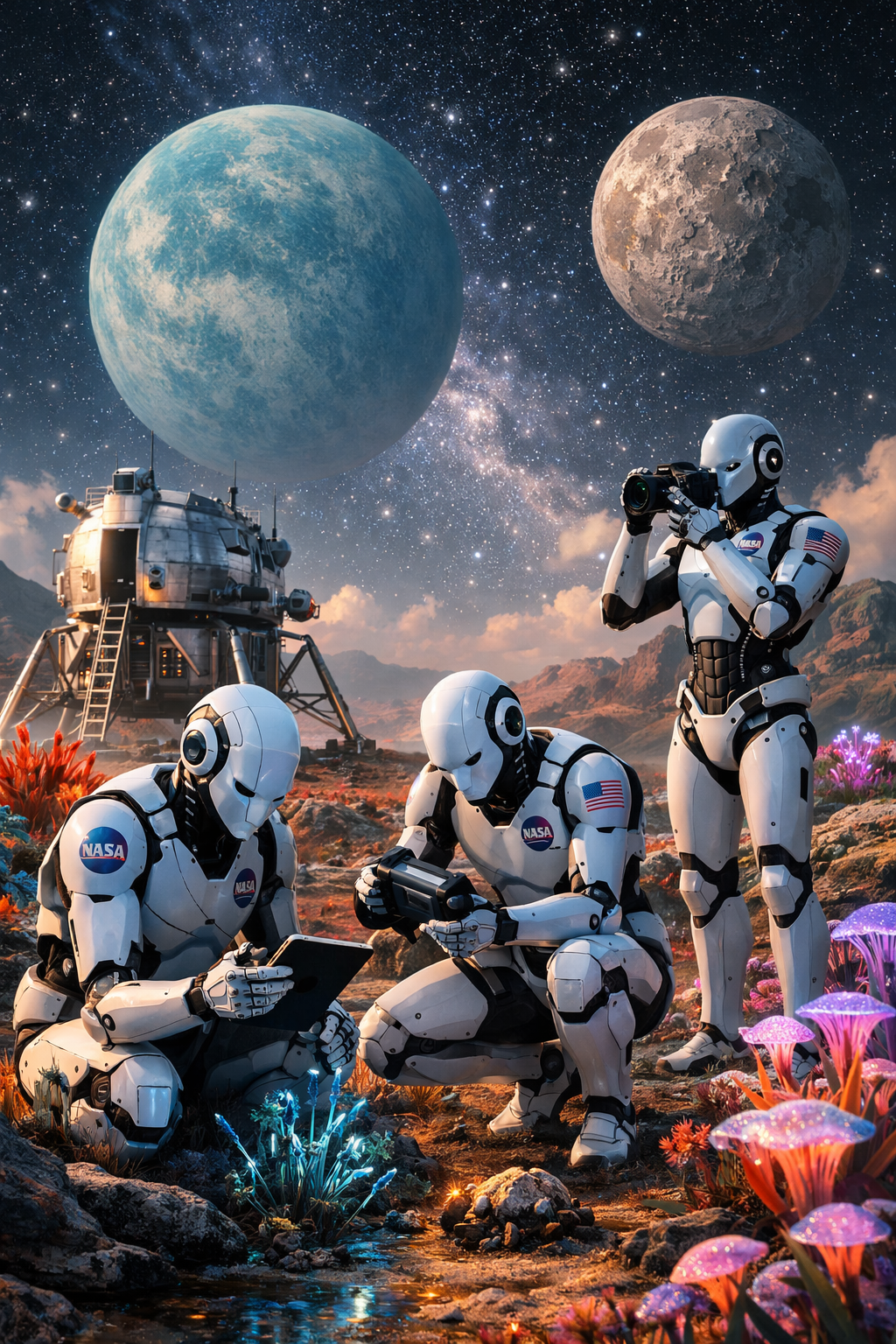
1. Loss of human scientific intuition and field creativity
A central argument against exclusive use of humanoid robots is that they cannot yet match human in‑situ scientific judgment, especially in unfamiliar, complex environments like an Earth‑like exoplanet or a young Mars. Field geology and astrobiology on such worlds are highly opportunistic: subtle anomalies, pattern recognition across many scales, and “gut‑level” theory revision often occur minute‑to‑minute in response to landscape cues, weather, and instrument surprises.(astrobites+1)
Empirical analog work suggests that even highly automated rovers are dramatically less productive than human scientists in suits, let alone in shirtsleeves, when measured by samples collected, hypotheses tested, and sites investigated per unit time. This implies that if we rely solely on humanoids, we might dramatically slow scientific progress, misinterpret ambiguous biosignatures, or simply fail to notice weak, distributed signs of life that a trained human would recognize.(lasp.colorado+1)
From this perspective, the objection is not just about speed but about the richness of scientific understanding: human explorers integrate tacit knowledge, cross‑disciplinary context, and embodied experiences (e.g., sound of regolith underfoot, proprioceptive sense of slope) in ways that present-day embodied AI systems cannot. In a once‑per‑planet “first contact” with an Earth‑like biosphere, permanently trading away that human intuition looks like an unacceptable scientific risk.(astrobites+1)
The counterargument emphasizes that humanoid platforms are increasingly designed as generalist agents with rich sensing, multi‑sensor fusion, and decision‑planning frameworks, specifically to operate autonomously in dynamic environments. Emerging humanoid astronaut projects—such as EngineAI’s PM01, developed as an “embodied general intelligent agent” for space—aim to close part of the human–robot creativity gap by combining real‑time perception with high‑level task planning, and by updating policies over many missions rather than a single human career.(interestingengineering+1)
Advocates also stress that human‑like scientific intuition can be approximated by tight coupling between on‑planet humanoids and distributed human teams via teleoperation, mixed‑initiative planning, and interactive machine learning. In this hybrid view, humanoids are the hands and eyes on the surface, but humans still supply conceptual creativity from orbit or from Earth, with high‑bandwidth communication on closer targets (e.g., Mars or nearby moons) mitigating some loss of in‑situ intuition. Over the long term, continual training on planetary data and simulated analogs could allow embodied AI to internalize domain‑specific heuristics, narrowing the gap further.(techjournal+1)
2. Planetary protection and contamination risks
A second major argument concerns planetary protection: both forward contamination (carrying Earth organisms to another biosphere) and back contamination (returning potentially hazardous material to Earth). COSPAR’s Planetary Protection Policy, adopted by agencies such as NASA and ESA, is explicitly built around minimizing biological contamination from both robotic and human missions, with especially strict requirements for “Special Regions” where life might exist.(sciencedirect+2)
Critics argue that humanoid robots, precisely because they are “human‑shaped” and designed to operate in varied, complex terrains and habitats, may be more likely to engage in high‑contact activities—digging, dwelling in caves, manipulating surface waters—and thus present more complex contamination pathways than simpler, task‑specific landers or orbiters. Embodied humanoids often include articulated hands, actuated joints with tribological materials, and complex thermal systems, increasing surfaces and interfaces where organic residues or microbes could be trapped and deployed.(leonarddavid+3)
Moreover, planetary protection policy documents assume detailed bioburden accounting and cleaning protocols that are hard to guarantee once a versatile humanoid system is repeatedly refurbished, upgraded, and reused. Critics worry that if such humanoids become the default exploration workhorses, political and commercial pressures might gradually erode conservative contamination practices, leading to irreversible alteration of pristine biospheres or to ambiguous life‑detection results.(nodis3.gsfc.nasa+2)
The counterargument begins with the legal and policy fact that COSPAR’s guidelines and related NASA and ESA documents treat planetary protection goals as equally applicable to robotic and human missions, and insist that requirements should not be relaxed simply to accommodate new mission architectures. Proponents claim that humanoid systems, being fully mechanical and not containing human microbiomes, are actually easier to sterilize and bioburden‑control than crewed systems, which must support living humans and thus inevitably carry a vast microbial cargo.(sciencedirect+2)
Humanoid platforms can be built from the ground up with bakeable components, minimal organics, encapsulated electronics, and modular segments that can be sterilized separately and tracked through chain‑of‑custody procedures defined by COSPAR Category IV and V requirements. Because these robots do not need to sustain life, they can use more aggressive sterilization regimes than human habitats, and can be designed to avoid Special Regions altogether if necessary, or to operate only after precursor missions have characterized the site per COSPAR recommendations.(nodis3.gsfc.nasa+2)
From a back‑contamination standpoint, advocates argue that humanoids can perform high‑risk sampling, drilling, and subsurface access while returning sealed sample canisters engineered according to restricted Earth‑return standards, thus decoupling the most dangerous biological interfaces from any crewed system. In this framing, relying primarily on sterilizable humanoid explorers is portrayed not as a planetary‑protection liability but as a tool to implement conservative policies more strictly than would be possible with human boots on the ground.(leonarddavid+2)
3. Reliability, fragility, and mission risk
Another strong objection is practical: humanoid robots are complex, fragile systems operating at the edge of current engineering capability, especially in terms of locomotion, manipulation, and autonomy under extreme conditions. Space and planetary environments impose vacuum, radiation, abrasive dust, thermal cycling, and reduced gravity, raising the risk that legged, highly articulated platforms will fail catastrophically far from repair infrastructure.(autonews.gasgoo+2)
Critics note that most proven planetary surface systems—Sojourner, Spirit, Opportunity, Curiosity, Perseverance, Chang’e rovers—are wheeled or tracked, with architectures tuned for reliability over flexibility. Humanoids add many degrees of freedom, tight tolerances, and complex dynamic control loops that may be brittle under dust infiltration, lubricant degradation, or partial system failures; if such systems are our only exploration agents, a single unexpected mode of failure could terminate high‑value missions and leave large planetary regions unexplored.(techjournal+3)
Furthermore, recovery strategies are limited: a stuck wheel on a rover is bad but sometimes manageable; a toppled humanoid with damaged limbs might become entirely inoperable, and self‑righting in unknown terrain is nontrivial. In environments far more complex than current testbeds—think muddy shorelines, dense forests, or karst caves on an Earth‑like world—critics argue that humanoids might underperform or fail precisely where we most need robust exploration.(autonews.gasgoo+1)
Proponents counter that humanoid platforms are not meant to replace all specialized systems but to complement them, taking on “general tasks that are not worth building specialized machines for,” as articulated by robotics experts working on space‑ready humanoids. Recent projects emphasize rigorous ground testing under simulated vacuum, temperature extremes, and microgravity, as well as multi‑sensor fusion and millisecond‑level motion control aimed at maintaining stability in dynamic environments, directly targeting the fragility concern.(interestingengineering+2)
Advocates further argue that humanoid robots are ideal candidates for incremental deployment: starting in low‑Earth orbit or on the Moon, where teleoperation and quick iteration are easier, then progressing to Mars and beyond as reliability improves. Because humanoids can be repeatedly upgraded, repaired in orbit by other robots, and iterated without life‑support constraints, their failure modes can be studied and mitigated over many missions, gradually increasing robustness.(interestingengineering+2)
Additionally, using humanoids as the sole surface agents can simplify logistics: standard interfaces, tools, and habitats can be designed for a single “body plan,” lowering integration complexity compared to a zoo of task‑specific robots, and enabling redundancy by sending multiple identical units that can assist in each other’s repair. For proponents, the complexity of humanoids is a front‑loaded engineering challenge that pays off in long‑term operational flexibility and maintainability across many worlds.(techjournal+2)
4. Economic efficiency and opportunity cost
Opponents also argue that humanoid exploration is economically inefficient compared to more traditional robotic architectures tailored to specific missions. Historical cost analyses show that as rovers become more capable, their costs have increased sharply (e.g., Pathfinder to Mars Exploration Rovers to Mars Science Laboratory), leading some planetary scientists to question whether budgets can sustain ever more complex machines.(lasp.colorado+1)
In this view, humanoids represent an even steeper step in cost and technological risk, diverting scarce funds from simpler orbiters, flybys, and landers that collectively deliver high scientific return per dollar. Critics worry about a “robotic flagship trap,” where a few expensive humanoid missions crowd out a diverse portfolio of smaller probes that sample many worlds, and about commercial primacy: if humanoids are developed primarily for non‑scientific markets, science agencies might end up paying premium prices to adapt commercial platforms.(astrobites+1)
There is also an opportunity‑cost argument relative to human exploration: some economists suggest that adding humans, even at higher cost, could increase the profitability or scientific return of lunar or planetary operations by enabling rapid problem‑solving and flexible decision‑making. If humanoids still require extensive human oversight and infrastructure, critics ask whether it is more rational to invest those resources in carefully selected human missions instead of attempting to fully replace humans with embodied AI.(politico+1)
The counterargument reframes the economic calculus around long‑term productivity rather than single‑mission cost. Analysis comparing human and robotic exploration suggests that human explorers in spacesuits can be orders of magnitude more productive than automated rovers per unit time, and proponents argue that sufficiently advanced humanoids, tightly integrated with human teams, might capture a meaningful fraction of that productivity without requiring life‑support.(lasp.colorado+1)
Advocates also note that humanoid robot development is heavily cross‑subsidized by terrestrial markets in manufacturing, logistics, and services, with companies and agencies investing in platforms that will be used in factories, warehouses, and hazardous environments on Earth as well as in space. This shared R&D base can amortize costs, making space‑grade humanoids relatively affordable compared to bespoke planetary rovers built in small numbers solely for science.(autonews.gasgoo+3)
Furthermore, humanoids can lower infrastructure costs on planetary surfaces by acting as general‑purpose labor: constructing habitats, deploying instruments, servicing telescopes, and maintaining power systems, tasks that would otherwise require separate specialized robots or humans. From this perspective, concentrating investment into a robust humanoid platform that can handle many different missions across multiple planets is economically rational, especially for sustained, multi‑decadal exploration and settlement.(interestingengineering+2)
5. Ethical, governance, and value‑alignment concerns
A final powerful objection targets ethics and governance. Embodied AI humanoids deployed as sole agents on new worlds raise questions about autonomous decision‑making, value alignment, and the moral status of both the robots and any encountered life. If humanoids can operate with significant autonomy (as communication delays demand), there must be clear policies about how they prioritize objectives when trade‑offs arise between scientific gain, planetary protection, commercial interests, and potential indigenous ecosystems.(sciencedirect+2
Critics worry that, in practice, these policies will be shaped by the interests of a few powerful states or corporations, and encoded into goal hierarchies and reward structures that embodied AI systems will execute relentlessly. Without humans physically present to experience and respond to the moral salience of an alien biosphere—or to resist perverse incentives—humanoid explorers might gradually normalize extractive behaviors, such as aggressive resource exploitation or habitat modification, that conflict with emerging norms about interplanetary environmental ethics.(leonarddavid+1)
There is also concern about transparency and accountability: complex learning systems controlling humanoid robots may behave in ways that are hard to predict or explain, complicating legal responsibility for harmful actions on another world. Critics argue that if embodied AI humanoids become the sole emissaries of Earth, their actions effectively define humanity’s ethical stance toward other biospheres, yet these systems may be governed more by engineering convenience and liability management than by robust deliberation about planetary stewardship.(nodis3.gsfc.nasa+2)
Proponents respond that the same international frameworks that guide human and robotic missions today—particularly COSPAR’s planetary protection policy and the space law regime around the Outer Space Treaty—can be extended and updated to cover embodied AI systems explicitly. Because humanoid robots are software‑defined, their behavior can be constrained by verifiable certification procedures, mission‑level ethical checklists, and remote supervision architectures that log decisions and provide audit trails, potentially making them more transparent than human crews whose judgments are opaque and idiosyncratic.(sciencedirect+2)
Advocates also suggest that keeping humans physically distant while still “in the loop” through teleoperation and supervisory control reduces the risk of impulsive or emotionally driven actions that violate planetary‑protection or conservation norms. Embodied AI systems can be required to obey strict rules about entering Special Regions, collecting samples, and altering environments, with hard‑coded fail‑safes and multi‑party approval protocols enforced through cryptographic controls.(nodis3.gsfc.nasa+1)
Finally, proponents argue that deploying humanoids as our primary surface agents buys time for humanity to mature its ethical frameworks for interplanetary contact. By studying how robot‑only missions interact with environments and governance structures, policy makers and ethicists can iteratively refine norms before committing humans to irreversible engagements with alien ecosystems, while still advancing science and infrastructure through robot‑mediated exploration.(leonarddavid+1)
For further reading, open, freely accessible discussions of these themes include NASA’s planetary protection policy documents (e.g., NPI 8020.7 and related COSPAR guidelines at NASA’s NODIS library), COSPAR’s Mars planetary protection papers, arguments about human versus robotic exploration efficiency in Crawford’s “Dispelling the Myth of Robotic Efficiency,” and contemporary reporting on humanoid astronaut projects and their claimed advantages in hazardous space environments.(astrobites+7)
[End]
Filed under: Uncategorized |


 Educational Technology and Change Journal

Hi Jim,
You have provided yet another stimulating article regarding AI and robotics.
Focus is important in articles, but I see a dichotomy between androids and tracked or wheeled platforms as false. There are nearly unlimited designs that are neither. Our proxies sent into space should have no such limits.
Why have two legs? That design requires much additional circuitry and software to maintain balance. Why not six legs? Our major sensors (hearing, vision, taste, and smell) are concentrated in a single part balanced on a rather fragile connection to the main body (“Off with her head!”) This compromise, like all compromises, has flaws.
Our arms also have limitations as exploratory devices and are fragile, which could prove fatal in an alien environment. While I don’t recommend it as a model for exploratory robots, Inspector Gadget shows how thinking outside the box can lead to new ways of building robots.
Nature did not have an unlimited palette for designing a species capable of developing technology. We do. We should stop admiring ourselves in a mirror and open our minds to a broad range of forms for exploration.
When it comes to household help, the android form may lead to greater acceptance but at a higher price point. Will people allow more flexibility in design that saves money in their homes? Robot vacuum cleaners show that the answer might be yes. They cost much less than Optimus.
Hi, Harry. Thanks for raising these issues. Embodied AI can take many different forms, and a humanoid is just one. It may not be the best for specific tasks, but it’s the most versatile for a general range of tasks. We currently have (robotic) machines doing our heavy lifting and fine motor tasks, but they don’t have the range and adaptability that we do. Embodied AI with nonhuman forms are increasingly taking on specific human tasks, but their range of functions in real-world environments is limited. The human-like form seems to be the most useful. Re “androids” — they are a subtype of humanoid, and the effort to make them “look” more human may be a legitimate goal for some purposes, but it may be superfluous when we consider the wide range of practical goals that we’re setting for AI.
Re cost: Once production of humanoids scales from scarcity to plenty, prices will drop. -Jim