


By Jim Shimabukuro (assisted by Claude)
Editor
Artificial intelligence has become one of the most disruptive forces in meteorological science, and 2025-2026 represents a watershed moment in weather forecasting. The convergence of massive computational advances, novel neural network architectures, and unprecedented access to historical climate data has enabled AI systems to challenge and often surpass traditional physics-based models that have dominated the field for over half a century. Five innovations—NOAA’s operational hybrid AI systems, ECMWF’s ensemble AI forecasts, Google DeepMind’s breakthrough hurricane prediction, Cambridge’s end-to-end Aardvark system, and NVIDIA’s open Earth-2 infrastructure—collectively represent a transformation in weather science as significant as the introduction of satellite imagery or numerical weather prediction itself. The convergence is happening now, in 2025 and 2026, and you are witnessing a genuine revolution in how humanity understands, predicts, and prepares for the atmosphere’s behavior.
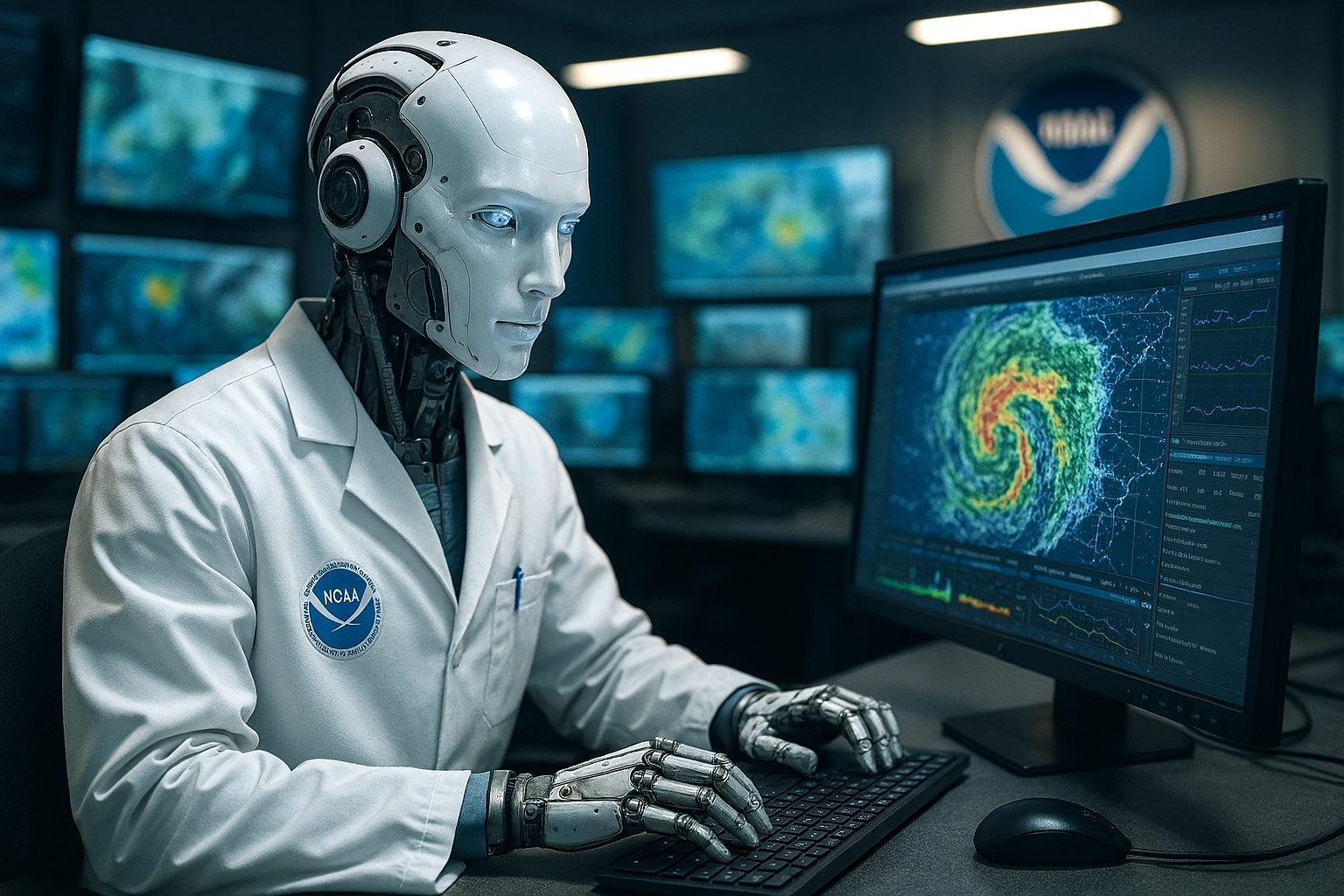
1. NOAA’s Operational AI Weather Models — America’s Strategic Leap into Hybrid Forecasting
The National Oceanic and Atmospheric Administration made history in December 2025 when it deployed three new AI-driven global weather models into operational use, marking the United States’ most significant advancement in weather prediction technology in decades. This development, spearheaded by NOAA Administrator Neil Jacobs and developed through Project EAGLE (a collaborative initiative between NOAA’s National Weather Service, Oceanic and Atmospheric Research labs, the Environmental Modeling Center, and the Earth Prediction Innovation Center), represents a fundamental shift in how America approaches weather forecasting. The initiative leveraged Google DeepMind’s GraphCast model as a foundation, which NOAA scientists then fine-tuned using the agency’s own Global Data Assimilation System analyses.
The three distinct applications comprise a comprehensive suite designed to address different forecasting needs. The Artificial Intelligence Global Forecast System, known as AIGFS, implements AI to deliver improved weather forecasts with unprecedented efficiency, using only 0.3 percent of the computing resources required by its traditional counterpart while completing a single sixteen-day forecast in approximately forty minutes. This dramatic reduction in computational requirements means forecasters receive critical data far more quickly than from the traditional Global Forecast System. The system demonstrates improved forecast skill over traditional GFS for many large-scale features, though NOAA acknowledges that version 1.0 shows some degradation in tropical cyclone intensity forecasts, which future iterations will address.
The second application, the Artificial Intelligence Global Ensemble Forecast System or AIGEFS, represents an AI-based thirty-one-member ensemble system that provides a range of probable forecast outcomes rather than a single deterministic prediction. Early results show this system extending forecast skill by an additional eighteen to twenty-four hours compared to the traditional Global Ensemble Forecast System, while requiring only nine percent of the computing resources. This efficiency gain is staggering when considering that ensemble forecasting typically requires running dozens of slightly different simulations to capture uncertainty in initial conditions and model physics.
Perhaps most innovative is the Hybrid-GEFS, a sixty-one-member grand ensemble that combines the new AI-based AIGEFS with NOAA’s flagship physics-based Global Ensemble Forecast System. To NOAA’s knowledge, this represents the world’s first implementation of such a hybrid physical-AI ensemble system at an operational weather center. Initial testing reveals that this pioneering approach consistently outperforms both the AI-only and physics-only ensemble systems across most major verification metrics. By combining two fundamentally different modeling philosophies—one based on mathematical equations describing atmospheric physics and one based on pattern recognition from historical data—the system creates a more robust representation of forecast uncertainty.
The significance of this development extends far beyond mere computational efficiency. Daryl Kleist, deputy director of NOAA’s Environmental Modeling Center, explained that these AI models learn to predict patterns and behaviors of the atmosphere by training on decades of historical data, much of which came from the older numerical modeling systems themselves. This creates an interesting feedback loop where traditional physics-based models essentially train their AI successors, ensuring that decades of meteorological knowledge embedded in conventional forecasting aren’t lost but rather transformed into a new computational paradigm.
The timing of this deployment proved particularly prescient. In December 2025, when an atmospheric river brought catastrophic flooding to the Pacific Northwest, the AIGFS model provided critical early warnings about the heavy precipitation event. The model’s ability to deliver forecasts more quickly meant emergency managers had additional time to prepare, potentially saving lives and property. This real-world validation demonstrated that AI weather models aren’t merely academic exercises but practical tools that can protect communities.
However, NOAA’s implementation philosophy reveals important wisdom about the future of weather forecasting. Rather than positioning AI as a replacement for traditional models, the agency frames these systems as complementary tools that forecasters can use alongside physics-based predictions. Erica Grow Cei, a spokesperson for the National Weather Service, emphasized that the latest models do not intend to replace traditional ones that rely on complex mathematical representations of atmospheric physics. This measured approach acknowledges that while AI excels at pattern recognition and can process certain forecasting tasks with remarkable speed, physics-based models still provide valuable insights, particularly for understanding the causal mechanisms driving weather phenomena.
The energy implications of this technological shift deserve particular attention. While the AI programs require between ninety-one and ninety-nine percent less computing power than traditional models for generating individual forecasts, this calculation doesn’t account for the substantial energy costs of initially training these neural networks. Training AI is notoriously energy-intensive, often requiring weeks or months of computation on powerful graphics processing units. Kleist acknowledged this important caveat, noting that the energy efficiency gains apply to operational forecasting but don’t include the upfront training costs. As the technology matures, the meteorological community will need to carefully evaluate the total lifecycle energy footprint of AI weather systems.
Looking forward, NOAA scientists continue working with members of academia and private industry on further advancements in forecasting technology. The agency has identified specific areas for improvement, including enhancing the ensemble’s ability to create a proper range of forecast outcomes and improving hurricane intensity forecasts in the hybrid system. These iterative improvements suggest that the December 2025 deployment represents not a finished product but rather the beginning of an ongoing evolution in American weather forecasting capabilities.
This development matters profoundly because it democratizes access to high-quality weather forecasts. By dramatically reducing the computational resources required for sophisticated forecasting, NOAA’s AI models make it feasible for smaller meteorological services, emergency management agencies, and even private sector entities to run their own high-resolution forecasts. This could lead to more specialized, locally-tailored predictions for agriculture, renewable energy, aviation, and countless other weather-dependent industries. The strategic application of AI, as Administrator Jacobs described it, represents not merely a technological upgrade but a fundamental reimagining of what’s possible in weather prediction.
Sources:
- NOAA News Release: https://www.noaa.gov/news-release/noaa-deploys-new-generation-of-ai-driven-global-weather-models
- CBS News Coverage: https://www.cbsnews.com/news/noaa-ai-driven-weather-models-improve-forecast-speed-accuracy/
- NOLA Coverage: https://www.nola.com/news/hurricane/ai-weather-models-hurricanes/article_f46817bf-e591-4680-beb7-3f07bd38cb44.html
2. ECMWF’s Operational AIFS — Europe’s Open-Source AI Forecasting Revolution
On February 25, 2025, the European Centre for Medium-Range Weather Forecasts made history by taking its Artificial Intelligence Forecasting System into full operational status, running side-by-side with its legendary physics-based Integrated Forecasting System. This milestone, followed by the July 1, 2025 deployment of the ensemble version called AIFS ENS, represents perhaps the most significant advancement in European weather prediction since ECMWF pioneered ensemble forecasting over three decades ago. Led by Director-General Florence Rabier and Director of Research Andy Brown, with critical contributions from scientists like Simon Lang and the broader Anemoi framework development team, this initiative demonstrates how a multinational research organization can successfully transition cutting-edge AI research into operational reality.
The journey began with AIFS Single, a deterministic model that runs a single forecast at a time. This system outperforms state-of-the-art physics-based models for many measures, including tropical cyclone tracks, with improvements of up to twenty percent. What makes these gains even more remarkable is the system’s efficiency—it can generate forecasts over ten times faster than traditional methods while reducing energy consumption by approximately one thousand times. This dramatic efficiency gain stems from the fundamental difference between how AI and physics-based models operate. Traditional numerical weather prediction requires solving complex partial differential equations that describe fluid dynamics, thermodynamics, and radiative transfer across millions of grid points covering the entire planet. These calculations demand enormous computational resources. AI models, in contrast, learn patterns from historical data and can apply those learned relationships to generate forecasts in a fraction of the time.
The AIFS architecture employs an encoder-processor-decoder design that has become a hallmark of modern weather AI. The encoder reduces input data to a lower-resolution internal representation, the processor—a transformer with sliding attention windows that operate across latitudinal bands—analyzes this representation, and the decoder projects results back to the output grid. The model currently operates at approximately 0.25-degree spatial resolution with six-hour time steps, with plans to increase both spatial and temporal resolution in future versions. With 229 million parameters, AIFS represents a sophisticated neural network trained on thirty-eight years of ERA5 reanalysis data (1979-2017) plus eight years of operational IFS analyses (2016-2023).
The July 2025 deployment of AIFS ENS marked an even more significant achievement. This ensemble system generates fifty-one different forecasts with slight variations to provide the full range of possible weather scenarios. The innovation lies in how these ensemble members are created. Rather than using diffusion-based methods that require calling the model many times for each forecast step, AIFS ENS employs a training approach based on the Continuous Ranked Probability Score, optimizing directly for proper ensemble spread and accuracy. This technique, which has since been adopted by others including NVIDIA’s FourCastNet 3 and Google DeepMind’s Functional Generative Networks, provides several practical advantages: the model learns to forecast across many time steps, and generating ensemble members requires just one model evaluation per forecast step, making the system orders of magnitude more computationally efficient than alternative approaches.
Performance analyses reveal impressive capabilities. The ensemble model outperforms state-of-the-art physics-based models for many measures, including surface temperature, with gains of up to twenty percent. During real-world events in 2025, the system demonstrated both strengths and areas for improvement. When severe flooding struck the Italian Alps in April 2025, both AIFS ENS and the traditional IFS ENS captured the precipitation event, though with slightly different intensity predictions. In the case of a French heatwave on April 30, 2025, AIFS ENS actually outperformed the physics-based ensemble by predicting higher temperatures closer to observed values at lead times around seven days, while IFS ENS underestimated the event’s severity.
The significance of ECMWF’s approach extends beyond the technical achievements. Director of Forecasts and Services Florian Pappenberger emphasized that ECMWF sees AIFS and IFS as complementary systems, both part of providing a range of products to the user community, who decide what best suits their needs. Making AIFS operational means it’s openly available with 24/7 support for the meteorological community—a crucial distinction from experimental research models. This commitment to operational reliability, combined with ECMWF’s open data policy that makes forecasts freely available under Creative Commons licensing, represents a philosophical stance that weather prediction is a public good deserving broad accessibility.
The system’s impact on ECMWF’s thirty-five Member and Co-operating States cannot be overstated. National meteorological services can now access high-quality AI forecasts to complement their own modeling efforts, potentially improving predictions while reducing their computational costs. For countries with limited supercomputing infrastructure, AIFS provides access to forecasting capabilities that would otherwise be prohibitively expensive. The renewable energy sector particularly benefits from improved predictions of surface solar radiation levels and wind speeds at turbine heights, enabling better optimization of power generation and grid management.
ECMWF’s development has now transitioned to the Anemoi framework, an open-source toolkit developed collaboratively with Member States. Anemoi provides tools for the entire data-driven modeling workflow, from generating training datasets to scalable probabilistic training and real-time inference. The framework ensures reproducibility and traceability through cataloguing and archiving of model and data checkpoints, guaranteeing that any models developed have clear lineage. This collaborative approach, involving an increasing number of ECMWF Member States and partner organizations, exemplifies how AI weather forecasting can advance through shared expertise rather than competitive secrecy.
Current AIFS limitations provide roadmaps for future development. The system operates at lower resolution (thirty-one kilometers) than the physics-based ensemble (nine kilometers), which remains indispensable for high-resolution fields and coupled Earth-system processes. Some surface variables and coupled processes aren’t yet included in AIFS forecasts. ECMWF researchers are actively working to address these gaps, with version 1.1.0 released in August 2025 incorporating physical consistency constraints through bounding layers that substantially improve precipitation forecasts, along with an expanded set of variables including land surface and energy sector fields.
Why does this matter? ECMWF’s implementation demonstrates that AI weather forecasting has matured from academic curiosity to production-ready technology. The organization’s careful validation, transparent communication about limitations, and commitment to operational support provide a template for how research innovations can responsibly transition to operational use. As climate change increases the frequency and intensity of extreme weather events, having multiple independent forecasting systems—some physics-based, some AI-driven, some hybrid—provides resilience and redundancy that could prove lifesaving. The AIFS project shows that the future of weather prediction isn’t about AI replacing traditional methods but about thoughtfully integrating complementary approaches to achieve forecasts that are faster, more accurate, and more accessible than either approach alone.
Sources:
- ECMWF Operational Launch: https://www.ecmwf.int/en/about/media-centre/news/2025/ecmwfs-ai-forecasts-become-operational
- ECMWF Ensemble Launch: https://www.ecmwf.int/en/about/media-centre/news/2025/ecmwfs-ensemble-ai-forecasts-become-operational
- ECMWF Technical Documentation: https://www.ecmwf.int/en/newsletter/185/earth-system-science/aifs-ens-becomes-operational
- EurekAlert Coverage: https://www.eurekalert.org/news-releases/1088526
3. Google DeepMind’s WeatherNext 2 and Hurricane Forecasting Breakthrough
In November 2025, Google DeepMind and Google Research introduced WeatherNext 2, their most advanced weather forecasting model, which has since been integrated into Google’s core forecasting systems powering Search, Gemini, Pixel Weather, Google Maps Platform’s Weather API, and soon Google Maps itself. This release, led by senior director of research Peter Battaglia within DeepMind’s sustainability program, represents a significant evolution in both the technical sophistication of AI weather models and their practical deployment to billions of users worldwide. The model’s breakthrough performance in the 2025 Atlantic hurricane season, particularly its accurate prediction of Hurricane Melissa’s catastrophic intensification, has convinced meteorologists at the National Hurricane Center that AI has become an indispensable component of tropical forecasting.
WeatherNext 2 introduces several fundamental innovations that distinguish it from both its predecessor and competing models. The system employs a novel approach called Functional Generative Networks, which injects noise directly into the model architecture rather than in traditional data space. This technique ensures that the hundreds of possible weather scenarios the model generates remain physically realistic and properly interconnected—a critical requirement because individual weather variables like temperature, pressure, and humidity are physically coupled in the real atmosphere and can’t vary independently. The model is trained only on what meteorologists call “marginals”—individual standalone weather elements like temperature at a specific location or wind speed at a certain altitude. Yet through its architecture, WeatherNext 2 learns to respect the physical relationships between these variables without explicit instruction, a capability that demonstrates remarkable emergent behavior.
Performance metrics reveal WeatherNext 2’s superiority across virtually all measures. The system surpasses the previous WeatherNext model on 99.9 percent of variables and lead times spanning zero to fifteen days. It can generate hundreds of possible weather outcomes from a single starting point using independently trained neural networks, with each scenario produced in under one minute using just one Tensor Processing Unit. This ensemble capability is particularly valuable for planning purposes, as decision-makers need to understand not just the most likely forecast but also the range of possibilities, especially worst-case scenarios that require the most preparation.
The model’s true test came during the 2025 Atlantic hurricane season, which featured thirteen named storms and three Category 5 hurricanes. Hurricane Melissa, which devastated Jamaica in late October with sustained winds of 185 miles per hour, proved to be a watershed moment for AI weather forecasting. When traditional physics-based models disagreed about Melissa’s track and intensity in the week before landfall, WeatherNext 2 correctly predicted both the storm’s path and its rapid intensification to Category 5 strength. James Franklin, a former branch chief at the National Hurricane Center who analyzed model performance for the season, found that Google’s DeepMind model outperformed all traditional forecast models, achieving the lowest overall track error.
This success in hurricane forecasting addresses what meteorologists consider the “holy grail” of tropical prediction: accurately forecasting rapid intensification. While track forecasts have become increasingly accurate over recent decades, intensity forecasts—particularly predicting when storms will explosively strengthen—have lagged in reliability. Rapid intensification is becoming more frequent as climate change warms ocean waters, and storms increasingly undergo this process right up through landfall, making accurate prediction ever more critical. WeatherNext 2 gave National Hurricane Center forecasters unprecedented confidence in predicting Melissa’s intensification approximately three days before impact, marking the first time NHC predicted a storm would become a Category 5 monster from the moment of its formation as a Category 1 hurricane.
Wallace Hogsett, science and operations officer at the National Hurricane Center, noted that the DeepMind model was specifically referenced in many forecast discussions during the 2025 season, particularly for Melissa. This institutional embrace represents a significant cultural shift. Operational forecasters have traditionally relied on physics-based models they deeply understand, where they can trace how specific atmospheric processes lead to particular forecast outcomes. AI models operate differently—they identify patterns in historical data without explicitly knowing the underlying physics. As Battaglia explained, the AI models don’t really understand how they forecast hurricanes, but they’re capable of treating a hurricane as almost a large macroscopic-scale object that is moving, demonstrating a kind of spatial awareness that traditional models didn’t possess.
The practical applications extend far beyond hurricane tracking. Southwest Power Pool, in collaboration with Hitachi, is using WeatherNext’s nowcasting capabilities and FourCastNet3 to improve intraday and day-ahead wind forecasting, supporting grid reliability and enabling more informed operational decisions. S&P Global Energy harnesses the technology to convert climate data into local insights for risk assessment. Global insurance group AXA uses FourCastNet to generate thousands of hypothetical hurricane scenarios for model evaluation, methodological development, and benchmarking. These diverse applications demonstrate how improved weather prediction cascades through multiple industries, influencing everything from electricity pricing to insurance premiums.
WeatherNext 2’s integration into Google’s consumer products means billions of people now receive weather forecasts influenced by this technology, often without realizing it. When someone checks the weather in Google Search or asks Gemini about tomorrow’s conditions, they’re accessing predictions shaped by AI models trained on decades of global atmospheric data. This democratization of advanced forecasting technology represents a quiet revolution—sophisticated meteorological AI that once required supercomputers now operates in the cloud, accessible through smartphones and web browsers.
The model’s availability through Google Cloud’s Vertex AI platform for custom inference, combined with its presence in Earth Engine and BigQuery for research and geospatial analysis, enables researchers and businesses to build specialized applications. A renewable energy company can fine-tune forecasts for their specific wind farm locations. Agricultural operations can optimize planting and harvesting decisions based on hyper-local temperature and precipitation predictions. The flexibility to customize such a powerful forecasting system democratizes capabilities that were previously available only to national meteorological agencies with massive computational budgets.
However, important questions remain about AI weather models’ performance on rare, extreme events. Since these systems learn from historical data, events that haven’t occurred frequently in the training period may be harder to predict accurately. As climate change pushes weather patterns outside historical norms, the meteorological community must carefully monitor whether AI models trained on past climate maintain accuracy in a changing future climate. The success with Hurricane Melissa is encouraging, but it represents one data point. Continued validation across diverse extreme events will be necessary to fully understand these systems’ capabilities and limitations.
Why does this matter so profoundly? Weather affects virtually every aspect of modern civilization, from agriculture and energy production to transportation and emergency management. As coastlines grow more populated, communities need increasing lead time to evacuate before dangerous storms. Earlier, more accurate forecasts mean more lives saved, more property protected, and better economic decisions across weather-dependent industries. WeatherNext 2’s demonstrated ability to improve tropical cyclone prediction represents tangible progress toward these goals. The model’s integration into everyday products ensures these advances benefit not just meteorologists and emergency managers but everyone who checks the weather forecast before planning their day.
Sources:
- Google DeepMind Blog: https://blog.google/innovation-and-ai/models-and-research/google-deepmind/weathernext-2/
- Google DeepMind Product Page: https://deepmind.google/science/weathernext/
- NPR Coverage: https://www.npr.org/2025/11/29/nx-s1-5604290/atlantic-hurricane-season-forecast-ai-google
- CNN Analysis: https://www.cnn.com/2025/12/03/climate/hurricane-forecast-melissa-ai-prediction-rapid-intensification
- Georgia Public Broadcasting: https://www.gpb.org/news/2025/12/01/the-2025-atlantic-hurricane-season-ends-the-future-of-forecasting-ai
- Nature News: https://www.nature.com/articles/d41586-025-03539-x
- Latitude Media Podcast: https://www.latitudemedia.com/news/catalyst-how-ai-is-changing-weather-forecasting/
4. Cambridge’s Aardvark Weather — The First True End-to-End AI Forecasting System
In March 2025, researchers from the University of Cambridge unveiled Aardvark Weather, a system that represents perhaps the most radical reimagining of weather prediction since numerical weather forecasting began in the 1950s. Published in the journal Nature and developed by a team led by Professor Richard Turner from Cambridge’s Department of Engineering, with first author Anna Allen from the Department of Computer Science and Technology, Aardvark replaces the entire traditional weather forecasting pipeline with a single machine learning model. Supported by the Alan Turing Institute, Microsoft Research (with contributions from Dr. Chris Bishop), and the European Centre for Medium-Range Weather Forecasts (with involvement from Matthew Chantry), this breakthrough demonstrates that weather forecasts can be produced in minutes on a standard desktop computer—a capability that could democratize high-quality weather prediction for developing nations and data-sparse regions worldwide.
To understand Aardvark’s revolutionary nature, one must first appreciate how traditional weather forecasting works. The conventional process involves three distinct stages, each computationally intensive and requiring specialized expertise. First, meteorologists gather observations from satellites, weather stations, weather balloons, ships, buoys, and aircraft, combining this data with a recent forecast to estimate the current state of the atmosphere through a process called data assimilation. Second, a numerical weather prediction model uses complex mathematical equations describing fluid dynamics and thermodynamics to calculate how this atmospheric state will evolve over time. Third, post-processing steps adapt the raw model output into usable forecast products for different users and applications. Each stage requires substantial computing power—often massive supercomputers—and large support teams to operate and maintain the systems.
Recent AI weather models from companies like Huawei (Pangu-Weather), Google (GraphCast), and NVIDIA (FourCastNet) have successfully replaced the second stage with neural networks that learn atmospheric evolution from historical data, achieving comparable or better accuracy while using far less computational power. However, these models still depend on the first stage—data assimilation using traditional numerical systems—to create their initial conditions. This dependency means they remain tethered to supercomputing infrastructure and the expertise required to operate conventional forecasting chains. Aardvark breaks this dependency entirely.
The Aardvark system ingests raw observations directly from satellites, weather stations, and other sensors, processes this multimodal data through a novel deep learning architecture designed to handle complex patterns of missing data and measurements from different locations at different times, and outputs both global and local forecasts up to ten days in advance. This end-to-end approach eliminates all the intermediate steps that traditionally required supercomputers and specialized personnel. The implications are staggering: weather predictions that once needed facilities costing hundreds of millions of dollars and teams of dozens of experts can now be produced on commodity hardware by small research groups or even individuals.
Performance validation reveals Aardvark’s impressive capabilities. When using just ten percent of the input data that traditional systems require, the model already outperforms the United States national Global Forecast System on many variables. It achieves competitive performance with United States Weather Service forecasts that incorporate input from dozens of different weather models and analysis by expert human forecasters. This achievement is particularly remarkable given Aardvark’s relative simplicity—it’s a single unified model rather than a complex ensemble of different forecasting systems. The researchers note these results are just the beginning of what Aardvark can achieve, as the end-to-end learning approach can be easily adapted to specialized forecasting problems like hurricanes, wildfires, and tornadoes, or extended to broader Earth system prediction including air quality, ocean dynamics, and sea ice.
The model’s flexibility represents one of its most exciting aspects. Because Aardvark learns directly from data rather than encoding specific physical equations, it can be quickly customized for particular industries or regions. A renewable energy company in Europe could fine-tune the model to provide highly accurate wind speed forecasts at turbine height for their specific locations. An agricultural organization in sub-Saharan Africa could adapt it to predict temperatures and rainfall for their growing regions. These customizations, which would take years and large teams using traditional approaches, become feasible projects for small groups. This capability has profound implications for weather prediction in developing countries where access to supercomputing infrastructure and meteorological expertise is limited or nonexistent.
Turner emphasizes that Aardvark reimagines current weather prediction methods with the potential to make forecasts faster, cheaper, more flexible, and more accurate than ever before. The system is literally thousands of times faster than previous forecasting methods. Scott Hosking from the Alan Turing Institute articulated the broader significance: by shifting weather prediction from supercomputers to desktop computers, the technology democratizes forecasting, making powerful capabilities available to developing nations and data-sparse regions around the world. This democratization could be transformative for vulnerable populations who often lack access to accurate weather information despite being disproportionately affected by weather extremes.
The computational efficiency also addresses sustainability concerns. Traditional numerical weather prediction consumes enormous amounts of electricity—the supercomputers running these models are among the most power-hungry facilities on Earth. As climate change makes weather forecasting ever more critical, the carbon footprint of the forecasting infrastructure itself becomes a concern. Aardvark’s ability to run on desktop computers dramatically reduces this energy consumption, potentially making weather prediction more environmentally sustainable even as it becomes more widespread and accessible.
Important caveats and challenges remain. The researchers acknowledge that AI systems trained on historical data may struggle with rare extreme events that aren’t well represented in training datasets. As climate change pushes weather patterns outside historical norms, models trained on past climate might become less accurate. However, there are strategies to address this limitation, including carefully curating training data to emphasize extreme events, combining AI approaches with physics-based models for validation, and regularly retraining models as new data accumulates. The fact that Aardvark performs competitively despite using only ten percent of conventional data suggests the architecture has learned robust representations of atmospheric dynamics rather than merely memorizing historical patterns.
The next steps for Aardvark involve developing a dedicated team within the Alan Turing Institute under Turner’s leadership to explore deploying the technology in the global south and integrating it with the Institute’s broader work on high-precision environmental forecasting for weather, oceans, and sea ice. Chris Bishop from Microsoft Research noted that Aardvark represents not only an important achievement in AI weather prediction but also reflects the power of collaboration and bringing the research community together to improve and apply AI technology in meaningful ways. This collaborative ethos—involving university researchers, national research institutes, private sector technology companies, and international meteorological organizations—exemplifies how complex scientific challenges are increasingly addressed through multidisciplinary partnerships.
Why does this matter? Weather forecasting has long been divided into two worlds: wealthy nations with sophisticated modeling capabilities and developing nations that must rely on forecasts produced elsewhere, often with limited applicability to their local conditions. Aardvark has the potential to bridge this gap, enabling meteorological services anywhere to produce high-quality local forecasts using affordable computational infrastructure. For smallholder farmers in Africa deciding when to plant crops, for disaster management agencies in island nations preparing for tropical cyclones, for public health services in densely populated cities managing heat waves—access to accurate, locally-relevant weather forecasts can mean the difference between prosperity and poverty, between preparedness and catastrophe, even between life and death. By making sophisticated forecasting technology accessible and affordable, Aardvark could help ensure that the benefits of meteorological science reach those who need them most.
Sources:
- University of Cambridge News: https://www.cam.ac.uk/research/news/fully-ai-driven-weather-prediction-system-could-start-revolution-in-forecasting
- Alan Turing Institute Blog: https://www.turing.ac.uk/blog/project-aardvark-reimagining-ai-weather-prediction
- EurekAlert: https://www.eurekalert.org/news-releases/1077296
- Axios Analysis: https://www.axios.com/2025/03/24/ai-weather-forecasting-model-aardvark
- AIHub Coverage: https://aihub.org/2025/04/04/end-to-end-data-driven-weather-prediction/
- Phys.org: https://phys.org/news/2025-03-fully-ai-driven-weather-accurate.html
5. NVIDIA Earth-2 Open Models — Democratizing AI Weather Infrastructure for Global Innovation
At the American Meteorological Society’s Annual Meeting in January 2025, NVIDIA unveiled the Earth-2 family of open models, libraries, and frameworks, marking the first fully open, accelerated weather AI software stack available to the global community. This initiative, led by NVIDIA’s climate and weather AI teams, represents a philosophical departure from proprietary model development and instead embraces radical openness—providing not just trained models but entire frameworks, customization recipes, and inference libraries that enable researchers, startups, government agencies, and enterprises worldwide to build upon state-of-the-art weather AI. Companies and organizations ranging from AI weather provider Brightband to Southwest Power Pool, S&P Global Energy, and insurance giant AXA are already deploying these tools for applications spanning real-time global forecasting, renewable energy grid management, climate risk assessment, and catastrophe modeling.
The Earth-2 family encompasses multiple specialized models addressing different forecasting challenges across various time and spatial scales. Earth-2 Medium Range provides fifteen-day global forecasts comparable to traditional numerical weather prediction systems but running orders of magnitude faster. The Earth-2 Nowcasting model uses generative AI trained on satellite and radar data to predict the evolution of realistic cloud and rainfall systems over the next few hours, learning to forecast how storms develop and organize—a notoriously difficult problem given precipitation’s chaotic, small-scale nature. FourCastNet3 offers high-resolution global predictions particularly valuable for renewable energy applications. CorrDiff enables downscaling of coarse climate model output to local scales needed for infrastructure planning and risk assessment.
What distinguishes NVIDIA’s approach from other AI weather initiatives is the commitment to complete openness. Rather than offering cloud-based API access to proprietary models, Earth-2 provides pretrained model weights that organizations can download and run on their own infrastructure. The accompanying frameworks handle everything from processing initial observation data to generating final forecast products. Customization recipes guide users through fine-tuning models for specific applications or regions. Inference libraries optimized for NVIDIA GPUs ensure efficient deployment. This comprehensive toolkit approach dramatically lowers barriers to entry for organizations wanting to develop specialized weather AI applications.
The computational efficiency gains are transformative. Traditional physics-based weather forecasting relies on powerful supercomputers running complex models that may require thousands of CPU hours for a single forecast cycle. AI weather models like those in the Earth-2 family can generate comparable forecasts using a single GPU in minutes once trained. This efficiency stems from fundamental differences in approach. Physics-based models solve differential equations describing atmospheric motion at millions of grid points, a computationally intensive process that must be repeated for each time step. AI models learn statistical relationships from historical data during an intensive training phase, but once trained, they can rapidly generate forecasts by applying learned patterns—similar to how an experienced forecaster can quickly intuit likely outcomes based on recognizing familiar weather patterns.
Practical applications demonstrate the value of this technology. Brightband, an AI weather tool provider and member of NVIDIA’s Inception program for sustainable startups, is among the first companies running Earth-2 Medium Range operationally to issue real-world global forecasts daily. CEO Julian Green noted that the revolution of new AI weather tools continues to gather speed, and having the models be open source accelerates innovation by allowing easier comparison and improvements by the weather research community. This collaborative development model mirrors successful open-source software projects, where global communities of contributors collectively advance capabilities faster than any single organization could alone.
Southwest Power Pool’s use case illustrates practical benefits for critical infrastructure. By collaborating with Hitachi and deploying Earth-2 Nowcasting along with FourCastNet3, the regional transmission organization improves intraday and day-ahead wind forecasting. Accurate wind prediction is crucial for grid reliability as renewable energy constitutes an increasing share of electricity generation. Wind power output can vary dramatically over short time periods, and grid operators must balance supply and demand in real time. Better forecasts enable more efficient unit commitment decisions, reduce reliance on fossil fuel backup generation held in reserve, and ultimately support the transition to cleaner energy while maintaining reliability.
S&P Global Energy’s application of CorrDiff to convert coarse climate data into local insights addresses a critical challenge in climate risk assessment. Global climate models typically operate at resolutions of fifty to one hundred kilometers—too coarse for evaluating risks to specific infrastructure, cities, or ecosystems. Downscaling techniques that add local detail have traditionally required running additional high-resolution models, a computationally expensive process. AI-based downscaling can generate plausible local climate scenarios much more efficiently, enabling risk assessments at unprecedented scales. This capability becomes increasingly valuable as businesses, governments, and insurers seek to understand climate change impacts on specific assets and populations.
AXA’s use of FourCastNet to generate thousands of hypothetical hurricane scenarios exemplifies AI’s potential for catastrophe modeling. Insurance and reinsurance companies need to estimate potential losses from rare but severe events to set premiums and maintain adequate reserves. Traditional approaches might simulate hundreds of storms based on historical statistics and run each through computationally expensive storm surge and wind damage models. AI weather models can generate diverse, physically plausible tropical cyclone scenarios far more quickly, enabling Monte Carlo simulations with thousands or even millions of events. This statistical richness provides more robust risk estimates, particularly for rare extreme events that historical records may not adequately represent.
The open infrastructure approach addresses a fundamental tension in AI development. Training state-of-the-art models requires substantial computational resources—often millions of GPU-hours and access to large datasets—that only well-funded organizations can afford. If these organizations keep resulting models proprietary, a small number of entities effectively control access to AI capabilities, potentially creating dependencies and limiting innovation. By making Earth-2 models and infrastructure freely available, NVIDIA enables the broader research community to build upon this foundation rather than duplicating expensive training efforts. Universities can conduct research without prohibitive computational costs. Startups can develop specialized applications without raising venture capital to train foundation models. Government agencies in developing nations can access state-of-the-art technology without foreign dependencies.
Technical sophistication underlies Earth-2’s capabilities. The models employ transformer architectures—the same neural network design powering large language models—adapted for gridded geophysical data. These architectures excel at learning long-range dependencies in space and time, critical for weather forecasting where atmospheric waves can propagate thousands of kilometers and conditions days in advance influence future weather. Training procedures incorporate physical constraints to ensure forecasts remain realistic—for instance, ensuring mass and energy conservation, preventing unphysical parameter combinations, and maintaining dynamical consistency between related variables.
Important challenges remain. AI models trained on historical data must generalize to future conditions, including climate regimes outside their training distribution. Rare extreme events pose particular difficulties since training data contains few examples. Precipitation forecasting remains challenging due to its small-scale, chaotic nature. These limitations explain why NVIDIA and others emphasize that AI weather models complement rather than replace physics-based systems. Hybrid approaches combining AI efficiency with physics-based understanding may ultimately prove most effective.
The broader ecosystem implications deserve attention. As AI weather models become widely available, innovation shifts from model development to applications. Agricultural technology companies can focus on translating forecasts into planting recommendations rather than building forecasting infrastructure. Emergency management systems can integrate weather predictions into logistics optimization without becoming weather modeling experts. This specialization and division of labor accelerates progress across weather-dependent sectors.
Why does this matter profoundly? Weather affects every human endeavor from agriculture and energy to transportation and health. Historically, sophisticated weather prediction required resources available only to wealthy nations and large organizations. By providing open, accessible, accelerated AI weather infrastructure, NVIDIA’s Earth-2 initiative helps democratize these capabilities globally. A startup in Nairobi, a research university in São Paulo, or a regional utility in rural America can access the same foundational weather AI technology as the world’s largest meteorological centers. This democratization has the potential to reduce global inequality in weather prediction capabilities, enabling vulnerable populations to better prepare for weather extremes and weather-dependent industries everywhere to operate more efficiently. In an era of climate change where weather impacts are intensifying, ensuring broad access to the best available forecasting technology isn’t merely a technical achievement—it’s a matter of global equity and resilience.
Sources:
- NVIDIA Blog: https://blogs.nvidia.com/blog/nvidia-earth-2-open-models/
- Eos Feature Article: https://eos.org/features/the-ai-revolution-in-weather-forecasting-is-here
- National Hydropower Association: https://www.hydro.org/powerhouse/article/four-predictions-for-how-ai-will-change-forecasts/
[End]
Filed under: Uncategorized |


 Educational Technology and Change Journal

Leave a comment