





By Jim Shimabukuro (assisted by Claude)
Editor
In 2026, artificial intelligence has evolved from an experimental novelty to a foundational tool that is fundamentally transforming how fashion designers work. The shift is not replacing human creativity but rather amplifying it, enabling designers to move from concept to production-ready visuals in minutes rather than months, while simultaneously making data-driven decisions that reduce waste and better align with consumer preferences. What began as backend infrastructure for demand forecasting has now penetrated every stage of the creative process, from initial ideation to final consumer engagement.
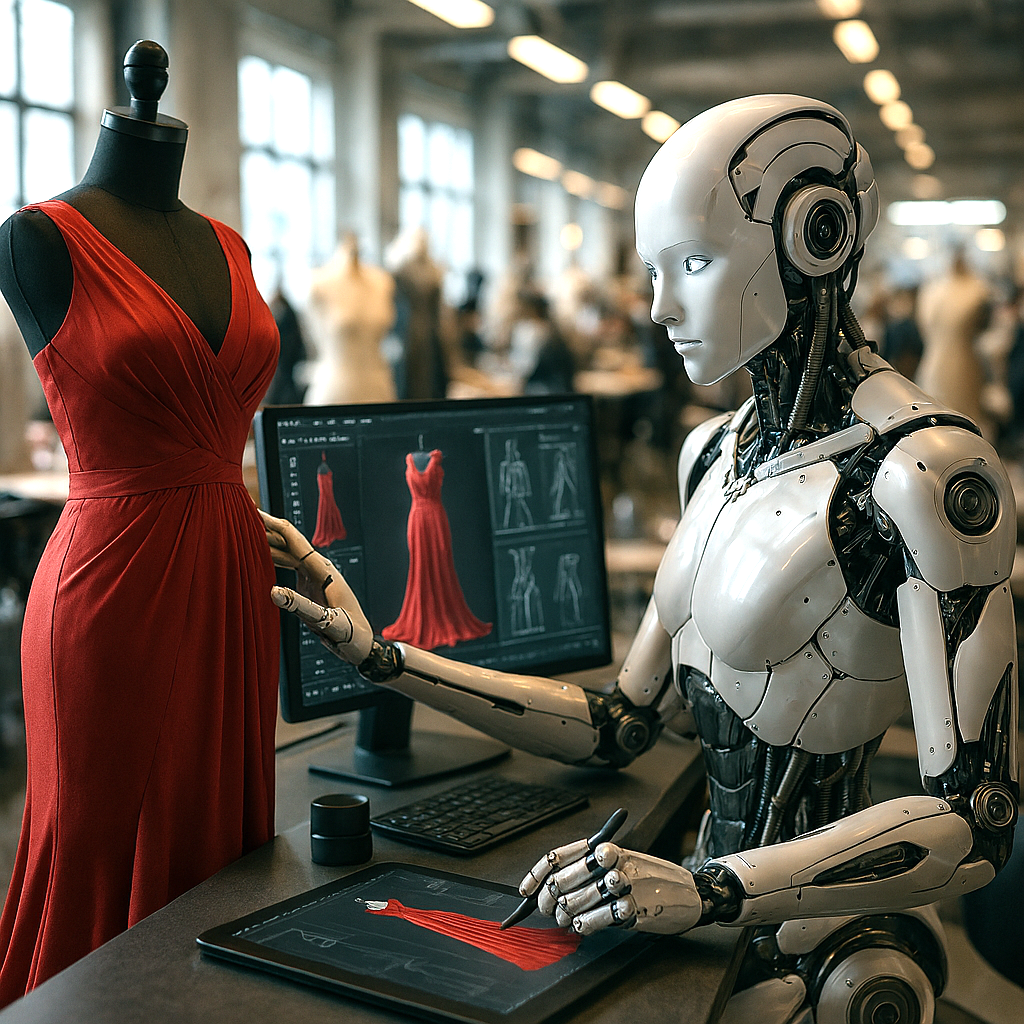
The most dramatic change in the design workflow comes from generative AI platforms that have become standard tools in fashion studios. Designers now routinely use platforms like Midjourney, DALL·E, and Adobe Firefly to co-create mood boards, sketches, and complete outfit designs. Tools such as The New Black allow designers to input text descriptions or rough sketches and receive polished clothing design images within minutes, turning what once required hiring illustrators into a rapid idea engine for early-stage concept development. NewArc.ai goes further by offering sketch-to-image conversion, materials simulation across different fabrics, and custom pattern generation, creating a complete creative suite that dramatically cuts design cycles and reduces sampling costs. According to recent reports, AI tools can slash design timelines from weeks to days, fundamentally altering the pace at which collections can be developed and brought to market.
This acceleration matters because fashion operates increasingly at internet speed. With platforms like TikTok and Instagram redefining how trends spread, the ability to quickly visualize and iterate on designs has become a competitive necessity. As Virginia Commonwealth University assistant professor Jennie Cook explains, the industry has experienced three distinct waves of AI adoption: first came backend infrastructure for merchandising decisions like demand forecasting and dynamic pricing; second was consumer-facing personalization in marketing systems; and third is the current wave of generative AI moving into creation itself, handling imagery, copy, concept boards, and early-stage ideation. This third wave is what consumers can actually see and what designers now use daily.
Beyond individual design creation, AI has transformed trend forecasting from an elite art practiced by fashion editors attending runway shows into a data-intensive science accessible to brands of all sizes. Paris-based company Heuritech, which works with brands like New Balance, Skims, and Prada, uses AI models that track everything from runway shows to social media to detect early signals of trends months before they become visible in the mainstream market. Their algorithms successfully predicted emerging trends for 2026 including dotted prints, flat-thong sandals, and the prominence of yellow as a color. Similarly, platforms like Designovel and Trendalytics analyze vast datasets from social media, street style images, e-commerce analytics, and runway reports to predict emerging trends in colors, silhouettes, prints, and consumer preferences, giving brands early insight into what will resonate with customers.
The significance of AI-powered trend forecasting extends beyond merely predicting what will be popular. It fundamentally changes the risk profile of fashion design. As Amy Sullivan, vice president of buying at Stitch Fix, notes, AI recently helped her team decide between a red or blue stripe shirt for spring by analyzing data rather than making a spot decision or requesting overseas samples that could take weeks. This data-driven approach allows brands to align production with actual customer interest, reducing overproduction and minimizing the risk of unsold inventory. According to industry reports, AI uses predictive analytics, machine learning, and image recognition to scan social media platforms, historical data, and customer feedback, identifying emerging trends and anticipating future demand with precision that traditional methods cannot match.
The integration of AI into fashion has reached its highest profile with major corporate partnerships. In late January 2026, PVH Corp., the global apparel group behind Calvin Klein and Tommy Hilfiger, announced a collaboration with OpenAI to embed AI capabilities across its entire value chain. Under CEO Stefan Larsson’s leadership, PVH is adopting ChatGPT Enterprise to empower employees across product and design, demand planning, inventory optimization, and consumer engagement. The partnership represents a comprehensive approach to AI integration, with PVH co-creating custom AI capabilities tailored to its data-driven operating model. As Giancarlo Lionetti, OpenAI’s Chief Commercial Officer, stated, PVH demonstrates what becomes possible when AI is embedded into the core of a fashion leader, resulting in less friction, more creativity, and sector-wide transformation.
Individual designers are also pioneering AI adoption in creative ways. Norma Kamali, the renowned designer who has shaped fashion for over five decades, completed MIT Professional Education’s “Applied Generative AI for Digital Transformation” course in 2023 and subsequently developed a closed-loop AI tool trained solely on her 57-year archive. Rather than seeing AI as replacing creativity, Kamali envisions it as expanding her design legacy, describing it as potentially serving as “my Karl Lagerfeld” in reference to that designer’s reverence for archival inspiration. Her work exploring “Fashion Hallucinations” using her custom AI archive to generate new interpretations of iconic collections like her Stud Collection demonstrates how established designers can leverage AI to preserve and propel their creative vision. Kamali also sees AI as a vehicle for sustainability, envisioning systems that streamline fabric selection, minimize waste, and enable on-demand production where consumers design items online and automated systems construct them.
The technology powering these transformations includes sophisticated 3D design software like CLO 3D, which has embraced AI-assisted features to make digital garment creation more powerful. Independent designers can now create true-to-life 3D models of garments and simulate how clothes will drape, fit, and move on human forms before cutting a single piece of fabric. Platforms like Refabric combine AI-generated design suggestions with automatic pattern generation and 3D mockups, drastically reducing development time and supporting sustainable practices by optimizing patterns and offering made-to-measure customization. FASHN and similar virtual try-on platforms allow brands to produce scalable product imagery by swapping clothes on model photos without reshooting, maintaining consistency across entire product lines.
Fashion education has had to adapt rapidly to this new reality. As Virginia Commonwealth University assistant professor Hawa Stwodah observes, students initially express wariness about generative AI, concerned about authorship, future career prospects, environmental ramifications, and the value of creativity and talent. However, after classroom discussions weighing benefits against perceived dangers, students develop a more nuanced understanding of how AI can be leveraged responsibly in the design process. Interestingly, research shows that while students almost universally express distaste for AI, a large percentage use it anyway, revealing a contradiction between stated values and actual practice. Students also demonstrate sophisticated concerns about sustainability, quickly connecting AI to environmental harm through data center energy use and the “more tech equals more consumption” pattern.
The environmental implications of AI in fashion present a complex duality. On one hand, AI enables efficiency gains that reduce waste: H&M uses AI to avoid overproducing collections, Adidas designs sneakers with recyclable materials guided by AI optimization, and AI helps textile factories reduce water and energy usage. By improving demand forecasting and enabling made-to-order production, AI can help address fashion’s notorious overproduction problem. On the other hand, as Sage Lenier of the nonprofit Sustainable and Just Future points out, AI enables fast fashion to become ultra-fast fashion, potentially accelerating consumption cycles. The energy-intensive nature of AI and its carbon footprint remain central concerns that the industry must address as adoption accelerates.
Looking toward 2027, the trajectory points toward even deeper AI integration across the fashion industry. McKinsey’s State of Fashion 2026 report identifies AI as shifting from a competitive edge to a business necessity, with companies reshaping workforces so that existing jobs become more AI-centric, enabling roles to shift toward higher-value creative and analytical tasks. Market projections suggest that the global fashion market’s use of AI will reach $4.4 billion by 2027, growing at 39.8% annually from its $2.89 billion valuation in 2025. The secondhand fashion and luxury market is forecast to grow two to three times faster than the firsthand market through 2027, with technology unlocking profitability for resale platforms and changing consumer behavior patterns.
Industry experts predict that future AI systems will be able to generate new design projects from start to finish with minimal human input, potentially encompassing everything from branding to marketing campaigns, product design, and development. Trend forecasting platforms like Trendalytics are already tracking signals for 2027, predicting that bright colors, creative streetwear, and digital fashion will dominate, with AI Fashion Trend Forecasting tools enabling brands to monitor viral TikTok and Instagram posts popular with Gen Alpha viewers and detect shifts instantly. The emphasis will increasingly be on hyper-personalization, with AI analyzing user preferences, purchase history, and body measurements to generate personalized outfit recommendations or custom clothing designs that feel uniquely tailored to individual consumers.
Yet as MIT research scientist Abel Sanchez emphasizes, this transformation requires human oversight and judgment. Industry voices consistently stress that AI cannot do fashion prediction on its own. As Noémie Voyer of Heuritech notes, while their AI is extremely sophisticated, the human aspect remains essential. Similarly, Francesca Muston of WGSN warns that while AI is excellent at efficiently predicting how much of a popular item to stock, human experts must ensure the information AI provides doesn’t lead to wrong conclusions, noting that trends that blow up online can feel huge but that entertainment and commerciality are two different things.
The changes AI has brought to fashion design in 2026 matter profoundly because they democratize access to sophisticated design tools, accelerate the creative process while reducing costs, enable more sustainable production through better demand forecasting, and allow even independent designers and small brands to compete with larger companies that once dominated through scale and resources. The industry is witnessing a fundamental restructuring where competitive advantages increasingly come from what remains hard to copy: taste, curation, and relationships, as Cook observes. Innovation in fashion now relies on what it has always required—ideation plus disciplined iteration—but AI has dramatically accelerated the front end of that process, generating volume, variation, and recombination at unprecedented speed.
As the fashion industry continues this transformation through 2026 and into 2027, the key question is not whether AI will be adopted but rather how it will be implemented within well-structured, sustainable, long-term strategies that address the real needs of all stakeholders while preserving the human creativity, passion, and cultural storytelling that make fashion meaningful. The designers, brands, and companies that master this balance—using AI to handle repetitive tasks and generate insights while channeling human vision into distinctive creative expression—will define fashion’s future.
Sources:
https://research.aimultiple.com/ai-in-fashion/
https://world-collective.com/blogs/news/top-ai-fashion-design-tools
https://www.printful.com/blog/ai-fashion-trends
https://www.crescendo.ai/blog/best-ai-tools-for-fashion-and-clothing-industries
https://openai.com/index/pvh-future-of-fashion/
https://www.news.vcu.edu/article/2026/02/how-ai-is-changing-fashion
https://fashn.ai/
https://www.crescendo.ai/blog/ai-in-fashion-retail-industry-actionable-guide
https://www.wearview.co/blog/12-best-ai-tools-for-fashion-brands-in-2025-complete-guide
https://masterofcode.com/blog/generative-ai-in-fashion
https://www.fashiondiffusion.ai/blog/ai-fashion-design-guide
https://fashionxt.com/2025/03/10-exciting-ai-fashion-companies-to-watch-in-2025/
https://www.insidefashiondesign.com/post/top-ai-tools-used-by-fashion-designers-in-2025
https://news.mit.edu/2025/norma-kamali-transforming-future-fashion-ai-0422
https://www.mckinsey.com/industries/retail/our-insights/state-of-fashion
https://www.npr.org/2025/10/04/nx-s1-5561128/paris-fashion-week-ai-predict-trends
https://trendalytics.co/insights/ai-trend-forecasting-tool-in-us-2025-2027
https://www.premierevision.com/en/articles/7e56f2a0-75fa-ef11-90cb-00224888722c/fashion-meets-ai-the-future-of-an-augmented-industry
https://www.sganalytics.com/blog/the-future-of-ai-in-fashion-trends-for-2025/
https://trendalytics.co/insights/ai-fashion-trends-transforming-the-industry-in-2025
Filed under: Uncategorized |


 Educational Technology and Change Journal

Leave a comment