


By Jim Shimabukuro (assisted by Perplexity)
Editor
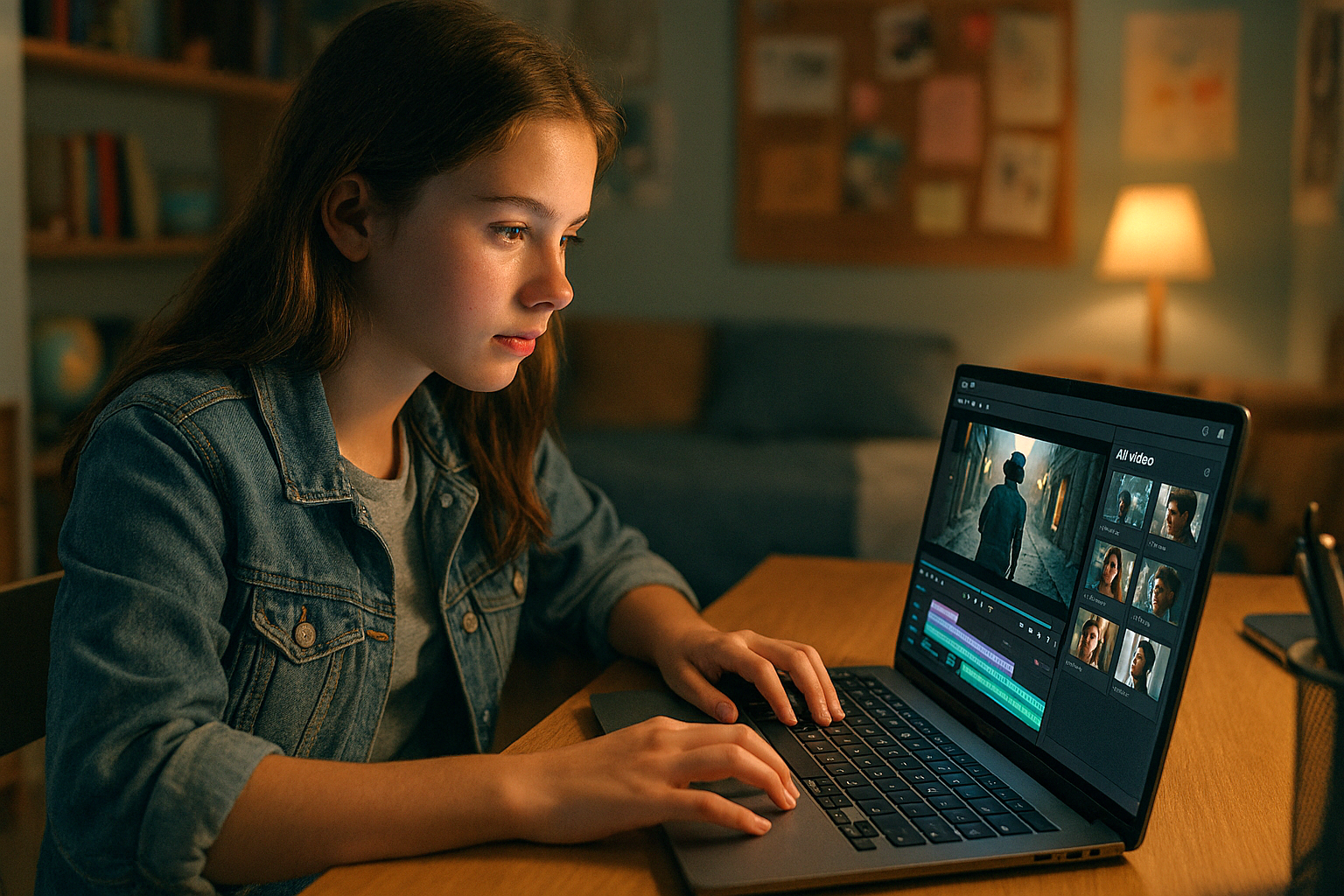
Yes. In 2026, a high school student working alone on a laptop with freely available AI tools can plausibly produce an AI‑driven short film that is competitive at the finalist level of national or international AI film competitions, especially those explicitly centered on AI‑assisted work. While public reporting does not yet single out a named teenager making a national‑finalist AI film strictly from their bedroom, the surrounding evidence from festivals, youth‑oriented AI film calls, and solo low‑budget creators shows that the technical and institutional conditions for this to happen are already in place.(forward-festival+7)
Evidence from AI film competitions and calls
Several recent AI‑specific festivals and competitions demonstrate that “no‑studio, just a laptop” production workflows are now formally recognized and celebrated at high‑level venues. Runway’s AI Film Festival (AIFF), established in 2022, receives thousands of submissions and selects ten finalists each year whose AI‑heavy shorts are screened at major venues such as Lincoln Center in New York and the Broad Stage in Los Angeles. AIFF’s rules explicitly require that films “include AI‑powered tooling in the creation process,” but do not require studio backing, and the organizers emphasize that “millions of individuals are creating billions of videos” with these tools, underscoring that they expect serious work from small independent creators.(reply+5)
Other AI‑focused competitions are even more explicit about the accessibility of the required tools. The “Shortest AI Film Competition” organized by Forward Festival and LTX Studio in 2025 invites anyone, from anywhere, to create up to 60‑second AI films using LTX Studio, with the promotional materials stressing that “no studio [is] needed, just a strong idea and a laptop,” and providing free access to the AI platform during the competition window. The best entries are screened at a dedicated AI short‑film festival in Berlin, with substantial cash prizes and visibility among industry professionals, which again illustrates that high‑level recognition is open to lone creators with commodity hardware.(forward-festival)
At a more general level, the Reply AI Film Festival, whose ten finalists are showcased alongside the Venice International Film Festival, is open internationally to “AI artists, filmmakers, writers, animators, VFX artists, and enthusiasts” using AI tools across scripting, production, and post‑production. The organizers note a “significant leap in quality” between editions and emphasize that the finalists demonstrate how AI can generate “authentic and emotionally engaging experiences” through cinematic language, confirming that the bar for “serious” AI cinema is rising even as access remains open.(finance.yahoo+1)
These competitions are not restricted by age, which means that a talented high school student is eligible to compete directly with adults if their work meets the artistic and technical criteria. In parallel, youth‑specific initiatives such as the MIT AI Film Hack’s “Next Generation” track explicitly call for AI shorts from creators 18 and under who have not yet enrolled in college, further normalizing the expectation that high‑school‑aged filmmakers can produce meaningful AI‑enhanced work.(mitaifilmhack+4)
Concrete examples of small‑team and solo AI productions
While mainstream coverage has focused more on young adults than on minors, several widely reported projects illustrate how a single person or tiny team, using consumer hardware and online AI apps, can reach award‑winning quality in AI‑assisted filmmaking.(creativitysquared+3)
One example is “Ghost Lap,” a short film by Josh Williams, a visual‑effects student at Bournemouth University, who has publicly described starting “with a dream and a laptop” and then relying on Kling AI’s generative video tools to realize an F1‑inspired narrative that would have been unaffordable with traditional VFX. His film won the Jury Prize in the Kling NextGen Creative Contest in October 2025, and in interviews he emphasizes that AI let a creator with limited budget, small team, and few actors produce a polished, emotionally driven film that resonated with judges. This is not a high‑school case but shows that the combination of personal laptop plus cloud‑based AI suffices for an award‑winning short at a major AI‑video platform’s competition.(hollywoodreporter])
Another case is “Lovely,” a two‑minute AI short made by two people who used nine AI tools over three days with a total budget of around $450. The creators report that they built a simple but emotionally focused, dialogue‑driven narrative, aiming to test the realism and storytelling power of current AI technologies; their experience suggests that small, resource‑constrained teams can deliver coherent character‑focused stories using only off‑the‑shelf generative tools and modest funds.(reddit])
Curated overviews of notable AI‑created movies also highlight solo creators working largely from home. A 2024 feature on “11 of the best AI‑created movies ever made” describes works such as “Checkpoint,” which won a Gold prize at Runway’s AI Film Festival, and “Generation,” the Grand Prix winner, both of which relied heavily on AI‑generated imagery and effects to deliver sophisticated visual experiences. The same article notes “/Imagine,” a short film produced single‑handedly by French artist Anna Apter, which uses sequences of AI‑generated images combined with narration to interrogate the digital world awaiting newly social‑media‑eligible teens; the film was showcased at an AI‑film event backed by Sony and Adobe, indicating that solo AI films can attract attention from established creative‑tech sponsors.(creativitysquared])
Although detailed age and working‑environment data are rarely disclosed in festival press materials, these examples collectively show that an individual creator or very small team, working outside a traditional studio and leveraging widely available cloud AI tools, can reach finalist or winning status at AI‑specific festivals and contests that have international juries and professional visibility. Given that many of the tools used in these projects (e.g., Runway Gen‑4, Veo 3.x, Luma AI, Kling AI, Adobe Firefly partners) are accessible via web interfaces from any laptop, there is no technical barrier preventing a capable high school student from doing the same.(hollywoodreporter+7)
AI tools and methods a home‑based student could use
The workflow for a high school student in her bedroom would likely center on a set of text‑to‑video and multimodal AI platforms that already underpin much of today’s AI cinema experimentation. Comparative reviews of leading 2025 text‑to‑video models emphasize OpenAI’s Sora 2, Runway’s Gen‑4, Pika 2.1, Google’s Veo 3, Kling AI 1.6, and Luma Dream Machine as the main engines behind millions of AI videos produced in 2025. These systems typically allow a user to describe scenes in natural language, upload reference images, or provide short clips, and then generate high‑resolution cinematic sequences with increasingly convincing physics, lighting, and character motion.(adobe+4)
Runway’s Gen‑4, for instance, is noted for its “perfect character consistency” capabilities, where a user can upload a single reference image and then generate multiple scenes with the same character, addressing one of the core challenges in narrative AI filmmaking. Sora 2 is described as offering native audio synchronization, producing synchronized dialogue and sound effects in a single pass, which reduces the need for separate sound‑design workflows and makes it easier for solo creators to produce cohesive audiovisual narratives. Kling AI’s later models, used in “Ghost Lap,” are reported to support dynamic scenes and improved cinematic quality suitable for complex sequences like car racing.(aivideodetector+2)
Student‑accessible platforms such as LTX Studio go further by integrating scripting, storyboarding, animation, directing, and editing functions in one cloud environment, with the Shortest AI Film Competition providing free access for entrants. Adobe’s 2025 Generative AI Film Festival showcases workflows where creators combine Adobe Firefly partner models (e.g., Nano Banana for visuals, Google Veo 3.x or Luma AI’s Ray 3 for animation) with tools like Runway for style transfer and Adobe audio tools for generative sound effects, blending live‑action, AI imagery, and AI‑generated audio into finished shorts.(adobe+1)
A plausible bedroom‑laptop workflow for a high school finalist could therefore involve writing a short script in a text editor, storyboarding with an image model, generating key sequences with a text‑to‑video model (e.g., Runway Gen‑4, Pika, Veo, Kling, Luma), using a platform like LTX Studio or a standard NLE editor for assembly and pacing, and augmenting with AI‑generated sound design and music. With competitions such as Project Yellow Light and other national high‑school contests already recognizing sophisticated student‑made PSAs and short films (often under eight minutes) in traditional formats, it is reasonable to infer that similar‑length AI‑assisted shorts could be competitive if festival rules permit AI usage.(collegevine+6)
Implications for the film and video industry
Industry and policy analyses increasingly describe generative AI as transformative for film and TV production, both in terms of the creative process and the structure of the content market. A 2026 report on AI in film and TV production argues that AI could “democratize high‑end content creation,” enable new production processes, and even “fundamentally reset” the economic model of video, with user‑generated content and smaller studios gaining ground as AI lowers traditional barriers to entry. The same analysis projects that AI could affect around 20 percent of original content spend within five years, largely by automating and accelerating pre‑visualization, VFX, editing, localization, and other post‑production tasks.(researchandmarkets+6)
Market research on generative AI in movies estimates that this segment grew from about $0.32 billion in 2024 to $0.4 billion in 2025 and could reach nearly $1 billion by 2029, driven by factors such as decreased labor costs, increased efficiency, and enhanced visual effects. These reports stress that text‑to‑video tools can automate routine tasks like scene creation, script drafting, and VFX rendering, helping filmmakers “bring their creative ideas to life more efficiently,” which in practice means that the capabilities once reserved for well‑funded studios are increasingly available to individuals and small teams.(smythos+1)
Analysts also highlight the potential for AI to disrupt professional roles and raise ethical concerns. An AI strategic‑intelligence report on film and TV notes both the opportunity of cheaper, faster VFX and the risk of backlash from artists and audiences worried about job displacement and the perceived erosion of human artistry. Coverage of tools like Sora 2 and Kling AI underscores Hollywood’s anxiety over copyright, source‑data consent, and the status of AI‑generated performances, especially as high‑end AI videos become “very hard” for general audiences to distinguish from conventional footage.(finance.yahoo+3)
For the industry, the fact that a teenager in a bedroom can, in principle, deliver a festival‑worthy AI film crystallizes three broad implications. First, it accelerates the democratization of production, shifting some creative power from large studios to a global pool of individual storytellers and micro‑teams, and increasing competition for viewer attention as content supply explodes. Second, it pressures professional filmmakers and institutions to redefine value, emphasizing distinctive voice, curation, community, and live or experiential elements over mere production polish, which AI can increasingly match. Third, it intensifies labor, legal, and educational debates about how to train emerging filmmakers: whether to double down on human‑only craft, to integrate AI fluency as a core skill, or to create new hybrid roles and accreditation systems that recognize AI‑assisted authorship.(aiff.runwayml+9)
In sum, even without a widely publicized, named example of a specific high‑school student’s bedroom‑made AI film reaching a national‑competition final, current festivals, youth‑oriented AI film initiatives, documented solo and small‑team successes, and rapidly improving cloud AI video tools collectively show that such a scenario is technically and institutionally feasible in 2025–2026, and that the industry is already adapting—uneasily—to a world where high‑end cinematic expression is no longer limited to those with studio budgets and physical infrastructure.(aiff.runwayml+9)
[End]
Filed under: Uncategorized |


 Educational Technology and Change Journal

Leave a comment