


By Jim Shimabukuro (assisted by ChatGPT)
Editor
In the United States in 2026, artificial intelligence is no longer a far-off force looming on the horizon of engineering — it is redefining how engineers work, what they are asked to do, and what skills they must possess. Rather than simply replacing people, AI is amplifying human capability, reshaping workflows, and elevating the role of human engineers toward higher-order thinking, complex problem-solving, and multidisciplinary collaboration.
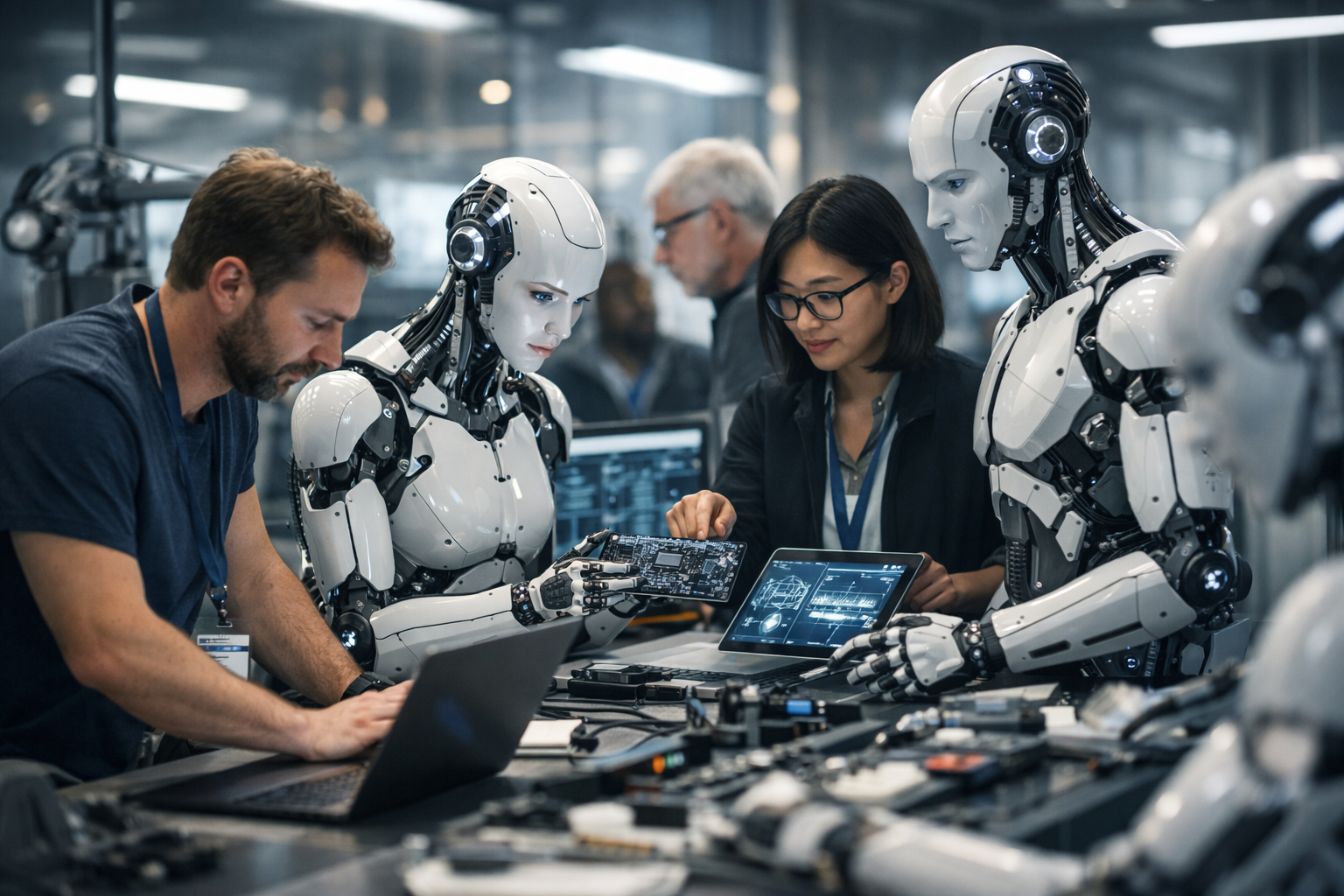
One of the most concrete illustrations of this shift comes from a recent comprehensive industry study by the ACEC (American Council of Engineering Companies) Research Institute, which finds that firms across the engineering and design services sector are integrating AI not to eliminate human workers, but to augment their capacity. According to this report, 85 % of firms view AI as essential to future success, and 74 % expect AI adoption to boost output without cutting overall staffing levels. Routine tasks such as drafting proposals, compliance checking, calculating standard design loads, and documentation are being automated, freeing engineers to focus on high-impact work such as innovation, client strategy, and system integration. (ACEC)
In practical terms, this looks like engineers using AI-driven generative design tools to rapidly explore vast design spaces that would once have required weeks of iterative modeling. In mechanical, civil, and aerospace engineering, AI-augmented CAD and simulation enables engineers to evaluate advanced performance metrics early in the design phase, or anticipate system failures via predictive maintenance analytics. These systems can analyze millions of possible failure modes, correlations, and environmental variables far faster than a human team could manually compute — and with far greater fidelity. (Rutgers)
Importantly, the role of humans is shifting from manual execution to trustworthy oversight, contextual judgment, verification, and ethical design. While AI systems can propose solutions or run models quickly, engineers still must validate assumptions, understand constraints, and account for regulatory and safety constraints that the AI does not fully internalize. As noted by engineering professionals analyzing current workforce trends, organizations increasingly value engineers who can interpret model outputs, communicate results to stakeholders, and integrate multidisciplinary insights — blending technical depth with team leadership and client engagement. (IEEE Spectrum)
What This Means for 2027
The trajectory into 2027 points toward deeper integration of AI in engineering practice. Rather than a sudden “AI takeover,” the industry appears to be progressing toward a collaborative ecosystem: engineers and AI systems working together, with humans focusing on strategy, creative innovation, ethical design, and accountability. Firms will increasingly adopt AI across the entire project lifecycle — from conceptual design and risk modeling through construction sequencing, real-time monitoring, and lifecycle maintenance forecasting. The tools will become more context-aware and more embedded within standard workflows, reducing time spent on repetitive tasks while increasing expectations for engineers to manage complex socio-technical systems.
Employment patterns are evolving as well. While some junior or highly routine roles may diminish, demand for engineers with AI fluency — especially those who can manage AI systems, interpret complex analytics, or design new AI-augmented products and infrastructure — is growing. A 2025 Autodesk AI Jobs Report indicates that listings for AI-related roles in design and “make” industries — including AI Engineer and AI Systems Designer — surged markedly in 2025, a trend likely to strengthen in 2026 and into 2027. (Autodesk News)
Are U.S. Engineering Schools Keeping Pace?
The short answer is: some are, but not all. Engineering education traditionally has been slow to change relative to industry evolution, but many leading universities are deliberately integrating AI education into core engineering curricula and degree requirements in recognition of the shifting landscape.
The Massachusetts Institute of Technology (MIT) has updated key mechanical and engineering design courses to incorporate AI and machine learning directly into real-world problem solving. This includes hands-on projects where students use predictive models, optimization algorithms, and data-driven workflows as part of solving design challenges that mirror industry applications. (Kukarella)
At Purdue University, administrators approved a system-wide AI competency requirement for all undergraduates, meaning every engineering student must demonstrate working proficiency with AI tools and concepts before graduation. This institutional strategy reflects a recognition that future engineers will be expected to work with these tools regardless of specialization. (Purdue University)
Carnegie Mellon University (CMU), long recognized for strength in computer science and AI, integrates AI deeply into both undergraduate and graduate engineering tracks, using cross-disciplinary projects and strong industry partnerships to keep curricula aligned with real-world needs. CMU’s pedagogy emphasizes project-based learning and adaptability in rapidly changing AI environments, preparing students to tackle ambiguous, complex engineering challenges that current tools alone cannot resolve. (blog.davidi.com)
Beyond these flagship examples, other institutions — from Ohio State integrating AI literacy into general education requirements to California State Universities creating AI machine learning concentrations — are gradually adapting teaching models to reflect industry needs. (San Francisco Chronicle)
Repercussions for Universities and Graduates Who Fall Behind
Universities that fail to adapt risk credential obsolescence. Graduates who emerge with engineering degrees centered on legacy workflows — heavy on manual calculation but light on AI fluency, data analysis, and human–AI collaboration — may find themselves at a competitive disadvantage. Employers increasingly seek engineers who can harness AI to create value, not just perform traditional tasks. Students from programs that do not integrate AI are likely to face steeper learning curves, slower career starts, and potential downgrades in employability compared to peers who graduate with strong AI-augmented competencies.
From an institutional perspective, programs that lag in updating curricula risk declining enrollment and reduced industry partnerships. As enrollment patterns stay sensitive to perceived job readiness — as evidenced by shifts in computer science and engineering applications — universities that are seen as out of step with the demands of employers will face both market and reputational pressures. (San Francisco Chronicle)
In short, AI in engineering is not about eliminating human engineers, but about transforming their roles and expectations. The future belongs to engineers who can think critically, validate and interpret AI outcomes, collaborate across disciplines, and embed AI into ethical, safe, and impactful solutions. For universities and graduates alike, the choice is not whether to engage with AI, but how deeply and strategically that engagement will shape education, practice, and professional identity.
[End]
Filed under: Uncategorized |


 Educational Technology and Change Journal

Leave a comment