





By Jim Shimabukuro (assisted by Copilot)
Editor
The short answer is that the United States is very likely to remain the single most powerful actor in AI over the next few years, but “exponential domination” in the sense of uncontested, unilateral control is improbable. Instead, what looks plausible is a world where the U.S. anchors the high‑end frontier—chips, hyperscale compute, leading models, and defense integration—while China, the EU, and a handful of others retain meaningful, sometimes growing influence in specific niches such as open models, regulation, and regional ecosystems. That configuration still has profound geopolitical consequences in 2026–2027, but it is more about asymmetric advantage than absolute monopoly.
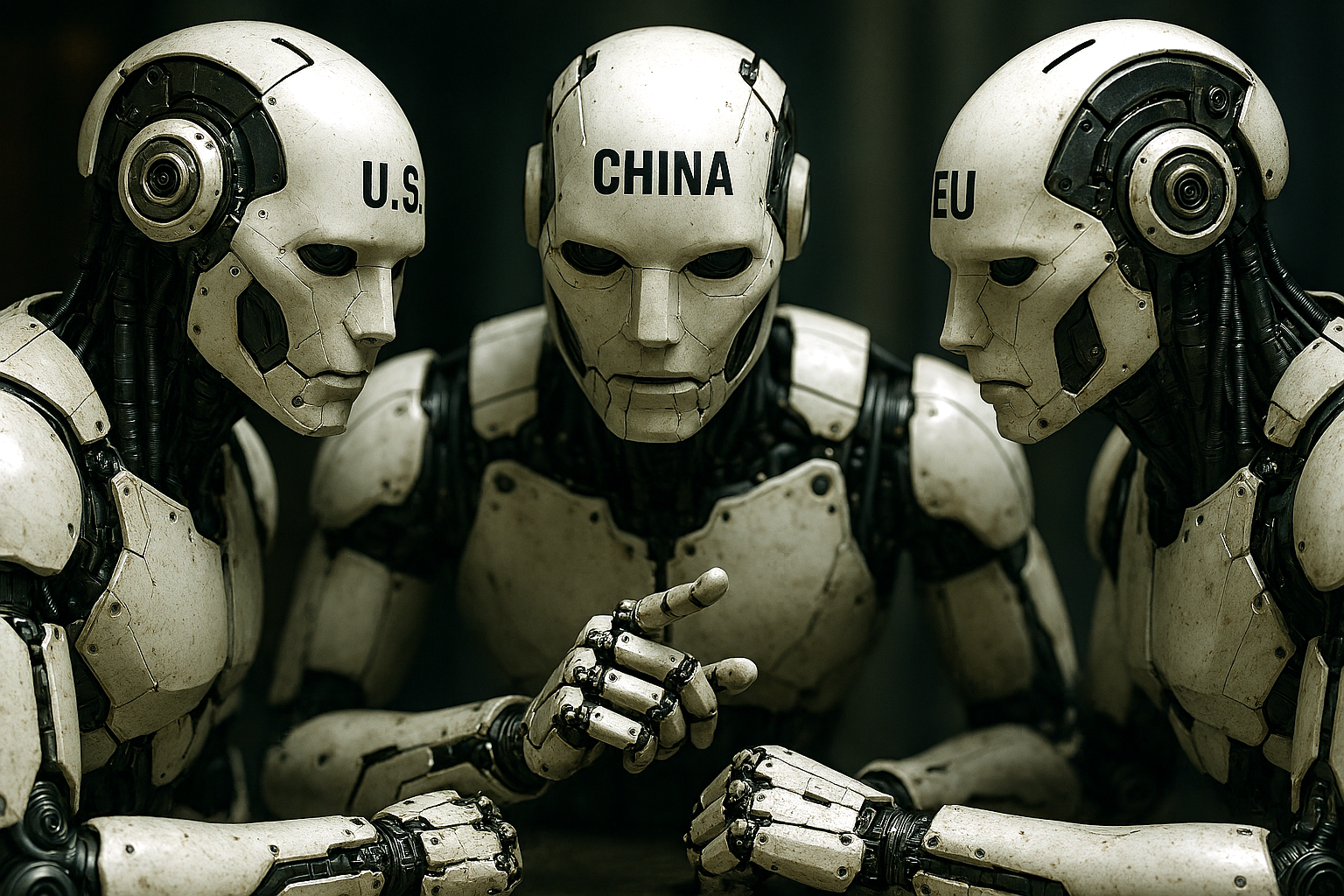
To see why, start with the hard numbers on investment and infrastructure. The 2025 AI Index from Stanford’s Human-Centered AI Institute reports that U.S. private AI investment reached about $109.1 billion in 2024—nearly twelve times China’s $9.3 billion and twenty‑four times the U.K.’s $4.5 billion. The report notes that the U.S. has widened its lead in global AI private investment and dominates generative AI funding in particular, with generative AI alone attracting $33.9 billion in 2024 and accounting for more than 20% of all AI-related private investment worldwide. That scale of capital, combined with deep venture markets and big‑tech balance sheets, is a structural advantage that compounds over time. (Stanford HAI)
A complementary view from central‑bank research underscores that this is not just hype. A 2025 note from the U.S. Federal Reserve on “The State of AI Competition in Advanced Economies” concludes that the United States retains “important advantages in infrastructure, talent, and commercialization,” even as China and other advanced economies close gaps in some metrics. The analysis stresses that U.S. strengths are especially pronounced in compute infrastructure, leading AI firms, and the ability to translate research into globally scaled products and platforms. (Federal Reserve)
Independent industry analyses echo this picture. The “State of AI 2025” report by Air Street Capital, summarized by Science|Business, describes the U.S. as “supremely dominant in terms of private investment and compute capacity,” while noting that Chinese open models are increasingly influential and that the EU is lagging in both investment and supercomputing capacity. The report highlights that U.S.-based hyperscalers and chip supply chains give Washington leverage over the “commanding heights” of AI infrastructure, even as other regions try to assert “tech sovereignty.” (Science|Business)
A broader geopolitical framing comes from a 2025 analysis titled “The Geopolitics of AI: Decoding the New Global Operating System,” which characterizes AI as a new layer of global power competition. It argues that the U.S. and China dominate on divergent paths: Beijing pursues state‑led self‑reliance and lower‑cost open‑source exports, while Washington leans on private‑sector innovation, infrastructure build‑out, and defense integration. The report emphasizes that semiconductors, critical minerals, and electricity capacity are emerging as chokepoints that determine who can scale AI and who falls behind. (Eurasia Group)
Finally, a 2025 overview of the “global AI race” notes that Goldman Sachs expects global AI investment to reach around $200 billion by 2025, with the U.S. accounting for nearly half. This reinforces the idea that, in aggregate, the U.S. is not just ahead but is the gravitational center of AI capital and commercialization, even as other countries build their own capabilities. (CSIS)
Putting these strands together, the probability that the U.S. will “exponentially dominate” AI in the next few years depends on how we define the term. If we mean that the U.S. will maintain and likely expand its lead in frontier model development, AI supercomputing capacity, and private investment through 2026–2027, the probability is high. The investment and infrastructure gaps are large, and they compound: more capital funds better models, which attract more users and data, which in turn justify more capital and specialized hardware. Export controls on advanced chips and manufacturing equipment further constrain China’s access to the highest‑end compute, reinforcing U.S. leverage over the most advanced systems. Given current trajectories, it is plausible—though not guaranteed—that by 2027 the U.S. share of frontier‑model training runs and hyperscale AI compute remains dominant, even if others catch up in specific domains.
If, however, “exponential domination” is taken to mean that other major powers become strategically irrelevant in AI, the probability is low. China continues to invest heavily, especially in open models and domestic applications, and has a vast internal market that can sustain large‑scale deployment even under hardware constraints. The EU, while lagging in investment and compute, is becoming a regulatory superpower in AI, shaping global norms through instruments like the AI Act and related digital regulations. Middle powers—India, the U.K., South Korea, the Gulf states—are building specialized niches in data centers, talent, and sovereign AI infrastructure. The more realistic scenario is a U.S.-anchored but contested AI order, not a U.S. monopoly.
The geopolitical impact of this likely configuration in 2026 and 2027 is substantial and, importantly, plausible given the mechanisms already visible today. First, AI becomes a core pillar of alliance politics. Because the U.S. controls much of the frontier compute, leading models, and key chip technologies, access to these assets becomes a tool of statecraft. We should expect AI‑related provisions to be woven into defense agreements, trade deals, and technology partnerships, especially within NATO, the Quad, and U.S.–EU frameworks. Allies that align with U.S. export controls and security priorities are more likely to receive preferential access to advanced models, cloud compute, and semiconductor supply chains. This is a natural extension of patterns already seen in semiconductor export controls and cloud security agreements; by 2026–2027, AI will be fully integrated into that toolkit.
Second, AI will deepen the strategic rivalry between the U.S. and China, but in a more differentiated way than a simple “winner‑takes‑all” race. The U.S. will likely dominate the highest‑end, closed frontier models and defense‑oriented applications, while China pushes aggressively on cost‑effective, open, and regionally attractive systems. Many countries in the Global South may find Chinese or other non‑U.S. offerings more accessible or politically palatable, especially if they come bundled with infrastructure financing and fewer governance conditions. This creates a world where the U.S. has superior capabilities, but China retains significant influence over standards, deployment practices, and the AI tools used in parts of Asia, Africa, and Latin America. The geopolitical “face of the earth” in 2026–2027, then, is not a single U.S. AI empire, but a patchwork of overlapping spheres of technological influence.
Third, regulatory and normative competition will intensify. The EU’s emerging AI regulatory framework, combined with its broader digital rule‑making, will push global firms—including U.S. giants—to conform to European standards if they want access to the EU market. The U.S., meanwhile, will likely emphasize sector‑specific rules, voluntary frameworks, and national security–driven controls, while China advances its own model of state‑centric, security‑first AI governance. By 2026–2027, many countries will be choosing not just whose models to use, but whose rules to adopt. U.S. dominance in technology does not automatically translate into dominance in norms; instead, we get a fragmented regulatory landscape where Washington’s technical edge coexists with Brussels’ regulatory pull and Beijing’s state‑centric template.
Fourth, AI will reshape economic hierarchies and bargaining power. Countries that host major data centers, chip fabrication plants, and AI research hubs will gain leverage in global value chains. The U.S., already home to most hyperscalers and leading AI labs, will likely see its centrality reinforced, attracting talent and capital from around the world. At the same time, energy and critical minerals become strategic bottlenecks: large‑scale AI requires enormous electricity and specialized materials, giving resource‑rich or energy‑abundant states new bargaining chips. This is consistent with the “energy and hardware as chokepoints” dynamic highlighted in the 2025 geopolitics of AI analysis, and it is entirely plausible that by 2026–2027, disputes over data center siting, grid capacity, and chip supply will be routine elements of international negotiations.
Finally, the security dimension will be decisive. As the U.S. integrates AI into intelligence, cyber operations, autonomous systems, and command‑and‑control, its military and intelligence edge could widen relative to most other states. But this also raises escalation and stability risks: AI‑enabled cyber tools, information operations, and automated decision‑support systems can compress decision times and increase uncertainty. A U.S. that “exponentially dominates” frontier AI capabilities may deter some adversaries, but it may also incentivize others to pursue asymmetric responses—such as targeting AI infrastructure, exploiting vulnerabilities in AI supply chains, or doubling down on non‑AI forms of coercion. By 2026–2027, it is plausible that AI will be embedded in most major security crises, not as a science‑fiction superweapon but as a pervasive layer of sensing, analysis, and influence.
In sum, current trends make it highly likely that the United States will remain the central power in AI through 2026 and 2027, with a significant and possibly growing lead in investment, compute, and frontier models. That advantage will shape alliances, economic hierarchies, regulatory competition, and security dynamics in ways that are already visible in today’s data and policy choices. What is less plausible is a world where this translates into total, uncontested domination. Instead, the emerging geopolitical landscape is one of U.S. primacy in capabilities, persistent Chinese and European influence in specific domains, and a crowded field of middle powers carving out niches—an AI order defined not by a single hegemon, but by asymmetric interdependence and contested power.
[End]
Filed under: Uncategorized |


 Educational Technology and Change Journal

Leave a comment