





By Jim Shimabukuro (assisted by Claude)
Editor
Introduction: The following three articles — by Erik Barmack, Modem Works & Chanwoo Lee, and Bhawani Shankar — address the question about AI-generated representations extending professional careers.
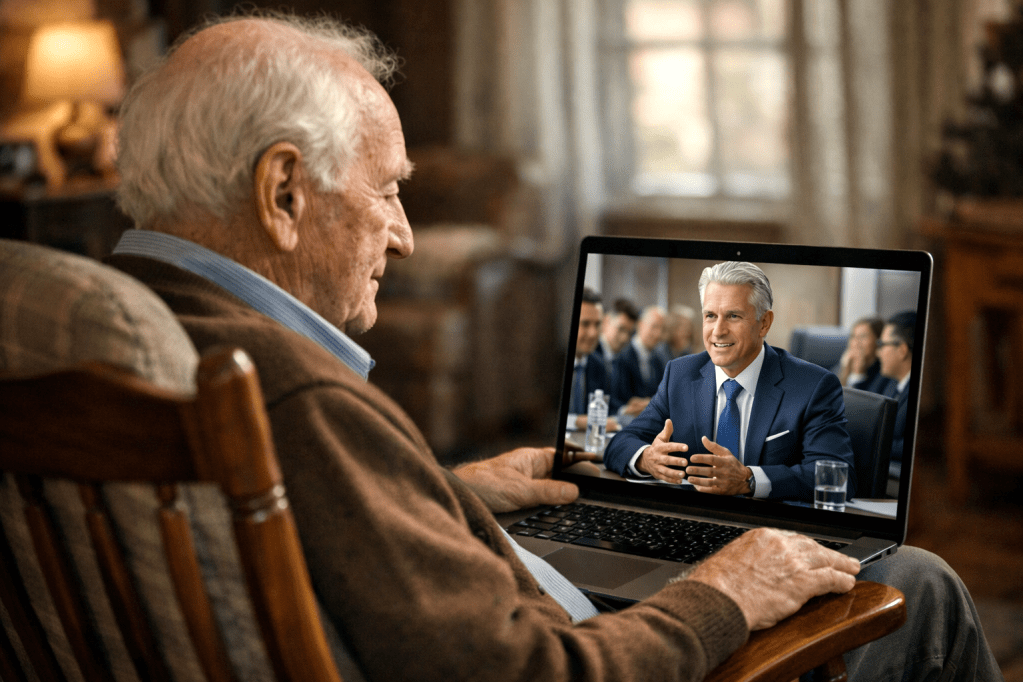
1. “Eternal Celebrities: The Multi-Billion Opportunity Coming” by Erik Barmack (The Ankler, 9 Apr 2025)
Erik Barmack’s incisive article in The Ankler presents perhaps the most comprehensive exploration of how AI technology is fundamentally transforming the business of celebrity into an eternal enterprise. Writing from his vantage point as a working producer and founder of Wild Sheep Content, Barmack examines the Suzanne Somers AI humanoid unveiled in early 2025 as a pivotal moment in entertainment history—one that marks the transition from posthumous tributes to active career continuation beyond death.
The article’s central thesis revolves around a quiet legal revolution that occurred on January 1, 2025, when California’s A.B. 1836 became law. This legislation, initially designed to protect deceased celebrities from unauthorized deepfake exploitation, inadvertently created the legal framework for something far more profound: it explicitly expanded post-mortem rights statutes to include AI-generated digital replicas of deceased personalities. Barmack astutely recognizes the paradox inherent in this law—it simultaneously protects the dead from exploitation while making their likenesses more valuable and more usable than ever before.
What makes Barmack’s analysis particularly compelling is his focus on the business ecosystem emerging around digital immortality. He reveals that the thirteen highest-earning dead celebrities collectively earned $1.2 billion in the twelve months ending September 2024, with Michael Jackson alone accounting for half of that through his touring musical. Yet this figure, Barmack suggests, represents only the beginning of what’s possible. The Suzanne Somers humanoid isn’t merely a hologram or voice clone—it’s an interactive AI that can theoretically negotiate contracts, make creative decisions, and insist on deal points. Barmack wryly notes it could even “ask for Evian water before heading into certain meetings.”
The article excels in identifying the stakeholder implications across the entertainment industry. For talent agents and managers, representation no longer ends with a client’s death—it shifts jurisdiction into estate planning and posthumous licensing. Barmack poses a provocative question: why should agencies surrender millions in fees to licensing firms that handle deceased celebrities when AI expands the pool of potential afterlife clients beyond a handful of iconic, gone-too-soon stars? For studios, digital actors present an appealing proposition—they never arrive drunk on set, never file harassment claims, and can work whenever needed. The AI version of James Dean, as Barmack notes, offers “powerful appeal” to executives like Warner Bros. Discovery CEO David Zaslav.
Yet Barmack doesn’t shy away from the darker implications. He examines how projects featuring AI celebrities could crowd out living actors, shrinking an already limited pool of opportunities. The nostalgia economy, he warns, could cannibalize Hollywood by prioritizing endless iterations of beloved dead performers over original work by living talent. He also traces the historical arc of moral panic surrounding each technological advance applied to deceased celebrities—from Fred Astaire dancing with a Dirt Devil vacuum in 1997 to the vituperative backlash against casting James Dean’s CGI likeness in the Vietnam War film “Finding Jack” in 2019.
This article provides the most thorough examination of the business mechanics, legal framework, and stakeholder incentives driving AI career extension. Barmack’s insider perspective as a producer lends credibility to his analysis of studio motivations and agent calculations. His treatment of the Robin Williams precedent—where the actor included a 25-year moratorium on posthumous use of his likeness in his will—demonstrates how celebrities themselves are beginning to grapple with these questions. Barmack ultimately asks whether we can resurrect the dead without losing our humanity in the process, a question that resonates far beyond Hollywood into the broader implications of AI-extended careers across all professions.
2. “Digital Doubles” by Modem Works & Chanwoo Lee (Modem Works, 2 Dec 2025)
This remarkable piece from the design and innovation office Modem Works, created in collaboration with HCI designer Chanwoo Lee from the Royal College of Art, takes a more philosophical and speculative approach to the question of AI-generated career extension. Rather than focusing solely on celebrities, it examines the broader phenomenon of “digital doubles”—AI avatars trained on our most intimate personal data that could represent us in work meetings, dating scenarios, and social interactions.
The article’s greatest strength lies in its recognition that we already have digital twins of a sort. As Douglas Coupland observed in “The Extreme Self,” our invisible doubles live in our devices, logging every purchase and post to create what Modem calls “a homunculus of accumulated attention.” Currently, these representations are crude caricatures built from consumer behaviors. But the piece argues persuasively that we’re approaching a transformation as small, powerful on-device AI becomes more sophisticated. Google Assistant already makes phone calls using realistic generated voices complete with verbal tics; content creators use apps like Captions and BIGVU to generate AI twins for social media production.
What distinguishes this article is its examination of three distinct manifestations of digital doubles through speculative design scenarios. The “Augmented Self” imagines a CEO whose multiple digital doubles handle meetings across five time zones while he surfs, selecting different avatars for different contexts—looking tired for boardrooms to signal hard work, healthier for dating profiles. The “Perceived Self” presents a more unsettling scenario where a woman begins to question whether her wife, constantly traveling for business, has been replaced by a digital double. The “Predictive Self” explores how someone might use digital doubles to game social interactions, running every possible apology through an AI simulation to find the “forgiveness combination” that works.
These scenarios illuminate profound questions about identity, presence, and authenticity. The article astutely notes that while tech industry optimists like Zoom CEO Eric Yuan promise digital doubles will handle mundane work so we can focus on creativity, and Bumble founder Whitney Wolfe Herd envisions AI “concierges” pre-screening romantic matches, the reality may be more complex. Will we automate work to focus on personal relationships, or automate relationships to focus on work? As Marshall McLuhan observed, every extension is an amputation—and the article warns that relegating conversations, meetings, and social interactions to our doubles may cause our capacities for small talk, writing, and critical thinking to atrophy.
The piece also addresses the question of posthumous digital doubles with particular sensitivity. It references the late composer Ryuichi Sakamoto, who created a hologram that performed a piano concert in June 2023, months after his death. Sakamoto had explicitly consented to this digital afterlife, stating: “This virtual me will not age and will continue to play the piano for years, decades, and centuries. Will there be humans, then?” This stands in stark contrast to the story of Drew Crecente, who discovered an AI chatbot posing as his murdered teenage daughter—a distinction that hinges entirely on informed consent and identity protections.
This article moves beyond the entertainment industry to examine the broader social and philosophical implications of digital career extension. Its speculative design scenarios make abstract concepts tangible and emotionally resonant. The piece recognizes that whether digital doubles are “conscious” matters less than whether people interact with them as though they were—citing the outcry when Replika added content filters that disrupted users’ romantic attachments to their chatbots. The authors’ warning that we may cede essential human capacities to our doppelgängers “at our peril” adds necessary caution to discussions often dominated by techno-optimism. Its exploration of how digital doubles could help us game social interactions or prepare for difficult conversations raises uncomfortable questions about authenticity and human connection that will only grow more urgent as the technology improves.
3. “Not Your Father’s Avatar: The Real Future of Artificial Intelligence” by Bhawani Shankar (CIO, 3 Mar 2025)
Bhawani Shankar’s article in CIO magazine offers a uniquely valuable perspective on AI career extension by examining it through the lens of enterprise technology and organizational transformation. As CEO of advisory firm Cubix and former analyst at Gartner, Shankar brings thirty years of experience observing how technology adoption actually unfolds in large organizations—making his analysis particularly relevant for understanding how digital avatars might transform professional careers beyond the entertainment industry.
The article’s most significant contribution is its documentation of an actual case study: Bjorn Jesch, Chief Investment Officer at German asset management firm DWS, who in February 2024 created an AI avatar of himself that now regularly produces podcasts without him recording anything. An AI script extracts information from meeting notes, files, and other sources, feeding it to the avatar which has “learned his style.” Jesch is developing a desktop version that could attend virtual meetings on his behalf. Shankar identifies this as potentially the first instance of a senior business executive using a generative AI alter-ego for both personal and business benefit in daily work—personal because it reduces stress for a rushed executive who can’t be in multiple places simultaneously, and business because it delivers timely content.
Shankar identifies three crucial aspects of this development that enterprise CIOs must understand. First, Jesch didn’t submit a formal IT request, define business requirements, or request a budget—he simply found the tools necessary to achieve his objective without impacting legacy systems. Second, the tools required minimal understanding of underlying technology, possibly because barriers to entry and exit were negligible. Third, and most importantly, the AI avatar became an extension of the business user—a human worker who became digitally augmented, creating what is effectively a self-learning digital twin. Though still nascent, Shankar predicts these digital twins will mature to independently execute tasks autonomously while preserving their owner’s mannerisms, speech patterns, and unique characteristics.
What makes Shankar’s analysis particularly valuable is his focus on the organizational implications. He poses challenging questions: How will companies measure, appraise, and reward these “converged individuals”? How will human capital management systems account for them? When an employee resigns, will their avatar follow—or remain behind for the next person to retrain? As creative workforces deploy digital personalities at scale, intellectual property lawyers will struggle to separate personal mannerisms that constitute individual brand from content that represents corporate assets.
The article also addresses a crucial issue for technology leaders: the potential disintermediation of CIOs and IT departments. Digital twins are being built without CIO facilitation, funded outside IT budgets. Analyst estimates suggest that 40-60% of technology spending already occurs outside CIO/CTO budgets, and generative AI will exacerbate this trend. Shankar argues that the key prerequisite for this shift is the ability to define outputs clearly—if business users can articulate what they need, generative AI can deliver without elaborate technical infrastructure. This represents generative AI functioning as an abstraction layer between complex technology and simple business outputs, potentially democratizing technology in ways that fundamentally alter the CIO’s role.
Shankar draws parallels to how GitHub and Stack Overflow created “digital backpacks” for developers, accelerating their work. But he notes that GitHub Copilot’s licensed offering has raised intellectual property concerns, including a class action lawsuit ongoing for two years. This presages similar questions for AI-augmented professionals: How will augmented and non-augmented employees work together? What management strategies will coordinate diverse digital-human teams? Issues of compensation, incentivization, psychometrics, legal frameworks, and ethics all demand attention starting in 2025.
This article grounds the abstract concept of AI career extension in concrete organizational reality. While other pieces focus on celebrities or philosophical implications, Shankar examines how this technology is already being deployed by business executives and what it means for enterprise technology strategy. His identification of the CIO disintermediation risk is particularly insightful—if business users can create their own digital twins without IT involvement, it fundamentally restructures organizational power and budget allocation. His warning that augmented professionals represent coming challenges for compensation, management, and legal frameworks provides practical guidance for organizations preparing for this transformation. The article serves as a crucial bridge between the entertainment industry focus of most coverage and the broader professional career implications your question addresses.
Thoughts on AI Images, Androids, and Career Extension
The convergence of these articles reveals that AI-powered career extension is not a distant possibility but an emerging reality unfolding across multiple domains simultaneously. Yes, this is absolutely a real possibility—indeed, it’s already happening. The question is not whether it will occur but how rapidly it will scale and what boundaries we’ll establish.
Several factors suggest this technology will develop faster than many anticipate. First, the economic incentives are extraordinary. As Barmack notes, deceased celebrities already generate over a billion dollars annually, and AI dramatically expands what’s possible. For living professionals, the productivity multiplier effect that Shankar documents—where executives can be in multiple meetings simultaneously or content creators can scale their output—creates powerful adoption drivers. Second, the technology is becoming democratized, as the Modem piece illustrates. We’re moving from expensive, studio-produced CGI resurrections to apps that anyone can use to create AI twins. Third, the legal and social frameworks are evolving to accommodate rather than restrict these applications, as demonstrated by California’s A.B. 1836.
However, the discussion matters profoundly for several interconnected reasons. First, it concerns fundamental questions of identity and authenticity. If our digital avatars can represent us in meetings, on dates, and in creative work, what remains distinctly human? The Modem article’s warning about amputation accompanying extension is particularly apt—we risk atrophying the very capabilities that make us valuable as we delegate them to our doubles. Second, this technology creates unprecedented inequality risks. Those who can afford sophisticated digital twins will compound their advantages, while those who cannot may find themselves competing against an ever-growing army of AI-augmented professionals who never sleep, never age, and never tire.
Third, the concentration of power and data this enables is staggering. Companies possessing the training data and computational resources to create convincing digital humans will wield enormous influence. Fourth, consent and exploitation concerns become acute, particularly posthumously. The contrast between Ryuichi Sakamoto’s planned digital concert and the unauthorized chatbot of Drew Crecente’s murdered daughter illustrates how the same technology can honor legacy or violate dignity depending entirely on consent frameworks. Fifth, this fundamentally restructures labor markets and organizational dynamics in ways we’re ill-prepared to manage. Shankar’s questions about how to compensate, evaluate, and manage converged human-AI workers have no ready answers.
The most unsettling implication may be what Barmack identifies as the cannibalization of opportunities. If dead actors can continue starring in reboots indefinitely, if retired executives’ avatars can keep making decisions, if established professionals can scale themselves infinitely through digital twins, when do newcomers get their chance? The nostalgia economy powered by AI risks becoming a gerontocracy where the past endlessly crowds out the future.
Yet the outlook is not entirely pessimistic. Done thoughtfully, with robust consent frameworks and equity considerations, this technology could genuinely extend human creative and professional capacity in valuable ways. The key is ensuring that AI avatars augment rather than replace, that they preserve rather than erode human agency and opportunity, and that their benefits distribute broadly rather than concentrate among elites. The articles collectively suggest we’re at an inflection point where these choices still matter—but the window for establishing ethical guardrails and equitable frameworks is closing as the technology rapidly advances and business models calcify around it.
This discussion matters because it forces us to articulate what we value about human work, creativity, and presence before those things become optional. It demands we decide whether careers should end with biological life or continue indefinitely through digital proxies, and who gets to make that choice. It requires establishing whether productivity gains accrue primarily to capital or distribute to workers, whether opportunities expand democratically or concentrate hierarchically. These aren’t merely technical questions—they’re civilizational choices that will shape human society for generations. The fact that we’re having this conversation now, while the technology is still maturing and norms remain unsettled, may represent our last best chance to influence outcomes before they’re determined by technological and economic momentum alone.
[End]
Filed under: Uncategorized |


 Educational Technology and Change Journal

Leave a comment