




By Jim Shimabukuro (assisted by Claude)
Editor
Elon Musk: Consolidation, Controversy, and Cosmic Ambitions
The first six weeks of 2026 have proven both transformative and turbulent for Elon Musk, as his artificial intelligence ventures reach new heights of ambition while grappling with significant organizational upheaval. The billionaire’s activities span multiple fronts: a historic corporate merger, controversial environmental battles, bold proclamations about AI’s trajectory, and increasingly grandiose visions that stretch from earthbound data centers to lunar manufacturing facilities.
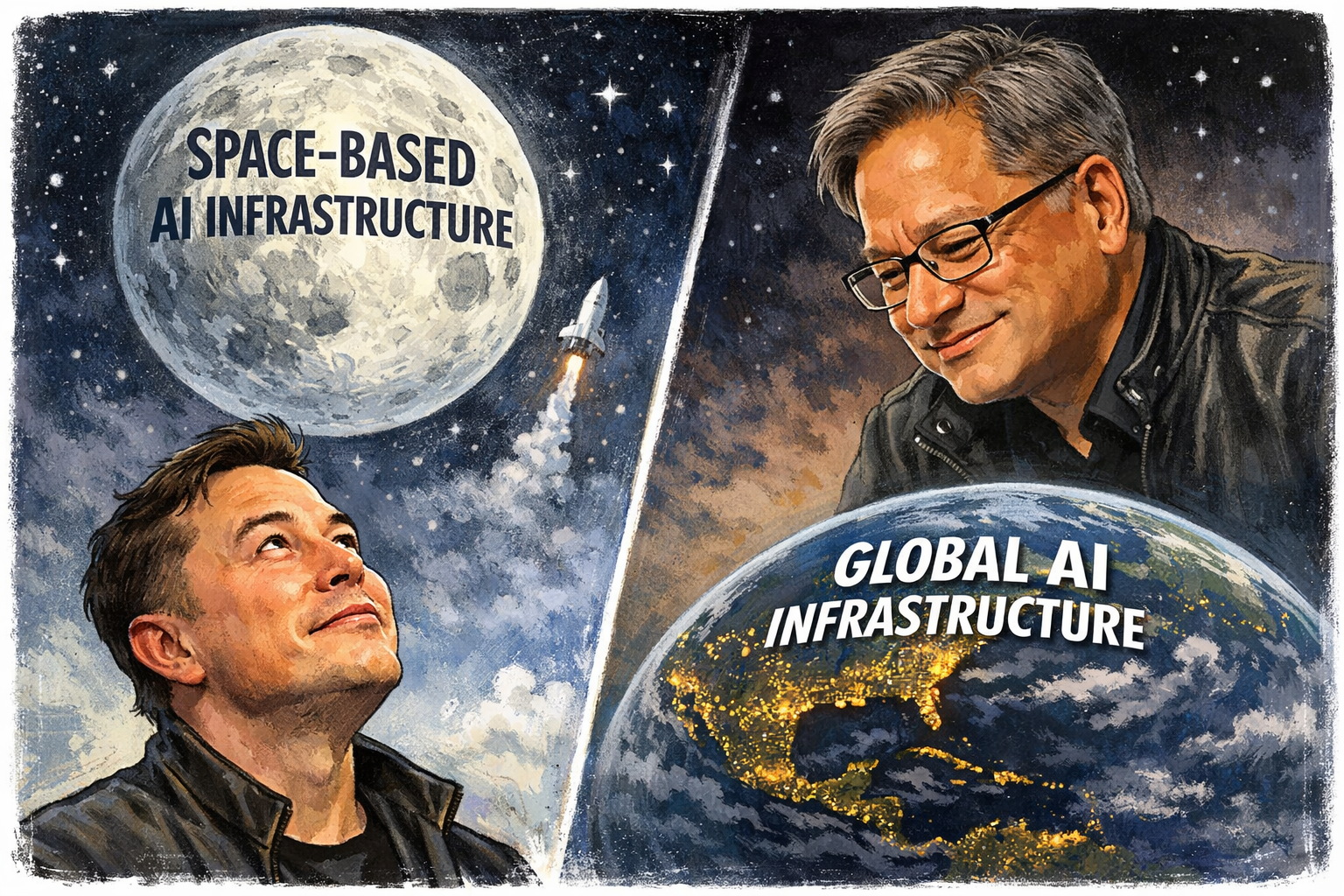
The most consequential development came on February 2, when Musk announced that SpaceX would acquire xAI in a transaction valued at $1.25 trillion, creating what Bloomberg described as “the most valuable private company in the world.” According to Loren Grush, Edward Ludlow, and Liana Baker writing for Bloomberg on February 2, 2026, “Elon Musk is combining SpaceX and xAI in a deal that values the enlarged entity at $1.25 trillion, as the world’s richest man looks to fuel his increasingly costly ambitions in artificial intelligence and space exploration.” The merger represents a fundamental bet that AI’s future lies not on Earth but in orbit, with Musk positioning space-based data centers as the inevitable solution to terrestrial power and cooling constraints.
This strategic consolidation comes at a moment when xAI faces both operational challenges and regulatory scrutiny. The company has been burning approximately $1 billion per month, according to multiple reports, while simultaneously dealing with a significant exodus of technical talent. In early February, six of xAI’s twelve founding members had departed the company, with two co-founders—Tony Wu and Jimmy Ba—announcing their exits within 24 hours of each other on February 9 and 10. Carmen Arroyo reported for Bloomberg on February 11, 2026, that following these departures, “Musk told staff Wednesday that xAI will be organized into four core groups: the Grok chatbot and voice tech, the Imagine video product, Coding, and the agentic MacroHard business.” The reorganization, Musk later clarified, involved parting ways with employees who were “better suited for the early stages of a company and less suited for the later stages,” suggesting that at least some departures were not entirely voluntary.
The timing of this talent drain coincides with mounting regulatory pressure. As Lora Kolodny reported for CNBC on February 13, 2026, “On Friday, the Southern Environmental Law Center and Earthjustice, on behalf of the NAACP, sent a notice of intent to sue xAI and subsidiary MZX Tech LLC, saying the company’s use of dozens of natural gas-burning turbines requires a federal permit, violates the Clean Air Act and harms nearby communities.” The lawsuit focuses on xAI’s facilities in Memphis, Tennessee, and Southaven, Mississippi, where the company has been accused of operating turbines without proper environmental permits, contributing to air quality problems in predominantly Black neighborhoods. This controversy underscores a pattern in Musk’s approach to AI infrastructure development: move fast, build aggressively, and deal with regulatory consequences later.
While managing these earthbound challenges, Musk has simultaneously been articulating an increasingly ambitious vision for AI that extends far beyond conventional corporate strategy. At the World Economic Forum in Davos on January 22, his first appearance at the gathering in years, Musk painted a picture of radical economic transformation driven by AI and robotics. According to reporting from the World Economic Forum on January 22, 2026, Musk declared that “If you have ubiquitous AI that is essentially free or close to it and ubiquitous robotics, you will have an explosion in the global economy that is truly beyond all precedent.” This vision of abundance, he suggested, would fundamentally alter human purpose and economic organization, making traditional concepts like retirement savings obsolete.
These sweeping predictions have become a recurring theme in Musk’s public appearances. On January 6, writing on his social media platform X, Musk proclaimed “We have entered the Singularity” and followed hours later with “2026 is the year of the Singularity,” declaring that artificial intelligence has already surpassed human intelligence in certain domains and will exceed collective human intelligence within five years. As reported by Benzinga on January 6, 2026, Musk framed this moment not as a distant possibility but as a present reality, stating flatly that “the Singularity isn’t coming. In his words, it’s already here.”
The most audacious element of Musk’s AI strategy emerged in a February 10 all-hands meeting with xAI employees, where he unveiled plans for lunar manufacturing facilities. Connie Loizos, writing for TechCrunch on February 10, 2026, reported that “Musk told employees that xAI needs a lunar manufacturing facility, a factory on the moon that will build AI satellites and fling them into space via a giant catapult.” This proposal, while technically challenging, reflects Musk’s conviction that AI computing demands will soon exceed what Earth’s power infrastructure can support. As he explained on a podcast appearance, constructing enough terrestrial power plants to meet AI’s energy requirements would be extraordinarily difficult, whereas solar panels in space could provide energy at effectively one-tenth the cost when accounting for the absence of nighttime and weather.
This shift toward space-based AI infrastructure also represents a pivot in SpaceX’s long-term planning. As Loizos noted, “The moon itself is a more recent preoccupation. For most of SpaceX’s 24-year existence, Mars was the end game.” Musk now argues that establishing a self-sustaining lunar presence could be accomplished in roughly half the time required for Mars colonization, making it a more practical near-term objective.
The practical implications of the SpaceX-xAI merger extend to revenue structures and business sustainability. Sean O’Kane, writing for TechCrunch on February 2, 2026, explained that the merger “brings together two of Musk’s companies, each with its own financial challenges,” noting that “SpaceX generates as much as 80% of its revenue from launching its own Starlink satellites.” The space-based data center strategy would create a perpetual revenue loop, ensuring SpaceX has continuous launch business while xAI gains access to orbital computing infrastructure. This self-reinforcing business model could address the financial pressures both companies face, though it also raises questions about whether Musk is essentially shuffling money between his own enterprises.
Concurrent with his AI ventures, Musk has been advancing Tesla’s robotaxi ambitions, though with characteristically aggressive timelines that invite skepticism. At Davos, Musk proclaimed that Tesla robotaxis would be “widespread” across the United States by the end of 2026. However, the current reality is more modest. According to Ari Levy and Michael Wayland writing for CNBC on January 22, 2026, “Tesla robotaxis finally hit the road in Austin, Texas, in June with human safety supervisors on board, after years of Tesla pushing back promises to deliver fully driverless cars.” By January 2026, the service had expanded to the San Francisco Bay Area but remained limited in scope, with many rides still requiring safety monitors despite Musk’s claims of fully autonomous operation.
The gap between Musk’s projections and operational reality has become a persistent pattern. Tesla announced plans to expand robotaxis to seven new cities in the first half of 2026—Dallas, Houston, Phoenix, Miami, Orlando, Tampa, and Las Vegas—but achieving regulatory approval and demonstrating safety at scale remains challenging. The company faces stiff competition from Waymo, which already operates in five cities and provides over 450,000 paid rides weekly without human safety drivers, far outpacing Tesla’s nascent service.
Beyond robotaxis, Musk has integrated his Grok AI into government operations. According to Wikipedia’s updated entry on Grok, “On January 12, 2026, Defense Secretary Pete Hegseth announced during a speech at Musk’s SpaceX headquarters that the Department of Defense would integrate Grok into its internal networks, including both classified and unclassified systems.” This integration of Musk’s AI technology into military infrastructure represents a significant expansion of xAI’s influence, though it also raises questions about conflicts of interest given Musk’s multiple roles in both commercial and quasi-governmental capacities.
The consolidation of Musk’s AI empire carries important implications for the months ahead. The merger creates powerful synergies but also concentrates risk. If xAI cannot stabilize its talent base, address environmental concerns, and demonstrate a path to profitability beyond Musk’s internal corporate transfers, the entire structure could face pressure from investors and regulators. The planned IPO, reportedly targeting a $1.5 trillion valuation for the combined SpaceX-xAI entity as early as summer 2026, will subject these ventures to unprecedented public scrutiny.
Moreover, Musk’s predictions about AI timelines and capabilities have historically proven optimistic. He has been promising fully autonomous Tesla vehicles “next year” since at least 2019. His declaration that AI will surpass all human intelligence by 2030 invites similar skepticism. Yet the sheer scale of his ambitions—from orbital data centers to lunar manufacturing—ensures that even partial success would reshape the AI industry.
For March and April 2026, several key developments will likely unfold. The NAACP lawsuit against xAI will move forward, potentially forcing the company to halt operations at its Tennessee and Mississippi facilities or undertake costly retrofits. The SpaceX-xAI IPO preparations will intensify, requiring greater financial transparency than Musk has historically provided. Tesla’s robotaxi expansion will either validate Musk’s aggressive timeline or expose further gaps between promise and execution. And xAI’s technical teams, now reorganized and reduced in size, will need to demonstrate that they can compete with OpenAI, Anthropic, and Google despite the recent talent exodus.
The most consequential question is whether Musk’s vision of space-based AI infrastructure will gain traction beyond rhetorical flourish. As CNN Business reported on February 4, 2026, “Experts disagree: Deutsche Bank estimates it will be well into the 2030s before orbital data centers ‘reach close to parity'” with terrestrial alternatives. Yet Musk has a track record of achieving technically improbable goals, from reusable rockets to mass-market electric vehicles. If SpaceX can demonstrate economically viable orbital computing even at small scale, it would validate Musk’s bet and potentially trigger a new space race centered on AI infrastructure rather than human exploration.
The convergence of Musk’s various enterprises—Tesla, SpaceX, xAI, and even the integration of his social platform X into the AI ecosystem—creates a corporate constellation unlike anything in modern business history. Whether this represents visionary vertical integration or unsustainable complexity remains an open question. What is certain is that Musk’s activities in early 2026 have set an audacious trajectory that will define not only his companies’ futures but potentially the broader direction of AI development itself.
Jensen Huang: Accelerating AI’s Infrastructure Revolution
While Elon Musk pursued dramatic corporate consolidation and cosmic visions, Jensen Huang spent the opening weeks of 2026 doing what he does best: methodically advancing Nvidia’s technological leadership while articulating a pragmatic vision of AI’s industrial transformation. Through a series of high-profile appearances and product announcements, Huang positioned Nvidia not merely as a chip supplier but as the architect of AI’s physical infrastructure, from silicon to systems to software.
The marquee event came on January 5 at the Consumer Electronics Show in Las Vegas, where Huang delivered a keynote that industry observers described as setting the agenda for AI hardware development through the end of the decade. The centerpiece was the announcement that Nvidia’s next-generation Rubin platform had entered full production—six months ahead of the previously stated timeline. As Danny Vena reported for The Motley Fool on January 17, 2026, “The revelation that the company’s next-generation processor was already rolling off the production line caught industry watchers off guard, as it extends Nvidia’s already sizable advantage.” Huang emphasized the significance: “Today, I can tell you that Vera Rubin is in full production,” marking an 18-month development cycle that compressed what typically spans 24-30 months in semiconductor development.
The Rubin platform represents more than an incremental GPU upgrade. According to Nvidia’s official blog post from January 12, 2026, the architecture consists of six co-designed chips—the Vera CPU, Rubin GPU, NVLink 6 Switch, ConnectX-9 SuperNIC, BlueField-4 DPU, and Spectrum-6 Ethernet Switch—working together as “one incredible AI supercomputer.” This extreme co-design approach, as Huang explained, addresses a fundamental challenge: AI computing demands are growing exponentially, but traditional approaches of optimizing individual components in isolation cannot keep pace. By designing the entire stack simultaneously, Nvidia aims to eliminate bottlenecks and dramatically reduce costs, with Huang promising to slash “the cost of generating tokens to roughly one-tenth that of the previous platform.”
The performance claims are striking. Compared to the current Blackwell architecture, Rubin promises five times better inference performance and 3.5 times better training performance. More importantly for commercial deployment, the platform requires only one-fourth as many GPUs to train mixture-of-experts models and delivers ten times higher inference throughput at one-tenth the cost per token. These improvements target the economic bottleneck that has limited AI deployment: while training costs have received extensive attention, inference costs—the expense of actually running AI models to generate outputs—will dominate long-term economics as AI applications scale to millions or billions of users.
Beyond raw performance, Huang emphasized architectural innovations designed for the next phase of AI development. The platform introduces what Nvidia calls “AI-native storage” through its Inference Context Memory Storage system, which addresses the challenge of long-context inference. As reasoning models and agentic AI systems process increasingly complex multi-step tasks, they generate vast amounts of intermediate data that must be stored and retrieved efficiently. Huang’s solution involves treating context memory as a distinct tier in the storage hierarchy, achieving what Nvidia claims is five times better performance per dollar and five times better power efficiency for long-context operations.
The deployment timeline for Rubin underscores Nvidia’s manufacturing prowess and ecosystem coordination. Major cloud providers including AWS, Google Cloud, Microsoft, and Oracle, along with specialized AI cloud operators like CoreWeave and Lambda, all committed to deploying Rubin-based systems in the second half of 2026. This rapid adoption schedule reflects both the intensity of demand for AI infrastructure and Nvidia’s ability to coordinate complex supply chains spanning chip fabrication, memory production, and system integration.
Huang’s CES presentation extended beyond hardware announcements to articulate a comprehensive vision of “physical AI”—artificial intelligence that understands and acts in the physical world. The centerpiece of this vision was Alpamayo, an open portfolio of reasoning models specifically designed for autonomous vehicles. As Sara Fischer reported for Axios on January 6, 2026, Huang declared that “The ChatGPT moment for physical AI is here—when machines begin to understand, reason and act in the real world,” with robotaxis positioned as the first major application. The Alpamayo system, which Huang described as “the world’s first thinking, reasoning autonomous vehicle AI,” represents a significant departure from rule-based autonomous driving systems, enabling vehicles to reason about complex road scenarios and explain their driving decisions in natural language.
The partnership with Mercedes-Benz exemplified this approach. Huang announced that the forthcoming Mercedes-Benz CLA would be the first passenger vehicle featuring Nvidia’s full autonomous driving stack, including Alpamayo reasoning models, arriving on U.S. roads in early 2026. This represents what Huang called Nvidia’s “first entire stack endeavor” in automotive, encompassing not just chips but simulation tools, training frameworks, and deployment software. The openness of the Alpamayo ecosystem—with models, simulation environments, and datasets released publicly—reflects a strategic bet that standardized, verifiable AI approaches will ultimately triumph over proprietary black-box systems in safety-critical applications.
Huang’s physical AI vision extended across multiple domains beyond automotive. According to Nvidia’s official announcement, the company released open foundation models spanning six areas: Clara for healthcare, Earth-2 for climate science, Nemotron for reasoning and multimodal AI, Cosmos for robotics and simulation, GR00T for embodied intelligence, and Alpamayo for autonomous driving. This comprehensive portfolio, all trained on Nvidia’s own supercomputers and released openly, represents a calculated response to both open-source competition and concerns about AI concentration. As Huang explained, “We build it completely in the open so that we can enable every company, every industry, every country, to be part of this AI revolution.”
The strategic rationale for this openness became clearer when Huang appeared at the World Economic Forum in Davos on January 21 for a conversation with BlackRock CEO Larry Fink. According to the World Economic Forum’s coverage, Huang framed AI as a platform shift comparable to the personal computer, internet, and mobile cloud, but requiring a fundamentally different infrastructure approach. “For the first time, we now have a computer that is not pre-recorded but it’s processing in real time,” he explained, emphasizing AI’s ability to process unstructured information. This capability shift demands corresponding infrastructure evolution, from chip architecture to data center design to energy systems.
During the Davos conversation, Huang addressed the persistent question of whether AI represents a bubble. His response focused on observable economic fundamentals: computing capacity remains scarce, rental prices for AI infrastructure continue rising, and customers demonstrate willingness to pay premium prices for access to cutting-edge systems. In Huang’s framing, these market signals indicate genuine demand rather than speculative excess. He also pushed back against concerns about AI-driven unemployment, arguing that AI augments rather than replaces human work. Citing examples from radiology and nursing, Huang noted that AI automation of tasks like charting and scan analysis gives professionals more time to focus on patient care—the actual purpose of their jobs.
The European context of the Davos discussion proved particularly relevant. Huang argued that “Europe had an incredibly strong industrial base, which was its strategic advantage,” and suggested that AI, particularly robotics and physical intelligence, offers Europe an opportunity to combine manufacturing expertise with advanced AI systems. However, he cautioned that success depends on investment in energy and infrastructure to support a thriving AI ecosystem, calling robotics “a once-in-a-generation opportunity for the European nations.”
Huang’s engagement with industrial AI became more concrete on February 3, when he appeared at the 3DEXPERIENCE World conference in Houston alongside Dassault Systèmes CEO Pascal Daloz. According to Nvidia’s blog coverage from February 3, 2026, the two executives “announced a partnership to build a shared industrial AI architecture, merging virtual twins with physics-based AI to redefine the future of design, engineering and manufacturing.” Huang’s message to the engineering-focused audience emphasized AI’s transformation of the computing stack, moving from hand-specified digital designs to systems that can generate, simulate, and optimize at industrial scale. He playfully referred to the audience as “Solid Workers,” a nod to Dassault’s SolidWorks platform, while delivering a serious message: “Artificial intelligence will be infrastructure,” like water, electricity, and the internet.
The Dassault partnership exemplifies Huang’s strategy of positioning Nvidia not as a mere component supplier but as a platform provider for entire industries. Virtual twins—digital replicas that simulate products and processes before physical construction—represent a form of “world model” that could revolutionize how everything from aircraft to pharmaceuticals to factories themselves are designed. By integrating Nvidia’s AI capabilities with Dassault’s simulation tools and deploying them on sovereign clouds across three continents, the partnership addresses both technical requirements and geopolitical concerns about data residency and security.
One notable development in mid-February involved Huang’s planned appearance at India’s AI Impact Summit. As reported by India TV News on February 14, 2026, “Jensen Huang, CEO of Nvidia, has cancelled his planned visit to India to attend the India AI Impact Summit, a senior government official said,” with the company citing “unavoidable circumstances” without further explanation. While the cancellation disappointed summit organizers, Nvidia committed to sending a high-level delegation. The incident, while minor, highlights the intense demands on Huang’s time as he navigates Nvidia’s position at the center of global AI infrastructure development.
A more substantive challenge emerged in early February regarding Nvidia’s proposed investment in OpenAI. The Wall Street Journal reported that Huang had privately expressed concerns about OpenAI’s business strategy and cast doubt on the scale of Nvidia’s commitment, originally announced at up to $100 billion. However, Huang quickly moved to clarify his position. As reported by CNBC on February 2, 2026, Huang denied any claims of being unhappy with OpenAI, calling such suggestions “nonsense,” while confirming: “We are going to make a huge investment in OpenAI. I believe in OpenAI, the work that they do is incredible, they are one of the most consequential companies of our time, and I really love working with Sam.” This clarification, while reaffirming commitment, notably avoided specifying an exact investment figure, suggesting continued negotiation over terms and structure.
The OpenAI investment controversy touches on broader questions about Nvidia’s role in the AI ecosystem. As both a supplier of essential infrastructure and an investor in companies using that infrastructure, Nvidia faces potential conflicts of interest and concerns about circular financing. Wedbush analyst Dan Ives framed the issue in a note: “This is part negotiation and part Nvidia making sure that other competitors are not fueled by Nvidia’s investments into OpenAI such as Alphabet and a host of others.” The delicate balancing act—supporting ecosystem growth while maintaining competitive advantage—will likely remain a recurring theme.
Looking ahead to March and April 2026, several key developments will unfold from the initiatives Huang launched in early 2026. The first Rubin-based systems will begin shipping to major cloud providers, allowing real-world validation of Nvidia’s performance claims and revealing whether the promised cost reductions materialize in production environments. The Mercedes-Benz CLA with Alpamayo autonomous driving will reach U.S. roads, providing the first public demonstration of Nvidia’s full-stack automotive approach and generating crucial safety data that could either validate or challenge the reasoning-based approach to autonomy.
The Dassault Systèmes partnership will move from announcement to implementation, with initial industrial AI deployments across the sovereign cloud infrastructure. This will test whether physics-based world models can deliver the promised advantages for design and manufacturing, potentially opening new markets for Nvidia beyond its current dominance in training and inference workloads. Competition will intensify as AMD’s MI455X and other alternatives reach market, forcing Nvidia to demonstrate that its integrated platform approach justifies premium pricing compared to potentially cheaper point solutions.
More fundamentally, the coming months will reveal whether the massive infrastructure buildout that has driven Nvidia’s growth can continue at current pace. Microsoft’s announcement that it remains capacity-constrained through at least mid-2026 suggests sustained demand, but the sheer scale of capital expenditure required—hundreds of billions of dollars across the industry—invites questions about when returns must materialize. Huang’s positioning of AI as infrastructure rather than application layer reflects awareness that the value proposition must extend beyond current use cases to justify continued investment.
Conclusion
The contrast between Huang’s methodical execution and Musk’s dramatic consolidation illuminates different approaches to AI leadership. Where Musk pursues vertical integration across space, automotive, and AI while making sweeping predictions about singularity and abundance, Huang focuses on horizontal platform development, providing tools and infrastructure that others can build upon while making measured claims grounded in demonstrable performance improvements. Both approaches carry risks and opportunities, but Huang’s track record of meeting aggressive timelines—exemplified by Rubin’s early production—provides credibility that Musk’s pattern of missed deadlines undermines.
As Nvidia’s market capitalization fluctuates around $4.6 trillion, making it periodically the world’s most valuable company, Huang’s challenge is sustaining innovation velocity while managing the complexities of market leadership. The company’s annual product cadence, compressed development timelines, and expanding ecosystem partnerships demonstrate continued momentum. Whether this can persist as competition intensifies, customers develop internal alternatives, and regulatory scrutiny increases will define Nvidia’s trajectory for the remainder of 2026 and beyond.
What remains clear from Huang’s activities in January and February 2026 is his conviction that AI represents a fundamental platform shift requiring corresponding infrastructure transformation. His focus on extreme co-design, open models, and physics-based approaches positions Nvidia not merely to supply components for others’ AI ambitions but to shape the architectural assumptions underlying the next decade of AI development. The success of this strategy will depend not on any single product or partnership but on the cumulative effect of sustained execution across multiple dimensions—from silicon to software to systems integration to ecosystem development.
Sources
Elon Musk
- Author: Loren Grush, Edward Ludlow, and Liana Baker
Article Title: “SpaceX Acquires xAI as Musk Prepares for Mega IPO”
Source: Bloomberg
Publishing Date: February 2, 2026
URL: https://www.bloomberg.com/news/articles/2026-02-02/elon-musk-s-spacex-said-to-combine-with-xai-ahead-of-mega-ipo
Direct Quote: “Elon Musk is combining SpaceX and xAI in a deal that values the enlarged entity at $1.25 trillion, as the world’s richest man looks to fuel his increasingly costly ambitions in artificial intelligence and space exploration.” - Author: Carmen Arroyo
Article Title: “Elon Musk Restructures xAI’s Teams After Co-Founders Exit”
Source: Bloomberg
Publishing Date: February 11, 2026
URL: https://www.bloomberg.com/news/articles/2026-02-11/musk-restructures-xai-s-teams-after-co-founders-exit
Direct Quote: “XAI will be organized in four core areas, the billionaire told staff in a meeting on Wednesday: Grok’s chatbot and voice product; Coding; the Imagine video product; and Macrohard, an AI software company run by digital agents.” - Author: Connie Loizos
Article Title: “With co-founders leaving and an IPO looming, Elon Musk turns talk to the moon”
Source: TechCrunch
Publishing Date: February 10, 2026
URL: https://techcrunch.com/2026/02/10/with-co-founders-leaving-and-an-ipo-looming-elon-musk-turns-talk-to-the-moon/
Direct Quote: “According to The New York Times, which reports that it heard the meeting, Musk told employees that xAI needs a lunar manufacturing facility, a factory on the moon that will build AI satellites and fling them into space via a giant catapult.” - Author: Lora Kolodny
Article Title: “Elon Musk’s xAI faces threat of NAACP lawsuit over air pollution from Mississippi data center”
Source: CNBC
Publishing Date: February 13, 2026
URL: https://www.cnbc.com/2026/02/13/musks-xai-faces-threat-of-naacp-lawsuit-over-pollution-in-mississippi.html
Direct Quote: “On Friday, the Southern Environmental Law Center and Earthjustice, on behalf of the NAACP, sent a notice of intent to sue xAI and subsidiary MZX Tech LLC, saying the company’s use of dozens of natural gas-burning turbines requires a federal permit, violates the Clean Air Act and harms nearby communities.” - Author: World Economic Forum
Article Title: “Elon Musk at Davos 2026: why technology could shape a…”
Source: World Economic Forum
Publishing Date: January 22, 2026
URL: https://www.weforum.org/stories/2026/01/elon-musk-technology-abundant-future-davos-2026/
Direct Quote: “If you have ubiquitous AI that is essentially free or close to it and ubiquitous robotics, you will have an explosion in the global economy that is truly beyond all precedent.” - Author: Staff
Article Title: “Elon Musk Says ‘We Have Entered the Singularity’ Declaring This The Year AI Becomes Smarter Than Humans”
Source: Benzinga (via Yahoo Finance)
Publishing Date: January 6, 2026
URL: https://finance.yahoo.com/news/elon-musk-says-entered-singularity-185946780.html
Direct Quote: “Musk’s responses weren’t warnings. They were timestamps.” - Author: Sean O’Kane
Article Title: “Elon Musk’s SpaceX officially acquires Elon Musk’s xAI, with plan to build data centers in space”
Source: TechCrunch
Publishing Date: February 2, 2026
URL: https://techcrunch.com/2026/02/02/elon-musk-spacex-acquires-xai-data-centers-space-merger/
Direct Quote: “The merger brings together two of Musk’s companies, each with its own financial challenges.” - Author: Staff
Article Title: “Grok (chatbot)”
Source: Wikipedia
Publishing Date: Updated February 11, 2026
URL: https://en.wikipedia.org/wiki/Grok_(chatbot)
Direct Quote: “On January 12, 2026, Defense Secretary Pete Hegseth announced during a speech at Musk’s SpaceX headquarters that the Department of Defense would integrate Grok into its internal networks, including both classified and unclassified systems.” - Author: Ari Levy and Michael Wayland
Article Title: “Musk: Tesla’s robotaxis will be widespread in the U.S. by end of 2026”
Source: CNBC
Publishing Date: January 22, 2026
URL: https://www.cnbc.com/2026/01/22/musk-tesla-robotaxis-us-expansion.html
Direct Quote: “Tesla robotaxis finally hit the road in Austin, Texas, in June with human safety supervisors on board, after years of Tesla pushing back promises to deliver fully driverless cars.” - Author: Chris Isidore
Article Title: “Elon Musk’s bold new plan to put AI in orbit isn’t as crazy as it sounds”
Source: CNN Business
Publishing Date: February 4, 2026
URL: https://www.cnn.com/2026/02/04/business/elon-musk-orbiting-ai-data-center-plans
Direct Quote: “Experts disagree: Deutsche Bank estimates it will be well into the 2030s before orbital data centers ‘reach close to parity.'”
Jensen Huang
- Author: Danny Vena
Article Title: “CEO Jensen Huang Just Delivered Bad News for Nvidia’s Rivals for 2026”
Source: The Motley Fool
Publishing Date: January 17, 2026
URL: https://www.fool.com/investing/2026/01/17/ceo-jensen-huang-delivered-bad-news-for-nvidia/
Direct Quote: “The revelation that the company’s next-generation processor was already rolling off the production line caught industry watchers off guard, as it extends Nvidia’s already sizable advantage.” - Author: NVIDIA Official
Article Title: “NVIDIA Rubin Platform, Open Models, Autonomous Driving: NVIDIA Presents Blueprint for the Future at CES”
Source: NVIDIA Blog
Publishing Date: January 12, 2026
URL: https://blogs.nvidia.com/blog/2026-ces-special-presentation/
Direct Quote: “With Rubin, NVIDIA aims to ‘push AI to the next frontier’ while slashing the cost of generating tokens to roughly one-tenth that of the previous platform, Huang said, making large-scale AI far more economical to deploy.” - Author: Sara Fischer
Article Title: “Nvidia CES 2026: Jensen Huang says ‘ChatGPT moment for physical AI’ is coming”
Source: Axios
Publishing Date: January 6, 2026
URL: https://www.axios.com/2026/01/05/nvidia-ces-2026-jensen-huang-speech-ai
Direct Quote: “The ChatGPT moment for physical AI is here—when machines begin to understand, reason and act in the real world.” - Author: World Economic Forum
Article Title: “Davos 2026: Nvidia CEO Jensen Huang on the future of AI”
Source: World Economic Forum
Publishing Date: January 21, 2026
URL: https://www.weforum.org/stories/2026/01/nvidia-ceo-jensen-huang-on-the-future-of-ai/
Direct Quote: “For the first time, we now have a computer that is not pre-recorded but it’s processing in real time.” - Author: Brian Caulfield
Article Title: “Everything Will Be Represented in a Virtual Twin, NVIDIA CEO Jensen Huang Says at 3DEXPERIENCE World”
Source: NVIDIA Blog
Publishing Date: February 3, 2026
URL: https://blogs.nvidia.com/blog/huang-3dexperience-2026/
Direct Quote: “Artificial intelligence will be infrastructure, like water, electricity and the internet, Huang told the crowd.” - Author: India TV News Staff
Article Title: “Nvidia CEO Jensen Huang cancels India visit; GPU maker to send delegation to India AI Impact Summit 2026”
Source: India TV News
Publishing Date: February 14, 2026
URL: https://www.indiatvnews.com/technology/news/nvidia-ceo-jensen-huang-cancels-india-visit-gpu-maker-to-send-delegation-to-india-ai-impact-summit-2026-2026-02-14-1030275
Direct Quote: “Nvidia has cancelled his visit due to some unavoidable circumstances, but it is sending a high-level delegation.” - Author: Staff
Article Title: “Nvidia shares are down after a report that its OpenAI investment stalled”
Source: CNBC
Publishing Date: February 2, 2026
URL: https://www.cnbc.com/2026/02/02/nvidia-stock-price-openai-funding.html
Direct Quote: “We are going to make a huge investment in OpenAI. I believe in OpenAI, the work that they do is incredible, they are one of the most consequential companies of our time, and I really love working with Sam.” - Author: Harlan Sur and others
Article Title: “Jensen Huang CES keynote ignites analyst optimism on Nvidia’s future”
Source: CNBC
Publishing Date: January 6, 2026
URL: https://www.cnbc.com/2026/01/06/jensen-huang-ces-keynote-ignites-analyst-optimism-on-nvidias-future.html
Direct Quote: “Nvidia’s development of physical AI ‘could potentially drive the next leg of revenue growth’ for the company.” - Author: NVIDIA Newsroom
Article Title: “NVIDIA Kicks Off the Next Generation of AI With Rubin — Six New Chips, One Incredible AI Supercomputer”
Source: NVIDIA Newsroom
Publishing Date: January 5, 2026
URL: https://nvidianews.nvidia.com/news/rubin-platform-ai-supercomputer
Direct Quote: “Rubin arrives at exactly the right moment, as AI computing demand for both training and inference is going through the roof.” - Author: Staff
Article Title: “Jensen Huang”
Source: Wikipedia
Publishing Date: Updated February 13, 2026
URL: https://en.wikipedia.org/wiki/Jensen_Huang
Direct Quote: “In January 2026, Huang appeared at the World Economic Forum Annual Meeting in Davos in a one-on-one session with BlackRock chief executive Larry Fink.”
[End]
Filed under: Uncategorized |


 Educational Technology and Change Journal

Leave a comment