





By Jim Shimabukuro (assisted by ChatGPT)
Editor
AI is changing our views of learning by shifting the focus from the transmission of fixed bodies of knowledge toward personalized, continuous, and learner-driven processes. Traditional schooling has typically been structured around set curricula, standardized pacing, and teacher-centered instruction, where all students are expected to acquire the same content at roughly the same time. In contrast, modern AI technologies—particularly large language models and adaptive learning systems—enable real-time analysis of a learner’s needs, deliver tailored feedback, and adjust learning pathways on the fly, effectively treating learning as a dynamic, individualized journey rather than a one-size-fits-all progression.
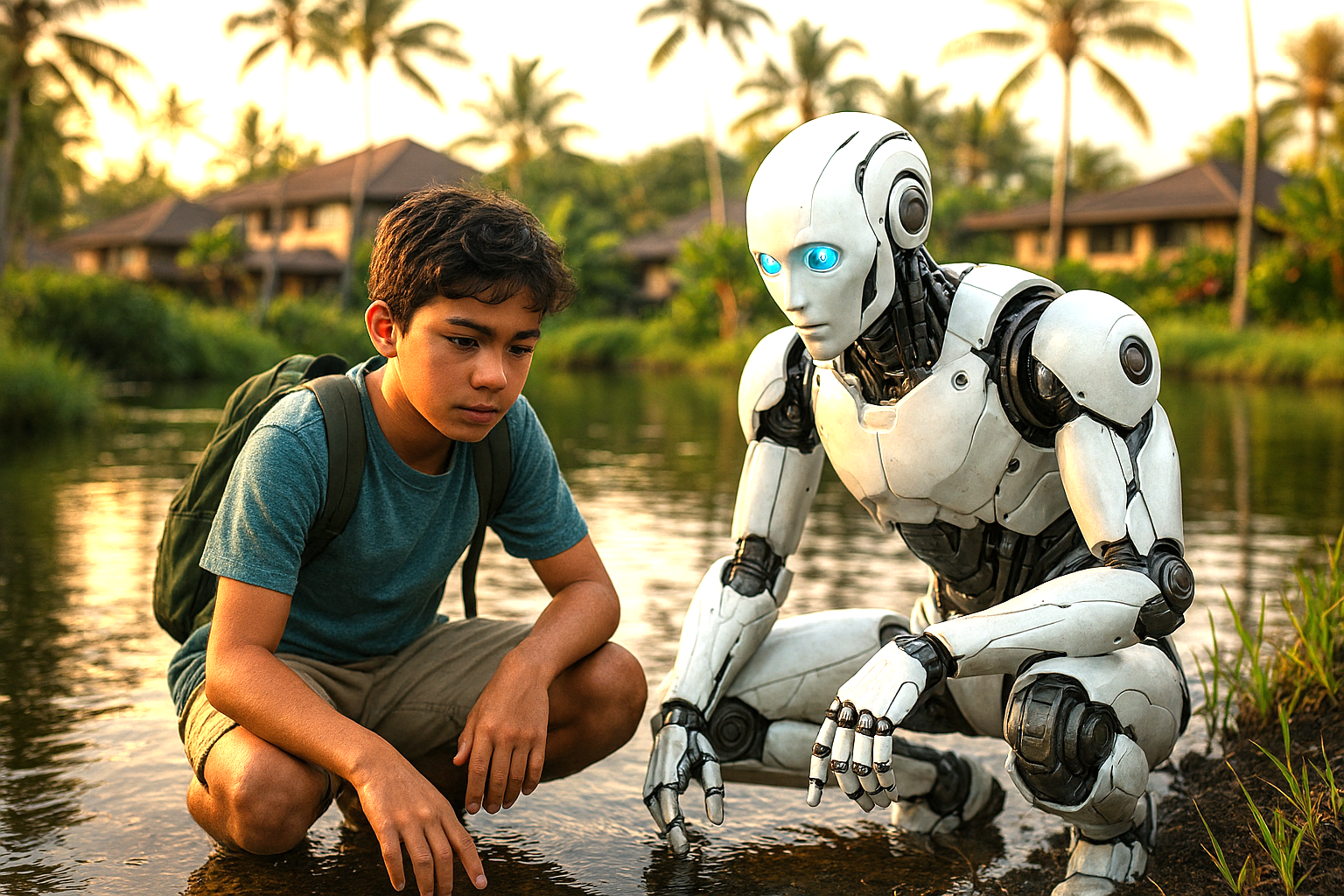
This represents a fundamental reconfiguration of learning itself: rather than merely being present in a classroom, learning becomes something that can unfold anywhere, anytime, and at the learner’s own pace while supported by intelligent systems that respond to their strengths and gaps. Research in education shows that these AI systems are not just administrative aids but are being designed to augment student engagement, provide personalized feedback, and create adaptive learning environments that contrast sharply with the uniformity of traditional schooling.[The future of learning: AI is revolutionizing education 4.0 (World Economic Forum)]
Where traditional schooling tends to emphasize rote memorization, fixed assessments, and uniform standards of mastery, AI-enabled learning emphasizes competency development, critical thinking, and co-construction of knowledge. In traditional models, school curricula are organized hierarchically and sequencing is often determined by the institution rather than the learner, prioritizing preparation for standardized tests and compliance with uniform benchmarks. AI challenges this by enabling students to interact with information in ways that encourage exploration, problem solving, and learner autonomy. For example, intelligent tutoring systems and AI analytics are being used to identify individual conceptual challenges and scaffold learning appropriately, rather than expecting all learners to succeed under the same instructional conditions. This shift has led educators and researchers to argue that what matters is no longer just “teaching content” but nurturing learners’ ability to learn how to learn—a capacity that becomes ever more important as knowledge evolves rapidly in an AI-infused world.[Springer Nature Link]
These distinctions matter because they redefine what it means to be educated in the 21st century and influence how societies design educational systems, professional pathways, and equity initiatives. Under traditional schooling, success is often measured by students’ ability to recall information and perform well on summative assessments; in an AI-rich era, success increasingly depends on critical thinking, contextual reasoning, and ethical use of technology. If we cling to old paradigms of schooling while integrating AI only as a tool for efficiency, we risk reproducing inequities and diminishing deep learning—as some critics warn that AI can create a “mirage of false mastery” when superficial performance is mistaken for true understanding.
Furthermore, when learning systems are reconceptualized to emphasize personalization and lifelong learning, educational goals expand beyond graduation to include ongoing adaptability and growth throughout life, which has profound implications for workforce development, curriculum design, and social equity. This doesn’t negate the value of traditional schooling traditions—teachers’ human judgment, mentorship, and community building remain crucial—but it does demand that we rethink those traditions in light of the transformative possibilities and challenges that AI introduces.[theaustralian.com.au]
If we re-imagine education in a world where AI-augmented, individualized learning is normal rather than exceptional, the very purpose and structure of “learning” expands far beyond the traditional classroom. In such a future, education resembles a lifelong, adaptive partnership between humans and intelligent systems, where learners engage with knowledge in ways that are deeply personalized, contextually rich, and seamlessly integrated into daily life. Learners would not simply attend classes; they would interact with adaptive AI companions that understand their current abilities, preferences, and goals, guide them through cognitive and emotional challenges, and help them reflect on their thinking and strategies — essentially teaching how to learn as much as what to learn. UNESCO’s recent framing of generative AI’s role in global learning highlights this shift toward “blended, conversational, multimodal learning environments accessible anytime, anywhere,” emphasizing that AI can support self-regulated and lifelong learning that is responsive to each individual’s pace and context.[The Lifelong Learning Blog]
In this reimagined education system, the roles of traditional institutions would evolve from gatekeepers of content toward facilitators of inquiry, mentors in ethical reflection, and designers of meaningful human-AI interactions. Rather than moving all learners through a fixed curriculum in synchronicity, adaptive systems would curate personalized pathways that integrate formal study, informal exploration, and real-world problem solving across a lifetime. For example, intelligent tutoring frameworks currently in research use iterative learner feedback to refine instruction in real time, helping learners address their knowledge gaps while engaging with tasks that matter to them — a stark contrast to fixed pacing and uniform assessments of classic schooling.[arXiv] Educators, in such a system, become learning designers and coaches, helping learners interpret AI-generated insights, connect learning to community and career contexts, and cultivate critical competencies such as creativity, ethical reasoning, and collaborative problem-solving rather than merely dispensing information.
Importantly, this vision emphasizes equity, access, and learner agency — not just efficiency or novelty. As UNESCO’s discourse on the right to education in the age of generative AI underscores, generative technologies have the potential to widen opportunities and actualize lifelong learning for people of all ages and backgrounds, but only if their deployment is guided by principles of inclusion, adaptability, and human-centred design.[The Lifelong Learning Blog] In such a future, “education” is no longer confined to school buildings or defined by age cohorts; it is a continuum that accompanies individuals through work, civic life, personal growth, and community engagement, supported by AI systems that make learning visible, meaningful, and continuously accessible. This reimagining challenges us not just to adopt new tools, but to rethink what it means to learn, to grow, and to contribute to a world where knowledge and adaptability are shared human values supported by technology rather than dictated by it.
Here are two stories that illustrate the AI-expanded learning environment beyond the traditional classroom.
The Pond That Answered Back
On the first Saturday of spring break, Kai Tanaka biked down to Kōlea Pond with a backpack, a peanut butter sandwich, and the small solar-powered tablet his parents said he was “responsible enough” to carry on his own. He was in fifth grade, which meant he was old enough to explore the neighborhood by himself—but not old enough, according to his mother, to stop asking questions.
The pond lay behind a row of houses and a baseball field, tucked into a shallow bowl of cattails and low ironwood trees. From far away it looked like nothing much—just a wide patch of brown-green water reflecting the sky. But up close it was busy with life. Dragonflies stitched the air. Frogs made small gulping sounds near the reeds. A thin film of algae shimmered like oil paint across the shallows.
Kai sat on a flat rock and opened his tablet. The home screen glowed softly.
“Ready to explore?” the AI asked in a calm, warm voice. Kai had named it Moku, after the Hawaiian word for island.
“Yeah,” Kai said, adjusting the tablet’s camera toward the water. “Where should we start?”
“Let’s begin with observation,” Moku replied. “Describe what you notice. Don’t rush. Scientists look before they label.”
Kai squinted at the pond like it was a puzzle. “It’s kind of… murky. There’s green stuff on top. The water near the edge looks clearer. I see little bugs skating on the surface.”
“Good. Those surface insects are likely water striders. Would you like to confirm?”
Kai zoomed in. The tablet’s camera sharpened the image and overlaid faint outlines around the insect’s legs. “Water strider,” Moku confirmed. “Notice how its legs distribute weight across the surface tension. Why doesn’t it sink?”
“Because it’s light?” Kai guessed.
“Partly. But also because water molecules attract each other strongly, creating surface tension. Would you like to test surface tension?”
Kai grinned. “Like, right now?”
“Yes. Find a small paper clip in your backpack.”
Kai fumbled around and found one he’d used to clip his permission slip to a field trip form. Following Moku’s instructions, he carefully placed the paper clip flat on the water’s surface with the help of a leaf.
The clip floated.
“No way,” Kai breathed.
“You’ve just demonstrated surface tension,” Moku said. “Now, what do you think would happen if you added a drop of soap?”
Kai’s eyebrows shot up. “It would… sink?”
“Try.”
Kai dripped a tiny drop from a travel soap bottle his mom had packed “just in case.” The paper clip trembled and then plopped into the water.
Kai laughed so loudly a mynah bird startled from the grass. “That’s awesome.”
“What did you learn?” Moku asked.
“That water kind of holds itself together. But soap breaks it.”
“Excellent. You are not just observing the pond. You are interacting with it.”
Kai liked that idea. It made the pond feel less like scenery and more like a conversation.
They moved along the bank. Moku prompted him to photograph a cluster of small white flowers growing near the mud. Within seconds, the AI identified them as invasive water hyacinth seedlings. A map overlay showed how the plant could spread quickly and choke waterways.
“Should I pull them out?” Kai asked.
“Before acting, consider the ecosystem,” Moku replied. “How many do you see? Are they established?”
Kai counted. “Just a few. Maybe five.”
“Removing a small number now could prevent larger problems later. But be careful not to disturb native plants.”
Kai carefully tugged the seedlings from the mud. The roots came up easily, thin and feathery.
“I feel like a park ranger,” he said.
“You are practicing stewardship,” Moku replied. “Knowledge supports responsibility.”
As the morning warmed, Kai crouched near the shallows. Tiny black shapes darted through the water.
“Tadpoles,” he whispered.
“Likely frog larvae,” Moku agreed. “Would you like to measure water temperature? It affects their development.”
Kai dipped the small thermometer probe attached to his tablet’s science kit. The reading popped up: 22°C.
“Is that good?” he asked.
“For many frog species, yes. But temperature fluctuations can affect growth and survival. What might cause the water to warm further?”
Kai looked around. “Less shade? Climate change?”
Moku paused briefly, then displayed a simple graph showing rising average temperatures in their region over the past decades.
“Environmental patterns influence small ecosystems,” Moku said. “Your pond is connected to global systems.”
Kai stared at the tadpoles again. They seemed suddenly fragile. “So if it gets too hot…”
“Some may not survive. Others may adapt. Ecosystems are dynamic.”
Kai sat back on his heels. He wasn’t just at a pond anymore. He was in the middle of a network of relationships—sunlight, plants, insects, frogs, weather, even himself.
They spent the next hour collecting data. Kai logged bird sightings. He sketched the outline of the pond and marked where algae was thickest. Moku helped him estimate pond depth using a weighted string and simple geometry.
At one point, Kai grew quiet.
“What are you thinking?” Moku asked.
“At school,” Kai said slowly, “we learn about ecosystems from the textbook. But this feels different. It’s like… I’m inside it.”
“You are learning through experience,” Moku replied. “School provides models. The world provides complexity.”
Kai nodded. He dipped his fingers into the water. It was cool and silky. A dragonfly landed briefly on his knee, its wings flickering like stained glass.
“Can we come back tomorrow?” he asked.
“Of course,” Moku said. “What would you like to investigate next time?”
Kai thought for a moment. “Maybe the frogs at night. And how many kinds of insects live here.”
“Then tonight we will prepare a survey plan.”
As the sun climbed higher, Kai packed up. He glanced back at the pond before hopping on his bike. It no longer looked like a random patch of water behind a baseball field. It looked alive with questions.
On the ride home, Kai felt taller somehow—not physically, but inside. The world had expanded. Not because the AI had given him answers, but because it had helped him ask better questions.
And the pond, in its quiet way, had answered back.
The Quiet Between Beeps
Maya Okafor adjusted her volunteer badge as the automatic doors of Children’s Harbor Hospital slid open. The lobby smelled faintly of disinfectant and bubble gum. A mural of sea turtles covered one wall. She was a high school junior, three months into her service-learning placement, and she still felt the small flutter in her stomach each time she arrived.
Her AI mentor—an app installed on her phone and paired with her school’s service program—vibrated gently.
“Good afternoon, Maya,” the AI said through her earbuds. She had named it Luma.
“Hi,” Maya whispered, stepping into a quieter corner. “I’m nervous today.”
“That is understandable,” Luma replied. “You are visiting the oncology floor. What concerns you most?”
Maya exhaled. “I don’t know what to say to kids who are… really sick.”
“Then today’s goal is not to say the perfect thing,” Luma said. “It is to be present. We will reflect afterward.”
Maya nodded and checked in at the volunteer desk. A nurse directed her to Room 412, where an eight-year-old boy named Daniel was recovering from chemotherapy.
Daniel’s room was dim, lit mostly by afternoon sunlight filtering through half-closed blinds. Machines beeped softly beside his bed. He was propped up with pillows, a superhero blanket pulled to his chin.
“Hi,” Maya said gently. “I’m Maya. I brought some art supplies. Want to draw?”
Daniel shrugged. “Okay.”
Maya set up colored pencils and paper on the rolling tray. For a moment, neither of them spoke. The silence felt heavy.
“Maya,” Luma’s voice whispered discreetly in her ear, “try an open-ended question.”
“What kind of things do you like to draw?” Maya asked.
“Dinosaurs,” Daniel said immediately. His eyes brightened a little. “T-Rex. And Spinosaurus.”
Maya grinned. “You’re the expert then. You have to teach me.”
As Daniel began sketching a fierce dinosaur head, Maya followed his lead, copying the shape of the jaw. She felt Luma tracking her heart rate through her smartwatch, but the AI did not interrupt.
After a few minutes, Daniel said quietly, “Do you think I’ll lose all my hair?”
Maya froze. The question hovered in the air.
“Pause,” Luma whispered. “Acknowledge his feeling.”
Maya swallowed. “It sounds like you’re worried about that.”
Daniel nodded.
“I don’t know exactly what will happen,” Maya continued slowly, “but I know a lot of kids here go through that. And it doesn’t make them any less awesome.”
Daniel studied her face, as if checking for cracks in her confidence. Then he returned to his drawing.
When Maya left the room an hour later, she felt emotionally wrung out. She found an empty bench in the hallway.
“Reflection time?” Luma prompted.
“Yes,” Maya said.
“What did you notice about Daniel’s mood at the beginning compared to the end?”
“He seemed… smaller at first. Like he was hiding. But when we talked about dinosaurs, he forgot about the machines for a while.”
“What helped create that shift?”
“Letting him lead,” Maya said. “Not trying to cheer him up. Just… being there.”
“Excellent observation,” Luma replied. “Service is relational. Not performative.”
Over the next weeks, Maya rotated through different floors. She helped toddlers stack blocks in the pediatric ward. She read stories to a girl awaiting heart surgery. She sat with anxious parents in waiting rooms.
Each evening, Luma guided her through structured reflection. The AI asked about emotional boundaries, cultural sensitivity, ethical dilemmas. When Maya struggled after witnessing a medical emergency, Luma recommended breathing exercises and connected her with the hospital’s volunteer coordinator for additional support.
“You cannot pour from an empty cup,” Luma reminded her.
At school, Maya’s service-learning class met once a week. While other students described tutoring at elementary schools or organizing beach cleanups, Maya spoke about Daniel’s dinosaur drawings and the way a toddler’s laugh could slice through the sterile air of the ICU.
Her teacher asked, “What are you learning about yourself?”
Maya thought carefully. “I thought I wanted to be a doctor. But now I think I want to work in child life services. Or maybe psychology. I like helping kids feel less alone.”
Luma later analyzed her journal entries and highlighted recurring themes: empathy, resilience, interest in mental health, curiosity about medical systems.
“Your reflections suggest alignment with pediatric psychosocial care,” Luma noted. “Would you like to explore related career pathways?”
Maya smiled. “Yes. But not today.”
One afternoon, Daniel was discharged. When Maya visited his room, it was empty except for a neatly made bed.
“He left this for you,” the nurse said, handing her a folded piece of paper.
It was Daniel’s drawing of a T-Rex, but this time the dinosaur had a cape. Across the top he had written, in uneven letters: THANK YOU MAYA.
Maya felt tears prick her eyes.
“Maya,” Luma said softly, detecting the spike in her biometric readings, “what are you feeling?”
“Grateful,” she whispered. “And… small. Like what I did wasn’t that big.”
“Impact is not measured by scale,” Luma replied. “It is measured by presence.”
That night, as Maya wrote her reflection essay, she realized that AI had not replaced human connection in her service-learning. It had scaffolded it. It had helped her prepare, process, and grow. But the warmth in Daniel’s smile, the weight of the crayon in her hand, the quiet between the beeps of hospital machines—those were irreducibly human.
Education, she thought, wasn’t just about mastering content or earning grades. It was about becoming someone who could step into hard spaces with courage and compassion.
And in that becoming, AI was not the hero of the story.
It was the steady light in her ear, guiding her toward it.
[End]
Filed under: Uncategorized |


 Educational Technology and Change Journal

Leave a comment