


By Jim Shimabukuro (assisted by Claude)
Editor
Paulo Freire’s most foundational critique of traditional education was what he famously called the “banking model” — a system in which students are treated as empty receptacles into which teachers deposit knowledge. In Pedagogy of the Oppressed (1968), he argued that this model strips learners of their agency, turning them into passive objects rather than active subjects of their own learning. Freire believed that true education must be dialogical, rooted in the lived experiences of the learner, and oriented toward conscientização — the process of developing a critical consciousness about one’s social reality in order to transform it. Were Freire alive today, he would almost certainly view AI in education through this same lens: not as a neutral tool, but as a technology embedded in social, political, and economic relations that can either liberate or further oppress. [https://www.freire.org/paulo-freire/pedagogia-do-oprimido]
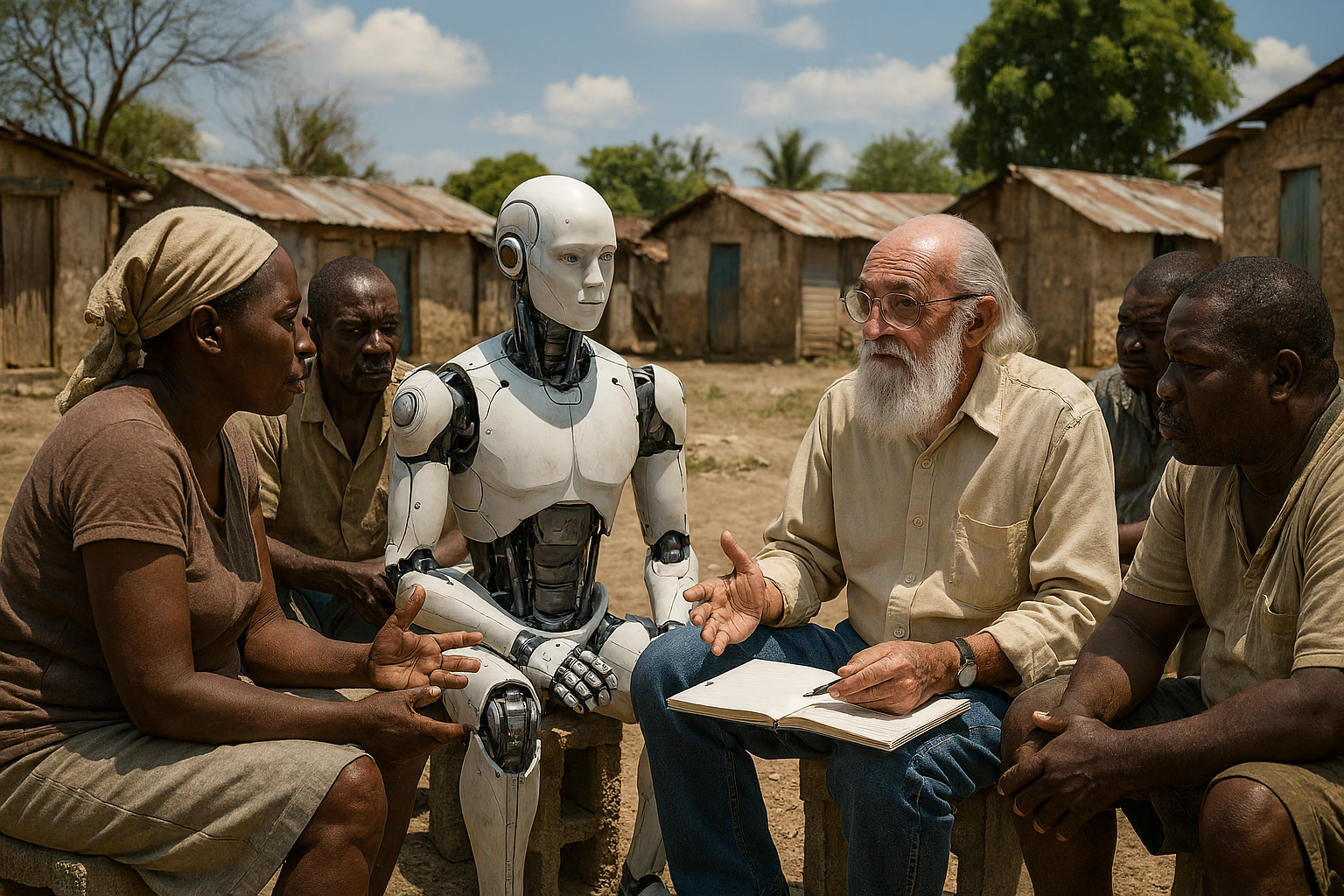
Freire was deeply suspicious of any educational technology or method that reinforced hierarchical relationships between the knower and the known. He warned that oppressive structures tend to reproduce themselves through the very tools designed to challenge them. AI, in its most commercially dominant forms today, risks doing precisely this: delivering pre-packaged content, algorithmically curated and standardized, to learners in the Global South whose local knowledge systems, languages, and epistemologies are effectively erased from the model’s training data. From a Freirean perspective, an AI that teaches a child in rural Brazil or sub-Saharan Africa through the lens of Western, English-language content is not educating that child — it is colonizing them further. Freire wrote that “it is not our role to speak to the people about our own view of the world, nor to attempt to impose that view on them, but rather to dialogue with the people about their view and ours.” [https://archive.org/details/pedagogyofoppres0000frei]
This principle of dialogue is where Freire’s thought becomes most generative for imagining what a liberatory AI in the Global South might look like. Rather than positioning AI as the all-knowing teacher depositing information into students, Freire would advocate for AI systems co-designed with communities — tools that emerge from and reflect local languages, oral traditions, cultural knowledge, and concrete material struggles. In countries like Mozambique, Haiti, or Bolivia, this would mean involving teachers, students, and community members as genuine co-creators of AI curricula, not merely end-users of platforms built in Silicon Valley or Beijing. Freire insisted that “the teachers and the students (leadership and people), co-intent on reality, are both Subjects, not only in the task of unveiling that reality, and thereby coming to know it critically, but in the task of re-creating that knowledge.” A Freirean AI would be one that facilitates this mutual unveiling rather than replacing it. [https://archive.org/details/pedagogyofoppres0000frei]
Freire also placed enormous emphasis on generative themes — the lived problems and contradictions that matter most to a given community — as the starting point for all meaningful education. In practical terms, this means that an AI deployed in a third-world educational context should not begin with a globally standardized curriculum, but with questions drawn from local reality: land rights, water scarcity, health, labor, and political disenfranchisement. Technology that helps students investigate, analyze, and collectively act on these realities would align with Freire’s vision. Organizations like the Barefoot College and initiatives connected to UNESCO’s community learning centers have explored this kind of grounded, participatory education, and AI could dramatically amplify their reach if designed with the same philosophy. Freire believed that “to speak a true word is to transform the world,” and an AI that helps marginalized communities find, articulate, and act on their own true words would be one of the most revolutionary educational tools imaginable. [https://unesdoc.unesco.org/ark:/48223/pf0000385030]
Perhaps the most urgent Freirean concern about AI in third-world education is the question of who controls the technology and in whose interest it operates. Freire was adamant that the oppressed must not simply be incorporated into oppressive structures, even under the banner of progress or modernization. The growing dominance of a small number of technology corporations over the global AI landscape represents exactly the kind of structural power Freire spent his life challenging. For AI to be genuinely liberatory in the Global South, it cannot be delivered as a charitable gift from the powerful to the powerless — what Freire called “false generosity” — but must be part of a broader project of political and economic transformation. He wrote that “the oppressed must not, in seeking to regain their humanity, become in their turn oppressors of the oppressors, but rather restorers of the humanity of both,” suggesting that the goal is not simply to redistribute access to existing tools, but to build a fundamentally more just world in which those tools serve human dignity rather than capital accumulation. [https://archive.org/details/pedagogyofoppres0000frei]
In sum, Freire would neither reject AI wholesale nor embrace it uncritically. He would insist that the technology be evaluated not by its efficiency or scalability metrics, but by a single, demanding question: does it help the marginalized become more fully human? That standard — humanization through critical consciousness and collective action — remains as urgent and as radical today as it was when Freire first articulated it in the favelas and countryside of Brazil.
Filed under: Uncategorized |


 Educational Technology and Change Journal

Leave a comment