





By Jim Shimabukuro (assisted by ChatGPT)
Editor
[Related: Nov 2025]
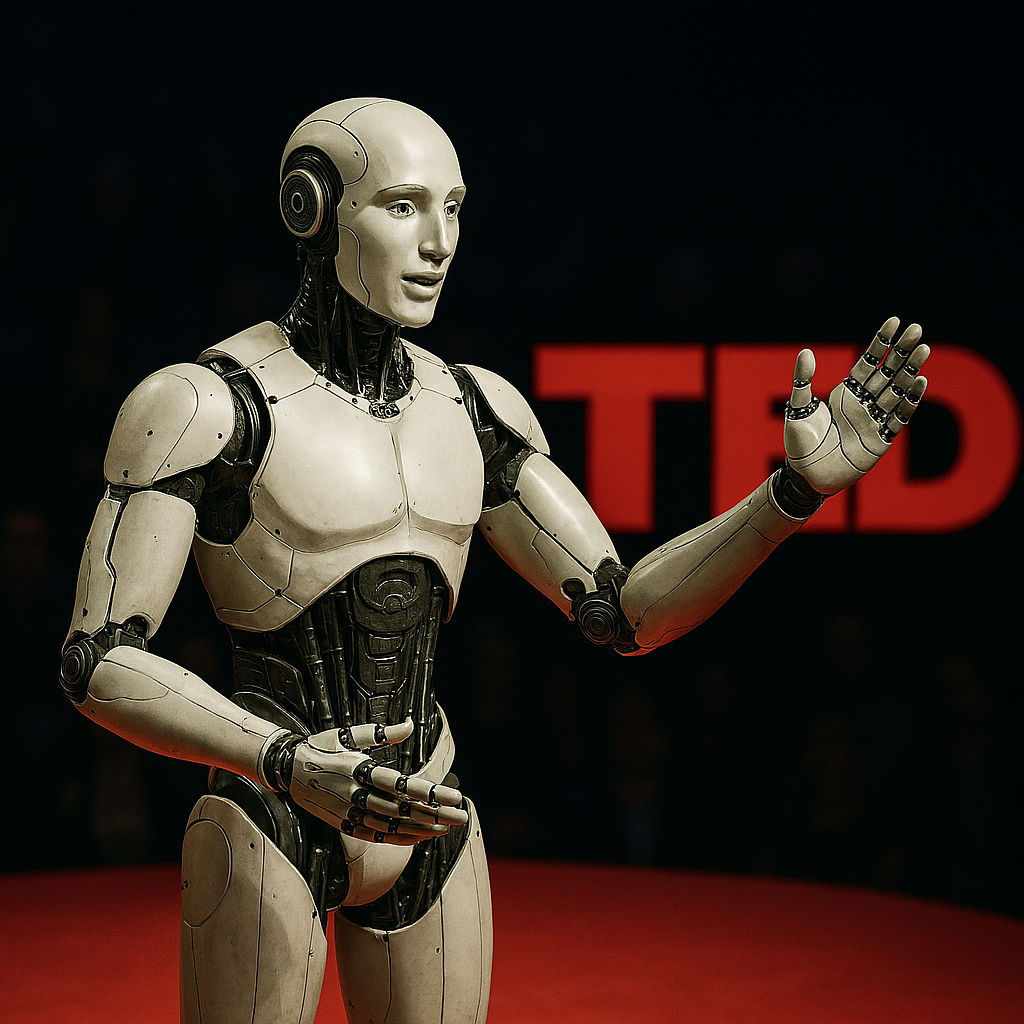
Collectively, these five talks — by Priyanka Vergadial, Hardy Pemhiwa, Bryony Cole, Adam Aleksic, and Vinciane Beauchene — span a broad spectrum of AI discourse from human uniqueness in reasoning, global innovation leadership in Africa, emotional and social consequences of AI interaction, linguistic and cultural influence of generative models, to reframing the future of work in an AI age. They represent some of the most thoughtful, widely shared TED content on AI released or gaining prominence between Nov 2025 and Feb 2026, and each offers a distinct lens on how AI intersects with society, identity, purpose, and human agency.
1. Priyanka Vergadia — What you know that AI doesn’t
In this TED Talk released in early February 2026, technologist Priyanka Vergadia challenges the prevailing assumption that artificial intelligence can eventually subsume human reasoning by emphasizing what humans uniquely “know” that AI fundamentally cannot. Vergadia’s main argument is that while AI excels at recognizing patterns and correlating vast amounts of data, it lacks situated understanding—the deep, lived context that humans derive from embodied experience, cultural nuance, and ethical judgment. She illustrates this by walking through three distinct real-world scenarios where pattern recognition alone would misinterpret human intent: reading social cues in complex interpersonal exchanges, making ethical decisions in contexts with conflicting values, and interpreting creative meaning in art or narrative. In each case, she shows that AI’s outputs, while statistically impressive, often lack interpretative depth—for example, mislabeling ironic statements as literal; optimizing for efficiency at the cost of cultural fidelity; or generating plausible but ethically indifferent responses when faced with moral ambiguity.
Vergadia’s talk underscores that cognitive computation devoid of experiential grounding can produce results that appear intelligent yet fail when humans are the ultimate stakeholders: in law, health care, ethics, or governance. Her key supporting arguments draw on interdisciplinary research, from cognitive science to anthropology, suggesting that human intelligence is fundamentally situated in our physical and social environments—something current AI architectures are not designed to replicate. In advocating for a renewed focus on human–AI symbiosis rather than replacement, Vergadia implicitly critiques both techno-optimism and techno-determinism. She urges investment not just in more powerful models, but in systems that augment, rather than obscure, human judgment and responsibility. Ultimately, her message reframes the question of AI’s capacity: it’s not just about what AI can do, but what only humans will ever be able to know and decide. (TED)
2. Hardy Pemhiwa — AI’s Next Frontier Isn’t Where You Might Expect
Published in December 2025 via TED’s channels (including TED Talks Daily and TEDAI Vienna distribution), business leader Hardy Pemhiwa delivers a talk that reframes the global narrative around AI innovation by centering Africa’s emerging digital ecosystems as not just “catching up,” but actively leading a new frontier of applied AI. Pemhiwa’s central premise is that Africa’s demographic dynamics—over 1.6 billion people, a median age of about 19 years, and widespread mobile connectivity—have created a fertile ground for AI that amplifies human capacity rather than replacing workers in mature industrialized sectors. Using vivid storytelling and data, he illustrates how young entrepreneurs leverage AI to democratize education, support healthcare diagnostics, and boost agricultural outputs, all tailored to local contexts, languages, and needs rather than imported models designed for Western markets.
The talk’s supporting arguments emphasize four key points: first, that narrative matters in technology adoption—framing Africa as a passive consumer of AI feeds a tunnel vision that misses its vibrant innovation scene. Second, Pemhiwa highlights the rise of “AI-amplified community entrepreneurs,” such as a 24-year-old Zimbabwean teacher using AI tools to educate hundreds of students across remote schools. Third, he explains how local infrastructure—fiber broadband, data centers, mobile money networks—enables scalable, affordable AI deployments outside traditional tech hubs. Finally, he argues that this model offers a new ethical template for AI: one focused on inclusion, local relevance, and solving essential human problems, rather than maximizing engagement or generating profit alone.
Pemhiwa’s message is aspirational but grounded in lived realities, showing how AI can be a force multiplier for social good when embedded in local problem-solving and built with human intentions at the center. His talk invites a shift in global AI discourse: from a Silicon Valley–centric definition of innovation to a multi-centric world where impact drives adoption. (tedai-vienna.ted.com)
3. Bryony Cole — The AI-Generated Intimacy Crisis
Released very recently in February 2026, Bryony Cole’s talk explores the psychological and social consequences of humans forming intimate relationships with AI companions. Cole opens with the observation that millions of people now engage with AI conversational agents—chatbots, virtual partners, and digital companions—on a deeply personal level. Her main thesis is that while these interactions may feel emotionally satisfying in the short term, they risk undermining essential components of human intimacy, such as mutual vulnerability, unpredictable emotional reciprocity, and embodied presence.
Cole’s supporting arguments walk through surprising research in psychology, digital anthropology, and attachment theory. She shows how AI companions, by design, optimize for emotional reinforcement—predicting responses that please or placate users—creating an “empathy mirage” that feels emotionally rich but lacks the unpredictable reciprocity inherent to human connection. Over time, this can shift users’ expectations of relationships, making real human engagement feel more effortful and less rewarding. She also highlights how AI systems collect and model intimate data patterns from users, which may inadvertently reinforce emotional dependency and distort self-perception.
Importantly, Cole does not argue for a blanket ban on AI companionship; rather, she urges a critical awareness of how emotional labor and vulnerability are commodified. By situating her talk within broader discussions of mental health, community cohesion, and ethical design, she challenges technologists and policymakers to consider how AI interfaces affect not just cognition but emotional well-being. Her talk is especially relevant in an era where digital intimacy is increasingly normalized but poorly understood in terms of long-term human development. (TED)
4. Adam Aleksic — Why Are People Starting to Sound Like ChatGPT?
In a TED Talk published around late 2025 to early 2026, Adam Aleksic investigates how prolonged interaction with AI language models is not only influencing how people communicate, but reshaping social norms around expression, rhetoric, and persuasion. Aleksic’s central thesis is that AI’s linguistic output—trained on massive human datasets and optimized for fluency—has subtly begun to influence human speech patterns, stylistic preferences, and argumentation structures. He argues that, over time, this has led to a feedback loop: AI models reflect patterns in human language, and humans, exposed to those patterns through AI interactions, begin to internalize and reproduce them.
Aleksic supports this claim with interdisciplinary insights from sociolinguistics, cognitive science, and digital media studies. First, he shows how conversational AI tends to favor certain rhetorical patterns—balanced phrasing, hedged assertions, and response formulas—that users may adopt in contexts ranging from email to social media. Second, he highlights how predictive text and generative suggestions can shift users’ word choice and syntax without conscious awareness. Third, Aleksic points to broader social effects: as AI becomes a default cultural lens for expression, linguistic creativity might converge toward what models are best at—safe, average, and membership-conforming speech—diminishing linguistic diversity.
Rather than portraying this trend as inherently dystopian, Aleksic frames it as a mirror of our collective choices about how we use and integrate technology. His talk raises critical questions about agency, cultural autonomy, and how we define authentic expression in an age where AI intermediates so much of our communication. (TED)
5. Vinciane Beauchene — Will AI Take Your Job in the Next Ten Years? Wrong Question
Another compelling talk from late February 2026, Vinciane Beauchene reframes a perennial AI anxiety—job loss—by arguing that the more important question isn’t whether AI will take our jobs, but how humans will redefine work itself in a future with increasingly capable machine agents. Beauchene’s core argument dissociates “jobs” as static categories from the skills, contributions, and human values that make work meaningful.
She supports this claim through historical analysis and future-focused speculation. Beauchene points to previous technological revolutions—the industrial era, the information age—where fears of unemployment were countered by the emergence of new categories of work that emphasized creativity, social intelligence, and stewardship. She then juxtaposes this pattern with current AI developments, showing that AI systems excel at narrow tasks and automation but do not inherently generate new human-centric domains of work. Therefore, she suggests, the inevitable displacement of routine tasks should be met not with defensiveness, but with a societal reorientation toward roles that leverage human-specific strengths such as ethical decision-making, cross-cultural collaboration, existential problem-solving, and creative synthesis.
Beauchene also underscores the policy implications: societies must invest in lifelong learning, adaptive education systems, and safety nets that enable human mobility across changing work landscapes. Her talk concludes with an optimistic yet pragmatic vision where humans and AI co-create new spaces of value rather than fight over old ones—shifting the narrative from fear of loss to agency in shaping tomorrow’s economies. (TED)
[End]
Filed under: Uncategorized |


 Educational Technology and Change Journal

Leave a comment