





By Jim Shimabukuro (assisted by Perplexity)
Editor
John Dewey would likely see AI not as a replacement for teachers or a new delivery channel for standardized content, but as a powerful set of tools that must be organized to enrich students’ experiences, deepen inquiry, and widen participation in democratic life. He would judge AI by whether it makes school more “educative” in his technical sense: promoting further growth, reflective thinking, and social engagement, rather than passive dependence or narrow skill training. [dewey.pragmatism.org, schoolofeducators.com]
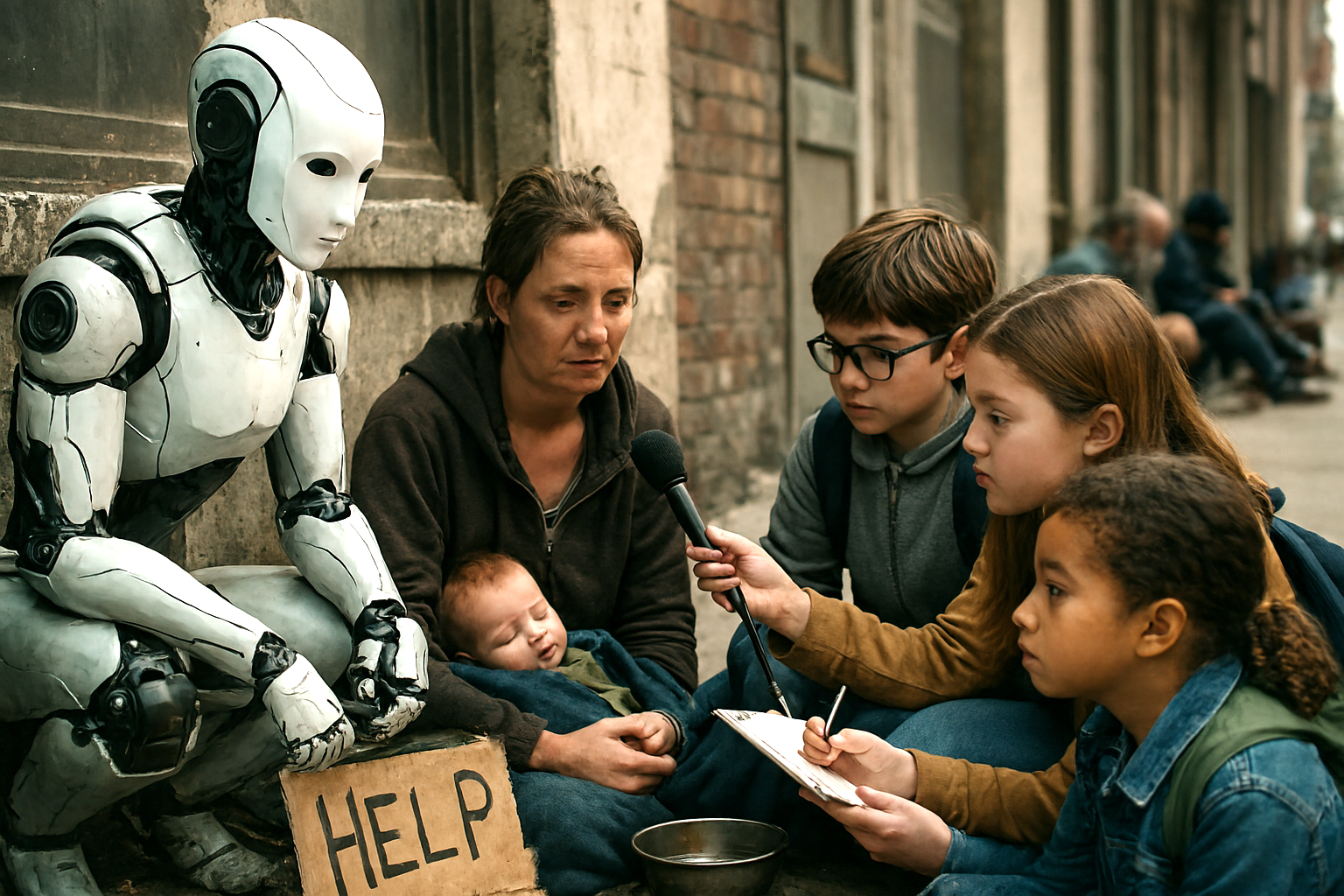
For Dewey, an experience is “educative” when it leads to more and better experiences in the future, while an experience is “miseducative” if it arrests or distorts the growth of further experience. In Experience and Education, he writes that “any experience is mis-educative that has the effect of arresting or distorting the growth of further experience,” emphasizing continuity and direction in growth. AI-rich schooling that makes students more passive, more distractible, or more dependent on machine output for answers would therefore be miseducative, even if it raises short-term test scores, because it undermines the habits of inquiry and reflection that support lifelong learning. [supersummary.com, schoolofeducators.com]
Dewey insists in “My Pedagogic Creed” that “the only true education comes through the stimulation of the child’s powers by the demands of the social situations in which he finds himself,” and that education is “a process of living and not a preparation for future living.” AI in K–12, on this view, should be embedded in real or realistic problem situations where students use AI to investigate issues that matter in their communities, design projects, and collaborate with others, rather than treat AI as a separate “tech” subject or a drill engine. The school should “represent present life—life as real and vital to the child as that which he carries on in the home, in the neighborhood, or on the play-ground,” so AI-rich classrooms would engage students in authentic uses of data analysis, simulation, and communication that mirror contemporary social and work practices. [dewey.pragmatism.org]
He would likely argue that the criterion for integrating AI is whether it supports experiential learning—learning by doing and reflecting—rather than mere information acquisition. Dewey’s account of experiential learning stresses that students learn best when they are actively engaged in meaningful activities that require critical thinking and problem solving, and when they have opportunities to reflect on their experiences. Applied to AI, this suggests designing tasks where students use AI tools to model a scientific phenomenon, draft and revise text, or explore multiple perspectives on a social issue, followed by structured reflection on how the AI shaped their thinking, what its limitations were, and how their own judgment evolved. Without that reflective layer, AI risks becoming just another form of rote assistance, undermining Dewey’s call for thoughtful, inquiry-based experience. [gilliamwritersgroup.com, elearningindustry.com, niu.edu]
Dewey’s emphasis on social learning and the school as a “form of social life” would push against individualized, screen-centric AI uses that isolate learners. In “My Pedagogic Creed” he argues that “all education proceeds by the participation of the individual in the social consciousness of the race” and that the teacher should see the school as a community, not as a place where stimulus and control “proceeds from the teacher” alone. In AI-enabled classrooms, this would mean structuring collaborative projects where students jointly plan how to use AI, critique each other’s prompts and outputs, and negotiate shared interpretations, so that AI becomes a medium for social interaction rather than a private tutor sealed off from peers. It would also reinforce the teacher’s role as a member of the community who “select[s] the influences which shall affect the child and assist[s] him in properly responding to these influences,” including algorithmic ones. [dewey.pragmatism.org]
Because Dewey ties education tightly to democracy, he would interpret AI in schools through the lens of democratic participation and control. In Democracy and Education, he presents education as the means by which a society renews itself and develops the dispositions needed for democratic life, criticizing systems that rely on external authority, strict discipline, and memorization for producing a conformist and “acquiescent” citizenry. A school system that silently embeds opaque AI systems into grading, discipline, or tracking without student understanding would conflict with this democratic ideal; instead, Dewey would likely ask schools to make AI itself an object of inquiry, helping students investigate how models work, whose data they rely on, and whose interests they serve, thereby cultivating habits of critical and informed citizenship. [standardebooks.org, gutenberg.org]
Central to Dewey’s reconstruction of schooling is the idea that teachers must organize experiences, not merely abandon students to their impulses or to external programs. In “Experience and Education” he argues that both “traditional” and “progressive” education can be miseducative when they fail to apply sound principles of experience, and he warns against an “Either-Or philosophy” that ignores the directive value of mature knowledge while glorifying unguided personal experience. Translating this to AI, Dewey would reject both naive automation (handing instruction and assessment over to AI) and naive student-led AI use (letting children freely explore AI tools without guidance). He would instead ask teachers to design and sequence AI-mediated experiences that draw on adult expertise about the discipline and about AI itself, while leaving room for student initiative and experimentation. [schoolofeducators.com]
Dewey’s notion that “education is life itself,” often summarized from Democracy and Education and “My Pedagogic Creed,” implies that AI should help students participate more fully in contemporary forms of communication, work, and culture, rather than treat schooling as mere preparation for a distant future. This could mean involving students in community-based projects where AI supports data gathering and analysis on local environmental or social issues, or using AI to connect classrooms with external experts and communities. In this way, AI becomes part of the living present of students’ social worlds, enabling them to act, communicate, and make a difference now, consistent with Dewey’s insistence that school life and broader community life be integrated. [dewey.pragmatism.org, standardebooks.org]
Finally, Dewey would measure any “optimization” of AI in schools by whether it supports growth in judgment, initiative, and shared inquiry. Experiential and project-based learning approaches influenced by Dewey already show how technology can be woven into interdisciplinary projects, collaborative work, and reflective practice, enhancing critical thinking and creativity when guided well. To be truly educative in his terms, AI-enhanced schooling would have to be deliberately designed as a series of connected, socially situated experiences in which students use AI as a tool to inquire, create, and participate, rather than as a crutch that narrows their capacities or shifts authority from human communities to hidden systems. [gilliamwritersgroup.com, elearningindustry.com]
Filed under: Uncategorized |


 Educational Technology and Change Journal

Leave a comment