


By Jim Shimabukuro (assisted by Gemini)
Editor
Car homelessness has emerged as a significant and expanding crisis within the United States, transitioning from a localized issue in high-cost coastal cities to a nationwide emergency. By 2024, the total population of people experiencing homelessness reached a record high of over 771,000, representing an 18% increase from the previous year—the largest single-year jump ever recorded¹. Within this broader crisis, vehicular homelessness (living in cars, vans, or RVs) has become a primary “shelter of last resort” for many, as official counts indicate that approximately half of the unsheltered population in major urban centers like Los Angeles now reside in vehicles².
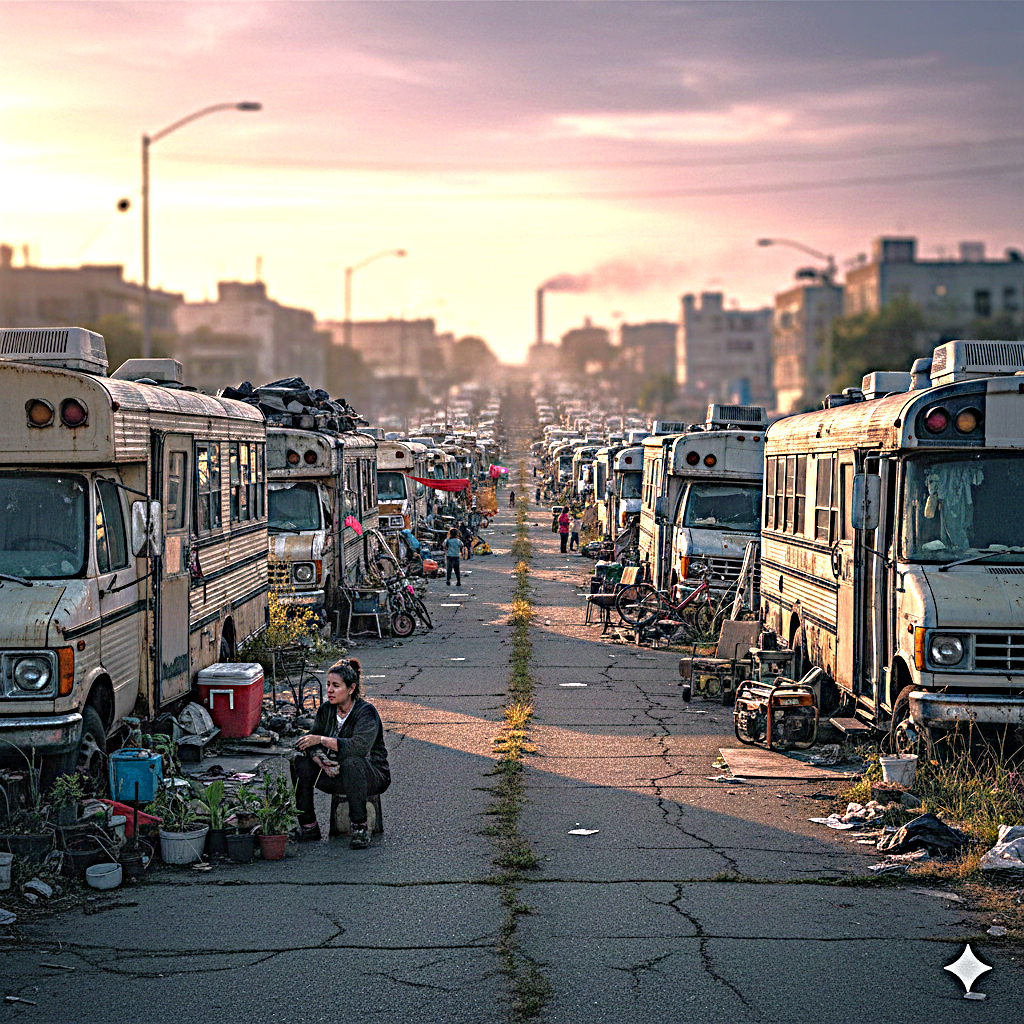
The trajectory is rising at an alarming rate, with estimates suggesting that hundreds of thousands of Americans have transitioned into vehicle-based living as traditional housing costs outpace stagnant wages³. This problem is no longer confined to specific regions; while states like California, New York, and Florida report the highest raw numbers, significant percentage increases have been documented across 43 states, including Illinois, Massachusetts, and Hawaii⁴. The demographic reach is equally expansive, increasingly impacting the “working homeless”—individuals with full-time employment who can afford a car payment and insurance but cannot secure a permanent residence—as well as seniors on fixed incomes and families with children, who saw a staggering 39% increase in homelessness between 2023 and 2024⁵.
The causes of this surge are multifaceted, but the immediate driver is a severe national shortage of affordable housing coupled with the expiration of pandemic-era safety nets. The end of federal COVID-19 relief funds, eviction moratoria, and the expanded child tax credit stripped away the temporary protections that had kept many families afloat during previous years⁶. When median rents increase by just $100, research from the U.S. Government Accountability Office shows a corresponding 9% rise in homelessness, a correlation that has become a grim reality as market-rate rents now require an income over twice the minimum wage in many jurisdictions⁷. Furthermore, the lack of adequate shelter beds and the perceived lack of safety or privacy in existing facilities often push individuals to choose their vehicles, which provide a modicum of security and mobility that a sidewalk or a congregate shelter cannot offer⁸.
Deep causes of car homelessness, however, point toward a structural failure in the American economic and social framework. Historically, the “deepest” driver is the widening chasm between housing costs and household income; from 2001 to 2023, median rents rose 23% while renters’ median incomes increased by a mere 5%⁹. Beyond simple economics, systemic racism continues to manifest in housing insecurity, as Black Americans remain disproportionately represented, making up 32% of the homeless population despite being only 12% of the general population¹⁰. Additionally, the criminalization of poverty through municipal ordinances—such as bans on overnight parking and “vagrancy” laws—creates a “permanent underclass” by trapping people in cycles of fines and arrests that further diminish their eligibility for housing and employment¹¹. This structural trap is compounded by a healthcare system that often fails to provide early intervention for mental health or substance use issues, which are frequently the result of, rather than the initial cause for, the trauma of losing one’s home¹².
To understand the true scale of vehicle homelessness, one must look past immediate triggers like rent spikes and examine the “deep causes” embedded in the American political and economic systems. At the foundational level, the financialization of housing has fundamentally altered the purpose of a home, shifting it from a social good to a high-yield investment asset¹³. Global capital flows and institutional investors now treat residential real estate as a “safe deposit box” for wealth, a trend that significantly inflates property values and prioritizes luxury development over the “deeply affordable” units required by the working class¹⁴. This shift ensures that even when the economy is nominally healthy, the “housing-wage gap” continues to widen because housing prices are no longer tied to local labor markets but to global investment cycles¹⁵. Without de-commodifying at least a portion of the housing stock through expanded social housing or community land trusts, the systemic pressure pushing people into vehicles will likely persist regardless of minor fluctuations in the job market.
Politically, the problem is exasperated by a fragmented federal-to-local governance model that incentivizes exclusionary land-use policies. Local governments often rely heavily on property taxes, which creates a “fiscal zoning” incentive to approve high-value single-family homes while blocking high-density or affordable projects that might require more in public services than they contribute in taxes¹⁶. This is reinforced by a century of car-centric urban planning; by mandating that vast swaths of land be dedicated to parking and roads rather than housing, cities have artificially restricted the supply of buildable land, driving up the cost of what remains¹⁷. Furthermore, the 2024 Supreme Court ruling in City of Grants Pass v. Johnson has granted municipalities broader powers to criminalize sleeping in public spaces, including vehicles, which often results in the impoundment of the very “homes” these individuals rely on, effectively institutionalizing a cycle of debt and displacement that prevents long-term stability¹⁸.
Socially, the deep cause lies in the erosion of the American social safety net and its replacement with “punitive governance.” Over the last several decades, federal funding for public housing has seen a steady decline in real dollars, shifting the burden to a voucher system that is currently so underfunded that only one in four eligible households actually receives assistance¹⁹. This creates a “lottery of survival” where the losers are forced into mobile living. Moreover, the lack of a comprehensive national healthcare system means that a single medical emergency or a period of mental health struggle frequently leads to total financial ruin, as the U.S. lacks the “social floors” common in other developed nations that decouple basic survival from employment status²⁰. Until these structural dependencies—the reliance on housing as an investment, the car-centric use of land, and the threadbare nature of social insurance—are addressed, vehicle homelessness will remain an enduring feature of the modern American landscape.
References
- State of Homelessness: 2025 Edition
- Geographic and Regulatory Impacts on Vehicular Homelessness in Los Angeles
- 900,000 Americans Losing Shelter — The RV Homeless Crisis No One Can Explain (2026)
- Homelessness in America: Statistics, Analysis, & Trends – Security.org
- The 2024 Annual Homelessness Assessment Report (AHAR) – HUD User
- Why Has the US Homeless Population Been Rising? – Econofact
- Homelessness in California: Recent challenges and new horizons
- How many homeless people are in the US? What does the data miss? – USAFacts
- Mapped: America’s Homeless Population by State – Visual Capitalist
- America’s Working Homeless Are Living in Cars (2026)
- America’s RV Homeless Crisis Is Turning Deadly (2026)
- California sees drop in unsheltered homelessness, bucking national trend
- THE STATE OF THE NATION’S HOUSING 2025 – Harvard Joint Center for Housing Studies
- How Zoning Laws Contribute to the Housing Crisis
- State of Homelessness: 2025 Edition
- Affordable Housing: What Experts Say About Zoning & Permitting
- 5 Trends Shaping Land Use for 2026 and Beyond
- 2025-2026 Vehicle and RV Residency Program Models Issue Paper
- Final FY2026 THUD Funding Summary – Bipartisan Policy Center
- Mapping Communities at Risk: Federal Policy Changes 2026
[End]
Filed under: Uncategorized |


 Educational Technology and Change Journal

Leave a comment