





By Jim Shimabukuro (assisted by Claude)
Editor
[Related: Five Strongest Criticisms Against the U.S.-Israeli Attack on Iran, 4 March 2026]
1. Rationale behind Operation Epic Fury
On February 28, 2026, the United States and Israel began conducting extensive strikes against a wide range of targets in Iran. The strikes were dubbed Operation Epic Fury by the United States and Operation Roaring Lion by Israel. President Trump announced the operation in an eight-minute video posted to Truth Social around 2:30 a.m. ET, saying the United States had begun “major combat operations in Iran.” There was no address to the media or public briefing to Congress beyond a notification to the Gang of Eight shortly before strikes commenced. The video concluded with a direct message from Trump to Iranians, stating “the hour of your freedom is at hand.” (White House | CSIS | The Hilltop)
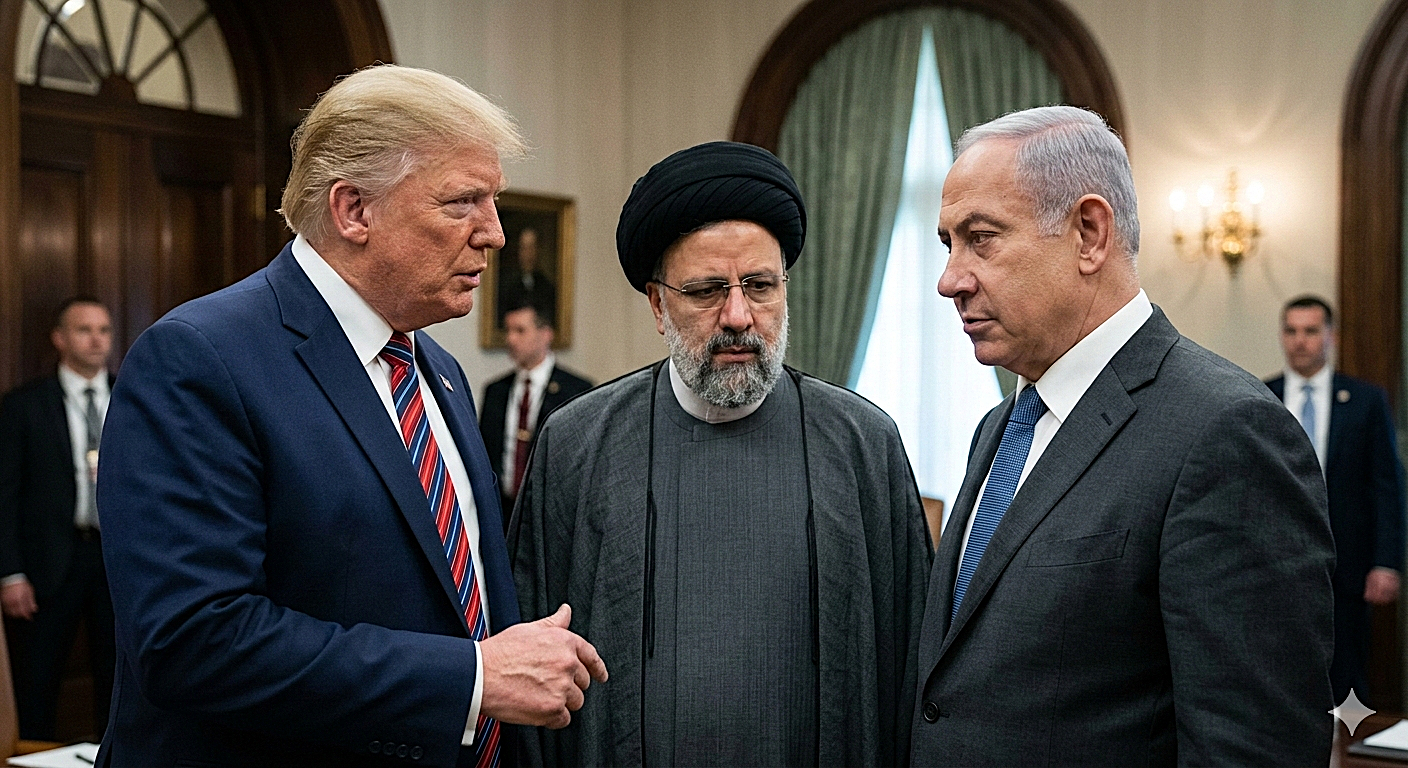
The Nuclear Threat
The administration’s most prominent justification was Iran’s ongoing pursuit of nuclear weapons. Trump framed the strikes as a counterproliferation operation and a direct consequence of Iran’s refusal to renounce nuclear ambitions despite three rounds of negotiations, stating that Iran “refused, just as it has for decades and decades,” rejecting “every opportunity to renounce their nuclear ambitions.” The White House described the operation as designed to eliminate “the imminent nuclear threat posed by the Iranian regime” following “exhaustive diplomatic efforts” and “47 years of Iranian aggression.”
Trump made clear in his initial address that the prior year’s limited strikes — Operation Midnight Hammer in June 2025 — had not resolved the problem. He said that after Midnight Hammer, Iran “was warned to make no future attempts to rebuild their weapons program,” yet he claimed they were “starting it all over.” He argued that “an Iranian regime armed with long-range missiles and nuclear weapons would be a dire threat to every American,” and that the U.S. could not “allow a nation that raises terrorist armies to possess such weapons.”
The claim carried notable ambiguity, however. Trump phrased the nuclear justification at least three different ways in a short period — that Iran was rebuilding its nuclear program, that it “wanted” to rebuild it, and that it had “attempted” to rebuild it. A Defense Intelligence Agency assessment from the prior year had indicated that Tehran would not have intercontinental ballistic missiles capable of reaching the U.S. until 2035. (CBS News | Times of Israel | U.S. Embassy Statement | CSIS)
Iran’s Ballistic Missile Arsenal
Destroying Iran’s conventional military capability — particularly its ballistic missiles — was presented as both an independent objective and as a precondition to addressing the nuclear threat. Defense Secretary Pete Hegseth indicated the justification for the offensive was Iran’s “swelling arsenal of ballistic missiles and killer drones,” which he said Iran was using to “create a conventional shield for their nuclear blackmail ambitions.”
Trump’s TruthSocial address outlined four military objectives: (1) preventing Iran from acquiring a nuclear weapon, (2) destroying its missile arsenal and production sites, (3) degrading its proxy networks, and (4) annihilating its navy. He also cited Iran’s continued development of long-range missiles, which he said now threatened U.S. troops stationed overseas and American allies in Europe.
The operational division of labor appeared to reflect this focus: Israel targeted Iran’s leadership, while the United States engaged in large-scale capability degradation of missile and air defense infrastructure. (CBS News | CSIS)
Preemption — Iran Was About to Strike First
A third justification, introduced in the hours after the attack began, was that the U.S. acted preemptively to forestall an imminent Iranian strike. A senior administration official briefing reporters said the U.S. “had indicators that they intended to use it potentially, preemptively… if not simultaneous to any actions against them.” Officials argued that the president “was not going to sit back and wait to get hit first,” and that acting preemptively would reduce American casualties.
However, this rationale quickly unraveled. Secretary of State Marco Rubio offered a significantly different version, telling reporters that the administration decided to attack because Israel was planning to strike Iran, and that “we knew that that would precipitate an attack against American forces,” so the U.S. chose to strike preemptively to take out Iran’s missiles. In other words, the anticipated threat was not an unprovoked Iranian assault on the U.S., but rather Iran’s anticipated retaliation to a separate Israeli operation. Trump administration officials privately admitted to Congress there was no intelligence suggesting Iran planned to attack the United States first, unraveling the central rationale used to launch the operation.
Senator Mark Warner of Virginia, the top Democrat on the Senate Intelligence Committee, told CNN that he “saw no evidence that Iran was on the verge of launching any kind of preemptive strike against the United States of America.” (CBS News | IBTimes UK | Times of Israel)
Iran as the World’s Leading State Sponsor of Terrorism
Running through all official statements was the argument that Iran’s decades-long sponsorship of terrorism placed it in a category that justified extreme measures. Trump and top White House officials cited Iran’s status as the world’s leading state sponsor of terrorism and its support of militant proxies as a central justification, with Trump calling the Iranian leadership “a vicious group of very hard, terrible people” whose malign activities “directly endanger the U.S., both at home and abroad, along with allies around the world.”
Congressional supporters reinforced this framing. Senator Tom Cotton said he had not heard “a single Arkansan express anything but unqualified support” for Trump’s decision to “finally put America’s foot down and end 47 years of terror and revolutionary violence by the Islamic Republic against the United States.” The 1979 hostage crisis, the 1983 Marine barracks bombing in Beirut that killed 241 U.S. service members, and Iran’s support for Hezbollah, Hamas, and the Houthis were all cited as part of the historical record justifying action. The Wall Street Journal editorial board called the attack “a necessary act of deterrence against a regime that is the world’s foremost promoter of terrorism.” (Washington Times | White House)
Regime Change and Liberation of the Iranian People
Beyond military and security objectives, administration officials and allies openly embraced the goal of toppling the Islamic Republic and replacing it with a government more favorable to the Iranian people and to Western interests. Trump told the Iranian people directly: “When we are finished, take over your government. It will be yours to take.” He also urged Iranians to “seize control of your destiny” and “unleash the prosperous and glorious future that is close within your reach,” framing the U.S. intervention as fulfillment of a promise made to the Iranian people.
Trump issued a direct ultimatum to the Revolutionary Guard and Iranian military to “lay down your arms and receive full immunity or face certain death,” arguing that the entire Iranian military command had been eliminated and that many personnel were “calling by the thousands” seeking immunity. The son of Iran’s last shah, Reza Pahlavi, urged Iranians to prepare for renewed protests as the Islamic Republic collapsed, and called on security forces to join the public to ensure a stable transition.
Commentators close to the administration argued that regime change would unlock a historic realignment of the region, with the prospect of Saudi-Israeli normalization returning to the table if Ayatollah Khamenei’s regime fell. (Stimson Center | Times of Israel | U.S. Embassy Statement | White House)
The Diplomatic Context
Official justifications for the operation were complicated by the state of diplomacy immediately before the strikes. Negotiations over Iran’s nuclear program had been underway for weeks, and during his State of the Union address, Trump had stated that his “preference is to solve this problem through diplomacy,” while insisting he would never allow Iran to possess a nuclear weapon. On the day the strikes began, the Omani foreign minister — who had been serving as mediator — said “substantial progress” was being made and a deal was “within reach,” telling CBS News that Iran had agreed it would “never, ever have nuclear material that will create a bomb.” Trump said that same day he was “not happy with how the talks were progressing.”
On February 25, Iranian Foreign Minister Abbas Araghchi had stated that a “historic” agreement with the United States to avert military conflict was “within reach” ahead of renewed talks in Geneva, emphasizing that diplomacy must be prioritized to avoid further escalation. (CBS News | Wikipedia — 2026 Iran Conflict)
Editorial note: This report reflects the official statements and rationales as presented by the U.S. and Israeli governments and their congressional and editorial supporters. It also includes, where directly relevant, documented discrepancies between those stated rationales and intelligence assessments or congressional testimony, as these are part of the public record and affect any clear understanding of the stated case for the operation.
2. Iran’s “nuclear blackmail ambitions”
Here is an expanded analysis of “nuclear blackmail ambitions” — the concept that sits at the intersection of Iran’s conventional military buildup and its nuclear program — as articulated by U.S. officials and substantiated (or contested) by independent analysts.
The Core Argument
The phrase “nuclear blackmail” entered the official lexicon of Operation Epic Fury through Secretary of Defense Pete Hegseth. In his March 2 Pentagon briefing, Hegseth declared that “Iran was building powerful missiles and drones to create a conventional shield for their nuclear blackmail ambitions,” adding that “our bases, our people, our allies, all in their crosshairs — Iran had a conventional gun to our head as they tried to lie their way to a nuclear bomb.” He returned to this framing repeatedly in the days that followed. In a March 3 address, Hegseth accused Iran of stalling in negotiations and “buying time to reload their missile stockpiles and restart their nuclear ambitions,” framing the regime’s goal as holding the U.S. hostage — threatening to strike American forces while advancing toward a nuclear capability.
The concept rests on a specific theory of Iranian strategic behavior: that Iran was not merely trying to build a bomb in isolation, but was constructing a layered military apparatus — long-range missiles, drone swarms, proxy armies — specifically to deter the United States and Israel from ever stopping it. Under this view, the conventional arsenal and the nuclear program are inseparable; one protects the other.
The Two-Layer Model: Conventional Shield, Nuclear Core
The administration’s argument drew on a “two-layer” model of Iranian strategy that had been circulating in defense and intelligence circles well before the operation. According to an Israeli defense research center’s February 2026 situation assessment, Iran appeared to have adopted what analysts called a “differential reconstruction doctrine” following the June 2025 strikes — combining a surface-level willingness for diplomacy with a covert prioritization of air defense rehabilitation, ballistic missile restoration, and the deep underground fortification of nuclear facilities damaged in the earlier operation.
Iran’s strategic goal before the June 2025 war had been to build an arsenal of approximately 8,000 ballistic missiles — a number intended to achieve what analysts described as a “target saturation” capability capable of overwhelming Israeli missile defense systems, including Arrow 2, Arrow 3, and David’s Sling. The administration’s argument was that this conventional buildup was not a deterrent in the traditional sense but an offensive tool designed to hold U.S. and Israeli decision-makers at risk while nuclear facilities were quietly rebuilt in hardened, buried bunkers beyond the reach of existing munitions.
Iranian engineers had drawn a clear lesson from Operation Midnight Hammer: they accelerated the excavation of the “Pickaxe Mountain” facility south of Natanz, digging to an estimated depth of 80 to 100 meters under hard granite rock — a depth calculated specifically to provide immunity against the American GBU-57 Massive Ordnance Penetrator bomb dropped by B-2 stealth bombers. In parallel, at the Parchin site, construction was completed on an underground blast chamber at the Taleghan 2 facility — a site that had previously served Iran’s past nuclear weapons development program — designed for high-explosive experiments essential to activating a nuclear device.
This reconstruction activity was the specific evidentiary basis for Hegseth’s claim that Iran was “lying its way to a nuclear bomb” while engaging in diplomacy.
“Breakout Time” and the Enrichment Question
A central component of the nuclear blackmail argument was the concept of “breakout time” — the interval between a political decision to build a bomb and actual weapons-grade material being available. Trump’s envoy Steve Witkoff claimed on February 21 that Iran was “probably a week away from having industrial-grade bomb-making material,” suggesting that breakout was imminent rather than theoretical. However, independent experts pushed back sharply on the precision of that framing.
While Iran’s breakout time to enrich sufficient weapons-grade uranium had indeed been measured in roughly a week or so for several years prior, arms control experts argued this figure was often misleading. As one analyst put it, possessing sufficient weapons-grade uranium is “only one piece of the puzzle” — after enrichment, Iran would still need to manufacture the rest of the weapon, a process likely taking months to a year. The Arms Control Association’s executive director noted that it was “clear that it would take Iran years to fully rebuild its enrichment plants” destroyed in June 2025, and that even a smaller, undisclosed number of centrifuges would take considerably longer to produce what the major bombed facilities once could.
The 2025 Defense Intelligence Agency Worldwide Threat Assessment stated that Iran was “almost certainly not producing nuclear weapons,” though it had “undertaken activities in recent years that better position it to produce them, if it chooses to do so.” This formulation — capability without demonstrated intent — was the contested ground at the heart of the nuclear blackmail argument: the administration insisted that Iran’s military buildup made intent irrelevant once capability was sufficiently advanced.
The ICBM Gap
A secondary dimension of the nuclear blackmail argument concerned long-range ballistic missiles — the delivery system that would make an Iranian nuclear weapon a threat to the American homeland rather than only to the Middle East. Trump stated that Iran had been “developing long-range missiles that can now threaten our very good friends and allies in Europe, our troops stationed overseas, and could soon reach the American homeland.”
This claim was directly contradicted by the administration’s own 2025 DIA missile threat assessment, which found that Iran could develop a long-range missile capable of reaching the United States by 2035 — if it chose to make a determined push — and not before. One arms control scholar noted wryly that a 1999 U.S. National Intelligence Estimate had already predicted the U.S. would face an Iranian ICBM threat by 2015, suggesting that such timelines had a long history of overstatement. “A decade or more is not ‘soon,'” he said. After Trump used similar language at the State of the Union, Secretary of State Rubio told reporters he “wouldn’t speculate” on how far away Iran actually was from such a capability.
Iran’s Reconstruction Activity as the Trigger
Where the administration’s case was arguably strongest was in pointing to Iran’s specific post-June 2025 actions as evidence of bad faith. Satellite imagery analyzed by the Institute for Science and International Security showed Iran conducting a massive engineering operation at the Isfahan nuclear complex to seal tunnel entrances — covering them with large quantities of earth using continuous truck and heavy equipment activity — in what analysts interpreted as an effort to protect underground facilities from future strikes and shield them from surprise IAEA inspections.
Iran had also established sanctions-bypassing supply chains from China to replenish solid fuel stocks for its medium-range ballistic missiles, even as its inventory had shrunk from an estimated 2,500 missiles before the June 2025 war to between 1,000 and 1,200 by early 2026. The administration cited this parallel track — diplomatic engagement alongside covert military and nuclear rebuilding — as the definition of nuclear blackmail: using the threat of force and the promise of negotiation simultaneously to buy time for a capability the regime had no intention of abandoning.
Hegseth summarized this view in a subsequent briefing: “As Trump told German chancellor Merz, Iran negotiated in bad faith. Stalling, scheming, and preparing to strike. Iran will never possess a nuclear bomb. Not on our watch. Not ever.”
(Sources: U.S. Army / Pentagon | CBS News | PBS NewsHour / PolitiFact | FactCheck.org | CSIS | Alma Research Center (February 2026 Iran Assessment) | Townhall / Hegseth March 4 briefing)
3. Quotes from Iranian leaders that have provoked the attack
The official case for Operation Epic Fury did not rest solely on capabilities assessments. It rested equally on the argument that Iranian leaders had spent decades openly declaring their intent to destroy Israel — and that when a state with that stated intent approaches nuclear breakout, the threat becomes existential by definition. The West Point Lieber Institute, analyzing the legal justifications for the preceding June 2025 strikes, noted: “It has been suggested that calls for Israel’s destruction are mainly meant for domestic political purposes and do not directly translate to an intention to use a nuclear weapon against Israel. However, if the leadership of one country repeatedly calls for the destruction of another, it strikes many observers that those declarations cannot simply be dismissed as rhetoric.” That argument — that repetition and consistency of language converts rhetoric into declared intent — became a cornerstone of the U.S.-Israeli rationale. What follows is a survey of the most cited Iranian statements, how they were used, and what the interpretive disputes around them reveal.
Ahmadinejad and “Wiping Israel Off the Map” (2005)
The most famous and most contested quote in the entire Iran-Israel confrontation came from then-President Mahmoud Ahmadinejad on October 26, 2005, at a “World Without Zionism” conference in Tehran. As translated by the official Islamic Republic News Agency and subsequently circulated by Western media outlets including the New York Times, Ahmadinejad declared that Israel “must be wiped off the map.”
How it was used: This formulation became the rhetorical shorthand for an entire generation of Western and Israeli argument about Iranian intent. Prime Minister Netanyahu invoked it repeatedly in his campaigns against both the 2015 nuclear deal and the diplomacy preceding Operation Epic Fury. It was the implicit foundation beneath Trump’s claim that Iran had been “threatening to annihilate” Israel “for forty years.”
The translation dispute: The accuracy of the English phrase was challenged immediately and remains genuinely contested. Arash Norouzi of the Mossadegh Project argued that the words “map,” “wipe out,” and even “Israel” never appeared in the original Persian, and that Ahmadinejad directed his comment toward the “regime occupying Jerusalem.” Juan Cole, a historian of the Middle East at the University of Michigan, agreed, arguing that the speech expressed a hope that the occupying regime would “vanish from the page of time” — an idiom he compared to Reagan-era predictions that the Soviet Union would collapse.
The Christian Science Monitor noted that this interpretation was reinforced by context: Ahmadinejad used the same “page of time” idiom in the same speech when describing the fall of the Shah’s regime, the Soviet Union, and Saddam Hussein — none of which, of course, were “wiped off the map” in a military sense.
The counter-argument: Michael Axworthy, who served as head of the Iran section of Britain’s Foreign and Commonwealth Office, rejected the notion that Ahmadinejad had been simply mistranslated: “The formula had been used before by Khomeini and others, and had been translated by representatives of the Iranian regime as ‘wiped off the map.’ When the slogan appeared draped over missiles in military parades, the meaning was pretty clear.” The Hoover Institution analysis pointed out that in the same speech, Ahmadinejad described Israel as a “stain of disgrace” that would “soon be cleaned from the garment of the world of Islam” — language that his own official presidential website clarified referred specifically to “Esraiil.”
Genocide scholar and former international prosecutor Gregory Gordon considered the statements an example of direct incitement to genocide. Holocaust historian Robert Wistrich compared the language to Hitler’s 1939 prophecy about “the annihilation of the Jewish race,” saying “the same genocidal intent is plainly there.”
What it ultimately proved: The dispute itself became politically significant. Congressman Dennis Kucinich attempted to enter alternative translations into the Congressional Record, warning that “a mistranslation could become a cause of war,” but members of the House blocked the inclusion. Whether or not the translation was precise, the phrase lodged itself permanently into Western political discourse — and both the Trump and Netanyahu governments treated it as settled evidence of Iranian eliminationist intent. (Wikipedia — Ahmadinejad and Israel | Hoover Institution | Christian Science Monitor | FAIR.org)
Khamenei — “The Cancerous Tumor” (2000–2025)
Over more than two decades, Khamenei returned again and again to a specific piece of dehumanizing language: Israel as a cancer that had to be removed from the body of the Muslim world. In a televised sermon on December 15, 2000, he declared: “Iran’s position, which was first expressed by the Imam [Khomeini] and stated several times by those responsible, is that the cancerous tumor called Israel must be uprooted from the region.” A month later he added: “It is the mission of the Islamic Republic of Iran to erase Israel from the map of the region.”
He never abandoned the metaphor. In May 2025, just months before Operation Epic Fury, Khamenei again called Israel “a lethal, dangerous, cancerous tumor” that “should certainly be eradicated, and it will be.”
How it was used: The dehumanizing framing of a state and its people as a disease to be excised — rather than a government whose policies were objectionable — was a key element of the U.S. and Israeli case that these were not standard diplomatic disputes but declarations of eliminationist intent. The South African Zionist Federation’s factsheet on the June 2025 Operation Rising Lion catalogued the pattern, noting that IRGC commander Hossein Salami warned in 2025 that Iran would “open the gates of hell” on Israel, and had declared in 2019 that “destroying Israel is now an achievable goal.”
Interpretation: Iranian-American academic Akbar Ganji, writing in the Boston Review, argued that Khamenei’s rhetoric had shifted over time and should be understood in the context of Palestinian rights advocacy rather than military planning, saying his statements referred to eliminating the Israeli government, not killing Jewish people. Ganji also noted that by consistently making such statements, Khamenei had paradoxically served Israeli strategic interests, allowing Netanyahu to elevate the Iranian threat above all other concerns and marginalize the Palestinian question in global diplomacy. (Hoover Institution | Times of Israel — May 2025 | Boston Review | SAZF Factsheet)
Khamenei’s “25-Year Countdown” (2015)
Perhaps the most strategically consequential of all Iranian statements — because of its explicit time frame — was Khamenei’s 2015 declaration, made in response to the JCPOA nuclear agreement. When Israel said the nuclear deal guaranteed its security for 25 years, Khamenei responded directly: “God willing, there will be no such thing as a Zionist regime in 25 years. Until then, struggling, heroic and jihadi morale will leave no moment of serenity for Zionists.”
Khamenei’s official website called this “the most important and memorable sentence” he uttered in 2015. A digital countdown clock was subsequently erected in Tehran’s central Palestine Square, publicly marking the days until 2040 — the year Khamenei had implicitly designated for Israel’s elimination.
How it was used: For Netanyahu and Trump, the clock became the most concrete proof that Iranian rhetoric was not abstract theology but a concrete strategic timeline — one that precisely intersected with both the expiration of JCPOA restrictions and Iran’s projected nuclear capability. An analysis in the Jerusalem Post argued that the statement was only coherent as a declaration of intent if Iran planned to acquire nuclear weapons well before 2040: “A nuclear arsenal was clearly a prerequisite. Khamenei obviously reckoned that Iran would have acquired its nuclear stockpile well before 2040, by which time Iran would have achieved its objective.”
Netanyahu, responding from London at the time, said the statement left the deal’s supporters with no “room for illusion,” adding that Khamenei had “made it clear that the U.S. is the Great Satan and that Iran intends to destroy the state of Israel.” (Wikipedia — Israel Won’t Exist in 25 Years | CNN | Times of Israel | Jerusalem Post Opinion)
Khamenei’s “Final Solution” Poster (2020)
In May 2020, Khamenei’s official website published an image that drew immediate international condemnation: a poster declaring “Palestine Will Be Free” alongside the words “The final solution: Resistance until referendum.” Netanyahu and Secretary of State Mike Pompeo accused Khamenei of endorsing the Nazi final solution. Netanyahu issued a statement saying, “He should know that any regime that threatens the destruction of the State of Israel faces a similar danger.”
Khamenei responded by insisting that “eliminating the Zionist regime doesn’t mean eliminating Jews,” clarifying that he meant “abolishing the imposed regime” and allowing Palestinian Muslims, Christians, and Jews to choose their own government — adding, “This is ‘Eliminating Israel,'” and insisting “it will happen.”
How it was used: The invocation of “final solution” language — even in a framing Khamenei claimed was non-genocidal — handed Israeli and American officials a ready-made rhetorical bridge to the Holocaust. In the run-up to Operation Epic Fury, Trump repeatedly invoked the phrase “never again” in the same breath as Iranian nuclear capabilities. An analysis published by the Jerusalem Center for Foreign Affairs argued that Khamenei’s simultaneous use of eliminationist language and formal diplomatic engagement with nuclear negotiators proved that he was engaged in deliberate strategic deception — using talks as “a tool for penetration and imposing their demands” while continuing to pursue both nuclear and proxy military options. (Times of Israel — Final Solution poster | JCFA Analysis)
Khamenei’s Vow to “Destroy” Israel After June 2025 Strikes
After Operation Rising Lion — the June 2025 Israeli strikes on Iran’s nuclear facilities — Khamenei issued a statement that became one of the most direct, unambiguous declarations in the entire record. In a statement read on Iranian state television, Khamenei declared: “The armed forces will act with determination and destroy the despicable Zionist regime.” He told the Iranian people there “will be no negligence after the major attack.”
How it was used: This statement was made not in the abstract but as a direct, military response to a real strike — and it was cited by U.S. and Israeli officials as among the most direct evidence that Iran’s rhetorical commitments would be converted into operational military planning the moment it acquired sufficient capability. The IDF’s own statement announcing Operation Roaring Lion (the Israeli component of Epic Fury) cited this: “The regime has not abandoned its plan to destroy Israel. In recent months, and despite the severe blow it sustained during Operation Rising Lion, the IDF identified that the regime continued efforts to advance production, fortify, and conceal its nuclear program.” (Yahoo News / AFP | Jerusalem Post — IDF Statement)
IRGC Commanders — “Gates of Hell” and the 24-Hour Threat
Beyond Khamenei, a series of IRGC commanders issued operationally specific threats that were used to argue the danger was institutional rather than personal. In July 2015, IRGC commander Mohammad Ali Jafari declared that Israel would be “wiped out in 24 hours” once Khamenei gave the order for jihad. IRGC Commander Hossein Salami declared in 2019 that “destroying Israel is now an achievable goal,” while deceased Quds Force commander Qasem Soleimani vowed to “make land, sky and sea turn into hell for Zionists” and called for their dismantling and uprooting.
The Lieber Institute at West Point observed that as recently as May 2025, IRGC deputy commander Abbas Nilforoushan threatened that if Israel attacked Iran, it would have to collect “bits and pieces of Tel Aviv from the lower depths of the Mediterranean Sea.”
How it was used: These statements were cited to show that the eliminationist ideology was not confined to one aging supreme leader but was embedded throughout the command structure of Iran’s military. This made it easier for U.S. and Israeli officials to argue that any leadership succession would not change Iran’s strategic direction — and that negotiating with the regime while it retained both nuclear capability and this institutional culture was structurally impossible. (West Point Lieber Institute | SAZF Factsheet — Operation Rising Lion | JCFA Analysis)
The Overarching Interpretive Problem
The fundamental dispute about all of these quotes is whether they constitute declarations of genocidal intent or a species of ritualized ideological rhetoric — performative statements that signal ideological alignment, galvanize domestic audiences, and deter adversaries, but do not constitute operational military planning. Ganji’s analysis in the Boston Review argued that Khamenei’s statements “have been taken advantage of by the Israelis, so much so that the Palestinian problem has almost been forgotten” — that the rhetoric, whatever its original purpose, functioned in Western political discourse as a perpetual justification for Israeli maximalism.
Complicating the picture further, Khamenei himself issued a fatwa in 2003 forbidding the production, stockpiling, or use of weapons of mass destruction on Islamic grounds — a religious edict that, if sincere, would have categorically prohibited the very nuclear weapons program his critics accused him of pursuing. A 2025 U.S. intelligence assessment said Iran “almost certainly is not producing nuclear weapons,” though it had taken steps that better positioned it to do so.
The Trump and Netanyahu governments’ answer to this ambiguity was essentially the argument that repeated declarations of intent, combined with advancing capability, must be taken at face value — that the accumulated weight of half a century of Iranian rhetoric, when placed alongside a missile arsenal and enrichment program, constituted a threat that could not be responsibly dismissed as political theater.
4. “Not Producing” vs. “Taking Steps”: The Anatomy of a Nuclear Distinction
This is genuinely one of the most important conceptual questions in the entire debate over Operation Epic Fury, and it cuts to the heart of how nuclear threat assessments get made and misread.
The Statement and the Question
The 2025 Defense Intelligence Agency Worldwide Threat Assessment contained the following formulation: “Iran almost certainly is not producing nuclear weapons, but Iran has undertaken activities in recent years that better position it to produce them, if it chooses to do so.” On its face, this sounds like two halves of the same sentence pointing in opposite directions. The question — aren’t they both part of the same process? — is not merely rhetorical. It exposes a real fault line in nuclear nonproliferation analysis, one that experts have spent decades arguing about and that governments have repeatedly exploited in both directions: to justify war and to justify restraint.
The short answer is: yes and no. The longer answer requires understanding how arms control experts, intelligence analysts, and military planners have formally divided the nuclear weapons development process into distinct stages — and why that division, while analytically useful, is also inherently political.
The Three-Stage Model of Nuclear Weapons Development
Nuclear weapons experts have long broken the weapons acquisition process into three broad stages, each of which can proceed independently, secretly, and at different speeds.
The first stage is fissile material production — enriching uranium to high levels or producing plutonium. This is the most visible, measurable, and internationally monitored stage. It takes place in centrifuge cascades inside facilities like Fordow and Natanz and is subject to IAEA inspection under the Nuclear Non-Proliferation Treaty. Iran had, by February 2025, accumulated approximately 605.8 pounds of uranium enriched to 60% purity — a level far beyond what is needed for civilian nuclear energy but just one technical step below weapons-grade 90% enrichment. According to IAEA metrics, roughly 92.5 pounds of 60%-enriched uranium is enough to make a single weapon if enriched further.
The second stage is weaponization — the engineering work of actually constructing a nuclear device: machining the fissile core into the right geometry, building the conventional explosive lenses that trigger an implosion, developing detonation mechanisms, and eventually miniaturizing the device so it can be delivered by a missile. This is what the IAEA’s 2003 findings addressed: the agency concluded that until 2003, Iran had a “structured program” to carry out “activities relevant to the development of a nuclear explosive device,” and that some of those activities were “specific to nuclear weapons.” It was this organized weaponization effort that U.S. intelligence assessed as having been halted in 2003.
The third stage is the political decision — the moment a head of state or supreme leader formally authorizes the construction and deployment of a nuclear weapon. This is the most opaque and most consequential of the three stages. It is also the one that American intelligence agencies have focused on most closely — and the one that the DIA assessed, as of May 2025, had not yet been made.
Why the Distinction Matters Analytically
The Institute for Science and International Security argued that U.S. intelligence reporting on Iran had repeatedly focused too narrowly on the political decision question — whether Iran had decided to restart its organized weaponization program — while underweighting the broader strategic significance of Iran’s continuously advancing enrichment and fissile material capabilities. The Institute concluded that the NIE conclusion about the absence of a “restart” decision “may provide false comfort about the status of Iran’s nuclear effort,” because Iran had “reported decision to halt the organized weaponization program but maintain the in-house capability and know-how to weaponize within various centers and universities” — a configuration that “permits a latent, dispersed weaponization capability that could be called up if the regime decided to construct nuclear weapons.”
In other words, the absence of an integrated, coordinated weapons program does not mean the components of such a program are not being quietly maintained and advanced. The formal distinction between “not producing” and “taking steps” maps precisely onto this three-stage model: Iran was not assembling weapons (stage three), and its organized weaponization program appeared dormant (stage two), but its fissile material production (stage one) had been advancing dramatically and continuously. The DIA itself estimated that it would take Iran “probably less than one week” to produce enough weapons-grade uranium to make its first bomb, if it decided to do so, and that another intelligence summary found Iran could make a complete nuclear device within three to eight months unless it faced technical or logistical delays.
The “Threshold State” Concept and Iran’s Deliberate Strategy
This is where the concept of nuclear hedging becomes essential. Since halting its crash nuclear weapons program in 2003, Iran had pursued what the Washington Institute for Near East Policy described as a cautious hedging strategy, enabling it to become an advanced nuclear threshold state while avoiding direct military confrontation with the United States and Israel.
A nuclear threshold state is defined as a country possessing all the technology, expertise, and infrastructure needed to quickly develop nuclear weapons without having actually done so. Nuclear latency can be achieved with solely peaceful intentions, but it can also be pursued in order to maintain the option to create nuclear weapons in the future — a strategy formally called nuclear hedging. While states engaging in nuclear hedging do not directly violate the NPT, they do risk encouraging neighboring states to seek similar capabilities, potentially spawning a virtual arms race.
Iran Watch, a proliferation tracking organization, characterized Iran’s status precisely: Iran possessed the technologies needed to build nuclear warheads, had a well-coordinated effort to develop them in the past, and had accumulated a stockpile of highly enriched uranium large enough to fuel multiple weapons with minimal further enrichment.
CNN’s analysis of Iran’s strategic thinking noted that even if Iran was sincere in declaring a peaceful intent, enrichment provided it powerful strategic leverage as a nuclear threshold state — one with the capability and infrastructure to build a weapon should it choose to in the future. In Tehran’s own thinking, its ability to change its mind at short notice was understood as a means of preventing coercion or attack from adversaries. Iran demonstrated this leverage explicitly after Trump withdrew from the JCPOA in 2018, gradually enriching uranium to levels far beyond what civilian power generation requires — the implicit message being that the 2015 deal had placed verifiable limits on enrichment, and without it, those limits no longer applied.
This strategy, the analysis continued, “appears to have backfired. Instead of getting Washington to return to an agreement, it ultimately prompted a surprise Israeli attack in June 2025 and the first direct American military strikes on Iranian territory.”
The Ambiguity Advantage — and Its Risks
The threshold strategy was, in a specific technical sense, deliberately ambiguous. The Carnegie Endowment for International Peace noted that Iran’s program showcased how a country might attempt to reach the nuclear weapons threshold without being perceived as clearly crossing any NPT redlines — accumulating weapons-usable enriched uranium and skills related to building a nuclear device while maintaining formal legal compliance with treaty obligations. The Endowment called this “deeply problematic” and “indicative of how more threshold states could complicate efforts to stem proliferation.”
The ambiguity cut both ways. From Tehran’s perspective, it was rational: Iranian officials and strategists — and increasingly hardliners inside the regime after the June 2025 strikes — viewed the nuclear program as the ultimate insurance policy against regime change from outside. The contrast between Iran’s vulnerability and North Korea’s immunity from military attack, despite Pyongyang’s far more provocative behavior, was cited explicitly by Iranian voices calling for a full breakout to nuclear weapons status.
From Washington and Jerusalem’s perspective, the same ambiguity was intolerable. The Institute for Science and International Security laid out multiple pathways by which Iran could construct a nuclear weapon after accumulating sufficient fissile material: it could rush to a bomb in a crash program, build production-scale infrastructure covertly, or delay the political decision while accumulating weapons-grade uranium under safeguards — waiting until “two months before the end of the timeline before diverting its enriched uranium from IAEA safeguards,” potentially shortening the warning time available to Western intelligence agencies to respond.
How the Administration Collapsed the Distinction
The Trump administration’s response to this analytical complexity was essentially to reject the distinction between “not producing” and “taking steps” as a meaningful policy guide. Their argument was threefold. First, at one week’s breakout time to sufficient weapons-grade uranium, the distance between “not producing” and “producing” had collapsed to a span shorter than the response time of any diplomatic intervention. Second, Iran had been demonstrably running what the IAEA called a “structured program” with activities “specific to nuclear weapons” until at least 2003, and there was no verified evidence that the knowledge and infrastructure from that program had been destroyed rather than merely dispersed. The Institute for Science and International Security concluded there was “considerable support” among analysts — though not unanimity — for the view that Iran had “made a strategic decision many years ago to obtain nuclear weapons,” and that there was “little support for the view that Iran’s goal of acquiring nuclear weapons ended in 2003.”
Third, and most consequentially, Iran had after the June 2025 strikes not dismantled its program but actively moved to bury, conceal, and harden whatever remained. The Israeli Institute for National Security Studies concluded that after Operation Rising Lion, Iran was no longer considered a threshold state capable of enriching to 90% weapons-grade material within two weeks, but that it retained residual capabilities “that may be enough to support rebuilding efforts or even a covert breakout” — potentially reaching threshold status again within a period the INSS declined to specify publicly. The same INSS analysis noted that if Iran opted for a crash covert program using just one or two cascades of advanced centrifuges, the timeline “could be accelerated further if Iran had already prepared a hidden facility or several smaller facilities scattered across the country in anticipation of strikes.”
It was precisely this residual and concealed capability — combined with Iran’s demonstrated willingness to exploit ambiguity strategically — that the Trump administration invoked to argue that the intelligence community’s formal distinction between “not producing” and “taking steps” was a distinction without a policy-relevant difference. The formal language of the DIA assessment, they argued, described a legal technicality rather than a strategic reality.
(Sources: CBS News — Iran Nuclear Program | Institute for Science and International Security | ISIS — Going for the Bomb | Washington Institute — Iran’s Nuclear Hedging Strategy | Wikipedia — Nuclear Latency | Carnegie Endowment for International Peace | Iran Watch | INSS — Israel and Iran’s Nuclear Program After the War | CNN — Why Iran Won’t Capitulate)
[End]
Filed under: Uncategorized |


 Educational Technology and Change Journal

Leave a comment