




By Jim Shimabukuro (assisted by Claude)
Editor
This is no longer a hypothetical scenario. On February 28, 2026, the United States and Israel launched joint airstrikes on Iran, killing Supreme Leader Ali Khamenei. The stated goals are to destroy Iran’s missile and military capabilities, prevent the state from obtaining a nuclear weapon, and ultimately to achieve regime change by bringing the Iranian opposition to power.2 In response, Iranian forces launched missiles and armed drones against Israel and US military facilities in all six Gulf Cooperation Council countries.6 The opening of this war, which the US calls “Operation Epic Fury,” has been swift and devastating — but the far more dangerous question is what comes next. The conditions for a prolonged, grinding standoff comparable to the Russia-Ukraine war are alarmingly present.
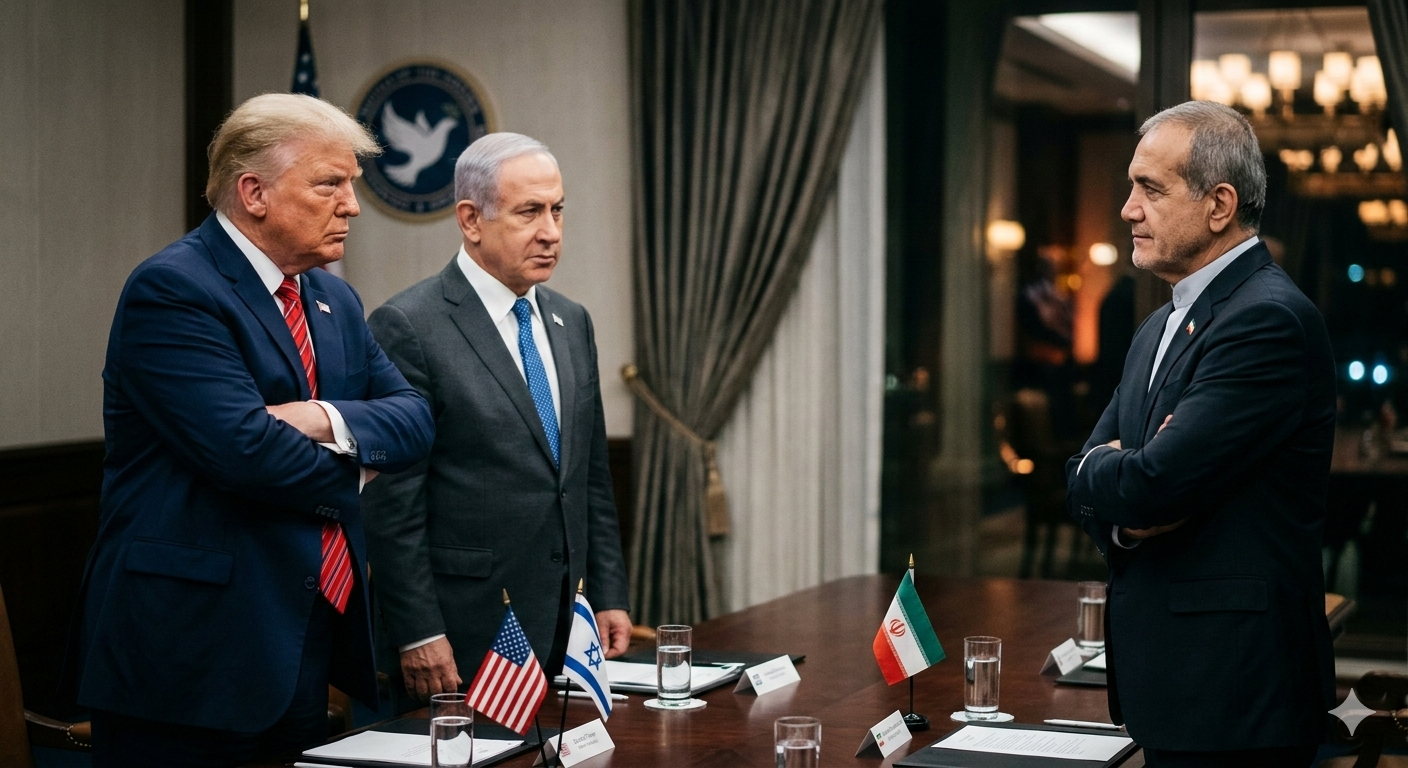
The Regime Proves Harder to Break Than Anticipated
The Iranian regime managed to survive the economic devastation wrought by US sanctions, the 2009 Green Movement protests, further protests in 2019-2020, and the 2022 Woman Life Freedom uprising. It then survived major anti-regime protests in 2025 and early 2026, mainly through state violence that killed thousands of Iranian citizens. To put it simply, Iran’s government is a hard target.6 The Trump administration’s strategy relies on popular uprising to fill the vacuum left by the regime’s decapitation, but as Middle East analyst Aron Lund has warned, “Absent a ground attack or a major internal insurgency, I don’t see how you can remove this regime.”20
The Absence of an Endgame
The United States in 2026 could not decide whether it wanted regime change, missile destruction, nuclear rollback, or merely to degrade Iranian power — and these objectives conflicted in practice.24 Secretary of Defense Pete Hegseth has explicitly ruled out nation-building, declaring “no nation building quagmire, no democracy building exercise.”2 But as a 2026 analysis from GlobalSecurity.org warns, the very act of destroying a regime or its military capacity creates a vacuum — a vacuum that will be filled by something. If the United States refuses to engage in nation-building, others — adversaries, militias, or chaos itself — will do so.24
Iran’s Strategic Calculus: Outlast American Will
Iran calculates that a protracted conflict, even at great cost, may outlast American political will — a calculation rooted in watching US withdrawals from Iraq and Afghanistan.24 Retired Lt. Gen. Mark Hertling reinforces the scale of what regime change would actually require: military analysts say there may need to be at least 500,000 US boots on the ground for regime change to take place — in a country that is three-and-a-half times the size of Iraq, with about three times the number of people.25 No such ground commitment is remotely on the table.
The Iraq and Afghanistan Echo
A senior fellow at CFR who reported from both Iraq and Afghanistan issues a direct warning: the disastrous aftermath of US-led regime change in Iraq more than two decades ago could be repeated in Iran with an even wider threat of regional upheaval unless a rational plan for ending the conflict diplomatically is put in place.26 As defense analyst Francis Sempa writing in RealClearDefense notes, regime change in Iraq and Afghanistan only led to more fighting.23 Military strategist Mick Ryan, a veteran of both conflicts, pointedly recalled that Defense Secretary Rumsfeld said before the second Gulf War: “Five days or five weeks or five months, but it certainly isn’t going to last any longer than that.”17 We know how that prediction aged.
A Reversal of Roles: The US as Aggressor, Russia and China as Backers?
This is the most geopolitically significant and underexamined dimension of the current war. It represents a near-perfect inversion of the role alignment in the Russia-Ukraine conflict.
Russia’s Foreign Ministry accused the US and Israel of carrying out a “premeditated and unprovoked act of armed aggression against a sovereign and independent UN member state,” saying the two countries had hidden their true intention of regime change “under the cover” of negotiations.13 With the support of China and Russia, the UN Security Council met in emergency session, and China declared it “stands ready to work with other parties to speak up for justice at the UN, the SCO and other platforms.”9
“Shadow Help” Without Direct Military Intervention — For Now
Moscow and Beijing have signed bilateral deals and expanded coordination through joint naval drills, projecting a united front against what they describe as a US-led international order. Yet despite their sharp rhetoric, neither has indicated a willingness to intervene militarily to support Iran.10 However, a critical report by the Special Eurasia intelligence group documents the deeper picture: Moscow and Beijing have transitioned from diplomatic allies to “technological anchors” by providing Iran with advanced S-400 air defenses, Su-35 fighters, and BeiDou-3 navigation to negate Western stealth and jamming capabilities.12 This is precisely the kind of indirect material support that the West initially provided to Ukraine — which proved decisive.
Russia’s Incentive to See the War Drag On
The Atlantic Council identifies a chilling dynamic: if the current air offensive escalates into a protracted military conflict, this will likely strengthen Russia economically while weakening Ukraine’s ability to defend itself and prolonging Europe’s largest invasion since World War II.18 Every dollar gained in higher oil revenues funds Moscow’s war machine in Ukraine. The Jerusalem Strategic Tribune notes that one of the most immediate consequences of this war is the diversion of American and allied attention and military aid away from Ukraine.21
China’s Calculated Opportunism
China’s posture is that of what one scholar at American University calls a cautious opportunist operating within clear constraints, preserving flexibility while avoiding entanglement in a conflict it cannot control.14 But Beijing’s strategic interest in seeing the US bogged down in Iran is undeniable. Foreign Policy notes that the widening Iran conflict has diverted US military resources from the Asia-Pacific, further marginalizing the China hawks in the White House and unsettling regional allies, including Japan, South Korea, and Taiwan.16 As support for Iran deepens — diplomatically, technologically, and economically — the world-power role reversal becomes structurally complete: the US and Israel would be the offensive force seeking regime change, while Russia and China supply the defender with the tools to resist and survive.
The Credibility Trap
The Special Eurasia report identifies a pivotal danger: if Russia and China fail to move beyond technology transfers to active deterrence, they risk a “credibility deficit” that could signal the failure of the multipolar world order and alienate potential partners in the Global South.12 This creates escalatory pressure on Moscow and Beijing to do more over time — a dynamic that mirrors how Western support for Ukraine incrementally deepened from defensive arms to offensive weapons to intelligence sharing.
Published Analysis on This Possibility
Several credible analysts and institutions have explored precisely these risks:
- Mick Ryan, Substack (“The New Iran War: Trajectory of the War and its Impact on Ukraine and the Pacific”), March 2026 — A retired Australian general and strategic analyst warns explicitly that wars are full of uncertainty, and because they feature belligerents with agency, they resist the best efforts of humans to impose time limits and achieve certainty about outcomes,17 comparing VP Vance’s assurances of a short war to Rumsfeld’s identical guarantee in 2003. https://mickryan.substack.com/p/the-new-iran-war-trajectory-of-the
- Council on Foreign Relations, “Conflicts to Watch in 2026” — Rated renewed Iran-Israel conflict as a high-likelihood, high-impact contingency months before it materialized. https://www.cfr.org/report/conflicts-watch-2026
- ECFR, “A War with No Winners: The Costs of US-Israeli Aggression on Iran,” March 2026 — Warns that European governments need to be engaged in shaping a realistic de-escalatory path now, prioritizing intensified partnership with Arab Gulf states and reaching out to both Washington and Tehran to push the two sides back to the negotiating table.8 https://ecfr.eu/article/a-war-with-no-winners-the-costs-of-us-israeli-aggression-on-iran/
- Chatham House, “The Iran War Exposes the Limits of Russia’s Leverage,” March 2026 — Argues that a prolonged war raises critical questions about spill-over effects — from refugee flows to the proliferation of arms and militant networks,15 and that Russia faces a strategic dilemma between managed distancing and deeper partnership. https://www.chathamhouse.org/2026/03/iran-war-exposes-limits-russias-leverage-fragmenting-regional-order
- Al Jazeera, “Where Are Iran’s Allies? Why Moscow and Beijing Are Keeping Their Distance,” March 2026 — Documents Russia and China’s current posture of rhetorical support without military commitment, while noting the structural pressures that could change this calculus. https://www.aljazeera.com/features/2026/3/5/where-are-irans-allies-why-moscow-beijing-are-keeping-their-distance
- Special Eurasia, “How Russian and China Tech Underpins Iranian Strategic Depth,” March 2026 — Identifies the “shadow help” already flowing to Iran and the credibility stakes for the multipolar order. https://www.specialeurasia.com/2026/03/01/russia-china-iran-tech-military/
- GlobalSecurity.org, “War Without Endgame: The Strategic Confusion of the 2026 Iran Conflict,” March 2026 — Draws direct parallels to post-war planning failures in Iraq and warns that destroying a regime without a replacement plan invites chaos. https://www.globalsecurity.org/military/ops/epic-fury-aims.htm
- CFR, “U.S. Campaign in Iran Ignores Iraq War Lessons,” March 2026 — https://www.cfr.org/articles/trumps-iran-campaign-ignores-the-lessons-of-the-iraq-war
The Warning: How to Avert a Prolonged Standoff
The path from the current sharp offensive to a Russia-Ukraine-style war of attrition is not inevitable — but it requires deliberate, courageous course correction on several fronts.
1. Define and Constrain the Objectives. The regime-change ambition is strategically unachievable through air power alone and politically unsustainable at home. As the Kyiv Independent’s analysts note, if the Islamic regime is not toppled — and the chances are not high at the moment — we are facing a protracted conflict, which will be diverting resources away from Ukraine.20 Narrowing the stated goal to verifiable nuclear rollback, rather than regime overthrow, creates an off-ramp that Iran could theoretically accept without existential capitulation.
2. Return to Diplomacy Before the Window Closes. Oman’s mediation channel, active as recently as February 26, remains the most viable pathway. The strikes came just two days after high-stakes US-Iran nuclear negotiations in Geneva ended without a breakthrough.7 That proximity is a tragedy, not an inevitability. The ECFR urges that European partners must ensure engagement with Gulf states and both belligerents does not become a slippery slope that drags them into yet another dangerous American regime change operation.8
3. Prevent Russia and China from Crossing the Threshold. The current posture of Moscow and Beijing — condemnation without material military commitment — is a window that will not stay open indefinitely. Washington must engage Beijing directly and urgently, recognizing that preserving détente with the US remains a strategic priority for China’s leadership11 and that this leverage is real and perishable. Every week of continued bombardment increases the pressure on both powers to escalate their support.
4. Plan for the Post-War, Not Just the War. History is unambiguous: the US, with its formidable military and intelligence capabilities, is capable of removing governments. Building legitimate political institutions in another country is far more difficult than toppling a regime.27 A refusal to plan for the morning after is not strength — it is a guarantee of chaos that adversaries will exploit. Iran is, as Hertling warns, a country three-and-a-half times the size of Iraq with three times the population. There is no version of success that does not require an answer to the question: what comes next?
The Russia-Ukraine war was born from a failure of diplomacy, an underestimation of resistance, and a miscalculation of great power reactions. All three of those conditions are present in the Persian Gulf today. The warning has been issued. The question is whether anyone in power is reading it.
References
- House of Commons Library, US-Israel Strikes on Iran: February/March 2026 — https://commonslibrary.parliament.uk/research-briefings/cbp-10521/
- Wikipedia, 2026 Iran War — https://en.wikipedia.org/wiki/2026_Iran_war
- ACLED, Middle East Special Issue: March 2026 — https://acleddata.com/update/middle-east-special-issue-march-2026
- CFR, Gauging the Impact of U.S.-Israeli Strikes on Iran — https://www.cfr.org/articles/gauging-the-impact-of-massive-u-s-israeli-strikes-on-iran
- Britannica, 2026 Iran Conflict — https://www.britannica.com/event/2026-Iran-Conflict
- Arab Center DC, The US-Israel War on Iran: Analyses and Perspectives — https://arabcenterdc.org/resource/the-us-israel-war-on-iran-analyses-and-perspectives/
- Al Jazeera, US, Israel Bomb Iran: A Timeline of Talks and Threats — https://www.aljazeera.com/news/2026/2/28/us-israel-bomb-iran-a-timeline-of-talks-and-threats-leading-up-to-attacks
- ECFR, A War with No Winners: The Costs of US-Israeli Aggression on Iran — https://ecfr.eu/article/a-war-with-no-winners-the-costs-of-us-israeli-aggression-on-iran/
- Chinese Foreign Ministry, Spokesperson Mao Ning Press Conference, March 2, 2026 — https://www.fmprc.gov.cn/mfa_eng/xw/fyrbt/202603/t20260302_11867202.html
- Al Jazeera, Where Are Iran’s Allies? Why Moscow and Beijing Are Keeping Their Distance — https://www.aljazeera.com/features/2026/3/5/where-are-irans-allies-why-moscow-beijing-are-keeping-their-distance
- CNBC, Why Iran Should Not Count on Allies Russia and China — https://www.cnbc.com/2026/03/02/iran-china-russia-strikes-assistance-alliance-weapons-missiles-geopolitics-oil-prices-ukraine.html
- Special Eurasia, How Russian and China Tech Underpins Iranian Strategic Depth — https://www.specialeurasia.com/2026/03/01/russia-china-iran-tech-military/
- Al Jazeera, Russia, China Raise Diplomatic Voices Against US-Israeli Attacks on Iran — https://www.aljazeera.com/news/2026/3/4/russia-china-raise-diplomatic-voices-against-us-israeli-attacks-on-iran
- The Conversation, China’s Muted Response Over War in Iran — https://theconversation.com/chinas-muted-response-over-war-in-iran-reflects-beijings-delicate-calculus-as-a-concerned-onlooker-277579
- Chatham House, The Iran War Exposes the Limits of Russia’s Leverage — https://www.chathamhouse.org/2026/03/iran-war-exposes-limits-russias-leverage-fragmenting-regional-order
- Foreign Policy, How China Sees the War in Iran — https://foreignpolicy.com/2026/03/03/china-iran-war-middle-east-us-military-alliance/
- Mick Ryan, The New Iran War: Trajectory of the War and its Impact on Ukraine and the Pacific — https://mickryan.substack.com/p/the-new-iran-war-trajectory-of-the
- Atlantic Council, Iran War Could Save Vladimir Putin’s Failing Ukraine Invasion — https://www.atlanticcouncil.org/blogs/ukrainealert/iran-war-could-save-vladimir-putins-failing-ukraine-invasion/
- CFR, Conflicts to Watch in 2026 — https://www.cfr.org/report/conflicts-watch-2026
- Kyiv Independent, Ukraine Backs US-Israeli War on Iran — https://kyivindependent.com/ukraine-backs-us-israeli-war-on-iran-as-zelensky-hopes-to-curry-favor-with-trump/
- Jerusalem Strategic Tribune, The Impact of Middle East Upheaval on Ukraine — https://jstribune.com/the-impact-of-middle-east-upheaval-on-ukraine/
- Al Jazeera, How Iran Fights an Imposed War — https://www.aljazeera.com/opinions/2026/3/4/how-iran-fights-an-imposed-war
- RealClearDefense, Iran War: Ends and Means — https://www.realcleardefense.com/articles/2026/03/07/iran_war_ends_and_means_1169124.html
- GlobalSecurity.org, War Without Endgame: The Strategic Confusion of the 2026 Iran Conflict — https://www.globalsecurity.org/military/ops/epic-fury-aims.htm
- WBUR Here & Now, How Iran Compares to Iraq — https://www.wbur.org/hereandnow/2026/03/02/iran-military-analysis
- CFR, U.S. Campaign in Iran Ignores Iraq War Lessons — https://www.cfr.org/articles/trumps-iran-campaign-ignores-the-lessons-of-the-iraq-war
- NBC/MS Now, What Two Centuries of U.S. Interventionism Tell Us About Regime Change in Iran — https://www.ms.now/ali-velshi/history-of-united-states-foreign-intervention-regime-change-iran-strikes-trump-afghanistan-iraq
Filed under: Uncategorized |


 Educational Technology and Change Journal

Leave a comment