





By Jim Shimabukuro (assisted by Copilot)
Editor
The Russia‑Ukraine war has underlined that national resilience and societal will can matter as much as raw military power, and that lesson should sit at the center of any thinking about a potential US/Israel‑Iran war. Ukraine’s ability to mobilize its population, maintain governance under fire, disperse critical infrastructure, and keep basic services functioning has repeatedly blunted Russian objectives and bought time for diplomacy and external support.1 In a US/Israel‑Iran context, that translates into prioritizing civilian preparedness, continuity of government, and rapid repair capabilities not only in Israel but across the wider region, including partners in the Gulf and beyond, so that societies can absorb shocks without collapsing into chaos. This matters for the “greater good” because wars that shatter basic social systems tend to radicalize populations, prolong grievances, and make any eventual peace far more fragile.
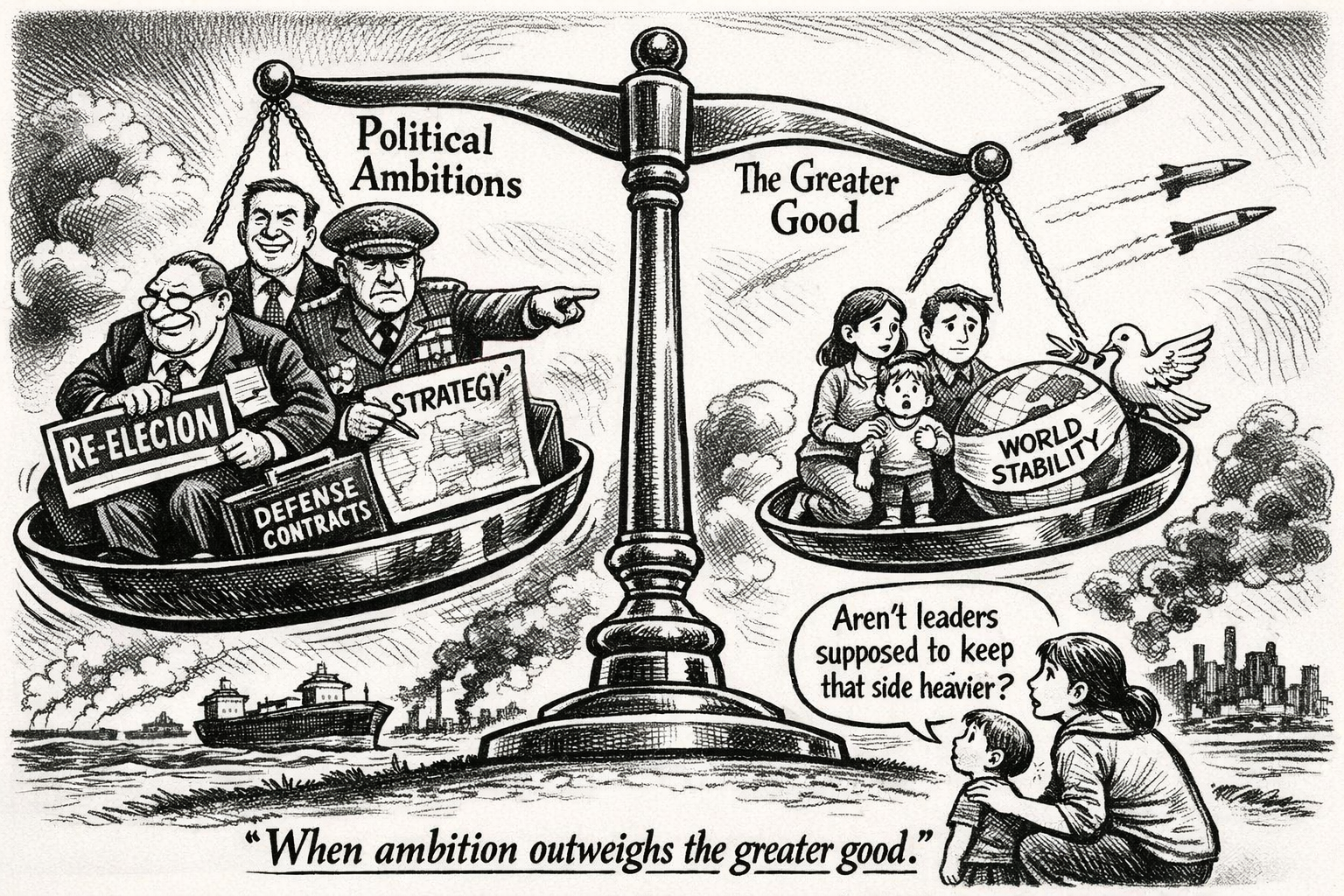
Another core lesson is that initial expectations of quick, decisive victory are often illusions. Many analysts predicted a rapid Russian success, yet the conflict evolved into a grinding war of attrition with enormous human and economic costs on both sides.1,4 That experience should warn US and regional leaders against assuming that a campaign against Iran—or a multi‑front conflict involving Israel, Iran, and non‑state actors—could be tightly controlled or short. Planning, therefore, should focus less on “shock and awe” and more on limiting long‑term damage: setting realistic political objectives, avoiding maximalist rhetoric that forecloses compromise, and building in off‑ramps before the war logic hardens. This matters because when leaders overpromise quick victory, they are more likely to escalate rather than adjust when reality proves harsher than their assumptions.
The war in Ukraine has also shown how central the protection of civilians and adherence to the law of armed conflict are—not only morally, but strategically. Urban fighting in places like Mariupol, Bakhmut, and Kharkiv has produced massive destruction, displacement, and allegations of war crimes, which in turn have galvanized international opinion, hardened sanctions, and narrowed the space for negotiated outcomes.2,5 In any US/Israel‑Iran war, large‑scale strikes on dense urban areas, critical infrastructure, or religiously significant sites in Israel, Iran, Lebanon, or elsewhere would likely generate similar outrage and long‑term trauma. Applying the lesson means investing heavily in precision targeting, robust civilian warning and evacuation systems, humanitarian corridors, and independent mechanisms to investigate alleged abuses. For the greater good, the aim should be to make civilian protection a central metric of success, not a secondary concern.
On the technological side, Russia‑Ukraine has been a watershed for drones, loitering munitions, and cheap autonomous or semi‑autonomous systems, which have reshaped the battlefield from the tactical to the strategic level.1,3 Small, inexpensive drones have enabled persistent surveillance, rapid artillery correction, and deep‑strike capabilities for both sides, while also driving innovation in air defense and electronic warfare.3 In a US/Israel‑Iran conflict, where all parties already field significant missile and drone arsenals, the lesson is that dominance in the air can no longer be taken for granted and that even technologically superior forces can be attrited by swarms of low‑cost systems. For the greater good, this should push planners toward stronger defenses of civilian infrastructure, tighter rules on target selection for autonomous systems, and international norms that limit the most destabilizing uses of such technology, rather than a race to the bottom in automated violence.
The information domain has been just as decisive. Ukraine’s effective use of strategic communications, social media, and open‑source intelligence has helped shape global narratives, sustain foreign support, and counter Russian disinformation.1,3 At the same time, both sides have used information operations to influence domestic and international audiences, sometimes blurring the line between truthful reporting and propaganda.3 In a US/Israel‑Iran war, information would be contested from the first hour: images of civilian casualties, claims about who struck first, and narratives about religious identity or “civilizational” struggle could inflame populations far beyond the immediate battlefield. The lesson here is to prioritize transparency, rapid fact‑checking, and credible public communication, while resisting the temptation to dehumanize adversaries or entire populations. Doing so matters because wars fought under a fog of deliberate misinformation are harder to end and more likely to spill over into broader sectarian or ideological conflict.
Another major takeaway from Ukraine is the centrality—and vulnerability—of logistics and industrial capacity. The conflict has exposed how quickly modern armies burn through artillery shells, air defenses, armored vehicles, and spare parts, and how dependent they are on resilient supply chains and a robust defense industrial base.1,3 For the United States and its partners, this has already triggered debates about stockpiles, production lines, and the ability to sustain multiple crises at once. Applied to a US/Israel‑Iran war, the lesson is that any serious planning must account for prolonged operations, potential disruptions to maritime routes and energy flows, and the need to support allies while maintaining deterrence elsewhere. For the greater good, this should encourage strategies that minimize disruption to global trade and energy markets, since economic shocks tend to hit vulnerable populations hardest and can destabilize countries far removed from the conflict zone.
Coalition management and economic statecraft are another area where Russia‑Ukraine offers sobering guidance. The war has shown that sanctions, export controls, and diplomatic isolation can impose real costs, but also that their effectiveness depends on broad, sustained international alignment and careful calibration to avoid excessive harm to third countries.1,5 In a US/Israel‑Iran scenario, there would likely be intense pressure to expand sanctions, restrict energy exports, and leverage financial tools against Iran and possibly others. The lesson is to design such measures with clear objectives, humanitarian carve‑outs, and realistic expectations about what they can achieve, while working to keep key global actors engaged rather than forcing them into rigid blocs. This matters because economic warfare that indiscriminately harms civilians can erode legitimacy, fuel black markets, and make post‑war reconstruction and reconciliation far more difficult.
The Russia‑Ukraine war has also been a live experiment in escalation management under the shadow of nuclear weapons. Western states have supported Ukraine with arms, intelligence, and training while trying to avoid direct NATO‑Russia combat, adjusting aid packages and messaging in response to perceived red lines and nuclear signaling from Moscow.1,4 That delicate balancing act underscores how misperceptions, domestic political pressures, or symbolic strikes can unintentionally push actors closer to a wider war. In a US/Israel‑Iran conflict—especially one that might involve attacks on nuclear facilities or fears of nuclear proliferation—the stakes would be similarly high. The lesson is to maintain multiple channels of communication, including indirect ones, to clarify intentions, avoid misreading signals, and create space for de‑escalation even amid intense fighting. For the greater good, leaders should treat escalation control as a continuous process, not a one‑time decision.
Finally, the war in Ukraine reminds us that how a war ends is as important as how it is fought. Analysts have noted that maximalist goals, such as regime change or total territorial revision, can make negotiated settlements nearly impossible and lock societies into open‑ended conflict.2,4 At the same time, the longer a war continues, the more entrenched narratives of victimhood and vengeance become, narrowing the political space for compromise. In thinking about a US/Israel‑Iran war, the lesson is to define political objectives that are firm on core security needs but flexible enough to allow for future coexistence, regional security arrangements, and gradual normalization. That means planning from the outset for post‑conflict governance, reconstruction, and regional dialogue, rather than treating them as afterthoughts. For the greater good, the ultimate aim should be a regional order where deterrence is paired with diplomacy, and where security is not built on the permanent marginalization or humiliation of any people.
In sum, the Russia‑Ukraine war teaches that resilience, restraint, civilian protection, truthful information, sustainable logistics, careful economic statecraft, escalation management, and realistic end‑states are not abstract ideals but practical necessities. Applying those lessons to any potential US/Israel‑Iran war is less about perfect strategy and more about constantly asking whether each decision reduces or multiplies long‑term human suffering. The “greater good” in this context is not victory at any cost, but the narrow, difficult path that protects lives, preserves the possibility of future peace, and keeps the region from sliding into a wider, generational catastrophe.
References
- Insights for Future Conflicts from the Russia‑Ukraine War – Center for Strategic and International Studies (CSIS),
https://www.csis.org/analysis/insights-future-conflicts-russia-ukraine-war(csis.org in Bing) - Something Old and Something New: Lessons from the Ukraine‑Russia War – Army University Press,
https://www.armyupress.army.mil/journals/military-review/online-exclusive/2024-ole/sukman-ukraine-russia-war/(armyupress.army.mil in Bing) - Lessons from the Ukraine Conflict: Modern Warfare in the Age of Autonomy, Information, and Resilience – Matthew N. Slusher, open‑access white paper via JSTOR,
https://www.jstor.org/stable/resrepXXXXXX(jstor.org in Bing) - Geopolitical and Military Lessons from the Russia–Ukraine Conflict (II) – Diplomat Magazine,
https://diplomatmagazine.eu/2025/10/02/geopolitical-and-military-lessons-from-the-russia-ukraine-conflict-ii/(diplomatmagazine.eu in Bing) - Russian War Against Ukraine: Lessons Learned Curriculum Guide – NATO Joint Analysis and Lessons Learned Centre,
https://www.jallc.nato.int/products/russian-war-against-ukraine-lessons-learned-curriculum-guide(jallc.nato.int in Bing)
Filed under: Uncategorized |


 Educational Technology and Change Journal

Leave a comment