


By Jim Shimabukuro (assisted by Claude)
Editor
[Related: “The Emerging AI‑First University Paradigm“]
“The Emerging AI‑First University Paradigm” (ETC Journal, 16 March 2026) makes a compelling case that Unity Environmental University, Ohio State University, the University of Washington, CUNY, and SUNY collectively sketch a new “AI-first” template for higher education — one in which AI is treated as a design principle rather than a peripheral tool, structures are reconfigured around AI’s capabilities, and ethics and equity are foregrounded as conditions of scale.¹ The five institutions do represent a meaningful advance beyond the typical university’s reactive, policy-memo approach to generative AI. Yet, when measured against what Thomas Kuhn understood as a genuine paradigm shift — a revolutionary displacement of the organizing assumptions, methods, and purposes of an entire field — these examples fall well short. They represent, rather, an intensification of one pole within the existing paradigm: the adoption-and-adaptation pole. The deeper anomaly AI poses to higher education — the radical destabilization of what universities are for, and of the three founding pillars on which they rest — remains largely unaddressed.
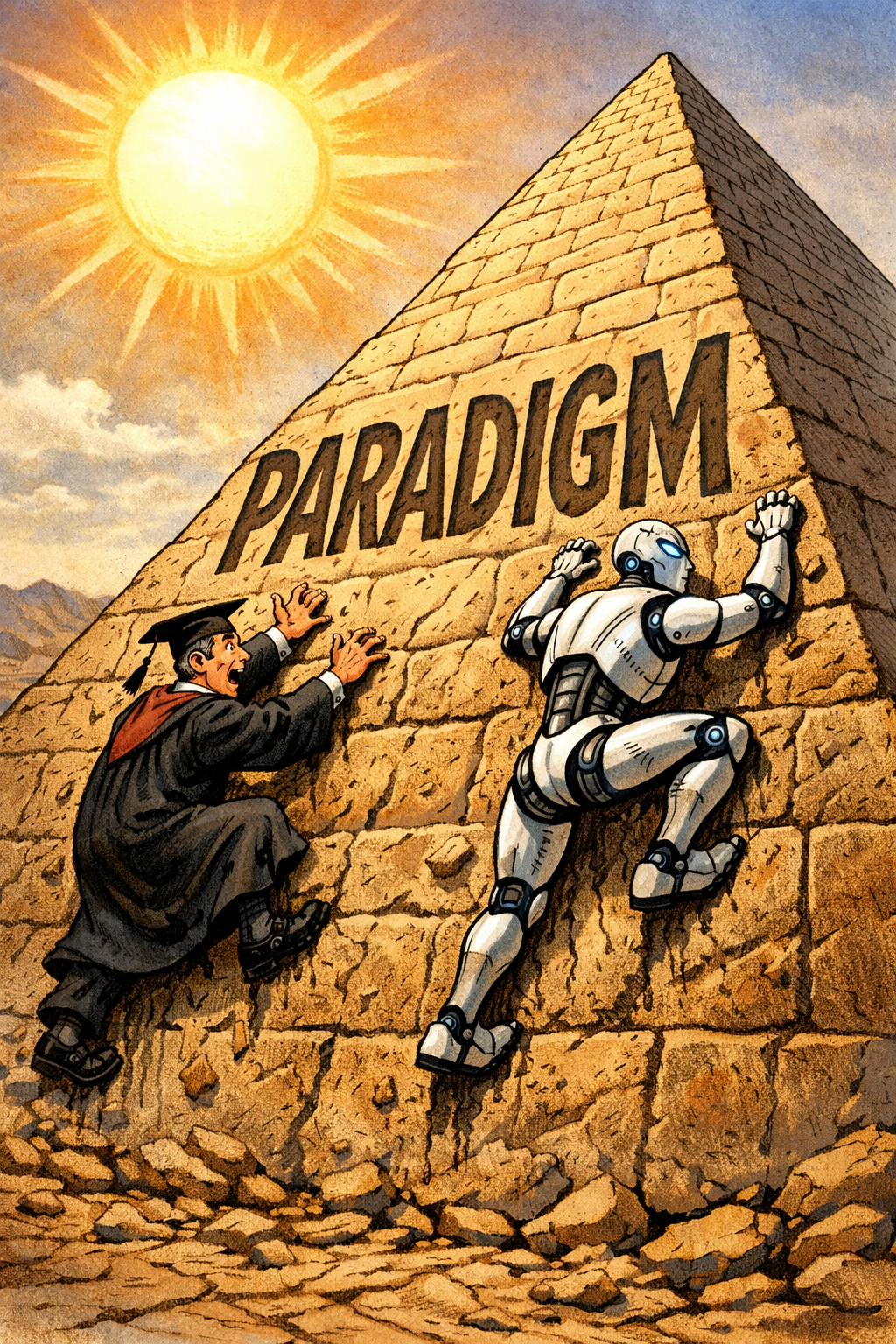
Kuhn argued that paradigm shifts do not occur when a field improves its tools or refines its practices. They occur when anomalies accumulate to such a degree that the foundational assumptions of normal science can no longer contain them, producing an epistemological crisis from which an entirely new framework must emerge.² The AI anomaly in higher education is precisely that kind of accumulating crisis, because it simultaneously undermines three pillars that have sustained the university for centuries: information transmission through lectures, standardized assessment as proof of mastery, and the university’s monopoly on credentialing.³
What is striking about the five AI-first institutions described in this article is that, for all their genuine ambition, not one of them has fundamentally dismantled any of these three pillars. Ohio State’s AI Fluency initiative embeds AI into every discipline and mandates required AI training for all incoming students,¹ but the credit-hour-bound, transcript-centered degree remains intact. CUNY’s AI Academic Hub foregrounds equity and human-centered values,¹ but the semester calendar, the lecture hall, and the conventional letter grade persist. SUNY’s system-wide chatbot program and new Departments of AI and Society represent meaningful institutional infrastructure,¹ but the department itself — with its feudal structures of tenure, disciplinary silos, and shared governance — remains the organizing unit of academic life.
AI analysts have noted that what is happening in 2026 is a transition from compliance-based adoption, where schools were responding to pressure from policy or peers, toward mission-based adoption, where AI is framed as a lever for core educational goals like access, equity, and lifelong learning. This is genuine progress, and it would be unfair to dismiss it. UW’s articulation of a university-wide AI strategy that builds shared guidelines, unified data infrastructure, and ethical governance as a proactive operating layer¹ is meaningfully different from the ad-hoc AI experimentation that characterized most campuses in 2023. Unity’s codification of AI-First Design Principles as a governing framework — what its president frames as a refusal of “abdication” in the face of an emergent technology¹ — does reflect a new institutional posture. But institutional posture is not the same as paradigm shift. A new posture operates within the existing framework; a paradigm shift replaces the framework.
What a True Paradigm Shift Would Require
A genuine AI-driven paradigm shift in higher education would demand at least four transformations that none of the five institutions has fully enacted. The first is the abolition or radical redesign of the credit-hour as the unit of academic currency. The credit hour is not merely an administrative convenience; it is the structural expression of the old paradigm’s central assumption — that time spent in the presence of an instructor is a proxy for learning. AI-enabled personalized learning, adaptive assessment, and competency-based progression make this assumption indefensible, yet even Unity’s acclaimed 90-credit applied bachelor’s degree, while compressing time and cost, retains the credit structure as its organizing logic.¹ A true paradigm shift would replace the credit hour with demonstrated competency, continuous AI-assessed mastery, or outcome-mapped learning portfolios that bear no necessary relationship to seat time.
The second transformation is the redesign of assessment from a retrospective, product-oriented activity into a continuous, process-oriented, AI-mediated dialogue. The emergence of agentic AI systems that can navigate learning management systems and complete entire course modules on behalf of students has made the defensive project of creating AI-resistant assignments increasingly futile, raising a more fundamental question about what assessment is actually for. Forward-thinking analysts predict that by the end of 2026, authenticity in student work will be redefined not by whether something was AI-free, but by how students demonstrate their thinking process — with oral defenses, AI co-authored writing, and collaborative projects becoming the norm. None of the five institutions described in this article has yet replaced its legacy assessment architecture with this kind of process-oriented, competency-verified alternative. Ohio State’s AI Fluency initiative and CUNY’s “AI Success Playbook” are pointed in the right direction, but they are retraining faculty to work within the existing assessment framework rather than replacing it.
The third transformation is the dismantling of the university’s credentialing monopoly. Scholars have noted that credential monopolies, once tightly held by universities as gatekeepers of expertise, are being eroded by AI-enabled micro-credentials and blockchain-based verification systems, with employers increasingly recognizing modular certifications while universities experiment cautiously with competency-based recognition. More than half of students surveyed in 2025 said they would choose more flexible modes of studying, including blended learning, microcredentials, and short courses, signaling a demand-side pressure that traditional degree programs have not yet adequately answered. A genuine paradigm shift would require universities to unbundle the degree — to separate knowledge acquisition from skill verification from credentialing from social signaling — and to collaborate with employers, AI platforms, and alternative providers in co-authoring learning architectures that no single institution controls. The five cases in the ETC Journal article are building better degrees and better AI-fluent graduates, but they are not unbundling the degree.
The fourth transformation is the reconception of academic labor — of what faculty do and what the professoriate is for. Analysts of the agentic university have pointed out that agentic AI can now perform portions of individual position descriptions that have historically defined faculty and staff roles, including data collection, analysis, documentation, and even feedback, raising structural questions about the size and composition of the academic workforce. Ohio State’s commitment to hiring 100 new tenure-track faculty with AI expertise¹ is notable, but it is an additive response — more faculty, redefined for AI — rather than a reconception of what tenure, academic freedom, and disciplinary expertise mean in a world where AI agents can teach, assess, advise, and research. A paradigm-shifting response would ask whether the tenure system, designed to protect intellectual independence in an era of scarce and powerful knowledge gatekeepers, makes sense when knowledge is abundant and AI can perform much of the transmission function that justified the professorial role.
Are There Examples of Deeper Transformation?
It would be wrong to suggest that no institutions are experimenting with the deeper structural changes a paradigm shift requires. Minerva University is the most frequently cited example of a first-principles redesign of higher education that anticipates, without fully completing, the AI-era transformation. Minerva adopts first-principles thinking in its pedagogy, emphasizes practical knowledge, active learning, and global exposure, and has built its curriculum around two distinct types of learning objectives — Habits of Mind and Foundational Concepts — to ensure students develop critical leadership and problem-solving skills, abandoning no-final-exams models and traditional lectures in favor of small seminars conducted synchronously online.
Crucially, Minerva eliminated tenure-track positions and classrooms, and designed its entire operating model around a proprietary technology platform rather than physical infrastructure.³⁴ Forbes highlighted at the start of 2025 how Minerva’s curriculum addresses complexity and systems thinking, with its president arguing that the university uses cognitive and behavioral science to cultivate skills essential for future leaders. Minerva’s model is closer to a paradigm shift than anything described in the article, precisely because it began with a question the five AI-first institutions have not asked: what would a university look like if it were designed from scratch around the science of learning rather than inherited from the medieval guild model?
The University of Florida’s AI Across the Curriculum initiative represents another partial example of deeper structural change. UF has embedded AI literacy as a cornerstone opportunity for all students regardless of discipline, and has tied its initiative to a required Quality Enhancement Plan as part of accreditation, positioning AI as a graduation standard rather than an elective enrichment. This is notable because it uses the accreditation system — one of the most conservative structural forces in higher education — as a lever for transformation rather than an obstacle to it, suggesting a pathway by which deeper change might propagate through the system.
On the governance side, emerging frameworks for AI governance in higher education are beginning to articulate a nine-domain architecture that encompasses academic integrity, data infrastructure, agentic AI oversight, vendor management, and equity resourcing — with a risk-tiering standard that differentiates between assistive, operational, and consequential AI systems. This kind of governance architecture, if adopted system-wide, would begin to constitute the new operating paradigm: not just AI tools deployed within the old structure, but a new structural layer that redefines accountability, transparency, and institutional agency.
Urgency around this has intensified in early 2026, as agentic AI systems have been documented logging into learning management systems and completing entire course modules on behalf of students, creating what legal experts describe as “shadow education records” that generate inferred risk scores without faculty oversight — a development that poses FERPA and accreditation liabilities that existing policy frameworks were never designed to handle. That crisis, more than any strategic AI plan, may be the anomaly that eventually forces the paradigm to break.
Conclusion
The five AI-first universities profiled in the ETC Journal are admirable and historically significant. They represent the leading edge of what might be called reformed normal science in higher education — a serious and self-aware effort to integrate the AI anomaly into the existing institutional paradigm with greater intentionality, equity, and structural coherence than most universities have managed. But a reformed paradigm is not a new paradigm. Scholars have argued that the real test for higher education is not defending what AI does better, but cultivating what AI cannot replicate — epistemic judgment, belonging, creativity, and wonder — and that universities must reimagine themselves as human commons where meaning-making, ethical responsibility, and imagination thrive.
That reimagination, if it is ever fully realized, will not look like Ohio State’s AI Fluency initiative or SUNY’s chatbot program, however valuable those are. It will look like an institution that has let go of the credit hour, the conventional degree, the lecture-and-exam cycle, and the credentialing monopoly — and built something genuinely new in their place. As one analyst has put it, 2026 must be the year of structural reconfiguration in which educators redesign teaching and assessment, unite their fragmented technological systems, and respond to the needs of the labour market and prospective students. Whether the five AI-first universities described in this article will lead that reconfiguration, or whether it will come from smaller, more radical experiments at the margins of the system — like Minerva — or from external disruption by AI-native platforms that the university never anticipated, remains the defining open question of this liminal moment in higher education.
References
- “The Emerging AI-First University Paradigm,” Educational Technology and Change Journal, March 16, 2026. https://etcjournal.com/2026/03/16/the-emerging-ai-first-university-paradigm/
- “Paradigm Shifts as Portals to Threshold Concepts and Epistemic Transformation,” Educational Philosophy and Theory, July 2025. https://www.tandfonline.com/doi/full/10.1080/00131857.2025.2531936
- “Reimagining Education in the Coming Decade: What AI Reveals About What Really Matters,” Frontiers in Education, October 2025. https://www.frontiersin.org/journals/education/articles/10.3389/feduc.2025.1699106/full
- “Higher Education Needs Structural Changes to Flourish in the AI Era,” Times Higher Education Campus, February 2026. https://www.timeshighereducation.com/campus/higher-education-needs-structural-changes-flourish-ai-era
- “2026 Predictions for AI in Higher Education,” Packback, December 2025. https://packback.co/resources/2026-predictions-for-ai-in-higher-education/
- “Will Agentic AI Break Higher Education?” The Chronicle of Higher Education, March 2026. https://www.chronicle.com/article/will-agentic-ai-break-higher-education
- “The Rise of the Agentic AI University in 2026,” UPCEA / Inside Higher Ed, January 2026. https://upcea.edu/the-rise-of-the-agentic-ai-university-in-2026/
- “AI & Higher-Education Global Brief: The Agentic Trap,” lynnfaustin.com, 2026. https://www.lynnfaustin.com/inspiration-moments/ai-higher-education-global-brief-the-agentic-trap/
- “The Nine AI Governance Domains for Higher Education,” CampusAIExchange / Substack, March 2026. https://joesabado.substack.com/p/the-nine-ai-governance-domains-for
- “Developing a Model for AI Across the Curriculum: Transforming the Higher Education Landscape via Innovation in AI Literacy,” Computers and Education: Artificial Intelligence, 2023. https://www.sciencedirect.com/science/article/pii/S2666920X23000061
- “Minerva: The Intentional University,” Daedalus / MIT Press, 2024. https://direct.mit.edu/daed/article/153/2/275/121282/Minerva-The-Intentional-University
- “Forbes Magazine Names Minerva University as Leader in AI-Era Education,” Minerva University Announcements, 2025. https://www.minerva.edu/announcements/forbes-magazine-names-minerva-university-as-leader-in-ai-era-education/
Filed under: Uncategorized |


 Educational Technology and Change Journal

Leave a comment